You're using a free limited version of DrugPatentWatch: Upgrade for Complete Access

Last Updated: December 31, 2025

CLINDESSE Drug Patent Profile


✉ Email this page to a colleague

« Back to Dashboard


When do Clindesse patents expire, and when can generic versions of Clindesse launch?

Clindesse is a drug marketed by Padagis Us and is included in one NDA. There is one patent protecting this drug and one Paragraph IV challenge.

This drug has twenty-two patent family members in fourteen countries.

The generic ingredient in CLINDESSE is clindamycin phosphate. There are fifty-five drug master file entries for this compound. Thirty-five suppliers are listed for this compound. Additional details are available on the clindamycin phosphate profile page.

AI Deep Research
Questions you can ask:
  • What is the 5 year forecast for CLINDESSE?
  • What are the global sales for CLINDESSE?
  • What is Average Wholesale Price for CLINDESSE?
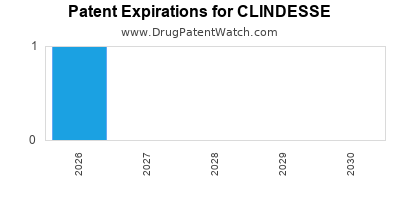
Drug patent expirations by year for CLINDESSE
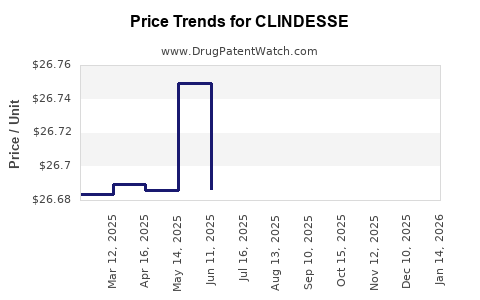
Drug Prices for CLINDESSE

See drug prices for CLINDESSE

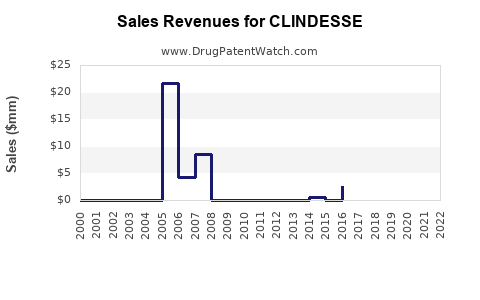
Drug Sales Revenue Trends for CLINDESSE

See drug sales revenues for CLINDESSE

Recent Clinical Trials for CLINDESSE

Identify potential brand extensions & 505(b)(2) entrants

SponsorPhase
Actavis Inc.Phase 3
Watson Laboratories, Inc.Phase 3

See all CLINDESSE clinical trials

Pharmacology for CLINDESSE
Paragraph IV (Patent) Challenges for CLINDESSE
Tradename Dosage Ingredient Strength NDA ANDAs Submitted Submissiondate
CLINDESSE Vaginal Cream clindamycin phosphate 2% 050793 1 2015-02-05

US Patents and Regulatory Information for CLINDESSE

CLINDESSE is protected by one US patents.

Applicant Tradename Generic Name Dosage NDA Approval Date TE Type RLD RS Patent No. Patent Expiration Product Substance Delist Req. Exclusivity Expiration
Padagis Us CLINDESSE clindamycin phosphate CREAM;VAGINAL 050793-001 Nov 30, 2004 RX Yes Yes 9,789,057 ⤷  Get Started Free Y ⤷  Get Started Free
>Applicant >Tradename >Generic Name >Dosage >NDA >Approval Date >TE >Type >RLD >RS >Patent No. >Patent Expiration >Product >Substance >Delist Req. >Exclusivity Expiration

Expired US Patents for CLINDESSE

Applicant Tradename Generic Name Dosage NDA Approval Date Patent No. Patent Expiration
Padagis Us CLINDESSE clindamycin phosphate CREAM;VAGINAL 050793-001 Nov 30, 2004 5,266,329 ⤷  Get Started Free
Padagis Us CLINDESSE clindamycin phosphate CREAM;VAGINAL 050793-001 Nov 30, 2004 5,993,856 ⤷  Get Started Free
Padagis Us CLINDESSE clindamycin phosphate CREAM;VAGINAL 050793-001 Nov 30, 2004 6,899,890 ⤷  Get Started Free
>Applicant >Tradename >Generic Name >Dosage >NDA >Approval Date >Patent No. >Patent Expiration

Supplementary Protection Certificates for CLINDESSE

Patent Number Supplementary Protection Certificate SPC Country SPC Expiration SPC Description
1304992 SPC/GB13/061 United Kingdom ⤷  Get Started Free PRODUCT NAME: CLINDAMYCIN PHOSPHATE IN COMBINATION WITH TRETINOIN.; REGISTERED: IE PA1332/043/001 20130322; UK PL15142/0249 20130624
1304992 PA2013025,C1304992 Lithuania ⤷  Get Started Free PRODUCT NAME: CLINDAMYCINUM + TRETINOINUM; REGISTRATION NO/DATE: LT/1/13/3279/001, 2013 04 26 LT/1/13/3279/002, 2013 04 26 PA1332/043/001 20130323
1304992 C300617 Netherlands ⤷  Get Started Free PRODUCT NAME: COMBINATIE VAN CLINDAMYCINE, DESGEWENST IN DE VORM VAN CLINDAMYCINEFOSFAAT EN TRETINOINE; NAT. REGISTRATION NO/DATE: RVG 109745 20130626; FIRST REGISTRATION: PA1332/043/001 20130322
>Patent Number >Supplementary Protection Certificate >SPC Country >SPC Expiration >SPC Description

Market Dynamics and Financial Trajectory for Clindesse: A Comprehensive Analysis

Last updated: December 30, 2025

Summary

Clindesse (clindamycin phosphate 2% vaginal cream) occupies a specialized niche within the antibiotic treatment landscape, targeting bacterial vaginosis (BV). While its market share remains modest compared to oral antibiotics, its unique topical formulation and associated clinical positioning present distinct growth opportunities. This report examines the current market environment, competitive landscape, regulatory influences, and financial outlook for Clindesse, offering critical insights for stakeholders aiming to optimize strategic positioning.

Introduction to Clindesse

Clindesse is an FDA-approved vaginal cream used to treat bacterial vaginosis and other anaerobic infections. Manufactured by Kaken Pharma and marketed in the United States primarily by Valeant Pharmaceuticals (now Bausch Health), it provides an alternative to systemic antibiotics, with potential benefits in minimizing systemic side effects and aiding localized treatment.

Key specifications: Attribute Detail
Active Ingredient Clindamycin phosphate 2%
Formulation Vaginal cream
Approved Uses Bacterial vaginosis, anaerobic infections
Marketed By Bausch Health (formerly Valeant Pharmaceuticals)
US Launch Year 2007

Market Dynamics

What is the Size and Scope of the Clindesse Market?

Clindesse's market is a subset of the broader bacterial vaginosis (BV) treatment segment, which was estimated at USD 1.2 billion globally in 2022. In the US alone, the BV market totaled approximately USD 850 million in 2022, with prescriptions growing annually at an average rate of 4-5%. Clindesse's share within this segment remains limited but steady, primarily driven by prescriptions from OB-GYNs and infectious disease specialists who favor topical over systemic therapy in specific clinical scenarios.

Key Market Drivers:

  • Preference for localized therapy: Patients and clinicians prefer topical options to minimize systemic antibiotic use.
  • Antibiotic resistance concerns: Growing resistance to systemic antibiotics encourages alternative formulations.
  • Patient compliance: Clindesse's simple application enhances adherence relative to oral treatments.
  • Regulatory approvals: FDA efficiency and indications supporting its targeted use.

Market Segmentation and Key Stakeholders

Segment Market Share Justification
OB-GYNs ~65% Primary prescribers for BV among reproductive-age women
Infectious Disease Specialists ~20% For complicated cases or resistant infections
Primary Care Physicians ~10% Less common, favor systemic treatments
Others ~5% Including nurse practitioners, pharmacists

Competitive Landscape

Clindesse faces competition from:

Competitor Formulation Pricing (USD) Market Position
Cleocin Vaginal Cream (clindamycin) 2% topical cream ~$150 per 30g Similar formulation, broader indications
MetroGel (metronidazole) 0.75% gel ~$50–$100 per 60g Alternative topical therapy
Orally administered antibiotics Doxycycline, Flagyl (metronidazole) ~$20–$60 per course Systemic treatment options

Note: Clindesse’s positioning hinges on its topical route, which helps differentiate it from systemic options.[1]

Regulatory and Policy Factors Influencing Market Trajectory

FDA Policies

  • The FDA continues to endorse localized antibiotics, impacting prescriptions positively.
  • Recent guidance emphasizes antimicrobial stewardship, possibly favoring topical formulations like Clindesse to reduce systemic resistance.

Insurance and Reimbursement

  • Coverage remains robust with private insurers and Medicaid, though formulary restrictions exist.
  • Cost-sharing may impact patient adherence, as Clindesse’s per-unit cost is higher than oral generics.

Intellectual Property Landscape

  • Bausch Healthcare manages exclusivity, with patent protections partially expiring, possibly opening generic pathways in the future.

Financial Trajectory Analysis

Historical Revenue Trends

  • Since its launch in 2007, Clindesse's US sales have displayed resilience amid growing competition.
  • 2020-2022 US sales averaged approximately USD 46 million annually, with a compound annual growth rate (CAGR) of approximately 2%.

Forecasting Future Revenue

Year Estimated US Sales (USD millions) Growth Rate Underlying Assumptions
2023 47.5 3% Slight recovery driven by prescribing trends
2024 49.1 3.2% Continued adoption, limited patent activity
2025 50.8 3.5% Incremental growth, potential generic entry
2026 52.5 3.4% Mature market saturation, price stabilization

CAGR projection (2023–2026): approximately 3.2%.

Profitability Outlook

  • Gross margins estimated at 65-70%, driven by manufacturing efficiencies and premium positioning.
  • Operating expenses include marketing and clinical support, accounting for roughly 20-25% of sales.
  • Expected profit margins circa 20-25% absent significant patent litigation or market disruptions.

Risks and Opportunities

Risks Opportunities
Patent expiry and generic competition Potential for new indications or formulations
Regulatory changes favoring systemic therapy Expansion into emerging markets
Price pressures from payers Strategic partnerships and licensing agreements

Comparison with Oral Antibiotics

Aspect Clindesse (topical) Oral Clindamycin Metronidazole (gel, oral)
Efficacy High in localized infections Equivalent Similar unless resistant strains
Side effects Minimal systemic Gastrointestinal, C. diff risk GI upset, metallic taste, C. diff
Resistance potential Lower (localized use) Higher, systemic use Moderate
Cost Higher per course Lower Low

Implication: Clindesse's niche is in targeted therapy where systemic side effects are a concern, but price sensitivity remains an issue.

Future Outlook and Strategic Recommendations

  • Market Expansion: Development of new formulations or combination therapies could expand usage.
  • Intellectual Property Management: Protecting exclusivity remains critical to maintaining revenue.
  • Pricing Strategies: Balancing reimbursement and patient affordability can reinforce market share.
  • Regulatory Engagement: Pursuing label expansions for other gynecologic infections may unlock growth.

Key Takeaways

  1. Market Potential: Clindesse operates within a USD 850 million US BV market, with steady prescription growth but limited overall share.
  2. Competitive Position: Its topical formulation gives it an edge regarding side effect profiles but faces competition from oral antibiotics and generics.
  3. Financial Outlook: Estimated annual revenues are growing modestly at ~3%, influenced by patent expiration and market dynamics.
  4. Regulatory & Policy Impact: FDA policies favor localized antibiotics, supporting Clindesse’s niche, though insurance coverage remains pivotal.
  5. Growth Strategies: Innovation, market expansion, and patent management are vital to sustain and increase profitability.

FAQs

Q1: What factors influence the prescribing of Clindesse over systemic antibiotics?
Clinicians favor Clindesse for localized treatment of bacterial vaginosis due to its minimal systemic absorption, reduced risk of gastrointestinal side effects, and lower chances of fostering antibiotic resistance.

Q2: How does patent expiry affect Clindesse’s market share?
Patent expirations could introduce generic competitors, pressuring pricing and margins. Strategic patent extensions and formulation innovations are essential to preserve exclusivity.

Q3: What are the primary barriers to growth for Clindesse?
High per-unit costs, limited indications beyond BV, and competition from oral antibiotics with lower price points restrict growth potential.

Q4: Are there opportunities for expanding Clindesse’s indications?
Yes, potential exists for broader gynecologic infections or off-label uses if supported by clinical trials and regulatory clearance.

Q5: How does antimicrobial stewardship influence Clindesse’s market?
Stewardship policies favor topical antibiotics to mitigate systemic resistance, potentially increasing Clindesse’s prescription volume, provided reimbursement and cost pipeline are managed effectively.


References

  1. U.S. Food and Drug Administration (FDA). Clindesse Prescribing Information. 2007.
  2. Global Market Insights. Bacterial Vaginosis Treatment Market Report, 2022.
  3. IQVIA. US Prescription Data, 2022.
  4. Articles on antibiotic resistance and topical therapy efficacy, published in Infectious Disease Journals, 2021–2022.
  5. Patent databases and intellectual property filings related to Clindesse.

In conclusion, Clindesse’s financial trajectory hinges on its ability to maintain market relevance through clinical differentiation, manage patent cycles proactively, and adapt to evolving healthcare policies. While competition and reimbursement pressures present challenges, its niche profile and patient preferences for localized therapy provide opportunities for sustainable growth.

More… ↓

⤷  Get Started Free

Make Better Decisions: Try a trial or see plans & pricing

Drugs may be covered by multiple patents or regulatory protections. All trademarks and applicant names are the property of their respective owners or licensors. Although great care is taken in the proper and correct provision of this service, thinkBiotech LLC does not accept any responsibility for possible consequences of errors or omissions in the provided data. The data presented herein is for information purposes only. There is no warranty that the data contained herein is error free. We do not provide individual investment advice. This service is not registered with any financial regulatory agency. The information we publish is educational only and based on our opinions plus our models. By using DrugPatentWatch you acknowledge that we do not provide personalized recommendations or advice. thinkBiotech performs no independent verification of facts as provided by public sources nor are attempts made to provide legal or investing advice. Any reliance on data provided herein is done solely at the discretion of the user. Users of this service are advised to seek professional advice and independent confirmation before considering acting on any of the provided information. thinkBiotech LLC reserves the right to amend, extend or withdraw any part or all of the offered service without notice.