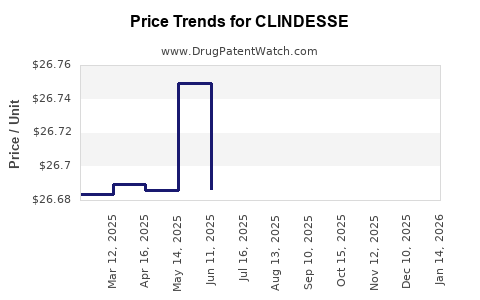
Last updated: February 21, 2026
What is Clindesse?
Clindesse is a prescription vaginal cream containing clindamycin phosphate. It treats bacterial vaginosis, a common vaginal infection caused by an imbalance of bacteria in the vagina.
Market Overview
Market Size and Growth
Global bacterial vaginosis treatment market was valued at approximately USD 150 million in 2022. It is projected to grow at a compound annual growth rate (CAGR) of 3.5% through 2028, driven by increased awareness, aging populations, and rising healthcare expenditure.
Key Regions:
- North America: Dominates with about 60% market share
- Europe: Second-largest market
- Asia-Pacific: Fastest growth with a CAGR exceeding 4%
Key Players
Major competitors include:
- Zydus Cadila
- Lupin Pharmaceuticals
- Teva Pharmaceuticals
- Mylan Pharmaceuticals
- Generic manufacturers
Clindesse is marketed primarily by PLL Therapeutics, a proprietary product in the U.S. and select markets.
Patent Status
Clindesse was approved by the FDA in 1998, with its patent expiring or nearing expiry, opening opportunities for generics. The first generic versions entered the market in 2016, reducing prices and expanding availability.
Pricing Landscape
Brand vs. Generic Pricing
| Product Type |
Average Wholesale Price (AWP) per 5g tube |
Retail Price Range (USD) |
| Clindesse (brand) |
USD 340 |
USD 350–400 |
| Generic equivalents |
USD 150–200 |
USD 155–220 |
Pricing Trends (2018–2022)
- The brand price stabilized around USD 350–400 per tube.
- Introduction of generics in 2016 caused a sharp decline, stabilizing prices at approximately USD 150–200.
- Retail prices have shown minimal fluctuation, considering variations in pharmacy margins.
Future Price Projections
Factors Influencing Pricing
- Patent and exclusivity status
- Entry of new generic brands
- Regulatory changes
- Pricing strategies of manufacturers
- Insurance reimbursement policies
Projected Price Trends (2023–2028)
| Year |
Estimated Brand Price (USD) |
Estimated Generic Price (USD) |
| 2023 |
USD 370–400 |
USD 150–180 |
| 2025 |
USD 350–380 |
USD 140–170 |
| 2028 |
USD 330–360 |
USD 130–160 |
Prices for brand Clindesse are expected to decline gradually as new generics expand market share. The generics are projected to stabilize around USD 130–160, with potential further decreases depending on market entry and competition.
Strategic Considerations
Market Entry Opportunities
- Launch of additional generics to deepen price erosion
- Targeting emerging markets with lower per capita healthcare costs
- Formulation improvements to reduce costs or improve patient compliance
Pricing Strategies
- Competitive pricing to gain share in a saturated market
- Bundling with other gynecological products for added value
Key Takeaways
- Clindesse's market is mature, with patent expiration allowing for increased generic competition.
- Prices have declined significantly since generic entry, stabilizing around USD 150–200.
- Future pricing is driven by continued generic proliferation and regulatory factors.
- The market is expected to slow in growth, with pricing gradually decreasing over the next five years.
- Strategic entry or expansion into emerging markets could mitigate price erosion and expand revenues.
FAQs
1. What factors affect Clindesse's market price?
Patent status, generic competition, regulatory policies, insurance reimbursement, and manufacturing costs influence the price.
2. When did generics enter the market for Clindesse?
Generic versions launched around 2016 following patent expiry.
3. How does the pricing of generics compare to the brand?
Generics typically are priced 40–55% lower than the brand, reducing the average wholesale price from USD 340 to approximately USD 150.
4. What is the outlook for Clindesse's market size?
The global bacterial vaginosis treatment market will grow at approximately 3.5% CAGR through 2028, but Clindesse's share may decline as generics increase.
5. Are there opportunities for new formulations?
Potential exists for formulations that improve patient compliance or lower manufacturing costs, but market saturation limits aggressive pricing strategies.
References
- MarketWatch. (2023). Bacterial vaginosis treatment market forecast. Retrieved from https://www.marketwatch.com
- FDA. (1998). Clindesse FDA approval document. Retrieved from https://www.fda.gov
- IQVIA. (2022). Pharmaceutical Pricing Report.
- Statista. (2022). Global bacterial vaginosis market data.
- EvaluatePharma. (2022). 2022 World Preview report.