Last updated: August 6, 2026
Cenestin was an oral menopausal hormone-therapy product containing synthetic conjugated estrogens, A. It competed primarily with Pfizer’s Premarin, the dominant conjugated-estrogen product. Cenestin’s commercial trajectory was constrained by Premarin’s entrenched prescribing base, the broader decline in menopausal hormone therapy after the Women’s Health Initiative findings, generic competition across estrogen products, and limited public disclosure of product-level revenue. Cenestin is not a biologic, so biosimilar competition is not relevant. Its principal commercial risks were substitution by generic hormone therapies, alternative estrogen formulations, and reduced demand for systemic hormone treatment.
What is Cenestin and what was it approved to treat?
Cenestin was an oral estrogen product indicated for the treatment of moderate-to-severe vasomotor symptoms associated with menopause and for vulvar and vaginal atrophy. Like other systemic estrogen products, its labeling addressed use at the lowest effective dose for the shortest duration consistent with treatment objectives.
| Attribute |
Cenestin |
| Active ingredient |
Synthetic conjugated estrogens, A |
| Dosage form |
Oral tablet |
| Therapeutic class |
Estrogen hormone therapy |
| Primary indications |
Menopausal vasomotor symptoms; vulvar and vaginal atrophy |
| U.S. sponsor at launch |
Duramed Pharmaceuticals |
| FDA approval |
1999, under NDA 21-035 records |
| Principal competitor |
Premarin, conjugated estrogens |
| Regulatory category |
Small-molecule prescription drug |
| Biosimilar exposure |
None |
Cenestin used a synthetic mixture of estrogenic compounds rather than the equine-derived conjugated estrogens used in Premarin. The products occupied the same broad therapeutic category but were not identical active ingredients.
How did Cenestin enter the U.S. hormone-therapy market?
Cenestin entered the market during a period when systemic estrogen therapy generated substantial prescription volume and branded products maintained strong pricing. The product’s positioning depended on offering an alternative to Premarin within the conjugated-estrogen segment.
Duramed Pharmaceuticals built its commercial business around women’s health products, including hormone therapy. Barr Pharmaceuticals acquired Duramed in 2001. Teva Pharmaceutical Industries later acquired Barr in 2008, transferring Cenestin into a larger generic and specialty-pharmaceutical portfolio.[1]
The ownership sequence affected Cenestin’s commercial role:
| Period |
Corporate event |
Market implication |
| 1999 |
FDA approval of Cenestin |
Entry into systemic menopausal hormone therapy |
| 2001 |
Barr acquired Duramed |
Cenestin became part of Barr’s women’s-health portfolio |
| 2008 |
Teva acquired Barr |
Product entered Teva’s broader branded and generic structure |
| Post-2002 |
Women’s Health Initiative results changed treatment patterns |
Lower demand and greater prescribing caution |
| Later commercial period |
Product availability declined |
Reduced visibility and limited financial relevance |
What market forces affected Cenestin sales?
Cenestin faced four major market pressures.
First, Premarin had a strong clinical, commercial and distribution position. Pfizer had marketed Premarin for decades and maintained broad physician familiarity, pharmacy access and formulary presence. Cenestin entered a category where the leading brand already had substantial brand equity.
Second, the Women’s Health Initiative results materially changed the hormone-therapy market. The 2002 publication of major trial findings led to increased concern about cardiovascular, thromboembolic and breast-cancer risks associated with certain hormone-therapy regimens.[2] Prescribing declined, treatment durations shortened, and physicians shifted toward more individualized risk assessment.
Third, patients and prescribers gained access to competing estrogen products. The competitive field included:
- Generic conjugated estrogens and other estrogen tablets.
- Estradiol tablets.
- Transdermal estradiol patches, gels and sprays.
- Vaginal estrogen creams, tablets and rings.
- Combination estrogen-progestin products for patients with an intact uterus.
- Nonhormonal therapies for vasomotor symptoms.
Fourth, Cenestin had no apparent durable platform advantage that could support premium pricing after generic and alternative estrogen products expanded. Its synthetic estrogen composition differentiated the product chemically, but that distinction did not create a large protected market.
What was Cenestin’s financial trajectory?
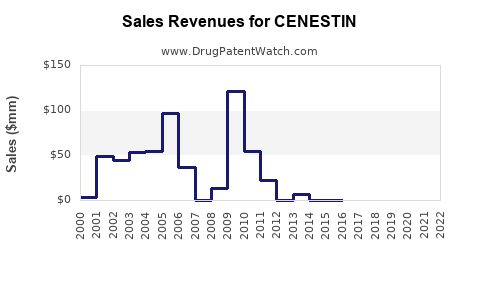
Cenestin’s product-level revenue was not separately disclosed in the public financial reporting of Duramed, Barr or Teva. The available evidence supports a declining commercial trajectory, but it does not support a reliable standalone sales estimate.
| Financial factor |
Effect on Cenestin |
| Initial branded launch |
Supported premium pricing and physician promotion |
| Premarin competition |
Limited share capture |
| 2002 hormone-therapy safety concerns |
Reduced category demand |
| Generic estrogen competition |
Increased price pressure |
| Teva ownership |
Shifted emphasis toward portfolio economics rather than a standalone branded growth strategy |
| Declining product visibility |
Reduced commercial relevance |
| Product-level disclosure |
Insufficient for a verified revenue series |
Barr reported portfolio-level revenue rather than a detailed Cenestin revenue line. Teva’s reporting similarly grouped products by broader business segment and did not provide an audited Cenestin sales history.[1,3]
The likely financial pattern was:
- Modest branded revenue after launch.
- Category-wide demand contraction after 2002.
- Increasing substitution by other estrogen products.
- Lower promotional priority after changes in ownership.
- Eventual commercial discontinuation or loss of meaningful U.S. market presence.
Any precise Cenestin sales estimate would require distributor data, prescription claims, company internal reporting or a validated commercial database. Public company filings do not provide that level of product detail.
When did Cenestin lose exclusivity?
Cenestin’s commercial exclusivity depended on a combination of patent rights, regulatory exclusivity and practical market protection. Public FDA sources identify the product and its approval history, but they do not establish a currently valuable, enforceable exclusivity position for Cenestin.
The relevant distinction is:
- FDA approval does not itself create permanent market exclusivity.
- Patent protection can expire before or after regulatory exclusivity.
- A product may remain technically approved while no longer being actively marketed.
- A discontinued product may have little commercial value even if the underlying NDA remains in FDA records.
The original Cenestin product was approved in 1999. Any five-year new chemical entity exclusivity associated with the NDA would have expired by approximately 2004, subject to the precise FDA classification and approval date. Patent terms depend on the specific patent, priority date, patent-term adjustment and terminal disclaimers.
The FDA Orange Book should be used to verify whether any listed patents remain associated with the product and whether the product is designated as discontinued.[4] Current commercial exposure appears to have been driven more by product availability and substitution than by an active patent moat.
What patents protect Cenestin?
Cenestin’s historical protection would have centered on the synthetic conjugated-estrogen composition, manufacturing processes and pharmaceutical formulations. Public sources do not establish a current, commercially material patent estate for Cenestin comparable to the active patent portfolios surrounding newer specialty drugs.
Potential protection categories included:
Composition patents
A composition patent could cover the defined mixture of synthetic estrogen compounds used in Cenestin. Such protection would be most valuable if the product’s precise estrogen profile differentiated it from generic or competing products.
Manufacturing patents
Conjugated-estrogen products may require controlled synthesis, purification and blending. Manufacturing claims could create technical barriers even if composition claims were narrow or expired.
Formulation patents
Oral tablet formulation claims could cover excipients, dosage strength, dissolution or stability. These patents generally provide narrower protection than composition claims and may not prevent substitution by different estrogen formulations.
Method-of-use patents
Cenestin’s approved uses were established menopausal hormone-therapy indications. Method-of-use protection would have had limited commercial strength if competing estrogen products were approved for the same indications and physicians could prescribe them under established labeling.
No current public record demonstrates that an active formulation or method-of-use patent gives Cenestin meaningful market exclusivity.
What is the Orange Book status of Cenestin?
The FDA Orange Book is the principal source for evaluating Cenestin’s approved product status, therapeutic-equivalence listings and listed patents. The relevant commercial questions are whether the Cenestin NDA remains active, whether the product is listed as discontinued, whether an approved generic exists under the same active ingredient designation, and whether any patent or exclusivity information remains attached to the NDA.[4]
A discontinued designation does not necessarily mean the FDA withdrew approval for safety or efficacy reasons. FDA records distinguish between products that are discontinued from commercial distribution and products withdrawn for safety or effectiveness concerns.
For market analysis, Cenestin’s practical status matters more than its historical approval:
- A product may remain in FDA databases after commercial sales cease.
- A listed NDA does not prove current pharmacy availability.
- A lack of active marketing reduces the value of legacy patents.
- Generic competition can persist even when the branded reference product is no longer commercially prominent.
Did Cenestin face Paragraph IV challenges?
There is no well-documented, commercially significant Paragraph IV litigation record associated with Cenestin comparable to high-value branded drugs with major generic launch exposure.
A Paragraph IV filing would require a generic applicant to challenge listed patents in an abbreviated new drug application. The commercial effect would depend on whether Cenestin had meaningful prescriptions, active patents and a viable generic market at the time of the challenge.
Cenestin’s risk profile was more consistent with gradual substitution than with a major patent cliff. The product operated in a mature therapeutic category with multiple estrogen alternatives, which reduced the incentive to build a large litigation campaign around one discontinued or low-volume brand.
How does Cenestin compare with Premarin and estradiol products?
| Factor |
Cenestin |
Premarin |
Generic estradiol |
| Estrogen source |
Synthetic conjugated estrogens, A |
Conjugated estrogens |
Estradiol |
| Brand strength |
Limited relative to Premarin |
Very strong historical position |
Low individual brand value |
| Market access |
Dependent on sponsor strategy |
Broad legacy access |
Broad pharmacy substitution |
| Patent value |
Limited current visibility |
Historically significant product and formulation protection |
Usually low branded protection |
| Formulation breadth |
Primarily oral tablets |
Oral and other legacy products |
Tablets, patches, creams and other forms |
| Price pressure |
High |
Lower historically, though subject to alternatives |
High |
| Current competitive risk |
Generic and therapeutic substitution |
Generic, formulation and nonoral estrogen competition |
Competition among multiple manufacturers |
Premarin had the strongest historical commercial position because of its long market tenure and broad physician recognition. Estradiol products gained share because they offered multiple delivery systems, including transdermal products that allowed physicians to avoid oral administration in selected patients. Cenestin lacked the same breadth of delivery formats.
What generic launch risks existed for Cenestin?
The principal generic risks were product substitution and category substitution.
Product substitution would occur if another manufacturer offered an equivalent synthetic conjugated-estrogen tablet and obtained therapeutic-equivalence status. Category substitution was broader and more important. Physicians could select estradiol tablets, patches, gels, vaginal products or combination hormone therapies depending on symptoms and patient risk factors.
The main launch scenarios were:
| Scenario |
Commercial outcome |
| Equivalent synthetic conjugated-estrogen generic |
Direct price erosion |
| Estradiol tablet substitution |
Loss of oral estrogen volume |
| Transdermal estrogen adoption |
Shift away from oral products |
| Local vaginal estrogen use |
Reduced need for systemic exposure |
| Nonhormonal therapy |
Exit from estrogen treatment for some patients |
| Branded reintroduction |
Unlikely without a differentiated formulation or delivery system |
What manufacturing and intellectual-property barriers affected Cenestin?
The manufacturing process for a synthetic conjugated-estrogen blend could present analytical and quality-control requirements. A generic applicant would need to demonstrate consistent identity, strength, purity, content uniformity and stability across the defined estrogen components.
Those requirements may create development complexity, but they do not necessarily produce durable commercial exclusivity. Once analytical methods and manufacturing controls are established, multiple manufacturers can compete if the market is sufficiently attractive.
Cenestin’s strongest historical barrier was likely product know-how and regulatory development experience rather than a current patent monopoly. The smaller the remaining market, the less valuable those barriers become because generic development costs must be recovered from limited volume.
What is the current investment and licensing relevance of Cenestin?
Cenestin has limited apparent standalone licensing value. Its commercial relevance would be higher only if a buyer could combine the product with:
- An active manufacturing platform for conjugated estrogens.
- A differentiated low-dose or extended-release formulation.
- A transdermal or local-delivery technology.
- A women’s-health portfolio with established distribution.
- Rights in a geographic market where estrogen access remains underdeveloped.
No major recent licensing transaction centered on Cenestin is established in the cited public sources. The absence of product-level sales disclosure and the mature competitive market reduce the case for a standalone acquisition.
Key Takeaways
- Cenestin was a synthetic conjugated-estrogen tablet approved in the United States in 1999.
- Its primary commercial competitor was Premarin.
- The 2002 Women’s Health Initiative findings reduced systemic hormone-therapy demand and changed prescribing behavior.
- Cenestin’s revenue was not separately disclosed by Duramed, Barr or Teva.
- Public information does not show a current, commercially meaningful patent moat.
- Biosimilar risk is irrelevant because Cenestin is a small-molecule drug.
- Generic and therapeutic substitution were more important risks than a single large Paragraph IV patent event.
- Cenestin’s financial trajectory was likely a decline from limited branded sales to reduced market relevance and commercial discontinuation.
- The FDA Orange Book and FDA discontinued-drug records remain the controlling sources for current regulatory status.
FAQs about Cenestin market dynamics
Is Cenestin still available in the United States?
Cenestin has limited current commercial visibility. FDA database status and pharmacy availability are separate questions, and an historical NDA listing does not establish active distribution.
Was Cenestin the same as Premarin?
No. Cenestin contained synthetic conjugated estrogens, A. Premarin contained conjugated estrogens derived from an equine source. Both were systemic estrogen products but had different active-ingredient compositions.
Did Teva disclose Cenestin sales?
No separate Cenestin revenue line is identified in the cited Barr or Teva public reporting. Sales were reported within broader company or business-unit categories.
Could a generic manufacturer still launch Cenestin?
A launch would depend on an active reference-product pathway, FDA approval requirements, market availability, manufacturing feasibility and commercial demand. A technically approvable product would not necessarily have an attractive market because physicians can substitute other estrogen products.
Does Cenestin have biosimilar competition?
No. Cenestin is a chemically synthesized small-molecule drug. Any competition would arise through generic drug pathways or therapeutic substitution, not biosimilar approval.
References
- Teva Pharmaceutical Industries Ltd. (2008). Annual report for the year ended December 31, 2008.
- Writing Group for the Women’s Health Initiative Investigators. (2002). Risks and benefits of estrogen plus progestin in healthy postmenopausal women: Principal results from the Women’s Health Initiative randomized controlled trial. JAMA, 288(3), 321-333.
- Barr Pharmaceuticals, Inc. (2007). Annual report for the year ended December 31, 2007.
- U.S. Food and Drug Administration. (n.d.). Approved drug products with therapeutic equivalence evaluations: Orange Book. FDA.