Share This Page
CELEXA Drug Patent Profile
✉ Email this page to a colleague
When do Celexa patents expire, and when can generic versions of Celexa launch?
Celexa is a drug marketed by Forest Labs and Abbvie and is included in two NDAs.
The generic ingredient in CELEXA is citalopram hydrobromide. There is one drug master file entry for this compound. Thirty-seven suppliers are listed for this compound. Additional details are available on the citalopram hydrobromide profile page.
DrugPatentWatch® Litigation and Generic Entry Outlook for Celexa
A generic version of CELEXA was approved as citalopram hydrobromide by AUROBINDO on October 28th, 2004.
AI Deep Research
Questions you can ask:
- What is the 5 year forecast for CELEXA?
- What are the global sales for CELEXA?
- What is Average Wholesale Price for CELEXA?
Summary for CELEXA
| US Patents: | 0 |
| Applicants: | 2 |
| NDAs: | 2 |
| Finished Product Suppliers / Packagers: | 1 |
| Raw Ingredient (Bulk) Api Vendors: | 1 |
| Clinical Trials: | 54 |
| Patent Applications: | 2,253 |
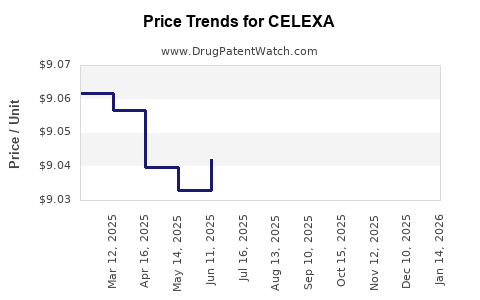
| Drug Prices: | Drug price information for CELEXA |
| What excipients (inactive ingredients) are in CELEXA? | CELEXA excipients list |
| DailyMed Link: | CELEXA at DailyMed |
Recent Clinical Trials for CELEXA
Identify potential brand extensions & 505(b)(2) entrants
| Sponsor | Phase |
|---|---|
| Food and Drug Administration (FDA) | Phase 1 |
| Spaulding Clinical Research LLC | Phase 1 |
| Western University, Canada | N/A |
Pharmacology for CELEXA
| Drug Class | Serotonin Reuptake Inhibitor |
| Mechanism of Action | Serotonin Uptake Inhibitors |
US Patents and Regulatory Information for CELEXA
| Applicant | Tradename | Generic Name | Dosage | NDA | Approval Date | TE | Type | RLD | RS | Patent No. | Patent Expiration | Product | Substance | Delist Req. | Exclusivity Expiration |
|---|---|---|---|---|---|---|---|---|---|---|---|---|---|---|---|
| Forest Labs | CELEXA | citalopram hydrobromide | SOLUTION;ORAL | 021046-001 | Dec 22, 1999 | DISCN | Yes | No | ⤷ Start Trial | ⤷ Start Trial | ⤷ Start Trial | ||||
| Abbvie | CELEXA | citalopram hydrobromide | TABLET;ORAL | 020822-003 | Jul 17, 1998 | AB | RX | Yes | Yes | ⤷ Start Trial | ⤷ Start Trial | ⤷ Start Trial | |||
| Abbvie | CELEXA | citalopram hydrobromide | TABLET;ORAL | 020822-001 | Apr 27, 2000 | AB | RX | Yes | No | ⤷ Start Trial | ⤷ Start Trial | ⤷ Start Trial | |||
| Abbvie | CELEXA | citalopram hydrobromide | TABLET;ORAL | 020822-002 | Jul 17, 1998 | AB | RX | Yes | No | ⤷ Start Trial | ⤷ Start Trial | ⤷ Start Trial | |||
| Abbvie | CELEXA | citalopram hydrobromide | TABLET;ORAL | 020822-004 | Jul 17, 1998 | DISCN | No | No | ⤷ Start Trial | ⤷ Start Trial | ⤷ Start Trial | ||||
| >Applicant | >Tradename | >Generic Name | >Dosage | >NDA | >Approval Date | >TE | >Type | >RLD | >RS | >Patent No. | >Patent Expiration | >Product | >Substance | >Delist Req. | >Exclusivity Expiration |
Celexa Market Dynamics and Financial Trajectory: Citalopram Sales, Generic Entry, Patents and Competitive Outlook
Celexa, the branded form of citalopram hydrobromide, followed a standard blockbuster-to-generic trajectory. Forest Laboratories built citalopram into a major U.S. antidepressant franchise, then shifted commercial emphasis to Lexapro, the single-enantiomer successor, before generic citalopram entered the market. Generic competition eliminated most branded Celexa revenue, while safety restrictions on dose and cardiac risk constrained the product’s later commercial potential.
Celexa remains FDA-approved for major depressive disorder, but it is now primarily a low-cost generic selective serotonin reuptake inhibitor, or SSRI. The product has no meaningful biosimilar exposure, limited remaining brand equity, and little apparent patent-based protection against generic competition.
What is Celexa and how does citalopram compete in the antidepressant market?
Celexa is the U.S. brand name for citalopram hydrobromide, an SSRI approved by the FDA in 1998 for the treatment of depression in adults. Its mechanism is based on selective inhibition of serotonin reuptake in the central nervous system.[1]
| Product | Active ingredient | FDA approval | Original developer | Current market position |
|---|---|---|---|---|
| Celexa | Citalopram hydrobromide | 1998 | Forest Laboratories | Generic-dominated |
| Lexapro | Escitalopram oxalate | 2002 | Forest Laboratories and Lundbeck | Generic-dominated |
| Prozac | Fluoxetine hydrochloride | 1987 | Eli Lilly | Generic-dominated |
| Zoloft | Sertraline hydrochloride | 1991 | Pfizer | Generic-dominated |
| Paxil | Paroxetine hydrochloride | 1992 | SmithKline Beecham | Generic-dominated |
Citalopram competed on tolerability, once-daily dosing and broad physician familiarity. Its primary commercial weakness emerged when Forest introduced Lexapro, the purified S-enantiomer of citalopram. Forest positioned Lexapro as a clinically differentiated successor while Celexa approached patent expiry.
How does Celexa compare with Lexapro?
Lexapro was designed to extend the commercial life of the citalopram franchise. It contained escitalopram, the pharmacologically active S-enantiomer, while Celexa contained a racemic mixture of R- and S-citalopram.
| Attribute | Celexa | Lexapro |
|---|---|---|
| Active ingredient | Citalopram | Escitalopram |
| Launch year | 1998 | 2002 |
| Product strategy | Original molecule | Chiral lifecycle-management product |
| Patent position | Expired | Later-expiring patents |
| Generic entry | Early 2000s | 2012 |
| Commercial role | Predecessor franchise | Revenue-protection successor |
Forest’s strategy reduced the immediate impact of citalopram patent expiry by transferring prescriptions and promotional investment to Lexapro. This is a common pharmaceutical lifecycle model: launch the racemate first, then introduce a single-enantiomer product before generic erosion begins.
What was Celexa’s financial trajectory before generic competition?
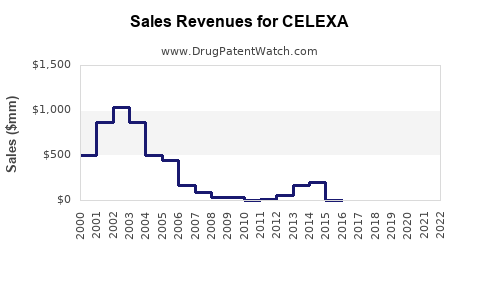
Celexa generated substantial revenue for Forest Laboratories during the early 2000s, but public disclosures often combined Celexa and Lexapro sales or reported products within broader franchise categories. The company’s financial trajectory therefore has to be interpreted through product launches, prescription trends and subsequent generic entry rather than through a continuous standalone Celexa revenue series.
Celexa commercial timeline
| Period | Commercial development | Financial effect |
|---|---|---|
| 1998-2000 | U.S. launch and physician adoption | Rapid growth from a new branded SSRI |
| 2001-2002 | Celexa becomes a major Forest product; Lexapro launches in 2002 | Franchise revenue remains strong, with sales beginning to migrate to Lexapro |
| 2003-2004 | Patent expiry and generic filings | Branded Celexa prescriptions and price deteriorate |
| 2005 onward | Generic citalopram becomes widely available | Celexa loses blockbuster economics |
| 2012 | Generic Lexapro entry | Forest loses the main successor product’s exclusivity |
| 2014 | Actavis acquires Forest Laboratories | Celexa becomes part of a legacy generic-exposed portfolio |
| 2015 onward | Allergan ownership, followed by AbbVie ownership from 2020 | No material strategic role for branded Celexa |
Forest’s antidepressant franchise was one of the company’s most important growth engines. In its fiscal 2004 reporting, Forest described strong Lexapro performance and the impact of generic competition against older products, including Celexa.[2] The company did not maintain Celexa as a standalone growth asset after the launch of Lexapro and the loss of citalopram exclusivity.
How did generic entry change Celexa revenue?
Generic entry caused three simultaneous effects:
- Unit volume shifted from the branded product to generic citalopram.
- Average selling prices fell sharply because multiple manufacturers competed on price.
- Forest redirected promotional resources and prescriptions toward Lexapro.
The post-expiry revenue curve was therefore not a gradual decline. It was a rapid loss of branded share followed by a low-value maintenance market. For a conventional oral tablet, generic substitution is usually stronger than for specialty products because the dosage form is simple, manufacturing is established and prescribers have many therapeutic alternatives.
When did Celexa lose market exclusivity?
Celexa lost effective U.S. market exclusivity in the early 2000s, with generic citalopram approvals beginning around 2004. The exact commercial transition reflected the expiration of the principal composition patent, regulatory review of abbreviated new drug applications and the timing of generic launches.
What patents protected Celexa?
The principal U.S. patent historically associated with citalopram was U.S. Patent No. 4,650,884, covering citalopram and related compounds. The patent was assigned to the original research interests associated with Lundbeck and formed the core composition protection for the drug.[3]
| Patent or protection | Subject matter | Commercial relevance |
|---|---|---|
| U.S. Patent No. 4,650,884 | Citalopram compound and related chemistry | Core molecule protection |
| NDA regulatory exclusivity | FDA approval of Celexa | Limited-duration non-patent protection |
| Label and formulation claims | Oral tablets and approved use | Limited protection after molecule expiry |
| Pediatric exclusivity, if applicable | Regulatory extension | Did not prevent eventual generic erosion |
The core compound patent was no longer an effective barrier when generic citalopram reached the U.S. market. Celexa’s practical exclusivity ended well before the later generic entry for Lexapro.
What was the Orange Book status of Celexa?
Celexa’s Orange Book-listed protection was historically centered on the citalopram composition patent. Current commercial relevance is limited because citalopram is available from numerous generic manufacturers and the original branded patent estate has expired.
The FDA Orange Book remains the principal source for listed patents, exclusivity and therapeutic-equivalence information for small-molecule products.[4] A current Orange Book review should distinguish between:
- historical patents that supported the original Celexa launch;
- expired patents that no longer block approval;
- any residual labeling or method-of-use listings; and
- the approved generic versions that have established therapeutic equivalence.
No active branded Celexa patent is generally viewed as a material barrier to standard generic citalopram tablets.
Which companies challenged Celexa patents through Paragraph IV filings?
Generic citalopram competition involved abbreviated new drug applicants, including major manufacturers such as Mylan, Teva, Ivax and Apotex. Public regulatory records identify multiple approved generic citalopram products, reflecting broad competition rather than a single challenger controlling market entry.[5]
A Paragraph IV certification asserts that a listed patent is invalid, unenforceable or not infringed. In Celexa’s case, the commercial result was eventual generic availability across multiple manufacturers. The market did not develop into a durable single-challenger settlement structure comparable to some later specialty-drug cases.
What patent litigation affected Celexa?
The key legal event was the challenge and eventual removal of the branded product’s effective exclusivity, rather than a long-running modern patent dispute over an active formulation or delivery system. Celexa’s market value declined because generic applicants could enter the conventional oral tablet market once the relevant protection no longer blocked approval.
The available commercial record does not indicate that a surviving Celexa formulation patent, manufacturing patent or method-of-use patent materially delayed generic citalopram entry.
What FDA regulatory restrictions affect Celexa’s market value?
The FDA added important safety information concerning QT-interval prolongation and torsades de pointes risk. The agency warned that citalopram causes dose-dependent QT prolongation and limited the recommended maximum dose for most adults to 40 mg per day. The maximum recommended dose for patients older than 60 years was set at 20 mg per day.[6]
The label also identifies restrictions or cautions involving:
- congenital long QT syndrome;
- bradycardia;
- hypokalemia or hypomagnesemia;
- recent acute myocardial infarction;
- uncompensated heart failure; and
- concurrent use of other QT-prolonging medicines.
These restrictions affect prescribing but do not eliminate citalopram’s role as a generic SSRI. They do, however, limit opportunities for premium repositioning and make differentiation against sertraline, fluoxetine and escitalopram more difficult.
What formulation patents and method-of-use patents protect Celexa?
Celexa has no commercially important formulation moat comparable to extended-release delivery systems, injectable products or complex combination products. Standard citalopram tablets and oral solutions are technically straightforward relative to biologics, inhaled products or depot formulations.
Are there biosimilar risks for Celexa?
No. Celexa is a small-molecule drug, not a biologic. The relevant competitive pathway is the abbreviated new drug application, or ANDA, rather than the biosimilar pathway under the Public Health Service Act.
The principal risks are therefore:
- additional ANDA approvals;
- generic price competition;
- pharmacy substitution;
- wholesaler contracting;
- manufacturing interruptions; and
- therapeutic substitution by other SSRIs.
Which companies own or commercialize Celexa today?
Forest Laboratories originally commercialized Celexa in the United States. Forest was acquired by Actavis in 2014 in a transaction valued at about $25 billion. Actavis later adopted the Allergan name, and AbbVie acquired Allergan in 2020 for approximately $63 billion.[7][8]
| Period | Relevant company | Celexa significance |
|---|---|---|
| 1998-2014 | Forest Laboratories | Original U.S. brand owner |
| 2014-2015 | Actavis | Acquired Forest and its product portfolio |
| 2015-2020 | Allergan | Held the legacy Forest assets |
| 2020-present | AbbVie | Successor owner of Allergan assets |
Ownership changed, but the economics did not return to the originator. By the time of the Forest acquisition, Celexa was a mature, largely genericized product. The strategic value of the Forest portfolio rested more heavily on other marketed products, pipeline assets and commercial infrastructure.
How strong is the Celexa patent estate?
Celexa’s current patent estate is weak from a competitive-barrier perspective.
| Patent-estate factor | Assessment |
|---|---|
| Core composition patent | Expired |
| Active molecule exclusivity | None of material commercial significance |
| Formulation protection | Limited |
| Method-of-use protection | No material barrier to generic depression treatment |
| Manufacturing complexity | Low to moderate |
| Generic substitutability | High |
| Biosimilar exposure | Not applicable |
| Geographic protection | Largely expired in major markets |
The manufacturing process does not present the type of technical barrier seen in peptide drugs, monoclonal antibodies or highly complex solid-state products. Suppliers can produce citalopram using established chemical processes, and multiple generic manufacturers have regulatory precedent.
What generic launch scenarios exist for Celexa?
The relevant commercial scenarios are already observable in the market.
Low-price generic maintenance
Multiple suppliers compete for a mature prescription base. Prices remain low, and market share depends on contracts, supply reliability and pharmacy purchasing rather than clinical differentiation.
Supply-constrained price increases
Generic markets can experience temporary price increases if manufacturers exit, active pharmaceutical ingredient supply is disrupted or regulatory actions reduce available capacity. Such events can affect citalopram pricing without restoring branded Celexa economics.
Therapeutic substitution
Prescribers may shift patients to sertraline, fluoxetine, escitalopram or other antidepressants. The QT-related label restrictions create an additional reason for some clinicians to select alternatives in higher-risk patients.
Branded relaunch
A branded relaunch would face weak commercial logic. Citalopram has limited differentiation, broad generic availability and no meaningful patent barrier. A relaunch would require a new delivery technology, combination product, digital adherence platform or clinically differentiated indication.
How does Celexa compare with competing antidepressant patent estates?
| Drug | Originator | Generic entry profile | Current patent strength |
|---|---|---|---|
| Celexa | Forest/Lundbeck | Early generic entry | Weak; core protection expired |
| Lexapro | Forest/Lundbeck | Generic entry in 2012 | Expired |
| Prozac | Eli Lilly | Generic entry in 2001 | Expired |
| Zoloft | Pfizer | Generic entry in 2006 | Expired |
| Paxil | GlaxoSmithKline | Generic entry in the early 2000s | Expired |
Celexa’s lifecycle-management value was higher than its current asset value. Forest extracted value from the original molecule, transferred demand to Lexapro and then monetized the broader company through acquisition. The strategy succeeded commercially at the franchise level even though Celexa itself lost exclusivity.
What is Celexa’s current revenue exposure?
Celexa has minimal direct revenue exposure for the successor company compared with its pre-generic period. AbbVie does not report Celexa as a major standalone growth product in its principal public financial disclosures. Generic citalopram sales are distributed across manufacturers and are not equivalent to branded Celexa revenue.
For investors and licensing teams, the key financial conclusions are:
- historical value was concentrated before generic entry;
- Lexapro captured a substantial portion of the successor-franchise economics;
- Celexa’s post-expiry revenue was structurally compressed;
- current branded revenue is immaterial relative to major pharmaceutical assets; and
- no patent-based reacceleration is visible.
What licensing deals affected Celexa?
Celexa’s commercial history was tied to the broader Forest-Lundbeck relationship and to Forest’s internal lifecycle strategy for Lexapro. The most important value-transfer event was not a later Celexa licensing deal but the corporate acquisition chain involving Forest, Actavis, Allergan and AbbVie.
No major current licensing transaction appears to have re-established exclusive commercial rights for branded Celexa in the United States.
What is the outlook for the citalopram market?
Citalopram will remain a mature generic antidepressant with stable medical demand but limited pharmaceutical innovation value. Volume is supported by the persistent need for depression treatment, while pricing remains constrained by generic substitution and therapeutic competition.
The principal market risks are regulatory safety concerns, supplier concentration and substitution by newer or better-tolerated antidepressants. The principal commercial opportunity would require a differentiated product built around formulation, adherence, tolerability or a new indication. The existing Celexa molecule alone does not provide a credible premium-growth platform.
Key Takeaways
- Celexa is citalopram hydrobromide, an SSRI approved by the FDA in 1998.
- Forest Laboratories used Lexapro, escitalopram, as the principal lifecycle-management successor.
- The core citalopram patent estate expired in the early 2000s, enabling generic entry around 2004.
- Generic citalopram eliminated most branded Celexa revenue and reduced pricing power.
- Celexa has no meaningful biosimilar risk because it is a small molecule.
- The FDA’s QT-prolongation warnings and dose restrictions limit clinical differentiation.
- Current value is concentrated in generic manufacturing and distribution, not branded patent exclusivity.
- Forest’s acquisition by Actavis, followed by Allergan’s acquisition by AbbVie, transferred Celexa into a broader legacy portfolio.
- A branded Celexa relaunch would require new formulation or clinical differentiation because the core molecule is commoditized.
FAQs
Is Celexa still sold as a brand-name drug?
Yes, but citalopram is overwhelmingly used as a generic. Branded Celexa has little commercial importance compared with generic citalopram.
Did Lexapro replace Celexa commercially?
Yes. Forest introduced Lexapro before Celexa lost exclusivity and shifted promotional and prescription activity toward escitalopram.
Can generic citalopram be substituted automatically for Celexa?
FDA-approved therapeutically equivalent generic products are generally eligible for pharmacy substitution under applicable state law and payer rules.
Does citalopram have a pediatric exclusivity extension?
Citalopram’s commercial history did not produce a durable pediatric exclusivity barrier comparable to the protection associated with some newer branded products. Any historical regulatory extensions did not prevent generic market entry.
Is citalopram more commercially exposed than sertraline?
Citalopram has similar generic pricing exposure to sertraline, but its QT-prolongation warnings can increase therapeutic substitution toward alternatives in patients with cardiac risk.
References
-
U.S. Food and Drug Administration. (2012). Celexa (citalopram hydrobromide) prescribing information. https://www.accessdata.fda.gov/drugsatfda_docs/label/2012/020822s042s043.pdf
-
Forest Laboratories, Inc. (2004). Annual report pursuant to Section 13 or 15(d) of the Securities Exchange Act of 1934 for the fiscal year ended March 31, 2004. U.S. Securities and Exchange Commission.
-
U.S. Patent and Trademark Office. (1987). U.S. Patent No. 4,650,884: Citalopram. https://patents.google.com/patent/US4650884
-
U.S. Food and Drug Administration. (n.d.). Approved drug products with therapeutic equivalence evaluations, Orange Book. https://www.accessdata.fda.gov/scripts/cder/ob/
-
U.S. Food and Drug Administration. (n.d.). Drugs@FDA: FDA-approved drugs. https://www.accessdata.fda.gov/scripts/cder/daf/
-
U.S. Food and Drug Administration. (2011). FDA drug safety communication: Abnormal heart rhythms associated with high doses of Celexa. https://www.fda.gov/drugs/drug-safety-and-availability/fda-drug-safety-communication-abnormal-heart-rhythms-associated-high-doses-celexa-citalopram
-
Actavis plc. (2014). Actavis to acquire Forest Laboratories for approximately $25 billion. https://www.sec.gov/
-
AbbVie Inc. (2020). AbbVie completes acquisition of Allergan. https://news.abbvie.com/-stats/news/abbvie-completes-acquisition-of-allergan.htm
More… ↓
