Last updated: June 19, 2026
Ceftazidime, a parenteral third-generation cephalosporin, operates in a mature, largely generic market with limited brand leverage. Commercial performance is driven by hospital and public-institution procurement, formulary status, antimicrobial stewardship policies, resistance epidemiology (especially Gram-negative coverage needs), and ongoing generic volume/price erosion. In the US, sales are concentrated in multi-source supply for IV/injectable use, with revenue trajectory shaped by contracting cycles, wholesaler buying patterns, and competitive intensity among generic manufacturers.
How big is the ceftazidime market and what drives demand?
Demand for ceftazidime is primarily hospital-driven, concentrated in acute care settings and intensive care units. Use is guided by local resistance patterns and guideline recommendations for severe Gram-negative infections where ceftazidime retains activity. Ceftazidime’s role is typically anchored in:
- Empiric and targeted treatment of serious Gram-negative infections (including Pseudomonas aeruginosa depending on susceptibility).
- Hospital pharmacy formularies that require reliable availability and low acquisition cost.
- Public sector procurement programs that select low-cost generics.
What infection indications underpin ceftazidime utilization?
Core utilization categories commonly include:
- Hospital-acquired and ventilator-associated bacterial pneumonia (susceptibility-dependent).
- Complicated intra-abdominal infections (susceptibility-dependent).
- Complicated urinary tract infections and pyelonephritis (susceptibility-dependent).
- Bloodstream infections and sepsis episodes with Gram-negative pathogens.
- Cystic fibrosis exacerbations caused by susceptible Gram-negative organisms (center-specific protocols).
How do antimicrobial resistance trends affect ceftazidime sales?
Resistance is a two-way lever:
- If local Gram-negative susceptibility to ceftazidime remains adequate, volume stays supported.
- If resistance rises (including ESBL-producing Enterobacterales or other mechanisms impacting ceftazidime activity), clinicians shift toward alternatives, reducing volumes.
The market is also sensitive to shifts toward newer β-lactam/β-lactamase inhibitor combinations and advanced cephalosporin derivatives (use depends on institutional protocols and payer contracting).
Why is ceftazidime’s financial trajectory dominated by generic competition?
Ceftazidime is off-patent in most developed markets, and the commercial base largely reflects multi-source generic supply. Financial trajectory is therefore characterized by:
- Persistent price compression from multiple approved ANDA products and wide stocking by wholesalers.
- Margin pressure at the manufacturer level as competition intensifies.
- Substitution effects when formularies favor lower-cost alternatives (or higher-cost agents with stronger guideline positioning for resistant phenotypes).
What delivery forms and strengths shape revenue?
Revenue mix is driven by injectable product forms and hospital dosing practices:
- IV and intramuscular injectable presentations.
- Common strengths include 1 g and 2 g vial formats depending on jurisdiction and product listing.
Because ceftazidime is dosed based on infection severity, renal function, and pathogen susceptibility, demand correlates with hospital admission volumes and sepsis/infection caseload rather than outpatient market expansion.
How does procurement structure influence quarterly sales volatility?
Hospital procurement creates purchasing step-changes:
- Contract renewals and tender awards can reallocate volume between suppliers.
- Inventory stocking by wholesalers ahead of demand can cause short-term shipment spikes followed by declines.
- Substitution at the formulary level can shift volumes quickly once contracts end.
When does ceftazidime lose exclusivity and how does that affect prices?
Because ceftazidime is a mature molecule with broad generic penetration, exclusivity effects have largely resolved across key geographies. The financial trajectory is instead dominated by:
- Patent estate sunset across markets.
- Ongoing ANDA launches and supply expansion.
- Tender-driven price resets.
What is the typical post-exclusivity price pattern for cephalosporins like ceftazidime?
Industry-wide patterns for mature injectables include:
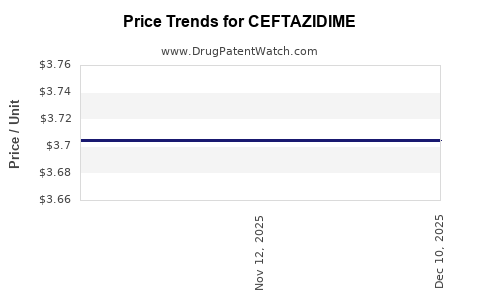
- Rapid erosion in net price within 12 to 36 months after multiple suppliers enter.
- Continued downward or flat net pricing due to periodic tenders.
- Stabilization when manufacturers exit low-margin lines or when shortages temporarily tighten supply.
What is the regulatory status of ceftazidime (FDA/Orange Book) and what does it imply for market entry?
In the US, ceftazidime products are regulated as approved generic injectables under ANDAs, with listing behavior that typically includes multiple NDCs from several generic firms. This regulatory structure implies:
- Ongoing entry of approved generics without long exclusivity barriers.
- Competitive focus on supply reliability, pricing, and contract performance rather than exclusivity.
How does Paragraph IV risk apply to ceftazidime?
For most mature cephalosporins, active Paragraph IV incentives diminish after the last relevant listed patent expires. As a result:
- The market is shaped less by litigation-driven entry timing and more by routine ANDA availability.
- Product launches can occur when regulatory readiness and manufacturing supply align with contract opportunities.
Which companies supply ceftazidime and how does the competitive landscape affect revenue?
Ceftazidime’s competitive landscape is characterized by multi-source generic supply. Revenue outcomes depend on which manufacturers win hospital contracts and maintain consistent distribution.
How does supply reliability affect market share in hospital injectables?
Hospital buyers prioritize dependable supply for IV antibiotics because shortages trigger expensive and risky therapeutic substitution. That dynamic:
- Rewards manufacturers with robust manufacturing and distribution.
- Penalizes suppliers affected by batch failures, manufacturing disruptions, or regulatory holds.
Where do branded or distributor-led advantages still matter?
Even for generics, revenue can track:
- Broad NDC coverage and tier-one wholesaler relationships.
- Contract pricing agreements with hospital systems.
- Dedicated market access teams for public procurement bids.
How does ceftazidime compare with alternative Gram-negative antibiotics that compete on formulary?
Ceftazidime’s market share is influenced by substitution across a spectrum of Gram-negative active agents:
- Other cephalosporins (cefepime, ceftazidime-avibactam in some protocols).
- Carbapenems (imipenem/cilastatin, meropenem, ertapenem) where severe or resistant phenotypes drive selection.
- β-lactam/β-lactamase inhibitor combinations (agent choice depends on local ESBL patterns).
- Newer agents in stewardship pathways that prioritize narrower or more targeted therapy where appropriate.
What is the commercial impact of guideline substitution?
When guidelines shift toward agents with broader resistance coverage, ceftazidime volume usually declines in those protocols. The magnitude depends on:
- Local antibiogram trends.
- Stewardship measures that enforce narrower empiric selection.
- Contract pricing changes that can preserve ceftazidime if it remains the lowest-cost option for susceptible cases.
What formulation and manufacturing/IP barriers can affect ceftazidime availability?
Even without strong patent barriers, injectables face manufacturing and compliance constraints that affect supply:
- Sterile manufacturing capacity and aseptic processing yields.
- Freeze-thaw, reconstitution stability, and packaging configurations.
- Batch release lead times and regulatory compliance across sites.
These factors can create temporary supply scarcity, which can lift net pricing for periods, but the effect is typically short-lived in a generic market unless supply reductions persist.
What is the risk profile for biosimilars or biologic substitution?
Ceftazidime is a small-molecule antibiotic and does not have biosimilar dynamics. Competitive pressure comes from other small-molecule antibacterials, not biologics.
What generic entry risks exist for ceftazidime in major markets?
For mature generics, entry risk is mostly operational rather than legal:
- Manufacturing qualification timelines and site readiness.
- Regulatory update cycles and data requirements.
- Procurement contracting constraints, where even approved products may fail to secure volume without pricing and supply commitments.
What litigation and settlements affect ceftazidime market supply?
For ceftazidime, major ongoing litigation is typically limited in a mature generic setting; revenue is generally not tied to court-ordered exclusivity. When litigation exists for older listed patents, outcomes mostly affect entry windows rather than long-term pricing power. In practice, commercial dynamics for ceftazidime track supply and contracting rather than exclusive ramp-ups.
What is the financial trajectory outlook for ceftazidime (3–5 year view)?
Given mature status and multi-source competition, the baseline financial outlook is:
- Low single-digit to mid single-digit revenue growth is unlikely absent epidemiology-driven volume changes or supply tightness.
- Revenue is more likely to trend sideways with periodic declines tied to price compression and contract renegotiations.
- Upside periods can occur when supply constraints tighten or when competitors face manufacturing disruptions.
Key performance drivers to monitor are:
- Net price vs. list price behavior at the hospital tender level.
- Supply availability through key distributors.
- Shifts in hospital formulary toward or away from ceftazidime based on resistance patterns.
Revenue exposure: where is ceftazidime most sensitive to volume vs. price?
Ceftazidime revenue sensitivity is typically:
- High to volume in large hospital systems and public procurement cycles.
- Moderate to high to net price changes driven by tender awards.
- Lower to brand-like factors because prescribing is stewardship and protocol driven.
Segment-level dynamics
- Acute care hospitals: primary volume driver.
- Specialty care (ICUs, oncology units): volume supported by severe infection caseload.
- Outpatient: usually smaller role due to injectable-only use.
Key takeaways
- Ceftazidime’s market is mature and primarily generic, with financial performance driven by hospital contracting, tender-driven net price erosion, and supply reliability.
- Demand tracks acute care infection caseload and local Gram-negative susceptibility patterns; higher resistance shifts use toward alternatives.
- Patent and exclusivity effects have largely transitioned to multi-source competition, reducing litigation-driven impact and increasing procurement and operations-driven impact.
- Outlook is more likely characterized by pricing pressure and modest volume dependency than by material exclusivity-based growth.
FAQs
1) What are the most common ceftazidime competitors in hospital formularies?
Ceftazidime competes with cefepime, carbapenems, and β-lactam/β-lactamase inhibitor combinations, selected based on local susceptibility, stewardship protocols, and acquisition cost.
2) How do antimicrobial stewardship programs affect ceftazidime prescribing volume?
Stewardship can reduce empiric broad-spectrum use where narrower agents are effective, which can lower ceftazidime volume. Where antibiograms support ceftazidime activity, stewardship may preserve its role.
3) Does ceftazidime pricing usually move with shortages?
Temporary supply disruptions can lift net pricing for periods, but in multi-source generic markets the effect typically fades unless supply constraints persist.
4) Can ceftazidime be substituted by other cephalosporins without losing efficacy?
Substitution depends on pathogen susceptibility, site of infection, and infection severity. In many settings, clinicians adjust to cefepime or other agents based on antibiograms and PK/PD considerations.
5) Is there biosimilar competition risk for ceftazidime?
No. Ceftazidime is an antibacterial small molecule, so biosimilar dynamics do not apply.
References (APA)
- FDA. (n.d.). Orange Book: Approved Drug Products with Therapeutic Equivalence Evaluations. U.S. Food and Drug Administration.
- World Health Organization. (n.d.). WHO Model Lists of Essential Medicines. World Health Organization.
- Infectious Diseases Society of America. (n.d.). Guidelines for the management of bacterial infections. Infectious Diseases Society of America.