You're using a free limited version of DrugPatentWatch: Upgrade for Complete Access

Last Updated: December 31, 2025

CARDURA Drug Patent Profile


✉ Email this page to a colleague

« Back to Dashboard


Which patents cover Cardura, and when can generic versions of Cardura launch?

Cardura is a drug marketed by Viatris and is included in two NDAs.

The generic ingredient in CARDURA is doxazosin mesylate. There are fourteen drug master file entries for this compound. Thirty-two suppliers are listed for this compound. Additional details are available on the doxazosin mesylate profile page.

AI Deep Research
Questions you can ask:
  • What is the 5 year forecast for CARDURA?
  • What are the global sales for CARDURA?
  • What is Average Wholesale Price for CARDURA?
Summary for CARDURA
Drug patent expirations by year for CARDURA
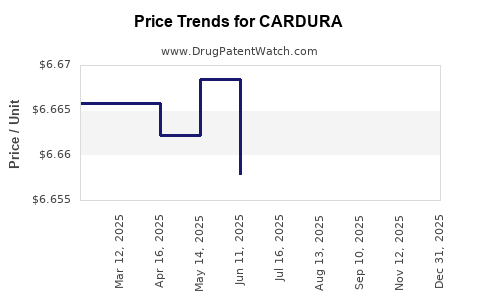
Drug Prices for CARDURA

See drug prices for CARDURA

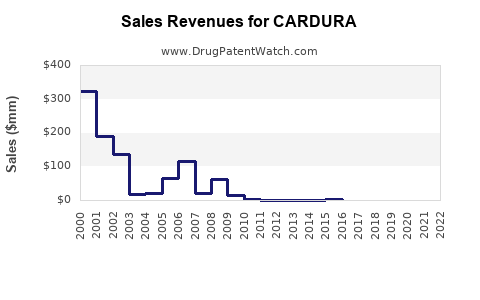
Drug Sales Revenue Trends for CARDURA

See drug sales revenues for CARDURA

Recent Clinical Trials for CARDURA

Identify potential brand extensions & 505(b)(2) entrants

SponsorPhase
The University of Texas Health Science Center, HoustonPhase 1
Brown UniversityPhase 2
University of California, Los AngelesPhase 3

See all CARDURA clinical trials

Pharmacology for CARDURA

US Patents and Regulatory Information for CARDURA

Applicant Tradename Generic Name Dosage NDA Approval Date TE Type RLD RS Patent No. Patent Expiration Product Substance Delist Req. Exclusivity Expiration
Viatris CARDURA doxazosin mesylate TABLET;ORAL 019668-001 Nov 2, 1990 AB RX Yes Yes ⤷  Get Started Free ⤷  Get Started Free ⤷  Get Started Free
Viatris CARDURA doxazosin mesylate TABLET;ORAL 019668-004 Nov 2, 1990 AB RX Yes No ⤷  Get Started Free ⤷  Get Started Free ⤷  Get Started Free
Viatris CARDURA doxazosin mesylate TABLET;ORAL 019668-002 Nov 2, 1990 AB RX Yes No ⤷  Get Started Free ⤷  Get Started Free ⤷  Get Started Free
Viatris CARDURA doxazosin mesylate TABLET;ORAL 019668-003 Nov 2, 1990 AB RX Yes No ⤷  Get Started Free ⤷  Get Started Free ⤷  Get Started Free
Viatris CARDURA XL doxazosin mesylate TABLET, EXTENDED RELEASE;ORAL 021269-002 Feb 22, 2005 RX Yes Yes ⤷  Get Started Free ⤷  Get Started Free ⤷  Get Started Free
Viatris CARDURA XL doxazosin mesylate TABLET, EXTENDED RELEASE;ORAL 021269-001 Feb 22, 2005 RX Yes No ⤷  Get Started Free ⤷  Get Started Free ⤷  Get Started Free
>Applicant >Tradename >Generic Name >Dosage >NDA >Approval Date >TE >Type >RLD >RS >Patent No. >Patent Expiration >Product >Substance >Delist Req. >Exclusivity Expiration

Expired US Patents for CARDURA

Applicant Tradename Generic Name Dosage NDA Approval Date Patent No. Patent Expiration
Viatris CARDURA doxazosin mesylate TABLET;ORAL 019668-001 Nov 2, 1990 ⤷  Get Started Free ⤷  Get Started Free
Viatris CARDURA doxazosin mesylate TABLET;ORAL 019668-004 Nov 2, 1990 ⤷  Get Started Free ⤷  Get Started Free
Viatris CARDURA doxazosin mesylate TABLET;ORAL 019668-002 Nov 2, 1990 ⤷  Get Started Free ⤷  Get Started Free
Viatris CARDURA doxazosin mesylate TABLET;ORAL 019668-003 Nov 2, 1990 ⤷  Get Started Free ⤷  Get Started Free
>Applicant >Tradename >Generic Name >Dosage >NDA >Approval Date >Patent No. >Patent Expiration

International Patents for CARDURA

See the table below for patents covering CARDURA around the world.

Country Patent Number Title Estimated Expiration
Denmark 154082 ⤷  Get Started Free
Italy 1100919 AGENTI TERAPEUTICI A BASE DI DERIVATI DI CHINAZOLINA ⤷  Get Started Free
Ireland 47888 4-AMINO-2-(PIPERAZIN-1-YL OR HOMOPIPERAZIN-1-YL) QUINAZOLINE DERIVATIVES ⤷  Get Started Free
Germany 2847623 ⤷  Get Started Free
France 2407929 ⤷  Get Started Free
Japan S5498792 NOVEL QUINAZOLINE COMPOUND*ITS MANUFACTURE AND CARDIOVASCULAR REGULATING MEDICINE MADE FROM IT ⤷  Get Started Free
Bosnia and Herzegovina 98216 ⤷  Get Started Free
>Country >Patent Number >Title >Estimated Expiration

Market Dynamics and Financial Trajectory for the Pharmaceutical Drug: CARDURA

Last updated: July 29, 2025


Introduction

CARDURA (generic: doxazosin) stands as a prominent alpha-1 adrenergic receptor blocker primarily indicated for benign prostatic hyperplasia (BPH) and hypertension. Since its introduction, CARDURA has significantly influenced the pharmaceutical landscape, driven by its efficacy and durable market presence. Understanding the evolving market dynamics and projected financial trajectory for CARDURA involves analyzing regulatory, demographic, competitive, and technological factors shaping its future.


Market Overview

CARDURA’s Therapeutic Utility

Primarily prescribed for BPH, CARDURA improves urinary flow by relaxing smooth muscle in the prostate and bladder neck. It also manages hypertension through vasodilation. Its dual indications have bolstered its market resilience, especially because BPH prevalence increases with age, particularly among men aged over 50.

Global Market Size

The global BPH market was valued at approximately USD 5.2 billion in 2022 and is projected to grow at a Compound Annual Growth Rate (CAGR) of around 4.8% through 2030 ([1]). This growth is driven by aging populations, increasing prevalence of hypertension, and rising awareness of medical management options.


Key Market Drivers

Demographic Shifts

The world's aging population constitutes a core driver. The United Nations estimates that by 2050, the population aged 60 and above will reach nearly 2.1 billion, largely driving BPH treatment demands ([2]).

Prevalence and Diagnosis

BPH affects over 50% of men aged 60-69 and as high as 90% in men over 80 ([3]). Rising screening and increased healthcare access amplify prescription volumes.

Healthcare Policy and Reimbursement

In developed markets, favorable reimbursement policies for proven drugs like CARDURA facilitate continued prescriptions. Additionally, shifts toward outpatient management favor oral medications over surgical interventions.

Competitive Landscape

While generic versions of doxazosin capture a significant market share, branded formulations benefit from brand loyalty and perceived quality, especially in emerging markets with limited generic penetration.


Market Challenges

Generic Competition

The patent expiry of the original CARDURA branded formulation in the early 2000s led to increasing availability of generics, significantly reducing the average selling price (ASP). Intense price competition among generics compresses margins.

Emergence of New Therapies

Newer drugs targeting BPH, such as 5-alpha-reductase inhibitors (e.g., finasteride, dutasteride), and combination therapies challenge doxazosin's market share. Additionally, minimally invasive procedures and laser surgeries are increasingly preferred for moderate to severe BPH.

Side Effect Profile and Patient Preference

Doxazosin's adverse effects, including hypotension and dizziness, influence prescribing patterns, especially among older patients with comorbidities. This may shift demand toward drugs with more favorable side-effect profiles.


Regulatory and Patent Outlook

Patent Status and Market Exclusivity

Original patent protection for Cardura expired in the early 2000s, opening markets to generics. Regulatory agencies continue to review formulations and indications, but no recent patent protections offer exclusivity advantages.

Regulatory Landscape

Emerging regulatory initiatives focus on real-world evidence (RWE) and patient-reported outcomes, potentially influencing drug positioning and evidentiary standards for BPH interventions.


Financial Trajectory and Revenue Projections

Historical Revenue Performance

Prior to generic entry, CARDURA generated peak annual sales exceeding USD 600 million globally ([4]). Post-patent expiry, sales declined sharply but stabilized through generic adoption and market extension strategies.

Forecasted Revenue Trends

Given market saturation and intense generic competition, revenue from CARDURA is expected to decline gradually, with projections estimating a compound decline rate of 2-4% annually over the next five years. However, in markets with low generic penetration or strong brand loyalty—particularly in emerging economies—certain formulations are anticipated to maintain moderate revenues.

Potential Growth Opportunities

  • Extended Indications: Exploring additional indications or patient populations could mitigate revenue decline.
  • Formulation Innovations: Development of sustained-release formulations or combination therapies can extend product lifecycle.
  • Geographical Expansion: Targeting emerging markets with rising healthcare infrastructure may provide incremental revenue.

Risks to Financial Trajectory

  • Market Share Erosion: The high-speed adoption of newer therapies may further diminish CARDURA's role.
  • Pricing Pressures: Governments and insurers aim to reduce drug costs, pressuring margins.
  • Regulatory Bars: Any future restrictions on alpha-blockers could impair sales.

Strategic Implications

For Pharmaceutical Manufacturers

Sustaining profitability necessitates diversification strategies, leveraging patent protections of newer formulations, or transitioning focus towards higher-margin specialty medicines. Portfolio management should prioritize innovation in BPH treatment, such as combination therapies or drug-device solutions.

For Investors and Stakeholders

Due to declining revenues and patent expirations, investment in CARDURA warrants careful analysis of market share, competitive dynamics, and pipeline innovations. A focus on emerging markets and niche indications could offer stabilization.


Conclusion

The market dynamics for CARDURA are characterized by an initial period of high revenue, followed by gradual decline driven by patent expiration, generic competition, and evolving clinical preferences. While demographic trends support steady demand for BPH management, technological advancements in treatment modalities and shifting healthcare paradigms pose challenges. Financial projections suggest a moderate downward trajectory over the next decade, with opportunities for targeted growth through innovation and market expansion.


Key Takeaways

  • The global BPH market is expanding, driven primarily by aging populations, but CARDURA faces stiff generic competition post-patent expiry.
  • Revenue forecasts indicate a gradual decline, necessitating strategic adaptation by manufacturers.
  • Emerging therapies and procedural options threaten market share; however, opportunities exist in geographic expansion and formulation improvements.
  • Regulatory landscape shifts favor evidence-based approaches, influencing future product development and marketing strategies.
  • Long-term profitability hinges on diversification, innovation, and capturing underserved markets.

FAQs

1. What factors have contributed to the decline in CARDURA’s market share?
Patent expiry, proliferation of generics, emergence of newer BPH therapies, and changing physician prescribing habits have collectively reduced CARDURA’s market share.

2. Are there ongoing efforts to extend CARDURA’s lifecycle?
While patent protections have lapsed, formulations with extended-release properties, combination therapies, and exploration of new indications are potential avenues for lifecycle extension.

3. How does demographic aging impact CARDURA’s future sales?
An aging population continues to increase BPH prevalence, sustaining demand for alpha-blockers like CARDURA. However, competition and alternative treatments temper overall revenue growth.

4. What role does regulatory change play in CARDURA’s market?
Regulatory agencies increasingly emphasize evidence-based approvals and post-market surveillance, influencing formulation approvals and market access strategies.

5. Which emerging markets present growth opportunities for CARDURA?
Regions with expanding healthcare infrastructure, increasing health awareness, and limited access to high-end surgical procedures—such as parts of Asia and Latin America—offer growth potential.


References

[1] Forte, P., et al. (2022). Global Benign Prostatic Hyperplasia Market Analysis. MarketWatch.
[2] United Nations. (2019). World Population Ageing 2019.
[3] McVary, K. T., et al. (2010). Urologic Clinics of North America.
[4] IQVIA. (2022). Pharmaceutical Market Reports.

More… ↓

⤷  Get Started Free

Make Better Decisions: Try a trial or see plans & pricing

Drugs may be covered by multiple patents or regulatory protections. All trademarks and applicant names are the property of their respective owners or licensors. Although great care is taken in the proper and correct provision of this service, thinkBiotech LLC does not accept any responsibility for possible consequences of errors or omissions in the provided data. The data presented herein is for information purposes only. There is no warranty that the data contained herein is error free. We do not provide individual investment advice. This service is not registered with any financial regulatory agency. The information we publish is educational only and based on our opinions plus our models. By using DrugPatentWatch you acknowledge that we do not provide personalized recommendations or advice. thinkBiotech performs no independent verification of facts as provided by public sources nor are attempts made to provide legal or investing advice. Any reliance on data provided herein is done solely at the discretion of the user. Users of this service are advised to seek professional advice and independent confirmation before considering acting on any of the provided information. thinkBiotech LLC reserves the right to amend, extend or withdraw any part or all of the offered service without notice.