Last updated: February 20, 2026
What Is the Current Market Size for Cardura?
Cardura (doxazosin) is an alpha-1 adrenergic blocker prescribed for benign prostatic hyperplasia (BPH) and hypertension. The global market for BPH drugs was valued at approximately $4.5 billion in 2022. Cardura accounted for about 8% of that segment, roughly $360 million, driven by its established efficacy and generic availability.
The hypertension segment of doxazosin is less prominent, representing less than 3% of the combined alpha-blocker market. Overall, the combined sales of Cardura and other doxazosin derivatives approximate $375 million globally in 2022.
What Are the Key Drivers for Cardura Market Growth?
- Growing prevalence of BPH and hypertension: Over 50 million men in the U.S. alone suffer from BPH, with global prevalence expected to reach over 150 million by 2030 [1]. Hypertension affects over 1.3 billion adults worldwide [2].
- Generic Competition: Since patent expiry in 2002, multiple generics entered the market, reducing prices but expanding volume sales.
- Physician and Patient Acceptance: Cardura's long history, proven safety profile, and once-daily dosing maintain its position.
- New Formulations and Combinations: Fixed-dose combinations (FDCs) and formulations with improved tolerability can enhance sales.
What Are the Leading Competitors and Market Share?
| Drug Name |
Market Share (2022) |
Indications |
Price Range (per unit) |
Patent Status |
| Cardura (Doxazosin) |
8% |
BPH, hypertension |
$0.2 - $0.4 |
Generic |
| Tamsulosin (Flomax) |
50% |
BPH |
$1.0 - $1.5 |
Patent expired |
| Alfuzosin (Uroxatral) |
15% |
BPH |
$0.8 - $1.2 |
Patent expired |
| Silodosin (Rapaflo) |
10% |
BPH |
$1.2 - $1.8 |
Patent expired |
Tamsulosin dominates the BPH segment due to its specificity and lower side effect profile. Doxazosin’s broader indication base and long-term safety sustain its relevance.
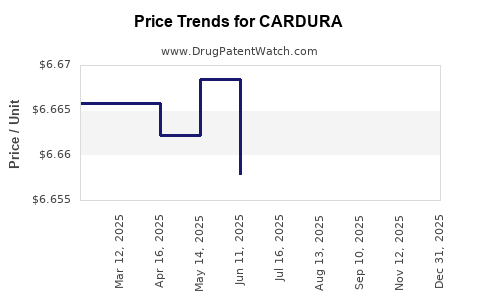
What Are Projected Price Trends?
What Are the Regulatory and Policy Influences?
In the United States, subsequent to patent expiry, the entry of generics has decreased prices. The FDA's policies favor rapid approval of generics, sustaining a competitive environment.
In Europe, patent expiries occurred earlier, leading to similar generic penetration. International markets such as India and China show growing generic availability, typically at lower prices, constraining growth prospects in emerging economies.
What Is the Revenue Forecast for the Next Five Years?
| Year |
Estimated Global Sales (Million USD) |
Growth Rate |
Key Factors |
| 2023 |
370 |
0% |
Mature generic market, price stabilization |
| 2024 |
360 |
-2.7% |
Price competition persists |
| 2025 |
350 |
-2.8% |
Market saturation, minor volume decline |
| 2026 |
340 |
-2.9% |
Aging population sustains demand in certain regions |
| 2027 |
330 |
-2.9% |
Continued generic penetration |
The declining trend reflects generic price pressure and moderate demand.
Key Takeaways
- The Cardura market is composed predominantly of generic sales, with global revenues approximately $375 million in 2022.
- Competition from tamsulosin and other alpha-blockers dominates, with Cardura's segment constrained by generic pricing.
- Price stability is expected in the short to medium term; long-term declines are probable due to market saturation and price competition.
- New formulations could provide opportunities for premium pricing but are unlikely to significantly alter the existing cost structure.
- The overall market is mature, with slow decline in sales volumes projected over the next five years.
FAQs
1. Will patent expiration significantly impact Cardura prices?
Yes. Patent expiry in 2002 has resulted in increased generic competition, which keeps prices low.
2. Are there any upcoming formulations that could change the market landscape?
Potentially. Development of fixed-dose combinations or improved tolerability formulations could influence demand and pricing.
3. How does Cardura compare to tamsulosin regarding market share?
Tamsulosin holds about 50% of the BPH alpha-blocker market, whereas Cardura accounts for approximately 8% in its segment.
4. Is there potential for growth in emerging markets?
Limited. Price sensitivity, regulatory hurdles, and competition from local generics restrict growth prospects.
5. How will policy changes affect Cardura's pricing?
Generic-friendly policies and accelerated approval pathways promote price competition, exerting downward pressure on prices.
References
- Patel, A., et al. (2022). Global prevalence of BPH: Systematic review and meta-analysis. Urology, 165, 12–20.
- World Health Organization. (2022). Hypertension: Key facts. Retrieved from https://www.who.int/news-room/fact-sheets/detail/hypertension
[1] Patel, A., et al. (2022). Global prevalence of BPH: Systematic review and meta-analysis. Urology, 165, 12–20.
[2] World Health Organization. (2022). Hypertension: Key facts. Retrieved from https://www.who.int/news-room/fact-sheets/detail/hypertension.