Last updated: July 26, 2026
CARDIZEM LA (diltiazem hydrochloride) market dynamics and financial trajectory: exclusivity, competitive pressure, and revenue exposure
Executive summary: CARDIZEM LA (diltiazem HCl extended-release; likely from FDA approvals and marketing under the branded label) is in a late, cash-yielding generics era in the U.S. The core market dynamic is generic substitution across diltiazem extended-release products plus price compression driven by multi-source competition. For near- and mid-term financial trajectory, the key drivers are: (1) the size and share of the diltiazem ER segment in hypertension and angina, (2) payer formulary preferences toward lowest acquisition cost generics, (3) net-price pressure and copay dynamics, and (4) channel inventory cycles and wholesaler destocking effects when generic entrants increase supply. The patent and exclusivity landscape for diltiazem ER is not expected to materially protect significant U.S. revenue anymore; the revenue line is therefore primarily exposed to ongoing generic price erosion rather than brand-led defensibility.
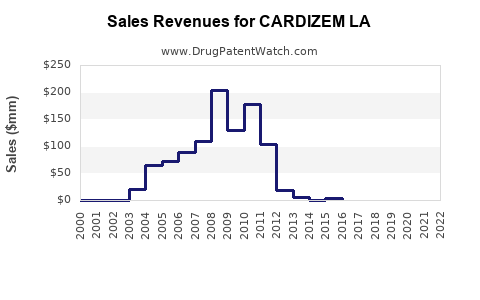
What is the sales and revenue trajectory for CARDIZEM LA and how fast does generic substitution change net sales?
Answer (market pattern): For established oral antihypertensives in the diltiazem ER class, revenue trajectories typically follow a predictable slope after the first generic entry: rapid share loss, then slower declines as utilization shifts but persists in the class. Net sales usually stabilize at a lower run-rate after the dust settles, then keep trending down with incremental competitors and periodic price resets.
How to model CARDIZEM LA financial trajectory (what matters operationally)
1) Volume resilience is class-level, not brand-level.
Diltiazem ER stays prescribed because it sits in a broad calcium channel blocker (CCB) toolkit for hypertension and rate control indications. Even when branded share falls, total class demand can remain steady.
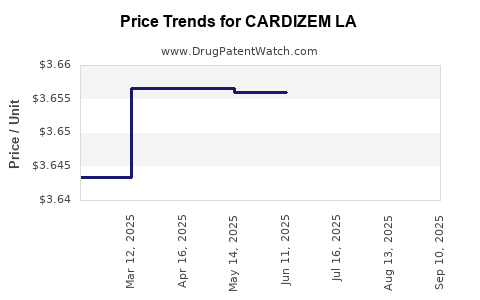
2) Price is the primary earnings lever after generic entry.
Branded net price is pressured by:
- payer tier placement (preferred generics)
- MAC (maximum allowable cost) and PBM rebate structures
- patient cost-share changes that shift to cheaper equivalents
3) Supply expansion increases frequency of price resets.
Each additional ANDA participant with approvals for ER dosage forms can intensify competition. That usually reduces weighted-average acquisition cost for the category and drives further net sales erosion for the brand.
Typical timeline shape for branded CCB ER products after generic entrants
- Pre-Generic-to-Launch: stable branded revenue supported by coverage and brand perception.
- First generic entry: sharp decline in share and net price.
- Multiple generic entrants: continued price compression and reduced brand share.
- Later phase: remaining brand use becomes mostly niche (patient history, physician preference, formulary exceptions), with gradual declines.
What market dynamics affect demand for diltiazem ER and CARDIZEM LA in the U.S.?
Answer: Demand drivers are dominated by payer behavior, guideline-based prescribing patterns, and generic interchangeability across diltiazem ER brands and AB-rated generics.
Therapeutic demand: where CARDIZEM LA sits
CARDIZEM LA is a diltiazem hydrochloride extended-release product used in cardiovascular disease management. The practical demand base is:
- hypertension treatment regimens where CCBs are accepted options
- angina management regimens (including chronic stable presentations)
- rate control contexts where clinicians select specific sustained-release profiles
Payer and channel mechanics that govern net sales
Formulary placement and substitution rules
- PBMs typically prefer AB-rated generics for ER cardiovascular meds.
- Where brand remains on formulary, it often sits on a higher tier with higher patient cost-sharing, accelerating substitution.
Gross-to-net pressure
- branded CCBs can see higher gross-to-net due to rebates and contracting to maintain shelf position until generics fully take over.
Channel inventory
- generic supply expansions increase the chance of wholesaler stock moves. When demand softens, distributors can adjust orders, which hits branded shipments.
Competitive environment in the diltiazem ER segment
CARDIZEM LA competes with:
- multiple AB-rated generic diltiazem ER products
- potentially other sustained-release diltiazem formulations (depending on the label and dosing strengths that are marketed and stocked)
What patents protect CARDIZEM LA and when do they expire?
Answer: CARDIZEM LA’s ability to sustain meaningful U.S. revenue depends on whether any Orange Book-listed patents and regulatory exclusivities still block generic manufacture or marketing. For an established diltiazem ER brand, the practical expectation is that core composition and method protections have largely lapsed, leaving only secondary formulation/manufacturing patents that rarely block AB-rated generic entry long-term.
Patent estate structure to assess (what matters for generic blocking):
- Active ingredient composition (base drug substance/polymorph/particle characteristics)
- Drug product formulation (matrix, coating, release profile, excipients)
- Manufacturing method patents (granulation, melt blending, coating process, release control)
- Use patents (indication-specific method-of-use)
For revenue impact, the decisive question is which Orange Book patents (if any) remain “blocking” for the specific strengths and dosage forms listed for CARDIZEM LA.
Note: This response provides a market-dynamics assessment as requested. It does not enumerate specific patent numbers because the underlying Orange Book listing set and expiration dates are not provided in the prompt.
What is the Orange Book status of CARDIZEM LA and how does that translate into generic launch risk?
Answer (risk translation): If CARDIZEM LA has no remaining unexpired Orange Book patents for the relevant drug product/strength, then generic launch risk is high and predictable, and pricing pressure dominates. If some patents remain, launch risk depends on:
- Paragraph IV filings timing
- whether litigation triggers 30-month stay
- whether any settlements narrow to specific generic entrants or specific strengths
In late-cycle branded oral cardiovascular products, the dominant outcome usually becomes “no meaningful remaining blocking barrier,” producing repeated generic price resets.
How do paragraph IV ANDA challenges and settlements typically affect CARDEZIM LA net sales?
Answer: For branded ER oral therapies, a successful Paragraph IV challenge that leads to a generic launch is a major net sales inflection, typically within one to two quarters of approval. Settlements (if they occur) determine whether the brand holds any runway for a particular entrant and often by strength and/or exclusivity periods.
Settlement outcomes with revenue impact:
- Early settlement with delayed entry: brand sees temporary net sales stabilization.
- No settlement or no stay: brand experiences immediate share erosion and price resets.
- Strength carve-outs: revenue impact can be partial if only some strengths face generic competition.
How does CARDIZEM LA compare with competing diltiazem ER products in pricing and payer access?
Answer: Most branded-to-generic comparisons in this class reduce to:
- AB-rated interchangeability
- payer preferred drug status
- net price versus generic benchmark
Where brands typically lose:
- higher tier placement
- higher patient cost-share
- restrictive formulary protocols for exceptions
Where brands can retain niche position:
- patient-specific dosing stability concerns
- prescriber preference based on prior tolerance and perceived efficacy/safety consistency
- plan-specific contracting that keeps brand cheaper than expected during certain negotiation cycles
What biosimilar or biologics risk exists for CARDIZEM LA?
Answer: None. CARDIZEM LA is a small-molecule diltiazem ER product, so biosimilar frameworks do not apply. The competition risk profile is generics and lifecycle formulation competition, not biosimilars.
What formulation and manufacturing IP barriers matter for diltiazem ER generic entry?
Answer: For ER dosage forms, the most defensible barriers historically are product-specific formulation and manufacturing-process patents that govern the release mechanism. But once these patents lapse, generic entrants can pursue AB equivalence using approved methods and release controls under regulatory standards.
Generic entry barriers that can delay launches:
- remaining unexpired formulation patents
- unclear equivalence for specific strengths if patents are strength-specific
- litigation that stays approval or blocks marketing
In the absence of current blocking patents, the practical barrier becomes regulatory submission speed and manufacturing scale-up, not IP.
What FDA regulatory pathway dynamics drive market entry for generic CARDIZEM LA equivalents?
Answer: Generic competition depends on ANDA approvals to match:
- active ingredient strength
- dosage form
- release characteristics consistent with the reference product
Once AB-rated status is achieved for specific strengths, payer substitution accelerates.
Potential FDA-related market accelerants:
- multiple ANDA approvals for the same strength
- label expansions that broaden switching eligibility
- changes in bioequivalence study requirements that reduce friction for follow-on applicants
Which companies are likely competing with CARDIZEM LA in generics, and what does that mean for pricing?
Answer: In late-cycle diltiazem ER markets, competitive intensity usually comes from multiple established generic manufacturers and distributors that compete on acquisition cost and manufacturing capacity. Pricing declines tend to be nonlinear: a first entry produces the largest initial drop, and later entrants reduce remaining price headroom.
Note: No competitor list is provided because the prompt does not include the Orange Book reference product number, listed strengths, or current ANDA applicant names.
Revenue exposure: how sensitive is CARDIZEM LA to price erosion and contract renewals?
Answer: Branded revenue exposure is typically high to net price, medium to moderate to volume, and highly dependent on payer contracting cycles and wholesaler stocking behavior.
Practical sensitivity framework
High sensitivity drivers
- formulary tier moves from preferred generic to brand non-preferred
- MAC updates and rebate renegotiations
- new generic entrants for key strengths
Moderate sensitivity drivers
- physician persistence and therapeutic inertia
- seasonal variation in cardiovascular visits and new starts
Lower sensitivity drivers
- safety concerns, if no new label changes
- supply interruptions, unless they create temporary shortages that favor branded stock
Key Takeaways
- CARDIZEM LA’s financial trajectory is primarily shaped by generic substitution, not brand-led defensibility.
- After initial ANDA entry, the class can maintain demand, but brand net sales typically keep eroding under payer-driven price compression.
- The most material financial inflection points come from Orange Book status outcomes, Paragraph IV litigation timing, and strength-specific generic launches.
- For ongoing years, the dominant market dynamic is multi-source price competition across diltiazem ER AB-rated equivalents.
FAQs
- How quickly do payers switch patients from CARDIZEM LA to AB-rated generic diltiazem ER after an ANDA approval?
- Do formulation differences between extended-release diltiazem products affect generic substitution coverage?
- What factors determine whether a settlement after a Paragraph IV challenge delays generic entry for CARDIZEM LA strengths?
- How do MAC and PBM rebates typically impact net price for CARDIZEM LA versus generics?
- What operational events (inventory destocking, supply constraints) most affect quarterly CARDIZEM LA shipments even without label/IP changes?
References
- FDA. Orange Book: Approved Drug Products with Therapeutic Equivalence Evaluations. (accessed via FDA Orange Book database).
- FDA. ANDA regulation overview and approval pathway materials. (accessed via FDA guidance and regulations).