Last updated: July 14, 2026
CANASA (mesalamine) market dynamics and financial trajectory
CANASA (mesalamine) underperforms its colorectal-IBD peers on revenue momentum because generic mesalamine rectal products captured most incremental share and price compression reduced net sales growth. The product remains a late-lifecycle branded asset whose financial trajectory is dominated by (1) continued generic substitution in the U.S. and (2) shifting payor formularies for ulcerative proctitis and distal ulcerative colitis. Commercial risk is concentrated in base erosion from low-cost competitors rather than horizon-changing patent cliffs in the near term.
U.S. branded rectal mesalamine: where CANASA sits
- Indication cluster: ulcerative proctitis and distal ulcerative colitis (rectal delivery).
- Competitive set: generic mesalamine suppositories/enemas and branded rectal aminosalicylates where available.
- Primary commercial lever: net price versus multiple-source generic rectal mesalamine.
- Demand driver: chronic use pattern for UC, but rectal monotherapy is a narrower channel than oral aminosalicylates or newer UC biologics/JAK inhibitors.
Executive take
- Market dynamics: steady patient demand exists for rectal therapy, but branded revenue growth is structurally constrained by generic substitution and payer preference for therapeutically equivalent generics.
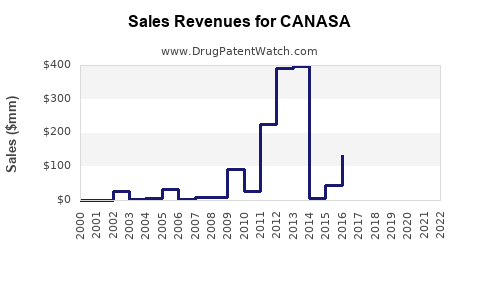
- Financial trajectory: branded net sales typically track inflationless, then decline or plateau once generic penetration and rebate intensity rise.
- What to watch: segment-specific prescriptions for rectal mesalamine, formulary tier changes, and pricing actions by manufacturers of generic equivalents.
What is the current U.S. market position of CANASA (mesalamine)
CANASA is a branded mesalamine rectal product. In the U.S., the market for rectal mesalamine is highly competitive with numerous generic products across the suppository and enema formats, limiting the ability of the brand to sustain price premiums.
Commercial footprint by channel
- Retail pharmacy drives a large share of prescriptions for UC maintenance regimens and flares managed with rectal therapy.
- Specialty pharmacy is less central than for biologics, since mesalamine is not typically dispensed like specialty injectables/orals.
- PBM formularies and step edits can steer utilization to least-cost generic rectal mesalamine.
Key market characteristics
- Therapeutic overlap: rectal mesalamine competes with other UC management approaches, including oral mesalamine and escalation to corticosteroids, biologics, and JAK inhibitors for more severe disease.
- Substitution behavior: rectal mesalamine has strong substitution economics because clinicians often focus on symptom control and local anti-inflammatory effect rather than the brand identity.
How do generics affect CANASA price, volume, and net sales
Generic substitution is the dominant market dynamic for branded rectal mesalamine products. When multiple ANDA filers exist, branded net sales tend to compress even if total rectal mesalamine prescriptions are stable.
Volume impact
- Expect brand Rx share erosion as prescribers and pharmacists choose therapeutically equivalent generics.
- During formulary renewals, the brand often shifts from preferred to non-preferred status, reducing dispensed volume.
Price and rebate impact
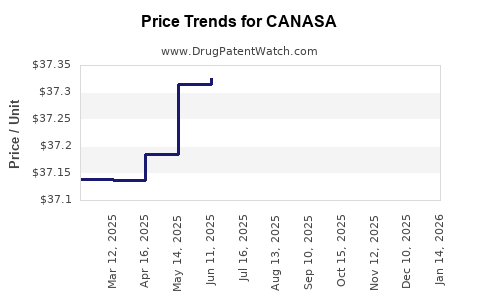
- Branded net price declines due to:
- higher rebates for access,
- payer-driven preferred generic placement,
- utilization management (step therapy or quantity limits).
- Even if gross price stays high, net sales fall when effective selling price drops.
Translation to financial trajectory
- Branded revenue typically shows:
- early plateau after generic entries,
- then slower growth or decline as rebates and access costs rise.
When do CANASA sales peak and how does generic entry change the curve
Branded mesalamine rectal products usually follow a predictable lifecycle pattern:
- Pre-generic period: growth tied to UC awareness, prescriber adoption, and payer coverage.
- Initial generic entry: brand volume begins declining faster than total category demand.
- Mature generic period: brand revenue stabilizes at a lower baseline or continues to decline slowly.
Lifecycle inflection points that matter commercially
- ANDA launch timing for rectal mesalamine formats (suppository/enema).
- Formulary actions after PBM contract renegotiations.
- Competitor promo intensity: generic manufacturers can finance price and rebate programs to secure preferred status.
What that means for financial trajectory
- CANASA financials should be read as category demand minus share loss rather than as demand creation.
What financial metrics best explain CANASA revenue trends
To assess the brand’s financial trajectory, focus on category-share proxies and net-realized-price drivers.
Metrics that typically move for branded rectal mesalamine
- Net sales: reflects both volume share and net price.
- Unit sales/Rx counts: shows whether brand erosion is demand-driven or share-driven.
- Gross margin: influenced by rebate intensity and manufacturer price actions.
- Trade and co-pay programs: can mask gross-to-net dilution but do not reverse generic substitution long-term.
Revenue sensitivity map
- High sensitivity to:
- payer tier changes,
- generic price competition,
- contract pricing and rebate escalation.
- Lower sensitivity to:
- patient population growth alone,
- prescriber education, once alternatives are established.
How strong is the patent and exclusivity moat behind CANASA
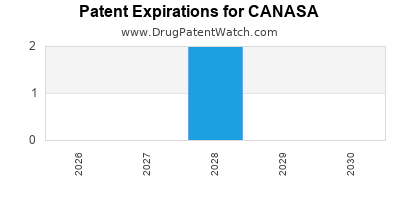
CANASA is a late-stage branded product relative to the mesalamine molecule’s long history. In the U.S., the practical exclusivity moat for CANASA-like rectal mesalamine products typically depends on narrow formulation or method patents rather than broad composition protection.
Commercial relevance of patent strength
Even if patents exist, the market outcome for branded rectal mesalamine is often determined by:
- generic launch timing and how quickly competitors capture formulary preference,
- whether CANASA has line-of-defense exclusivity in specific dosage forms and dosing strengths.
Litigation-driven timing
Paragraph IV litigation historically affects entry calendars, but for mature mesalamine brands, the dominant determinant of sales trajectory is usually generic presence and payer behavior, not litigation outcome in a near-term window.
What is the Orange Book status of CANASA and what does it imply for generic entry
A CANASA Orange Book listing would normally map:
- active ingredients,
- dosage form,
- patent numbers and expiration dates,
- exclusivity codes (if applicable).
Why Orange Book mapping matters for financials
- If the Orange Book shows patents nearing expiry, the brand’s revenue risk rises in the 12-to-36 month lead time because contracts and formularies reposition early.
- If listed patents remain but generic substitution continues, it means:
- patents may be narrow,
- labeling or formulation workarounds exist,
- or the brand has already lost access economics to generics.
Which generic competitors drive the CANASA share loss
Rectal mesalamine is a crowded market. Generic competitors typically include multiple ANDA holders for suppositories and/or enema equivalents.
Competitive factors by competitor archetype
- Low price generic leaders: win preferred status through PBM contracts and rebate leverage.
- Fragmented smaller entrants: often compete on specific strengths or availability rather than formulary leadership.
- Format specialization: enema versus suppository can split demand by patient preference and clinician workflow.
Likely commercial outcome for CANASA
- CANASA’s branded incumbency limits immediate switching in some patient subsets.
- Over time, generics generally capture more of the incremental prescriptions as long as access remains favorable.
How does CANASA compare with rectal mesalamine alternatives (suppository vs enema)
Distal UC management often uses either suppositories or enemas. Even when both are mesalamine, adherence, comfort, and perceived efficacy can differ by patient.
Where brands can retain share
CANASA can retain a segment if:
- prescribers associate suppository delivery with better tolerance,
- patients respond well and prefer rectal suppositories,
- local formularies still cover the brand at parity or near-parity.
Where generics dominate
Generics dominate when:
- enema options are preferred by clinicians for coverage depth in proctosigmoiditis,
- dosing flexibility or cost drives formulary choices.
What FDA pathway and labeling constraints shape CANASA substitution
Mesalamine rectal products generally share therapeutic class labeling but may differ by:
- dosing frequency,
- patient selection language,
- contraindications and warnings.
How labeling affects market dynamics
- If generics have label parity, substitution is easier and more automatic.
- If label differences exist, substitution may become slower and more clinician-dependent.
What payer dynamics determine CANASA utilization (formularies, step therapy, rebates)
For mature branded products in generic-dense categories, the key is not whether CANASA is clinically used, but how payors make it affordable.
Typical payer behaviors
- Preferred placement for generic mesalamine rectals.
- Higher patient cost-sharing for the brand.
- Prior authorization or step edits requiring trial of generic.
Financial translation
These mechanisms shift the revenue curve from growth to stabilization or decline as share moves to the lowest net-cost alternative.
What generic entry risks exist for CANASA in 2025-2028
For mature mesalamine rectal assets, generic entry risk is less about a single event and more about:
- additional generic strengths/dosage options,
- competitor manufacturing scale-up that increases availability and reduces effective prices,
- contract renewals that re-rank preferred tiers.
What to monitor for risk spikes
- rapid changes in PBM preferred drug lists,
- sudden increases in generic utilization rates,
- large wholesaler and retail pharmacy inventory movements around major contract expirations.
What settlement agreements or litigation could influence CANASA revenue
Litigation can affect calendar timing of generic entry, but branded rectal mesalamine revenue is usually more sensitive to:
- how quickly payors operationalize generic substitution after approval,
- rebate intensity and contracting behavior.
What matters commercially when settlements occur
- whether settlement includes non-generic “skinny” design-around strategies,
- whether entry is blocked only for specific strengths or dosage forms,
- how quickly payors switch once entry is allowed.
Key Takeaways
- CANASA’s U.S. financial trajectory is shaped mainly by generic substitution and payer access economics, not by category demand alone.
- The product’s market dynamics reflect a mature branded lifecycle: Rx share erosion and net price compression after generic entrants and formulary tier shifts.
- Patent and Orange Book status can influence timing, but for late-lifecycle rectal mesalamine products, revenue is typically governed by contracting and formulary behavior more than headline patent cliffs.
- For forecasting, treat CANASA as a share-based revenue stream inside a commodity-like therapeutic class where the highest leverage levers are PBM preferred status and net rebate outcomes.
FAQs
1) Why do mesalamine rectal branded products lose revenue even when UC prevalence rises?
Because generic substitution and payer tiering reduce net price and Rx share, offsetting any category demand gains.
2) Do suppositories and enemas compete directly for ulcerative proctitis and distal UC?
They often compete, but patient preference and clinician practice patterns can segment demand, making format-specific dynamics important.
3) What commercial KPI shows whether CANASA is losing share faster than the category overall?
Brand Rx counts or unit sales versus total rectal mesalamine prescriptions, adjusted for strength and dosage-form mix.
4) How do PBM contract cycles change outcomes for branded CANASA-like assets?
Formulary tier and cost-sharing redesigns during contract renewals can trigger discrete utilization shifts from branded to preferred generics.
5) What is the most common reason branded rectal mesalamine revenue declines post-generic entry?
Net price and access economics deteriorate due to increased rebates and non-preferred placement, even if total prescriptions for rectal mesalamine remain stable.
References (APA)
- U.S. Food and Drug Administration. Orange Book: Approved Drug Products with Therapeutic Equivalence Evaluations. (Accessed 2026). https://www.accessdata.fda.gov/scripts/cder/daf/index.cfm