Last updated: September 7, 2026
Calcipotriene, also known as calcipotriol outside the United States, is a topical vitamin D analog used primarily to treat plaque psoriasis. Its original branded products have lost core exclusivity, and the market is now driven by low-cost generic creams, ointments, and solutions. Commercial value remains concentrated in differentiated formulations and combinations, particularly calcipotriene plus betamethasone dipropionate products such as Enstilar and Taclonex. Standalone calcipotriene revenue is no longer reported separately by most manufacturers, making market share and product-level financial estimates less reliable than for newer branded dermatology drugs.
What is calcipotriene and how is it used?
Calcipotriene is a synthetic analog of vitamin D3. It regulates keratinocyte proliferation and differentiation and is approved for topical treatment of plaque psoriasis. In the United States, the active ingredient is marketed in several dosage forms:
| Product type |
Typical strength |
Primary use |
Market status |
| Cream |
0.005% |
Plaque psoriasis |
Generic and branded products |
| Ointment |
0.005% |
Plaque psoriasis |
Generic and branded products |
| Topical solution |
0.005% |
Scalp psoriasis |
Generic products |
| Aerosol foam |
0.005% |
Plaque psoriasis |
Branded and limited generic competition |
| Fixed combination foam |
Calcipotriene 0.005% plus betamethasone dipropionate 0.064% |
Plaque psoriasis |
Branded product, formulation protection |
| Fixed combination suspension or ointment |
Calcipotriene plus betamethasone dipropionate |
Plaque psoriasis |
Branded and generic competition varies by dosage form |
The FDA approved Dovonex, the original U.S. calcipotriene brand, in the 1990s. The product was developed and commercialized by LEO Pharma. The drug is not a biologic and does not face biosimilar substitution. Its principal competitive threat is generic substitution and therapeutic competition from topical corticosteroids, topical retinoids, PDE-4 inhibitors, aryl hydrocarbon receptor agonists, and biologic psoriasis therapies.
What is the FDA regulatory status of calcipotriene?
Calcipotriene is an FDA-approved prescription drug. Approved topical products include creams, ointments, solutions, and combination products. The FDA labeling for calcipotriene products identifies plaque psoriasis as the principal indication and includes warnings relating to hypercalcemia, hypercalciuria, and use over extensive body-surface areas [1].
Calcipotriene has also been approved in combination with betamethasone dipropionate. The combination improves commercial positioning because it combines vitamin D analog activity with corticosteroid efficacy in a single product. Enstilar foam is one of the best-known U.S. products in this category.
The regulatory distinction between standalone calcipotriene and combination products is commercially important. A generic calcipotriene cream can substitute for a branded cream, but it does not automatically substitute for a branded aerosol foam or a fixed-dose combination. Each dosage form requires its own FDA approval pathway and may carry separate formulation, device, or method-of-use claims.
When does calcipotriene lose exclusivity?
The core calcipotriene market lost effective exclusivity years ago. Original composition and formulation patents associated with first-generation products have expired, allowing multiple generic manufacturers to enter the market.
| Exclusivity category |
Current position |
| Original calcipotriene active-ingredient protection |
Expired |
| Original Dovonex product protection |
Expired or commercially obsolete |
| Standalone generic cream and ointment entry |
Established |
| Standalone generic solution entry |
Established |
| Foam formulation protection |
Product-specific; expiration depends on patent and regulatory status |
| Calcipotriene-betamethasone combination protection |
Varies by dosage form and patent family |
| Regulatory exclusivity for the original drug |
Expired |
The relevant commercial question is no longer whether calcipotriene has basic molecule protection. It does not. The question is whether a specific product, such as a foam, suspension, vehicle system, or fixed-dose combination, has remaining formulation or method-of-use protection.
What patents protect calcipotriene products?
The strongest remaining intellectual-property positions are generally associated with formulation technology, delivery vehicles, combination products, and manufacturing processes rather than the calcipotriene molecule itself.
Standalone calcipotriene patents
The original Dovonex patents protected the active ingredient and pharmaceutical formulations during the early commercialization period. Those rights no longer provide a meaningful barrier to standard generic creams, ointments, and solutions.
Generic applicants can challenge listed patents through the abbreviated new drug application process. Because the foundational patents have expired, ordinary ANDA competition is more likely than a high-value Paragraph IV dispute involving the active ingredient itself.
Calcipotriene-betamethasone patents
Combination products have a more durable patent profile because they may claim:
- The specific ratio of calcipotriene to betamethasone dipropionate.
- A nonaqueous or anhydrous vehicle.
- Foam stability and propellant systems.
- Particle-size distribution.
- Improved skin penetration.
- Reduced degradation of the active ingredients.
- Dosing regimens for plaque psoriasis.
- Reduced treatment frequency or improved tolerability.
These claims can delay generic substitution even when the standalone ingredients are both old and widely available.
Manufacturing and formulation barriers
Calcipotriene is sensitive to formulation conditions, including pH, light exposure, excipient selection, and chemical stability. Combination products create additional manufacturing complexity because calcipotriene and corticosteroids can degrade through different pathways.
Manufacturing barriers are not equivalent to patent barriers. A company may have a technically difficult formulation without possessing enforceable exclusivity. Conversely, a narrow formulation patent may remain legally relevant even if competing manufacturers can develop alternative vehicles.
How many patents cover calcipotriene?
No single patent count accurately describes the calcipotriene market. Patent coverage must be assessed by product and jurisdiction.
A practical segmentation is:
| Product segment |
Patent strength |
Generic-entry exposure |
| Calcipotriene cream |
Low |
High |
| Calcipotriene ointment |
Low |
High |
| Calcipotriene solution |
Low to moderate |
High |
| Calcipotriene foam |
Moderate |
Depends on product-specific listings |
| Calcipotriene-betamethasone ointment |
Moderate |
Product and jurisdiction dependent |
| Calcipotriene-betamethasone foam |
Moderate to high |
Lower than standard calcipotriene products |
| New delivery systems |
Potentially high |
Depends on issued claims and FDA listings |
The FDA Orange Book should be reviewed at the product level because patent listings can differ across dosage forms and reference-listed drugs [2]. A patent listed for an aerosol foam does not necessarily protect a cream or ointment.
What is the Orange Book status of calcipotriene?
The Orange Book contains approved calcipotriene and calcipotriene-combination products, together with patent and exclusivity information where applicable. Standard generic calcipotriene dosage forms are generally exposed to ANDA competition because their foundational exclusivity has ended.
Orange Book analysis should distinguish:
- The active ingredient.
- The reference-listed drug.
- The dosage form.
- The strength.
- The listed patent family.
- The expiration date.
- Whether the patent claims the product, formulation, or method of use.
For investors and licensing teams, the highest-value Orange Book review is usually directed at branded foam and combination products rather than generic calcipotriene cream.
Which companies manufacture or market calcipotriene?
The market includes originator, specialty dermatology, generic, and contract-manufacturing companies.
| Company category |
Representative participants |
Commercial position |
| Originator and branded dermatology |
LEO Pharma |
Dovonex and combination-product heritage |
| Branded combination products |
LEO Pharma and partners |
Enstilar and related products |
| Generic dermatology companies |
Taro, Teva, Perrigo, Fougera/Sandoz and other ANDA holders |
Low-cost creams, ointments, and solutions |
| Specialty formulation companies |
Product-specific licensees and dermatology marketers |
Foam, vehicle, or combination differentiation |
Manufacturer participation changes over time as ANDAs are acquired, discontinued, or transferred. FDA approval does not guarantee active commercial supply, and the number of approved applicants can exceed the number of manufacturers with meaningful market share.
What is the financial trajectory for calcipotriene?
The financial trajectory follows a conventional mature-drug pattern:
- Branded growth phase: Dovonex generated value through prescription dermatology positioning and limited competition.
- Patent-expiration phase: Generic entry compressed price and volume shifted toward lower-cost products.
- Product-extension phase: Foam and calcipotriene-betamethasone products preserved branded pricing through delivery and combination differentiation.
- Mature-market phase: Standalone calcipotriene became a low-growth, price-sensitive product, while branded combinations retained higher revenue per prescription.
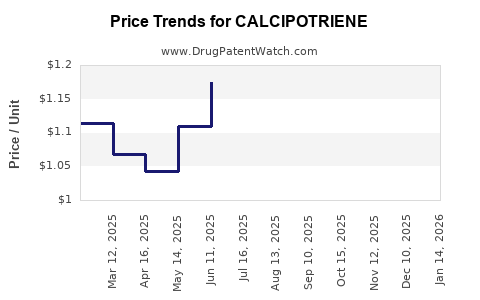
Public companies generally do not disclose calcipotriene revenue as a standalone line item. LEO Pharma reports broader product and regional sales rather than a detailed, current calcipotriene revenue series. As a result, a precise global market size or product-level revenue forecast cannot be derived from public manufacturer filings alone [3].
The commercial value is now divided between:
- Low-margin generic calcipotriene.
- Higher-priced branded foam formulations.
- Fixed-dose calcipotriene-betamethasone products.
- Licensing and manufacturing economics.
- Pharmacy benefit manager formulary positioning.
- Dermatology prescriber preference for vehicles that improve adherence.
Standalone calcipotriene is unlikely to produce material high-growth revenue without a new delivery system, nonprescription transition, combination strategy, or major geographic expansion.
What generic entry risks exist for calcipotriene?
Generic entry risk is high for standard creams, ointments, and solutions. The principal risks include:
- Price erosion after multiple ANDA approvals.
- Substitution by pharmacy benefit managers.
- Loss of branded prescription volume.
- Discontinuation of low-volume package sizes.
- Contract-manufacturing consolidation.
- Competition from other generic topical psoriasis medicines.
Risk is lower for differentiated foams and fixed-dose combinations where the reference product has distinct formulation or device attributes. The risk profile still depends on whether the generic applicant can demonstrate pharmaceutical equivalence and therapeutic equivalence, whether patents remain listed, and whether the applicant files a Paragraph IV certification.
Which companies are challenging calcipotriene patents?
There is no broad, molecule-level patent challenge comparable to the Paragraph IV activity surrounding high-revenue small molecules. The basic calcipotriene market is already genericized.
Paragraph IV risk is more relevant to branded combination and foam products. Potential challengers would typically target:
- Expiring formulation patents.
- Combination-product patents.
- Vehicle and foam patents.
- Method-of-use claims.
- Patents listed for the reference-listed drug in the Orange Book.
The absence of a prominent public litigation campaign does not eliminate patent risk. Dermatology ANDA cases may settle privately, proceed without extensive public reporting, or remain commercially immaterial.
What patent litigation and settlements affect calcipotriene?
The main litigation exposure is product-specific. Potential disputes may involve:
- Whether a generic foam infringes formulation claims.
- Whether a combination product has an enforceable patent covering the claimed ratio or vehicle.
- Whether a method-of-use patent is valid and infringed.
- Whether a Paragraph IV filing triggers a 30-month stay under the Hatch-Waxman framework.
- Whether the parties resolve the dispute through a launch-date settlement.
For standard calcipotriene cream, the legal risk is primarily ordinary generic competition rather than active patent enforcement. For branded combination products, settlement terms can materially affect launch timing, royalty economics, and expected revenue erosion.
How does calcipotriene compare with competing psoriasis drugs?
| Drug class |
Examples |
Competitive effect on calcipotriene |
| Topical corticosteroids |
Betamethasone, clobetasol, triamcinolone |
Strong efficacy and low generic prices |
| Vitamin D analogs |
Calcipotriene, calcitriol |
Direct therapeutic competition |
| PDE-4 inhibitors |
Crisaborole, roflumilast |
Nonsteroidal alternatives and vehicle differentiation |
| Topical retinoids |
Tazarotene |
Alternative mechanism for plaque psoriasis |
| Biologics |
Adalimumab, secukinumab, guselkumab and others |
Reduce demand for topical therapy in moderate-to-severe disease |
| Oral small molecules |
Apremilast and TYK2 inhibitors |
Expand systemic-treatment alternatives |
Calcipotriene remains relevant for localized plaque psoriasis and steroid-sparing regimens. It is less competitive in extensive or moderate-to-severe disease, where systemic therapies and biologics provide broader skin clearance.
What is the geographic coverage of calcipotriene?
Calcipotriene or calcipotriol is marketed in the United States, Europe, Canada, Australia, and other regulated markets. Naming conventions differ:
- United States: calcipotriene.
- Many other markets: calcipotriol.
Patent expiration and generic penetration vary by country. European markets generally have more pronounced tendering and reference-price effects, while the U.S. market is shaped by formulary rebates, specialty pharmacy distribution, and Orange Book-listed patents.
A global revenue analysis should separate the United States from Europe and emerging markets. Product approvals, reimbursement, prescription volume, and generic substitution rates are not interchangeable across regions.
How strong is the calcipotriene patent estate?
The patent estate is weak for the original active ingredient and standard formulations. It is stronger for newer delivery systems and fixed combinations, but the strength is narrow and product-dependent.
| Patent layer |
Relative strength |
| Original molecule |
Weak or expired |
| Standard cream and ointment |
Weak |
| Solution formulations |
Weak to moderate |
| Foam delivery |
Moderate |
| Calcipotriene-betamethasone combinations |
Moderate |
| Manufacturing process claims |
Variable |
| Method-of-use claims |
Variable and potentially vulnerable to validity challenges |
The strongest commercial strategy is to protect a differentiated product rather than rely on calcipotriene itself. Companies seeking licensing opportunities should prioritize proprietary vehicles, combination products, improved adherence, reduced application frequency, and manufacturing know-how.
Key Takeaways
- Calcipotriene is a mature topical psoriasis drug with extensive generic competition.
- Core molecule and standard formulation exclusivity have expired.
- Standalone cream, ointment, and solution products face high price and substitution pressure.
- Commercial value is concentrated in foams and calcipotriene-betamethasone combinations.
- No biosimilar risk exists because calcipotriene is a small molecule.
- Paragraph IV exposure is more relevant to branded foam and combination products than to basic calcipotriene.
- Public manufacturers generally do not report standalone calcipotriene revenue.
- The financial trajectory is mature to declining for generic forms and more resilient for differentiated branded formulations.
- Patent strength depends on dosage form, vehicle, combination, jurisdiction, and Orange Book listings.
- Future value creation requires formulation differentiation, licensing, or combination-product protection.
FAQs
Is calcipotriene still commercially profitable?
Generic calcipotriene can remain profitable at manufacturing scale, but standalone products generally have limited pricing power. Higher margins are more likely in branded foams and fixed-dose combinations.
Is calcipotriene the same as calcipotriol?
Yes. Calcipotriene is the U.S. name, while calcipotriol is used in many international markets.
Can generic calcipotriene replace Enstilar?
No. Generic calcipotriene does not provide the same fixed combination, vehicle, or dosage form as Enstilar. Substitution depends on the prescription, product approval, and payer rules.
Does calcipotriene have biosimilars?
No. Calcipotriene is a chemically synthesized small molecule, so competition occurs through generic drugs rather than biosimilars.
What would increase the market value of calcipotriene?
A new foam, spray, cream, combination, or delivery system could increase value if it improves adherence, tolerability, application convenience, or clinical outcomes and receives enforceable patent protection.
References
-
U.S. Food and Drug Administration. (2023). Calcipotriene topical prescribing information. FDA Drugs@FDA.
-
U.S. Food and Drug Administration. (2024). Approved drug products with therapeutic equivalence evaluations. FDA Orange Book.
-
LEO Pharma A/S. (2023). Annual report 2023. LEO Pharma.
-
U.S. Food and Drug Administration. (2023). Drugs@FDA: FDA-approved drug products. FDA.
-
U.S. Food and Drug Administration. (2024). Approved drug product label information for calcipotriene and calcipotriene-betamethasone products. FDA.