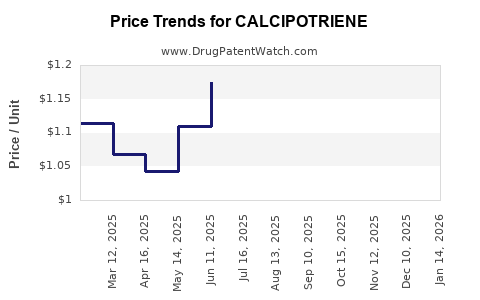
Last updated: February 20, 2026
What is Calcipotriene?
Calcipotriene (calcipotriol) is a synthetic vitamin D analog. It is primarily used to treat psoriasis vulgaris. Approved by the U.S. Food and Drug Administration (FDA) and the European Medicines Agency (EMA), it is marketed under various brand names, such as Dovonex and Daivobet.
Market Overview
Market Size
The global psoriasis treatment market, which includes calcipotriene, was valued at approximately USD 3.8 billion in 2022. Psoriasis medications account for roughly 12% of the overall dermatology market, which exceeded USD 30 billion in 2022 (MarketWatch, 2023).
Key Players
Major companies manufacturing calcipotriene include:
- Leo Pharma (Denmark): Dovonex
- Sun Pharmaceutical Industries (India): Calcipotriol topical formulations
- LEO Pharma: Daivobet (combination with corticosteroids)
Regulatory Status
Calcipotriene is approved for topical use in multiple jurisdictions, with formulations available as ointments, creams, and scalp solutions.
Competitive Landscape
| Company |
Product Names |
Formulations |
Market Share (Est.) |
Notes |
| Leo Pharma |
Dovonex |
Ointment |
40% |
First-mover advantage in several regions |
| Sun Pharma |
Calcipotriol creams |
Creams |
25% |
Expanding presence in Indian and emerging markets |
| LEO Pharma |
Daivobet (with betamethasone) |
Topical ointments and gels |
20% |
Approved for severe psoriasis |
| Others |
Various generics |
Ointments, creams |
15% |
Price-sensitive segment |
Market Dynamics & Drivers
- Rising prevalence of psoriasis globally. Estimated to affect 2-4% of the population in North America and Europe.
- Increased adoption of topical vitamin D analogs as first-line therapy.
- Growth in strategic partnerships for combination therapies.
- Patent expirations and the rise of generics, leading to price competition.
Price Trends and Forecasts
Current Pricing
| Formulation |
Price Range (USD per unit) |
Source |
Notes |
| Dovonex ointment |
USD 40-60 / 60 g tube |
Pharmacies (2022) |
Premium brand, patent expired in 2022. |
| Generic calcipotriene cream |
USD 10-25 / 60 g |
Online pharmacies |
Price competition rising; cheapest options. |
Future Price Projections (Next 5 Years)
| Scenario |
Price Range (USD / 60 g tube) |
Assumptions |
Notes |
| Conservative |
USD 15-25 |
Continued generic competition, moderate inflation |
Prices stabilize as patent losses fully impact revenues. |
| Optimistic |
USD 10-20 |
Increased demand, improved access in emerging markets |
Expansion into low-income regions with affordable formulations. |
| Pessimistic |
USD 20-30 |
Patent protections extended, supply chain disruptions persist |
Higher prices maintained in markets with brand loyalty or limited generics. |
Factors Influencing Price Trajectories
- Patent expiration timing varies across territories; many patents expired by 2022.
- Entry of generics and biosimilars drives prices downward.
- Regulatory changes can restrict or facilitate access, influencing pricing.
- Development of novel formulations (e.g., foam, spray) could command premium pricing.
Market Opportunities
- Growth in topical formulations combining calcipotriene with corticosteroids or other active ingredients.
- Expansion into emerging markets with rising psoriasis prevalence.
- Development of new delivery systems to improve patient adherence.
Key Challenges
- Price erosion due to generic competition.
- Limited pipeline innovations; most formulations are established.
- Regulatory hurdles in different jurisdictions.
Summary
The calcipotriene market is characterized by high generic penetration, leading to declining prices over the past two years. Current prices vary significantly globally, with premium brands costing USD 40-60 per 60 g tube, while generics sell for under USD 25. Price projections suggest continued downward pressure with potential stabilization in certain markets, depending on patent status and regulatory developments.
Key Takeaways
- The global psoriasis treatment market exceeds USD 3.8 billion, with calcipotriene forming a significant segment.
- Patent expirations and generics have caused prices to decline; future prices are expected to stabilize or decrease further.
- Opportunities exist in combination therapies and emerging market expansion.
- Regulatory and patent landscape will shape price trends over the next five years.
FAQs
Q1: What factors most affect calcipotriene pricing?
A: Patent status, generic market entry, regulatory environment, and formulation innovation.
Q2: In which regions is calcipotriene most widely used?
A: North America, Europe, and parts of Asia-Pacific, driven by psoriasis prevalence and healthcare access.
Q3: How much can a company expect to earn from launching new combinations?
A: Premium pricing may range from USD 50-70 per tube; market adoption depends on efficacy and safety data.
Q4: Are biosimilars a threat to calcipotriene?
A: Biosimilars are less relevant as calcipotriene is a small-molecule topical; however, new topical agents could compete.
Q5: What is the future outlook for patient access?
A: Increased availability of affordable generics should improve access, especially in emerging markets.
Sources
[1] MarketWatch. (2023). Psoriasis Market Size, Share & Trends Analysis.
[2] European Medicines Agency. (2022). Product approval documents.
[3] Bloomberg Intelligence. (2022). Dermatology therapeutics market analysis.