Last updated: September 7, 2026
Cabergoline is a mature, low-cost generic dopamine agonist used primarily to treat hyperprolactinemia. Its commercial value is driven by prescription volume, manufacturing efficiency, regional availability, and use in fertility and endocrine care rather than by patent exclusivity. The originator brand, Dostinex, no longer controls the market in the United States. No biosimilar pathway applies because cabergoline is a chemically synthesized small molecule.
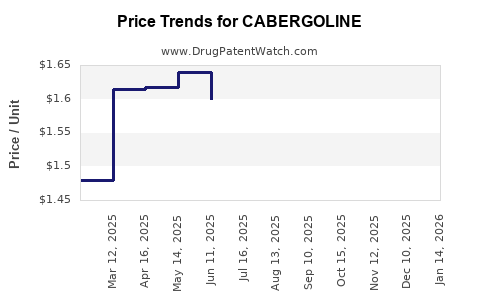
The market has moved from branded specialty medicine to fragmented generic supply. Revenue growth is unlikely to come from price expansion. The main commercial opportunities are geographic expansion, reliable supply, contract manufacturing, hospital procurement, and branded-generic positioning.
What is cabergoline and how is it used?
Cabergoline is an orally administered ergot-derived dopamine D2 receptor agonist. It suppresses prolactin secretion from the pituitary gland and is FDA-approved for the treatment of hyperprolactinemic disorders, including conditions associated with pituitary adenomas and idiopathic hyperprolactinemia.[1]
The approved U.S. dosage form is a 0.5 mg tablet. Treatment often begins at a low dose and is titrated according to serum prolactin levels and clinical response. The long half-life supports once- or twice-weekly administration, which distinguishes cabergoline from older dopamine agonists such as bromocriptine.
| Attribute |
Cabergoline |
| Active ingredient |
Cabergoline |
| Drug class |
Dopamine D2 receptor agonist |
| Primary approved use |
Hyperprolactinemic disorders |
| U.S. dosage form |
0.5 mg oral tablet |
| Original brand |
Dostinex |
| Originator |
Pharmacia, later acquired by Pfizer |
| FDA approval |
1996 |
| Product type |
Small-molecule prescription drug |
| Current market structure |
Generic and branded-generic |
| Biosimilar exposure |
None |
Cabergoline is also used in fertility medicine, gynecology, endocrinology, and selected veterinary applications. Parkinson’s disease use has historically existed in some markets, but safety concerns and the availability of newer dopamine agonists limit its role in that indication.
How large is the cabergoline market?
Cabergoline is a global niche pharmaceutical market rather than a large branded-drug category. Public companies generally do not disclose cabergoline revenue as a separate reporting line. Sales are embedded within broader generic, women’s health, endocrinology, or specialty-pharmaceutical categories.
Market value is concentrated in:
- Prescription treatment of hyperprolactinemia
- Fertility and reproductive-endocrinology care
- Endocrinology clinics
- Hospital and institutional procurement
- Regional branded-generic markets
- Veterinary use in selected countries
The U.S. market is competitive and price-sensitive. Generic cabergoline is typically dispensed through retail, specialty, and mail-order channels. Outside the United States, branded generics can retain stronger pricing, particularly where physicians prescribe by manufacturer or where local regulatory requirements limit rapid generic substitution.
What drives demand for cabergoline?
Demand is linked to diagnosis and treatment of hyperprolactinemia, pituitary microadenomas, infertility associated with elevated prolactin, and selected reproductive-health conditions. Growth is also influenced by access to endocrine testing and fertility services.
The key demand factors are:
- Increased diagnosis of pituitary disorders and endocrine infertility.
- Expansion of assisted-reproduction services.
- Greater availability of generic medicines in emerging markets.
- Physician preference for weekly dosing.
- Continued use where bromocriptine is poorly tolerated or less convenient.
The market does not have the growth profile of oncology, immunology, or diabetes products. Patient volume can increase while market revenue remains flat because generic prices decline over time.
What is the financial trajectory for cabergoline?
Cabergoline’s financial trajectory has four stages.
| Period |
Commercial profile |
Financial effect |
| 1996 to early 2000s |
Originator-led Dostinex market |
High brand pricing and strong product-level margins |
| Generic-entry period |
Multiple manufacturers enter |
Sharp price erosion and loss of exclusivity value |
| Mature generic period |
Fragmented supply and low prices |
Stable volume, low unit economics |
| Current market |
Regional branded generics and commodity supply |
Revenue depends on volume, availability, and manufacturing cost |
The originator’s revenue opportunity declined after generic competition became established. Cabergoline now produces limited direct value for multinational innovators unless sold through a branded-generic, specialty, or emerging-market portfolio.
For generic manufacturers, profitability depends on manufacturing scale and supply reliability. The product is not technically among the most complex oral dosage forms, but cabergoline is a high-potency active pharmaceutical ingredient used in small quantities. Quality control, content uniformity, impurity management, and validated analytical methods remain important production requirements.
Is cabergoline commercially attractive for generic manufacturers?
Cabergoline can be commercially attractive when a manufacturer has:
- A low-cost supply of cabergoline API
- Regulatory approvals in multiple markets
- Access to endocrinology or fertility distribution channels
- Reliable tablet manufacturing
- Low-cost packaging and logistics
- A differentiated supply position in shortage-prone markets
The product is less attractive for manufacturers seeking high absolute revenue. Low annual treatment volumes relative to common chronic medicines limit the addressable market. Competition can also be concentrated among a small number of approved suppliers, which creates supply opportunities but does not guarantee durable pricing power.
When did cabergoline lose exclusivity?
Cabergoline lost its commercially meaningful exclusivity after the expiration of the originator’s patent and regulatory protections, allowing generic manufacturers to enter the market. The original U.S. product was approved under NDA 020664.[2]
The originator patent estate is no longer a material barrier to ordinary generic entry. Current commercial competition is governed primarily by abbreviated new drug application approvals, product quality, manufacturing capacity, and distribution agreements rather than by active compound patent protection.
FDA’s Orange Book lists approved products and patent information submitted by NDA holders. For a mature product such as cabergoline, the practical question is not whether the molecule remains protected but whether any active, listed patent or regulatory exclusivity blocks a particular formulation or indication.[2]
Does cabergoline have active U.S. patent protection?
No active U.S. compound patent is generally understood to block standard generic cabergoline tablets. The relevant commercial rights associated with the original product expired before the current mature-generic phase.
Any remaining patent issue would more likely involve:
- A specific formulation
- A controlled-release delivery system
- A new combination product
- A newly approved method of use
- A manufacturing process with enforceable claims
These rights would not normally prevent approval of a conventional immediate-release cabergoline tablet unless the generic product practiced the protected claims.
What is the Orange Book status of cabergoline?
Cabergoline is an FDA-approved prescription drug listed in the Orange Book through its original NDA and approved generic products. Generic versions are generally approved through the ANDA pathway, which requires pharmaceutical equivalence and bioequivalence to the reference listed drug.[2,3]
The Orange Book is relevant for determining:
- The reference listed drug
- Approved generic products
- Listed patents submitted by the NDA holder
- Regulatory exclusivity
- Therapeutic-equivalence ratings
For a mature generic product, the Orange Book has greater value as a regulatory-status database than as evidence of a continuing commercial monopoly.
Are there Paragraph IV challenges involving cabergoline?
Paragraph IV litigation was relevant during the original generic-entry period, when applicants could challenge listed patents by asserting that the patents were invalid, unenforceable, or not infringed. The commercial significance of those disputes has declined because cabergoline is now a mature generic product with no widely recognized active patent barrier to standard tablets.
No current, material Paragraph IV dispute is broadly associated with the conventional U.S. cabergoline market. Any future Paragraph IV activity would most likely involve a new formulation, combination, or indication rather than the basic 0.5 mg tablet.
What formulations are protected by cabergoline patents?
The commercially established product is an immediate-release oral tablet. The main intellectual-property opportunity would be a product that creates a clinically meaningful or regulatory distinction, such as:
- Extended-release cabergoline
- Long-acting injectable cabergoline
- Improved dissolution or absorption
- A combination with fertility or endocrine medicines
- A formulation designed to reduce gastrointestinal effects
- A veterinary-specific dosage form
A new formulation would need to demonstrate a commercial benefit sufficient to offset development, regulatory, and market-access costs. Cabergoline’s long half-life reduces the commercial urgency for extended-release development. This limits the likely value of formulation patents unless they solve a specific adherence, tolerability, or administration problem.
What manufacturing and intellectual-property barriers affect cabergoline?
Cabergoline does not have the same manufacturing barriers as biologics, sterile injectables, or complex inhaled products. Its principal technical barriers are quality and supply related.
Important manufacturing controls include:
- API identity and purity
- Impurity and degradation-product control
- Tablet content uniformity
- Stability under approved storage conditions
- Dissolution performance
- Cross-contamination controls for a potent active ingredient
- Compliance with current good manufacturing practices
The API supply chain can be more important than formulation science. A disruption at a small number of API or finished-dose suppliers can create regional shortages, particularly where inventories are lean and demand is concentrated among fertility or endocrine clinics.
What is the FDA regulatory status of cabergoline?
The FDA approved Dostinex for hyperprolactinemic disorders in 1996. Generic cabergoline products can enter through the ANDA pathway if they meet FDA requirements for pharmaceutical equivalence, bioequivalence, manufacturing quality, labeling, and facility compliance.[1,3]
Cabergoline’s regulatory profile includes several safety considerations:
- Valvular heart disease associated with higher cumulative exposure
- Fibrotic reactions
- Orthostatic hypotension
- Nausea and other gastrointestinal effects
- Psychiatric or impulse-control effects in susceptible patients
- Drug interactions involving dopamine antagonists or blood-pressure-lowering medicines
The valvular-risk issue is commercially relevant because it can influence physician prescribing and monitoring. It also limits the attractiveness of expanded chronic-use indications.
What litigation and settlement agreements affect cabergoline?
There is no widely recognized current patent litigation or settlement agreement that materially restricts standard generic cabergoline competition in the United States.
Historical generic-entry disputes may have affected timing and launch economics, but the current market is not defined by an active litigation overhang. A new entrant would face ordinary ANDA, manufacturing, labeling, and market-access risks rather than a visible branded patent settlement barrier.
Which companies compete in the cabergoline market?
Competition is fragmented and varies by country. Pfizer is associated with the original Dostinex product, while generic cabergoline has been marketed by multiple regional and multinational manufacturers.
The competitive set can include:
- Large generic manufacturers
- Regional branded-generic companies
- Specialty women’s-health companies
- Contract manufacturers
- Local suppliers serving hospital and fertility channels
Company-level market shares are difficult to compare because product sales are often reported within larger portfolios. A manufacturer may have regulatory approval without meaningful commercial share, while a regional distributor may control local access without owning the underlying product authorization.
How does cabergoline compare with bromocriptine?
Cabergoline generally has a more convenient dosing schedule and is often better tolerated than bromocriptine in hyperprolactinemia. Bromocriptine has a longer market history and broader availability in certain regions.
| Factor |
Cabergoline |
Bromocriptine |
| Dosing convenience |
Usually once or twice weekly |
Often daily or more frequently |
| Tolerability |
Often favored in clinical practice |
Gastrointestinal effects can limit use |
| Market status |
Mature generic |
Mature generic |
| Patent barrier |
No material standard-tablet barrier |
No material standard-tablet barrier |
| Main commercial advantage |
Adherence and efficacy |
Broad historical availability |
| Main commercial risk |
Low prices and limited market size |
Strong generic substitution |
Cabergoline can maintain physician preference even after patent expiry because dosing convenience and clinical response influence prescribing. That preference supports branded-generics in some countries, but it does not create strong pricing power in highly substitutable markets.
What generic launch scenarios exist for cabergoline?
A new generic entrant would typically face three scenarios.
Low-price commodity launch
The manufacturer enters through pharmacy wholesalers and competes primarily on price. This strategy can secure volume but produces limited margins and exposes the company to rapid price erosion.
Regional branded-generic launch
The manufacturer markets cabergoline under a proprietary name through endocrinology, fertility, and gynecology channels. This strategy can support higher prices where physician loyalty and local branding matter.
Supply-reliability strategy
The manufacturer targets markets with limited approved suppliers or recurring shortages. The value proposition is consistent availability rather than the lowest price. This approach can produce stronger commercial returns if regulatory approval and distribution coverage are secure.
What is the geographic coverage of the cabergoline market?
Cabergoline is sold across North America, Europe, Latin America, Asia, and other markets through different regulatory and commercial models.
The United States is dominated by generic substitution and pharmacy pricing. Europe has extensive generic penetration, but national reimbursement systems and tender structures influence supplier economics. Emerging markets may offer stronger branded-generic pricing but carry greater risks involving reimbursement, currency, registration, distribution, and local manufacturing requirements.
Fertility markets can be commercially important because treatment is concentrated among specialist prescribers and patients may pay directly or through private insurance. Endocrine use is more dependent on public reimbursement and chronic prescription volume.
How strong is the cabergoline patent estate?
The patent estate is weak as a barrier to conventional generic entry and has limited strategic value in its expired compound form. Any meaningful future patent value would need to come from a differentiated formulation, delivery system, combination, or approved method of use.
| Patent category |
Current commercial strength |
| Original compound patent |
Expired or commercially exhausted |
| Standard immediate-release tablet |
Weak barrier |
| Method-of-use patents |
Limited unless tied to a new approved indication |
| Extended-release formulation |
Potentially meaningful if clinically differentiated |
| Injectable delivery |
Potentially meaningful but development-intensive |
| Manufacturing patents |
Narrow and product-specific |
| Combination products |
Possible but dependent on clinical and regulatory value |
What revenue exposure does cabergoline create for manufacturers?
For diversified pharmaceutical companies, cabergoline is usually a minor revenue contributor. Its financial importance is higher for small generic companies with concentrated portfolios.
Revenue exposure depends on:
- Number of approved markets
- Share of fertility and endocrine prescriptions
- API sourcing costs
- Wholesale discounts
- Reimbursement rates
- Product shortages
- Competitive supplier exits
- Regulatory compliance costs
A manufacturer with a broad generic portfolio can use cabergoline to deepen its women’s-health or endocrinology offering. A single-product company would face substantial concentration risk because a regulatory warning, manufacturing interruption, or price cut could reduce revenue quickly.
Key Takeaways
- Cabergoline is a mature generic dopamine agonist used mainly for hyperprolactinemia.
- The original Dostinex franchise no longer has meaningful exclusivity over standard cabergoline tablets.
- No biosimilar risk exists because cabergoline is a small molecule.
- Market revenue is fragmented and generally not separately disclosed by public companies.
- Volume may grow in fertility and endocrine care while total market value remains constrained by generic price erosion.
- The strongest commercial opportunities involve regional branded-generics, reliable supply, and fertility-channel distribution.
- The strongest potential future IP would cover extended-release, injectable, combination, or otherwise differentiated formulations.
- Standard generic entry is primarily an execution and supply-chain question, not a patent-litigation question.
- Cabergoline has limited strategic value for large innovators but can be material to focused generic manufacturers.
FAQs
Is cabergoline still under patent?
Standard immediate-release cabergoline tablets are not generally blocked by active compound patent protection. Current competition is primarily generic.
Is Dostinex still sold?
Dostinex may remain available in selected markets, but the U.S. market is primarily supplied by generic cabergoline products rather than an originator-led franchise.
Is cabergoline a biologic drug?
No. Cabergoline is a chemically synthesized small molecule and is regulated through the conventional pharmaceutical pathway.
Can a company obtain a new patent for cabergoline?
A company could seek patents for a novel formulation, delivery system, combination, manufacturing process, or method of use if the claims satisfy patentability requirements.
Does cabergoline have high commercial growth potential?
Its growth potential is limited in conventional tablet markets. The strongest opportunities are geographic expansion, specialist fertility distribution, branded-generics, and supply positions in markets with few reliable suppliers.
References
- U.S. Food and Drug Administration. (1996). Dostinex (cabergoline) prescribing information.
- U.S. Food and Drug Administration. (n.d.). Approved drug products with therapeutic equivalence evaluations: Orange Book.
- U.S. Food and Drug Administration. (n.d.). Abbreviated new drug application process.
- U.S. Food and Drug Administration. (n.d.). Cabergoline drug label and safety information.