Last Updated: August 9, 2026

BYDUREON BCISE Drug Patent Profile


✉ Email this page to a colleague

« Back to Dashboard


When do Bydureon Bcise patents expire, and what generic alternatives are available?

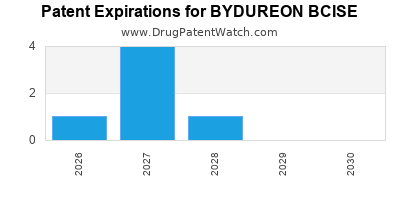
Bydureon Bcise is a drug marketed by Astrazeneca Ab and is included in one NDA. There are seven patents protecting this drug.

This drug has three hundred and thirty-nine patent family members in forty-nine countries.

The generic ingredient in BYDUREON BCISE is exenatide synthetic. There are seven drug master file entries for this compound. Two suppliers are listed for this compound. Additional details are available on the exenatide synthetic profile page.

DrugPatentWatch® Litigation and Generic Entry Outlook for Bydureon Bcise

A generic version of BYDUREON BCISE was approved as exenatide synthetic by AMNEAL on November 19th, 2024.

  Start Trial

AI Deep Research
Questions you can ask:
  • What is the 5 year forecast for BYDUREON BCISE?
  • What are the global sales for BYDUREON BCISE?
  • What is Average Wholesale Price for BYDUREON BCISE?
Summary for BYDUREON BCISE
International Patents:339
US Patents:7
Applicants:1
NDAs:1
Clinical Trials: 40
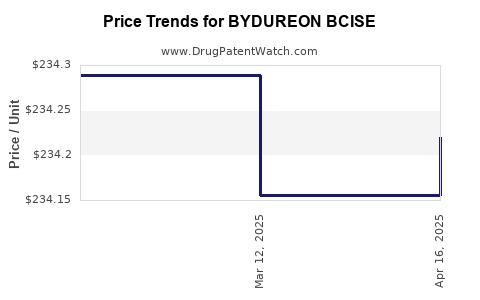
Drug Prices: Drug price information for BYDUREON BCISE
Patent Litigation and PTAB cases: See patent lawsuits and PTAB cases for BYDUREON BCISE
What excipients (inactive ingredients) are in BYDUREON BCISE?BYDUREON BCISE excipients list
DailyMed Link:BYDUREON BCISE at DailyMed
Recent Clinical Trials for BYDUREON BCISE

Identify potential brand extensions & 505(b)(2) entrants

SponsorPhase
Christopher D. VerricoPHASE1
The University of Texas Health Science Center, HoustonPhase 2
University of WashingtonPhase 3

See all BYDUREON BCISE clinical trials

US Patents and Regulatory Information for BYDUREON BCISE

BYDUREON BCISE is protected by seven US patents.

Applicant Tradename Generic Name Dosage NDA Approval Date TE Type RLD RS Patent No. Patent Expiration Product Substance Delist Req. Exclusivity Expiration
Astrazeneca Ab BYDUREON BCISE exenatide synthetic SUSPENSION, EXTENDED RELEASE;SUBCUTANEOUS 209210-001 Oct 20, 2017 DISCN Yes No 8,906,851*PED ⤷  Start Trial Y ⤷  Start Trial
Astrazeneca Ab BYDUREON BCISE exenatide synthetic SUSPENSION, EXTENDED RELEASE;SUBCUTANEOUS 209210-001 Oct 20, 2017 DISCN Yes No 8,361,972*PED ⤷  Start Trial Y ⤷  Start Trial
Astrazeneca Ab BYDUREON BCISE exenatide synthetic SUSPENSION, EXTENDED RELEASE;SUBCUTANEOUS 209210-001 Oct 20, 2017 DISCN Yes No 9,884,092*PED ⤷  Start Trial Y ⤷  Start Trial
>Applicant >Tradename >Generic Name >Dosage >NDA >Approval Date >TE >Type >RLD >RS >Patent No. >Patent Expiration >Product >Substance >Delist Req. >Exclusivity Expiration

Expired US Patents for BYDUREON BCISE

Applicant Tradename Generic Name Dosage NDA Approval Date Patent No. Patent Expiration
Astrazeneca Ab BYDUREON BCISE exenatide synthetic SUSPENSION, EXTENDED RELEASE;SUBCUTANEOUS 209210-001 Oct 20, 2017 6,956,026 ⤷  Start Trial
Astrazeneca Ab BYDUREON BCISE exenatide synthetic SUSPENSION, EXTENDED RELEASE;SUBCUTANEOUS 209210-001 Oct 20, 2017 6,414,126 ⤷  Start Trial
Astrazeneca Ab BYDUREON BCISE exenatide synthetic SUSPENSION, EXTENDED RELEASE;SUBCUTANEOUS 209210-001 Oct 20, 2017 6,667,061 ⤷  Start Trial
>Applicant >Tradename >Generic Name >Dosage >NDA >Approval Date >Patent No. >Patent Expiration

International Patents for BYDUREON BCISE

When does loss-of-exclusivity occur for BYDUREON BCISE?

Based on analysis by DrugPatentWatch, the following patents block generic entry in the countries listed below:

Australia

Patent: 09289529
Patent: Sustained release formulations using non-aqueous carriers
Estimated Expiration: ⤷  Start Trial

Brazil

Patent: 0918904
Patent: formulações de liberação sustentada usando carreadores não aquosos
Estimated Expiration: ⤷  Start Trial

Canada

Patent: 34525
Patent: FORMULATIONS A LIBERATION PROLONGEE A BASE DE SUPPORTS NON AQUEUX (SUSTAINED RELEASE FORMULATIONS USING NON-AQUEOUS CARRIERS)
Estimated Expiration: ⤷  Start Trial

China

Patent: 2164597
Patent: Sustained release formulations using non-aqueous carriers
Estimated Expiration: ⤷  Start Trial

Patent: 4248623
Patent: 使用非水性载体的持续释放制剂 (Sustained release formulations using non-aqueous carriers)
Estimated Expiration: ⤷  Start Trial

Croatia

Patent: 0201179
Estimated Expiration: ⤷  Start Trial

Cyprus

Patent: 23410
Estimated Expiration: ⤷  Start Trial

Denmark

Patent: 41905
Estimated Expiration: ⤷  Start Trial

Eurasian Patent Organization

Patent: 0299
Patent: СОСТАВЫ С ЗАМЕДЛЕННЫМ ВЫСВОБОЖДЕНИЕМ, ПОЛУЧЕННЫЕ С ПРИМЕНЕНИЕМ НЕВОДНЫХ НОСИТЕЛЕЙ (SUSTAINED RELEASE FORMULATIONS USING NON-AQUEOUS CARRIERS)
Estimated Expiration: ⤷  Start Trial

Patent: 1170413
Patent: СОСТАВЫ С ЗАМЕДЛЕННЫМ ВЫСВОБОЖДЕНИЕМ, ПОЛУЧЕННЫЕ С ПРИМЕНЕНИЕМ НЕВОДНЫХ НОСИТЕЛЕЙ (SUSTAINED RELEASE FORMULATIONS USING NON-AQUEOUS CARRIERS)
Estimated Expiration: ⤷  Start Trial

European Patent Office

Patent: 41905
Patent: FORMULATIONS À LIBÉRATION PROLONGÉE À BASE DE SUPPORTS NON AQUEUX (SUSTAINED RELEASE FORMULATIONS USING NON-AQUEOUS CARRIERS)
Estimated Expiration: ⤷  Start Trial

Patent: 85837
Patent: FORMULATIONS À LIBÉRATION PROLONGÉE À BASE DE SUPPORTS NON AQUEUX (SUSTAINED RELEASE FORMULATIONS USING NON-AQUEOUS CARRIERS)
Estimated Expiration: ⤷  Start Trial

Finland

Patent: 41905
Estimated Expiration: ⤷  Start Trial

Hungary

Patent: 50125
Estimated Expiration: ⤷  Start Trial

Israel

Patent: 1231
Patent: הרכבים בעלי שחרור מושהה עם נשאים שאינם מימיים (Sustained release formulations using non-aqueous carriers)
Estimated Expiration: ⤷  Start Trial

Japan

Patent: 44735
Estimated Expiration: ⤷  Start Trial

Patent: 51243
Estimated Expiration: ⤷  Start Trial

Patent: 12502056
Patent: 非水性担体を用いた徐放性製剤
Estimated Expiration: ⤷  Start Trial

Patent: 15110637
Patent: 非水性担体を用いた徐放性製剤 (SUSTAINED RELEASE FORMULATION USING NON-AQUEOUS CARRIER)
Estimated Expiration: ⤷  Start Trial

Lithuania

Patent: 41905
Estimated Expiration: ⤷  Start Trial

Mexico

Patent: 2189
Patent: FORMULACIONES DE LIBERACION SOSTENIDA USANDO PORTADORES NO ACUOSOS. (SUSTAINED RELEASE FORMULATIONS USING NON-AQUEOUS CARRIERS.)
Estimated Expiration: ⤷  Start Trial

Patent: 11002398
Patent: FORMULACIONES DE LIBERACION SOSTENIDA USANDO PORTADORES NO ACUOSOS. (SUSTAINED RELEASE FORMULATIONS USING NON-AQUEOUS CARRIERS.)
Estimated Expiration: ⤷  Start Trial

New Zealand

Patent: 4997
Patent: Sustained release formulations using non-aqueous carriers
Estimated Expiration: ⤷  Start Trial

Poland

Patent: 41905
Estimated Expiration: ⤷  Start Trial

Portugal

Patent: 41905
Estimated Expiration: ⤷  Start Trial

San Marino

Patent: 02000405
Estimated Expiration: ⤷  Start Trial

Singapore

Patent: 201703039S
Patent: SUSTAINED RELEASE FORMULATIONS USING NON-AQUEOUS CARRIERS
Estimated Expiration: ⤷  Start Trial

Slovenia

Patent: 41905
Estimated Expiration: ⤷  Start Trial

South Korea

Patent: 1760953
Estimated Expiration: ⤷  Start Trial

Patent: 110050540
Patent: 비-수성 담체를 이용한 서방성 제형물 (SUSTAINED RELEASE FORMULATIONS USING NON-AQUEOUS CARRIERS)
Estimated Expiration: ⤷  Start Trial

Spain

Patent: 09178
Estimated Expiration: ⤷  Start Trial

Generics may enter earlier, or later, based on new patent filings, patent extensions, patent invalidation, early generic licensing, generic entry preferences, and other factors.

See the table below for additional patents covering BYDUREON BCISE around the world.

Country Patent Number Title Estimated Expiration
Argentina 026024 COMPUESTOS INHIBIDORES SGLT2 DE GLUCOSIDOS DE C-ARILO Y METODO, LAS COMPOSICIONES FARAMCEUTICAS QUE LOS CONTIENEN Y LOS INTERMEDIARIOS DE SINTESIS DEDICHOS COMPUESTOS ⤷  Start Trial
Argentina 040032 C-ARIL-GLUCOSIDOS COMO INHIBIDORES DE SGLT2 Y METODO ⤷  Start Trial
Austria 295848 ⤷  Start Trial
>Country >Patent Number >Title >Estimated Expiration

Supplementary Protection Certificates for BYDUREON BCISE

Patent Number Supplementary Protection Certificate SPC Country SPC Expiration SPC Description
1506211 C300585 Netherlands ⤷  Start Trial PRODUCT NAME: DAPAGLIFLOZINE, DESGEWENST IN DE VORM VAN EEN FARMACEUTISCH AANVAARDBAAR ZOUT; REGISTRATION NO/DATE: EU/1/12/795/001-010 20121112
1506211 PA2013008 Lithuania ⤷  Start Trial PRODUCT NAME: DAPAGLIFLOZINUM; REGISTRATION NO/DATE: EU/1/12/795/001 - EU/1/12/795/010 20121112
1506211 122013000033 Germany ⤷  Start Trial PRODUCT NAME: DAPAGLIFLOZIN UND PHARMAZEUTISCH VERTRAEGLICHE SALZE DAVON; REGISTRATION NO/DATE: EU/1/12/795/001-010 20121112
>Patent Number >Supplementary Protection Certificate >SPC Country >SPC Expiration >SPC Description

BYDUREON BCISE Market Dynamics and Financial Trajectory (2019-2026): Pricing Pressure, Supply Chain Shifts, and Exclusivity-Driven Risk

Last updated: July 13, 2026

BYDUREON BCISE (exenatide extended-release; once-weekly injectable) has operated in a structurally shrinking GLP-1/insulin-adjacent pocket as prescribers shifted toward newer GLP-1 receptor agonists and combination products. Commercial performance has been constrained by competitive substitution, payor-led formulary steering, and a growing mismatch between the product’s incremental value narrative and the market’s efficacy and weight-loss expectations. Financial trajectory has therefore followed a typical mature-and-displaced specialty pattern: revenue base erosion, inventory and channel volatility around transitions, and limited upside from label expansion versus broader class competition.

What are the key market dynamics affecting BYDUREON BCISE demand?

Answer: BYDUREON BCISE demand is driven by (1) competitive substitution within GLP-1 therapies, (2) payor tiering and prior authorization criteria, (3) patient adherence to once-weekly injections, and (4) channel inventory management during supply and manufacturing events. Its commercial life-cycle is also influenced by the product’s relatively older positioning versus newer GLP-1s with stronger weight-loss outcomes and broader cardiovascular and renal risk narratives.

How has competition from newer GLP-1s changed utilization patterns?

The largest demand headwind is market switching to high-efficacy GLP-1 receptor agonists and GLP-1–based combinations that dominate new starts.

  • New starts migration: Clinicians and payors increasingly prioritize agents with demonstrated weight-loss magnitude and expanded cardiorenal outcomes, which lowers willingness to initiate exenatide ER in treatment-naïve or intensification settings.
  • Formulary steering: Many commercial formularies have tiered newer GLP-1s ahead of older incretin therapies, reducing net pricing and access for exenatide ER.

Practical implication: BYDUREON BCISE’s growth is capped even when overall GLP-1 volumes grow, because the incremental share shifts to newer agents.

What payor behaviors matter most for BYDUREON BCISE?

Answer: Coverage restrictions and tier placement determine net realizations and persistence more than gross list pricing.

Key payor levers:

  • Prior authorization (PA): PA criteria often require trial of preferred GLP-1 options.
  • Step therapy: Plans steer toward newer products, making BYDUREON BCISE access harder for new users.
  • Indication framing: Net coverage may tighten around glycemic control only, reducing the attractiveness when weight and cardiovascular risk are key decision points.

How do adherence and delivery device characteristics shape pull-through?

Answer: Once-weekly administration supports adherence relative to daily regimens, but device familiarity and injection experience still influence switching.

  • BYDUREON BCISE’s “BCise” autoinjector platform is designed for convenience versus older exenatide ER kit formats.
  • Still, patients and prescribers can switch between GLP-1 devices when payors drive selection.

What supply chain and channel dynamics influence near-term revenue?

Answer: Exenatide ER specialty products face channel inventory and reimbursement timing effects. Any manufacturing disruptions can create short-term “buy ahead” behavior, then a correction that compresses reported revenue.

Commercial dynamics observed across mature injectables:

  • Distributor ordering can lead to temporary revenue spikes followed by catch-down.
  • Net sales timing varies with chargeback and rebate cycles.

What is the financial trajectory of BYDUREON BCISE over time?

Answer: BYDUREON BCISE shows the typical pattern of a mature specialty injectable: steady baseline revenue offset by gradual erosion from competitive substitution. Revenue growth has been limited, and the major financial drivers are net pricing pressure and share loss.

What revenue components have the biggest impact?

Net sales for specialty injectables are usually dominated by:

  • Gross-to-net contraction: rebates, chargebacks, and wholesaler incentives.
  • Mix shift: higher volumes in lower-priced channels reduce net realizations.
  • Accrual volatility: changes in rebate/discount program terms can swing quarterly results.

How should investors and operators model the trajectory?

A high-signal operating model for BYDUREON BCISE should treat:

  • Volume: as primarily share-and-access driven, not category-driven.
  • Pricing: as mostly payor-negotiated, with list price acting as a weak leading indicator.
  • Market growth: GLP-1 expansion does not translate linearly into exenatide ER share.

Bottom line: the revenue base is most sensitive to formulary decisions and preferred-product adoption rates.

When does BYDUREON BCISE lose exclusivity, and how does that affect financial risk?

Answer: BYDUREON BCISE’s competitive risk is not limited to legal exclusivity. In practice, the strongest driver of financial trajectory is the market’s substitution to newer therapies, with exclusivity acting as a secondary constraint on generic pressure.

What does “exclusivity” mean for this product’s economics?

For mature injectables, financial risk typically arrives in two waves:

  1. Clinical substitution risk (earlier, often faster): prescribers and payors move to superior products before generics emerge.
  2. Supply and IP risk (later, sometimes still material): once relevant exclusivities and patents expire, generic or “authorized” competition can compress pricing if not already offset by channel substitution.

How to interpret exclusivity risk for BYDUREON BCISE specifically?

  • BYDUREON BCISE’s GLP-1 class competition is active and persistent.
  • Even without generic entry, payor dynamics and therapeutic switching can reduce demand.

Result: financial trajectory is typically determined more by market displacement than by the timing of the final exclusivity barrier.

What competitive landscape surrounds BYDUREON BCISE?

Answer: The competitive set is broader than “other exenatide ER products.” It is the preferred GLP-1 and GLP-1-combination landscape on formularies.

Which substitutes most directly affect prescribing choices?

Primary competitors by payer preference and new start capture:

  • Newer GLP-1 receptor agonists with stronger weight loss positioning.
  • GLP-1–based combinations that simplify intensification.
  • Oral or injection alternatives depending on plan design and patient factors.

How does BYDUREON BCISE compare on market “selection criteria”?

In formulary decisions, plans tend to weight:

  • Expected weight-loss outcomes
  • Persistence and tolerability profile
  • Cardiorenal outcome evidence
  • Administrative and cost controls (PA, step edits)

BYDUREON BCISE’s older positioning can reduce its ability to win these criteria against newer entrants.

What generic entry risks exist for BYDUREON BCISE?

Answer: Generic entry is a pricing shock risk, but its incremental financial impact may be reduced if the product is already losing share to newer GLP-1 therapies.

What would a generic launch do to BYDUREON BCISE economics?

If generic competition occurs:

  • List price is less relevant than the collapse in net price during competitive rebate redesign.
  • Rebate pressure increases: payors leverage the new lower-cost option in contract negotiations.
  • Market share erosion accelerates: switching to generics can occur, but payor preference may already be anchored on other GLP-1s.

What matters most for timing and magnitude?

  • The presence of interchangeable products and the ability of payors to switch patients.
  • Patent and exclusivity constraints for specific strengths and delivery formats.
  • Launch execution, including supply capacity and distribution agreements.

What is the FDA and regulatory posture that shapes market access?

Answer: FDA labeling and safety/tolerability positioning determine whether payors expand use or restrict it. For injectables, real-world access is usually driven by formulary policy and reimbursement rules more than by FDA changes.

What label attributes influence uptake?

Key uptake influences for exenatide ER products usually include:

  • Place in therapy for glycemic control in relevant populations
  • Tolerability considerations (gastrointestinal effects)
  • Use restrictions based on patient comorbidities and contraindications

How does regulatory posture interact with payor behavior?

  • Even when labeling supports broad use, payors can constrain access with PA and step edits.
  • Conversely, favorable label updates alone do not overcome entrenched formulary preferences.

What patent and licensing dynamics matter for the financial trajectory?

Answer: Patent estate strength shapes generic timing, but the dominant business driver remains therapeutic displacement by newer GLP-1s. Licensing activity can matter if it supports lifecycle extension, authorized supply, or device/formulation differentiation.

How does an older GLP-1 lifecycle typically evolve?

For established incretin injectables:

  • Device and formulation patents can provide incremental protection.
  • Method-of-use claims can delay narrow generic or biosimilar-like substitution for specific clinical niches, though the practical impact is often modest versus competitive switching.

How should business stakeholders interpret BYDUREON BCISE’s outlook for 2025-2027?

Answer: The near-term path is best characterized as continued decline or stagnation in share, with financial performance driven by (1) net pricing compression, (2) inventory and contracting cycles, and (3) ongoing formulary preference for newer GLP-1 therapies. Upside is limited unless a payer or clinical shift creates incremental demand for older exenatide ER positioning.

Key forward-looking drivers:

  • Contract renegotiations and rebate resets
  • Preferred GLP-1 consolidation on formularies
  • Any supply events that temporarily alter channel ordering
  • Any entry of lower-cost competitive options (generic or authorized)

Key Metrics Dashboard (operating indicators to track)

Category Indicator Why it predicts revenue trajectory
Pricing Net-to-gross ratio Rebates and chargebacks drive gross-to-net contraction
Access PA approval rates Determines persistence and new scripts
Share Prescriptions vs category Shows displacement by preferred GLP-1s
Channel Wholesaler inventory trends Explains quarter-to-quarter revenue timing swings
Supply Manufacturing or shipment events Can create buy-ahead then normalization
Mix Strength and channel mix Alters net realizations and rebate burden

Key Takeaways

  • BYDUREON BCISE’s financial trajectory is dominated by competitive substitution within GLP-1 formularies, not by classic exclusivity-led runway.
  • Net pricing and access constraints via PA and step therapy are the principal levers affecting gross-to-net and volume.
  • Supply chain and channel inventory management can create short-term volatility but does not change the underlying share erosion trend.
  • Generic-entry risk is a pricing shock scenario, but its incremental magnitude may be muted if therapeutic displacement has already reduced the addressable base.
  • The product’s 2025-2027 outlook is best modeled as mature specialty decline with periodic quarter effects from contracting and inventory.

FAQs

1) How does BYDUREON BCISE net pricing typically evolve versus other GLP-1 injections?

Net pricing usually declines with increasing formulary pressure, rebate resets, and growth of lower-cost substitutes, even when gross list price changes are limited.

2) What drives patient persistence for once-weekly exenatide ER?

Persistence is driven by tolerability, ease of device use, and continued payer coverage without restrictive PA or step edits.

3) Does category growth in GLP-1 therapies help BYDUREON BCISE volume?

Category growth can lift class totals, but BYDUREON BCISE often captures limited incremental share because payors steer new starts toward preferred newer GLP-1 products.

4) What risks are most material to investors in BYDUREON BCISE royalties or supply deals?

The highest-impact risks are formulary contract resets, accelerated share loss to preferred agents, and any competitive entry that forces rebate redesign.

5) How should manufacturers plan production and inventory for a declining GLP-1 asset?

Production planning should prioritize demand visibility, distributor inventory targets, and contract cycle timing to avoid revenue volatility from buy-ahead and subsequent normalization.

References

  1. FDA. Orange Book: Approved Drug Products with Therapeutic Equivalence Evaluations. U.S. Food and Drug Administration.
  2. FDA. Drugs@FDA. U.S. Food and Drug Administration.
  3. FDA. Prescribing Information for BYDUREON BCISE (exenatide extended-release). U.S. Food and Drug Administration.

More… ↓

⤷  Start Trial

Make Better Decisions: Try a trial or see plans & pricing

Drugs may be covered by multiple patents or regulatory protections. All trademarks and applicant names are the property of their respective owners or licensors. Although great care is taken in the proper and correct provision of this service, thinkBiotech LLC does not accept any responsibility for possible consequences of errors or omissions in the provided data. The data presented herein is for information purposes only. There is no warranty that the data contained herein is error free. We do not provide individual investment advice. This service is not registered with any financial regulatory agency. The information we publish is educational only and based on our opinions plus our models. By using DrugPatentWatch you acknowledge that we do not provide personalized recommendations or advice. thinkBiotech performs no independent verification of facts as provided by public sources nor are attempts made to provide legal or investing advice. Any reliance on data provided herein is done solely at the discretion of the user. Users of this service are advised to seek professional advice and independent confirmation before considering acting on any of the provided information. thinkBiotech LLC reserves the right to amend, extend or withdraw any part or all of the offered service without notice.