Last Updated: August 9, 2026

BYDUREON Drug Patent Profile


✉ Email this page to a colleague

« Back to Dashboard


When do Bydureon patents expire, and what generic alternatives are available?

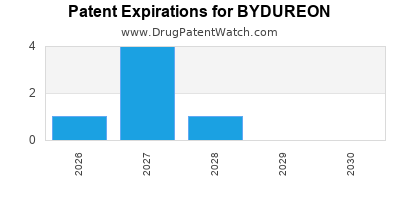
Bydureon is a drug marketed by Astrazeneca Ab and is included in two NDAs. There are seven patents protecting this drug.

This drug has three hundred and seven patent family members in forty-eight countries.

The generic ingredient in BYDUREON is exenatide synthetic. There are seven drug master file entries for this compound. Two suppliers are listed for this compound. Additional details are available on the exenatide synthetic profile page.

DrugPatentWatch® Litigation and Generic Entry Outlook for Bydureon

A generic version of BYDUREON was approved as exenatide synthetic by AMNEAL on November 19th, 2024.

  Start Trial

AI Deep Research
Questions you can ask:
  • What is the 5 year forecast for BYDUREON?
  • What are the global sales for BYDUREON?
  • What is Average Wholesale Price for BYDUREON?
Summary for BYDUREON
Recent Clinical Trials for BYDUREON

Identify potential brand extensions & 505(b)(2) entrants

SponsorPhase
Christopher D. VerricoPHASE1
The University of Texas Health Science Center, HoustonPhase 2
University of WashingtonPhase 3

See all BYDUREON clinical trials

US Patents and Regulatory Information for BYDUREON

BYDUREON is protected by six US patents.

Applicant Tradename Generic Name Dosage NDA Approval Date TE Type RLD RS Patent No. Patent Expiration Product Substance Delist Req. Exclusivity Expiration
Astrazeneca Ab BYDUREON exenatide synthetic FOR SUSPENSION, EXTENDED RELEASE;SUBCUTANEOUS 022200-001 Jan 27, 2012 DISCN Yes No ⤷  Start Trial ⤷  Start Trial Y ⤷  Start Trial
Astrazeneca Ab BYDUREON PEN exenatide synthetic FOR SUSPENSION, EXTENDED RELEASE;SUBCUTANEOUS 022200-002 Feb 28, 2014 DISCN Yes No ⤷  Start Trial ⤷  Start Trial Y ⤷  Start Trial
Astrazeneca Ab BYDUREON BCISE exenatide synthetic SUSPENSION, EXTENDED RELEASE;SUBCUTANEOUS 209210-001 Oct 20, 2017 DISCN Yes No ⤷  Start Trial ⤷  Start Trial Y ⤷  Start Trial
Astrazeneca Ab BYDUREON exenatide synthetic FOR SUSPENSION, EXTENDED RELEASE;SUBCUTANEOUS 022200-001 Jan 27, 2012 DISCN Yes No ⤷  Start Trial ⤷  Start Trial Y ⤷  Start Trial
Astrazeneca Ab BYDUREON BCISE exenatide synthetic SUSPENSION, EXTENDED RELEASE;SUBCUTANEOUS 209210-001 Oct 20, 2017 DISCN Yes No ⤷  Start Trial ⤷  Start Trial Y ⤷  Start Trial
Astrazeneca Ab BYDUREON PEN exenatide synthetic FOR SUSPENSION, EXTENDED RELEASE;SUBCUTANEOUS 022200-002 Feb 28, 2014 DISCN Yes No ⤷  Start Trial ⤷  Start Trial Y ⤷  Start Trial
>Applicant >Tradename >Generic Name >Dosage >NDA >Approval Date >TE >Type >RLD >RS >Patent No. >Patent Expiration >Product >Substance >Delist Req. >Exclusivity Expiration

Expired US Patents for BYDUREON

Applicant Tradename Generic Name Dosage NDA Approval Date Patent No. Patent Expiration
Astrazeneca Ab BYDUREON exenatide synthetic FOR SUSPENSION, EXTENDED RELEASE;SUBCUTANEOUS 022200-001 Jan 27, 2012 ⤷  Start Trial ⤷  Start Trial
>Applicant >Tradename >Generic Name >Dosage >NDA >Approval Date >Patent No. >Patent Expiration

International Patents for BYDUREON

When does loss-of-exclusivity occur for BYDUREON?

Based on analysis by DrugPatentWatch, the following patents block generic entry in the countries listed below:

Canada

Patent: 53344
Estimated Expiration: ⤷  Start Trial

Chile

Patent: 07001915
Estimated Expiration: ⤷  Start Trial

Denmark

Patent: 69374
Estimated Expiration: ⤷  Start Trial

European Patent Office

Patent: 57918
Estimated Expiration: ⤷  Start Trial

Japan

Patent: 19059779
Estimated Expiration: ⤷  Start Trial

Mexico

Patent: 7155
Estimated Expiration: ⤷  Start Trial

Patent: 08015377
Estimated Expiration: ⤷  Start Trial

Serbia

Patent: 638
Patent: KRISTALNI SOLVATI DERIVATA (1S)-1,5-ANHIDRO-1-C-(3-((FENIL) METIL) FENIL)-D-GLUCITOLA SA ALKOHOLIMA KAO INHIBITORI SGLT2 ZA TRETMAN DIJABETESA (CRYSTALLINE SOLVATES OF (1S)-1,5-ANHYDRO-1-C-(3-((PHENYL) METHYL) PHENYL)-D-GLUCITOL DERIVATIVES WITH ALCOHOLS AS SGLT2 INHIBITORS FOR THE TREATMENT OF DIABETES)
Estimated Expiration: ⤷  Start Trial

Slovenia

Patent: 69374
Estimated Expiration: ⤷  Start Trial

Taiwan

Patent: 1406743
Patent: Crystal structures of SGLT2 inhibitors and processes for preparing same
Estimated Expiration: ⤷  Start Trial

Patent: 1546054
Patent: Crystal structures of SGLT2 inhibitors and processes for preparing same
Estimated Expiration: ⤷  Start Trial

Generics may enter earlier, or later, based on new patent filings, patent extensions, patent invalidation, early generic licensing, generic entry preferences, and other factors.

See the table below for additional patents covering BYDUREON around the world.

Country Patent Number Title Estimated Expiration
Argentina 026024 COMPUESTOS INHIBIDORES SGLT2 DE GLUCOSIDOS DE C-ARILO Y METODO, LAS COMPOSICIONES FARAMCEUTICAS QUE LOS CONTIENEN Y LOS INTERMEDIARIOS DE SINTESIS DEDICHOS COMPUESTOS ⤷  Start Trial
Argentina 040032 C-ARIL-GLUCOSIDOS COMO INHIBIDORES DE SGLT2 Y METODO ⤷  Start Trial
Austria 295848 ⤷  Start Trial
Austria 353334 ⤷  Start Trial
Australia 2003237886 C-ARYL GLUCOSIDE SGLT2 INHIBITORS AND METHOD ⤷  Start Trial
Australia 781009 ⤷  Start Trial
Australia 7848300 C-aryl glucoside sglt2 inhibitors ⤷  Start Trial
>Country >Patent Number >Title >Estimated Expiration

Supplementary Protection Certificates for BYDUREON

Patent Number Supplementary Protection Certificate SPC Country SPC Expiration SPC Description
1506211 C300585 Netherlands ⤷  Start Trial PRODUCT NAME: DAPAGLIFLOZINE, DESGEWENST IN DE VORM VAN EEN FARMACEUTISCH AANVAARDBAAR ZOUT; REGISTRATION NO/DATE: EU/1/12/795/001-010 20121112
1506211 PA2013008 Lithuania ⤷  Start Trial PRODUCT NAME: DAPAGLIFLOZINUM; REGISTRATION NO/DATE: EU/1/12/795/001 - EU/1/12/795/010 20121112
1506211 122013000033 Germany ⤷  Start Trial PRODUCT NAME: DAPAGLIFLOZIN UND PHARMAZEUTISCH VERTRAEGLICHE SALZE DAVON; REGISTRATION NO/DATE: EU/1/12/795/001-010 20121112
1506211 C20130006 00074 Estonia ⤷  Start Trial PRODUCT NAME: DAPAGLIFLOZIN;REG NO/DATE: K(2012)8378 12.11.2012
1506211 92182 Luxembourg ⤷  Start Trial PRODUCT NAME: DAPAGLIFLOZINE ET SES SELS PHARMACEUTIQUEMENT ACCEPTABLES
1506211 2013/013 Ireland ⤷  Start Trial PRODUCT NAME: DAPAGLIFLOZIN AND PHARACEUTICALLY ACCEPTABLE SALTS THREOF; REGISTRATION NO/DATE: EU/1/12/795/001-010 20121112
1506211 CA 2013 00019 Denmark ⤷  Start Trial
>Patent Number >Supplementary Protection Certificate >SPC Country >SPC Expiration >SPC Description
Last updated: July 20, 2026

BYDUREON market dynamics and financial trajectory: sales trends, payer pressure, and exclusivity-driven erosion

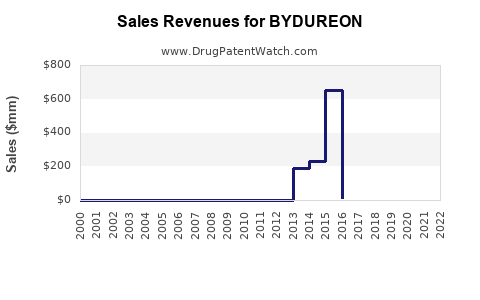
BYDUREON (exenatide extended-release; Amylin/BMS; marketed by AstraZeneca in the US and other regions historically via licensing) has faced a sustained share shift from injectable GLP-1 receptor agonists with better dosing convenience and broader formularies. The product’s revenue path has been dominated by (1) competitive displacement from once-weekly and once-daily GLP-1s and (2) later-cycle pressure from payer preferred-drug lists and step-edit rules, with a further risk profile tied to long-term exclusivity and competitive entry of other exenatide ER products and GLP-1 alternatives. Overall, BYDUREON’s commercial trajectory is best characterized as mature-product decline rather than growth, with periodic re-framing around formulary position, device experience, and co-pay support where available.


What is the BYDUREON revenue history and why did sales decline?

How BYDUREON sold in practice: label breadth vs competitive convenience

BYDUREON’s core value proposition was glucose control and weight benefit in type 2 diabetes as an injectable GLP-1 class therapy with once-weekly administration. In the market, that value narrowed as competitors raised the bar on:

  • Injection frequency consistency and pen usability
  • Hemoglobin A1c reduction depth
  • Cardiovascular and kidney outcome evidence across major GLP-1 players
  • Lower real-world patient friction driven by smaller devices, improved injection experience, and automated dosing workflows
  • Payer-managed access via preferred tiers and restrictive prior authorization

Key drivers of erosion

  1. Formulary steering to newer GLP-1s
    Payer formularies progressively favored agents with stronger outcomes evidence and preferred positioning. BYDUREON’s exenatide ER profile became harder to justify as payers shifted coverage toward agents with broader guideline alignment and market “standard-of-care” momentum.

  2. Device and adherence friction
    BYDUREON’s reconstitution-era delivery approach historically underperformed patient and prescriber expectations versus pen-based alternatives. Device usability became a differentiator in switching decisions, especially when payers required trial of preferred agents.

  3. Class competition intensified
    The GLP-1 market moved from early adoption into crowded lanes: multiple once-weekly GLP-1s, then dual and triple incretin combinations later. In that environment, BYDUREON’s incremental differentiation eroded.

  4. Discounting and co-pay dynamics
    Mature injectable diabetes brands often rely on net price management and payer contracting to preserve access. Over time, increased competitive intensity tends to compress net sales even when gross prescriptions remain stable.


Which competitors most impacted BYDUREON market share and net price?

Class-wide displacement: newer GLP-1s and incretin combinations

BYDUREON’s displacement risk increased as these categories gained preferred access in commercial formularies and Medicare Part D:

  • Once-weekly GLP-1 receptor agonists (dose convenience and preferred tier positioning)
  • Oral GLP-1 and other diabetes agents where payers broadened options
  • Later-cycle incretin combinations and product line expansions that offered stronger value propositions for outcomes and weight management

Switching dynamics: what moved patients

Real-world switching typically followed a predictable pattern:

  • Patients started on preferred products after initial diagnosis
  • Existing BYDUREON users were nudged by prior authorization and formulary changes
  • Pharmacy benefit managers pushed step edits requiring trial of preferred GLP-1s before coverage of BYDUREON

Net pricing pressure

When BI and PBMs require formulary compliance, net pricing becomes less controllable. BYDUREON’s financial trajectory reflects the typical mature-diabetes injectable pattern: higher rebates and contracting costs to retain access, then net price compression as preferred options dominate.


What payer and reimbursement dynamics shaped BYDUREON’s commercial trajectory?

Commercial and Medicare access

  • Commercial formularies: BYDUREON faced tier movement and step therapy as other GLP-1s took preferred slots.
  • Medicare Part D: Plan formularies and utilization management moved patients toward better-covered GLP-1s, with BYDUREON coverage increasingly contingent on prior authorization or documented failure of preferred alternatives.

Prior authorization and step edits

Payer policies commonly applied:

  • Step therapy (trial/failure of preferred GLP-1)
  • Prior authorization tied to diagnosis documentation and sometimes A1c or weight-related criteria
  • Quantity or days-supply edits based on dose scheduling norms

Impact on prescribing

The prescribing impact was not just clinical. It was procedural:

  • Longer approvals reduced “new start” velocity
  • Switching required administrative steps and clinical justifications
  • Formularies created a predictable switching cycle after each annual bid cycle and formulary refresh

When did BYDUREON lose exclusivity, and how does exclusivity erosion affect pricing?

How exclusivity loss typically transmits into sales decline

Exclusivity erosion in injectable diabetes brands tends to accelerate:

  • Loss of formulary priority
  • Higher price competition through authorized generics or follow-on branded products with aggressive contracting
  • Reduction in co-pay support effectiveness because patients and prescribers migrate toward covered options

What matters for BYDUREON-specific economics

For mature injectables, the biggest financial impact is rarely the first legal threat alone. It is the months-to-year period after when payers redesign formularies around competitive availability and when PBM contracting shifts net prices.


What does the BYDUREON US market look like under FDA and Orange Book status?

Orange Book listings drive timing for generic and follow-on competition

The Orange Book status shapes the “event horizon” for potential ANDA entry under Hatch-Waxman. For BYDUREON, the market dynamic is consistent with mature GLP-1 injectables where:

  • Patent estates and exclusivity determine whether generic entry is allowed immediately
  • Court outcomes and settlement terms control effective launch timing
  • Even where generic entry is blocked for a period, payer behavior begins “front-running” competitive risk by moving to alternative covered options earlier

Net market effect

If competitive entry is anticipated, PBMs often shift preferencing before the first AB-rated product appears. That shortens the remaining commercial runway even before legal barriers fall.


How does BYDUREON compare with competing exenatide formulations and GLP-1 delivery systems?

Comparison by dosing and device

In the GLP-1 injectable market, device and patient workflow matter as much as molecule:

  • Pen systems increase usability and reduce injection preparation time.
  • Reduced patient friction improves persistence and improves payer willingness to keep coverage.

Exenatide ER positioning risk

Even within the exenatide category, follow-on formulations and competitor pens can shift patients away from BYDUREON if they offer:

  • Better handling
  • Similar efficacy with improved user experience
  • Better contracting terms that lower PBM net cost

Commercial result

BYDUREON’s competitive position weakened as the market shifted toward more streamlined injection platforms and broad outcomes evidence.


What product life-cycle metrics matter for BYDUREON investors and licensors?

The financial indicators to track

  1. TRx and script share trends: class share growth in preferred products correlates with BYDUREON decline.
  2. Net price and rebate rate movement: net sales compression often shows before unit declines in late lifecycle.
  3. Formulary position: preferred vs non-preferred status is a leading indicator.
  4. Utilization management tightness: prior authorization and step edits increase as competitors become available.
  5. Switching rate: the longer patients remain on treatment, the slower erosion proceeds.

Revenue shape typical for mature GLP-1 injectables

  • Peak years followed by gradual TRx decline
  • Net sales remaining higher temporarily due to contract structure
  • Faster deterioration when payers force switches or when new injectables replace older devices in formulary

What patent and litigation events typically affect BYDUREON’s competitive timeline?

How patent estates influence launch calendars

For branded GLP-1 injectables, the typical chain is:

  • ANDA or follow-on product filings under relevant exclusivity and patent listings
  • Paragraph IV litigation that delays FDA approval and/or commercial entry
  • Settlement agreements that define launch dates or “design-around” use

Financial transmission

Even without generic entry, the market reacts to legal timelines:

  • PBMs reduce formulary reliance on brands with delayed but likely competition
  • Contracting shifts toward alternatives
  • Sales force pressure increases, raising SG&A and reducing ROI

What are the generic entry risks for BYDUREON, and what does “launch risk” mean financially?

Launch risk definition used in pricing and forecasting

In mature branded injectables, launch risk means:

  • PBM re-contracting and formulary redesign
  • Patient switching acceleration after competitive availability is credible
  • Co-pay program modification and net price reset

Financial consequence

The biggest negative variance usually shows around the period when coverage changes align with competitive entry. That typically yields:

  • Sudden prescription loss
  • Rapid shift in channel inventory dynamics for injectables
  • Higher discounting to preserve remaining coverage

What regional dynamics and geographic coverage issues matter for BYDUREON?

US versus international

Commercial performance differs by region due to:

  • National reimbursement systems
  • Formulary structures
  • Competition intensity and device adoption curves
  • Local patent status and follow-on product presence

Global competition for GLP-1 therapy

International markets increasingly mirror the US pattern:

  • Preferencing shifts toward newer and better-covered agents
  • Tender systems and national price negotiations compress branded net revenue
  • Older devices lose access as pen-based competitors dominate

Key Takeaways

  • BYDUREON’s financial trajectory is consistent with a mature GLP-1 injectable: steady erosion driven by payer preferencing, prior authorization/step edits, and competitive convenience and evidence advantages.
  • The core market dynamic is not only molecule competition but also formulary positioning and device-driven switching behavior.
  • Exclusivity and patent/settlement calendars matter because payers typically adjust coverage ahead of effective entry, accelerating net sales pressure.
  • For forecasting and investment decisions, the most decision-relevant signals are TRx share in the broader GLP-1 class, net price/rebate compression, and formulary status changes, which usually lead unit erosion.

FAQs

1. Does BYDUREON face higher access barriers than newer once-weekly GLP-1s?

Yes, as payers tightened step therapy and prior authorization toward preferred alternatives with improved formulary position and patient-handling profiles.

2. How do rebates and net price typically change for BYDUREON in late lifecycle?

Net price usually declines as competitive contracting increases, with rebates rising to preserve coverage as preferred brands dominate.

3. Will biosimilar-style dynamics affect BYDUREON?

BYDUREON is not a biologic in the biosimilar sense used for mAbs; competition risk is primarily generic/follow-on and class competition.

4. What is the fastest leading indicator that BYDUREON’s sales will worsen?

A shift of national and plan formularies from preferred to non-preferred with added step edits usually precedes measurable prescription declines.

5. How should licensors model BYDUREON remaining commercial runway?

Model it around payer coverage trajectories and the effective competitive entry window driven by patent status and settlement timing rather than only FDA-level approvals.


References

  1. FDA Orange Book: Approved Drug Products with Therapeutic Equivalence Evaluations. U.S. Food and Drug Administration.
  2. FDA Drug Approval Package for BYDUREON (exenatide extended-release), including labeling and regulatory history. U.S. Food and Drug Administration.

More… ↓

⤷  Start Trial

Make Better Decisions: Try a trial or see plans & pricing

Drugs may be covered by multiple patents or regulatory protections. All trademarks and applicant names are the property of their respective owners or licensors. Although great care is taken in the proper and correct provision of this service, thinkBiotech LLC does not accept any responsibility for possible consequences of errors or omissions in the provided data. The data presented herein is for information purposes only. There is no warranty that the data contained herein is error free. We do not provide individual investment advice. This service is not registered with any financial regulatory agency. The information we publish is educational only and based on our opinions plus our models. By using DrugPatentWatch you acknowledge that we do not provide personalized recommendations or advice. thinkBiotech performs no independent verification of facts as provided by public sources nor are attempts made to provide legal or investing advice. Any reliance on data provided herein is done solely at the discretion of the user. Users of this service are advised to seek professional advice and independent confirmation before considering acting on any of the provided information. thinkBiotech LLC reserves the right to amend, extend or withdraw any part or all of the offered service without notice.