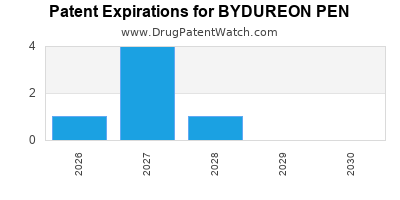
Last updated: August 15, 2026
Bydureon Pen, including Bydureon BCise, is an extended-release formulation of exenatide for Type 2 diabetes. Its commercial position has deteriorated sharply as semaglutide, tirzepatide, dulaglutide, insulin analogs, and lower-cost GLP-1 therapies displaced exenatide. AstraZeneca no longer treats Bydureon as a growth product, and the U.S. product has faced commercial withdrawal and limited availability. No FDA-approved generic or biosimilar equivalent has replaced the pen, but the product has limited remaining strategic value because of weak demand, device complexity, and intense GLP-1 competition.
What is Bydureon Pen and how does it compare with Bydureon BCise?
Bydureon Pen is a once-weekly exenatide extended-release injection. Bydureon BCise is the later single-dose autoinjector presentation developed to improve administration compared with the original reconstitution-based Bydureon pen.
| Product |
Active ingredient |
Administration |
FDA milestone |
Commercial position |
| Byetta |
Immediate-release exenatide |
Twice daily |
2005 |
Mature, declining |
| Bydureon |
Exenatide extended release |
Once weekly |
2012 |
Legacy product |
| Bydureon BCise |
Exenatide extended release |
Once weekly autoinjector |
2017 |
Later device version, limited commercial momentum |
| Trulicity |
Dulaglutide |
Once weekly |
2014 |
Major branded competitor |
| Ozempic |
Semaglutide |
Once weekly |
2017 |
Major growth product |
| Mounjaro |
Tirzepatide |
Once weekly |
2022 |
Rapidly expanding competitor |
The product’s pharmacology is based on exenatide, a GLP-1 receptor agonist. Bydureon uses microsphere-based extended release, allowing weekly dosing. Its principal clinical disadvantages are gastrointestinal adverse effects, less favorable efficacy than newer GLP-1 and dual GIP/GLP-1 therapies, and a more complicated delivery system than modern prefilled pens.
What is the FDA regulatory status of Bydureon Pen?
Bydureon received FDA approval in January 2012. Bydureon BCise received FDA approval in October 2017 as a once-weekly extended-release exenatide suspension in a single-dose autoinjector.[1][2]
The FDA label includes use as an adjunct to diet and exercise for adults with Type 2 diabetes. Bydureon is not indicated for Type 1 diabetes or diabetic ketoacidosis. Important label restrictions include:
- Boxed warning for thyroid C-cell tumors based on rodent findings.
- Contraindication in patients with a personal or family history of medullary thyroid carcinoma or MEN 2.
- Warning for pancreatitis.
- Risk of hypoglycemia when used with insulin or insulin secretagogues.
- Gastrointestinal adverse effects and renal impairment concerns.
- Not recommended as a first-line treatment for patients inadequately controlled on diet and exercise.
The FDA’s approval of newer GLP-1 products changed the therapeutic and commercial benchmark. Semaglutide and tirzepatide have demonstrated greater weight-loss and glycemic benefits in broad clinical use, while Bydureon’s once-weekly administration no longer provides sufficient differentiation.
When did Bydureon lose market exclusivity?
Bydureon’s core market exclusivity has expired. The relevant exclusivity periods were tied to the original exenatide active ingredient and subsequent clinical or formulation approvals, not to an indefinite monopoly over the Bydureon brand or device.
Byetta was approved in 2005 and established exenatide as a mature small-molecule peptide drug. Bydureon’s 2012 approval provided regulatory protection for the approved formulation and clinical data, but it did not create a new long-term exclusivity period comparable to biologic reference-product exclusivity. Bydureon BCise was approved through a supplemental application and did not reset the underlying exenatide exclusivity clock.
The practical result is that the core drug and much of the formulation estate are old. Commercial barriers now depend more on product complexity, manufacturing know-how, device engineering, and the economics of launching a low-volume injectable product than on strong remaining exclusivity.
What patents protect Bydureon Pen?
Bydureon historically relied on patents covering exenatide formulations, sustained-release microspheres, manufacturing processes, and delivery devices. Patent protection has been materially weakened by expiry of early exenatide and extended-release formulation patents.
The most relevant patent categories are:
| Patent category |
Protected subject matter |
Current strategic value |
| Active-ingredient patents |
Exenatide molecule and sequence |
Expired or commercially exhausted |
| Extended-release patents |
PLGA microspheres and controlled release |
Mainly expired or approaching the end of meaningful enforceability |
| Manufacturing patents |
Encapsulation, particle size, drug loading, and release profile |
Potentially relevant for process replication |
| Device patents |
Pen or autoinjector structure and dose delivery |
Limited value if the branded device is withdrawn |
| Method-of-use patents |
Treatment of Type 2 diabetes with exenatide |
Narrow and commercially weak after broad exenatide use became established |
The FDA Orange Book remains the primary source for patents listed against approved Bydureon presentations. Orange Book listings must be evaluated by product presentation because the original Bydureon suspension and Bydureon BCise autoinjector are not identical products.[3]
Patent strength is best characterized as moderate for manufacturing replication but weak for long-term market exclusion. A competitor would face technical development work to reproduce the extended-release microsphere profile and device, yet those barriers do not support premium pricing in a category dominated by higher-performing products.
Are there Paragraph IV challenges to Bydureon?
Publicly visible patent litigation and Paragraph IV activity against Bydureon has been limited compared with major products such as Victoza, Trulicity, Ozempic, and Mounjaro.
The main reasons are commercial:
- Exenatide has substantially lower demand than newer GLP-1 products.
- A generic applicant would need to develop a complex injectable suspension and delivery system.
- The addressable market is declining.
- Payers have stronger incentives to prefer lower-cost alternatives or higher-efficacy GLP-1 products.
- A Paragraph IV launch would carry development and litigation costs against a shrinking branded franchise.
There is no widely established FDA-approved generic Bydureon Pen or Bydureon BCise equivalent. A future applicant could pursue an abbreviated pathway if FDA requirements for the relevant presentation are met, but the regulatory pathway would be more difficult than for a conventional oral tablet.
What formulation patents protect the Bydureon delivery system?
The Bydureon formulation uses biodegradable microspheres designed to release exenatide over approximately one week. The technical barriers include:
- Polymer composition and molecular weight.
- Drug loading and encapsulation efficiency.
- Particle size distribution.
- Initial burst release.
- Long-term release kinetics.
- Suspension stability after reconstitution.
- Syringe, pen, or autoinjector compatibility.
- Sterility and container-closure performance.
These characteristics can create meaningful product-development risk even after patent expiry. FDA approval would require evidence that the competing product delivers comparable exenatide exposure and maintains acceptable quality across manufacturing batches.
The Bydureon BCise device reduces preparation steps compared with the earlier formulation but creates a separate device and combination-product assessment. A competing company could avoid some device patents through a different injector design, but it would still need to demonstrate accurate dose delivery and stable suspension performance.
What is the Orange Book status of Bydureon?
Bydureon and Bydureon BCise have been listed in the FDA Orange Book as prescription drug products with associated patent and exclusivity information. The commercial relevance of those listings has declined as the principal exclusivity periods ended and U.S. demand contracted.
An Orange Book listing does not guarantee continued commercial protection. The key questions are whether:
- A listed patent remains unexpired.
- The patent claims the proposed generic presentation.
- The patent is enforceable.
- A generic applicant files a Paragraph IV certification.
- The branded product remains commercially attractive enough to defend.
For Bydureon, the last question is decisive. A theoretical patent dispute is less valuable when the branded product has lost formulary position and prescriber demand.
How has Bydureon revenue changed over time?
AstraZeneca’s financial disclosures show a declining diabetes portfolio as competition intensified and the company shifted capital toward oncology, respiratory medicines, cardiovascular therapies, and newer pipeline assets. Bydureon sales were not consistently reported as a standalone financial line in later disclosures, which limits precise product-level revenue analysis.[4]
The financial trajectory can be summarized as follows:
| Period |
Financial direction |
Main drivers |
| 2012-2015 |
Expansion |
Weekly dosing and limited GLP-1 competition |
| 2016-2018 |
Plateau to decline |
Trulicity and other weekly GLP-1 products gained share |
| 2019-2020 |
Accelerating pressure |
Ozempic, payer controls, and U.S. pricing pressure |
| 2021-2023 |
Mature or declining |
Semaglutide and tirzepatide reshaped the category |
| 2024 onward |
Low strategic priority |
Commercial availability and demand weakened |
Bydureon was once a meaningful contributor to AstraZeneca’s diabetes business, but it became a declining legacy product. Revenue exposure is now concentrated in residual prescriptions, selected international markets, and patients who remain stable on exenatide.
The product’s gross-to-net economics also deteriorated. Rebates and formulary concessions became necessary to defend share against Trulicity and Ozempic. Those concessions reduced net price while higher manufacturing complexity limited the ability to compete with low-cost generic or older diabetes therapies.
Which companies are challenging Bydureon commercially?
Bydureon’s principal competitors are not generic manufacturers. They are branded incretin therapies with stronger efficacy, simpler administration, or broader commercial support.
| Competitor |
Company |
Competitive advantage |
| Trulicity |
Eli Lilly |
Established weekly GLP-1 franchise and broad payer access |
| Ozempic |
Novo Nordisk |
Strong efficacy, cardiovascular-outcomes positioning, and brand demand |
| Rybelsus |
Novo Nordisk |
Oral semaglutide option |
| Victoza |
Novo Nordisk |
Established liraglutide franchise and generic erosion risk |
| Mounjaro |
Eli Lilly |
Dual GIP/GLP-1 mechanism and high metabolic efficacy |
| Wegovy |
Novo Nordisk |
Obesity indication and major demand expansion |
| Generic metformin and sulfonylureas |
Multiple companies |
Low cost and established reimbursement |
| Insulin products |
Multiple companies |
Broad clinical use and payer familiarity |
The greatest competitive threat is tirzepatide, followed by semaglutide. Both products support higher willingness to switch among physicians and patients, especially where weight reduction is a treatment objective.
What generic launch risks exist for Bydureon Pen?
A generic or follow-on exenatide extended-release product would face lower patent risk than technical and commercial risk.
Regulatory risk
The applicant would need to satisfy FDA requirements for a complex injectable suspension. Demonstrating pharmaceutical equivalence may require more than matching the active ingredient and dosage strength. Device performance, suspension characteristics, release profile, and immunogenicity-related considerations can complicate approval.
Manufacturing risk
The manufacturing process is more difficult than conventional liquid injectables. Minor changes in polymer composition or microsphere morphology can alter exposure and tolerability. Scale-up, sterile processing, and batch consistency would require substantial investment.
Commercial risk
A generic entrant would enter a shrinking market dominated by therapies with better efficacy and stronger patient demand. A lower price could generate volume, but payer coverage may still favor alternative GLP-1 products with stronger clinical and commercial positioning.
Launch timing
The most plausible launch scenario is a low-price, limited-share product targeting patients for whom exenatide remains clinically acceptable or for whom formulary economics favor the older agent. A large branded-style launch is unlikely to be rational.
What is the litigation and settlement status for Bydureon?
Bydureon has not generated the level of high-value patent litigation associated with blockbuster GLP-1 products. No major settlement has created a widely recognized authorized-generic or licensed follow-on launch for Bydureon in the United States.
The absence of prominent litigation reflects the franchise’s economics. AstraZeneca and successor commercial stakeholders have less incentive to spend heavily defending a product with declining revenue and limited future growth. Any remaining disputes are more likely to concern individual formulation, device, manufacturing, or market-access issues than a broad exclusivity battle.
Is Bydureon Pen still commercially viable?
Bydureon Pen is commercially viable only as a declining legacy product. It has limited capacity to regain share because:
- Exenatide is less effective for weight loss than semaglutide and tirzepatide.
- The once-weekly advantage is no longer distinctive.
- The device and reconstitution requirements are less competitive.
- Payers increasingly manage GLP-1 use through prior authorization and preferred-product tiers.
- The franchise lacks the growth profile required to support substantial promotional spending.
The product could retain niche value in markets where price, local regulatory access, or physician familiarity supports continued use. Its strategic value is materially lower in the United States.
How does Bydureon compare with newer GLP-1 drugs?
| Attribute |
Bydureon |
Ozempic |
Trulicity |
Mounjaro |
| Mechanism |
GLP-1 agonist |
GLP-1 agonist |
GLP-1 agonist |
GIP/GLP-1 agonist |
| Dosing |
Weekly |
Weekly |
Weekly |
Weekly |
| Delivery |
Extended-release suspension/autoinjector |
Prefilled pen |
Prefilled pen |
Prefilled pen |
| Weight-loss profile |
Modest |
Stronger |
Moderate |
Strongest among listed diabetes products in major studies |
| Commercial momentum |
Declining |
Strong |
Established |
Rapid growth |
| Patent and exclusivity value |
Mature |
High |
High but declining over time |
High |
| Generic or biosimilar pressure |
Low current competition, but technical barriers |
Limited near-term risk |
Limited near-term risk |
Limited near-term risk |
Bydureon’s principal remaining advantage is familiarity and established weekly dosing. That advantage is insufficient against products with stronger efficacy, broader indications, and greater promotional support.
Key Takeaways
- Bydureon Pen is a legacy exenatide extended-release product with declining commercial relevance.
- Bydureon BCise was the principal later-generation autoinjector presentation.
- Core exenatide and early formulation exclusivity have expired or lost practical commercial force.
- No FDA-approved generic or biosimilar Bydureon equivalent has achieved broad U.S. market entry.
- Formulation and device manufacturing remain technical barriers, but they are not strong enough to support durable premium pricing.
- AstraZeneca’s reported financial disclosures do not consistently provide standalone current Bydureon revenue.
- The product’s revenue trajectory moved from growth after launch to decline as Trulicity, Ozempic, and Mounjaro gained share.
- Commercial withdrawal, limited availability, and weak demand reduce the value of further branded investment.
- Generic entry would face more commercial risk than patent risk.
- Bydureon’s remaining value is concentrated in residual patients, selected geographies, and price-sensitive formularies.
FAQs About Bydureon Pen
Is Bydureon Pen discontinued in the United States?
U.S. availability has been materially reduced, and Bydureon has become a low-priority legacy product. Product availability can differ by presentation, distributor, and market.
Can patients switch from Bydureon to Ozempic?
Physicians may consider a switch, but dosing, tolerability, renal status, glycemic control, insurance coverage, and treatment goals must be assessed. The products are not dose-equivalent.
Does Bydureon have a biosimilar pathway?
No. Exenatide is a peptide drug rather than a biologic reference product handled through the traditional biosimilar pathway. A follow-on product would need to satisfy the applicable FDA abbreviated or full approval requirements for the complex injectable formulation.
Why has no major generic company launched Bydureon?
The product requires complex microsphere manufacturing, device development, sterile production, and clinical or comparative evidence. The declining market makes that investment less attractive than developing simpler generic products or entering higher-growth GLP-1 categories.
What is the largest business risk associated with Bydureon?
The largest risk is market obsolescence rather than a single patent event. Newer GLP-1 and GIP/GLP-1 drugs have reduced Bydureon’s clinical differentiation, pricing power, formulary access, and revenue potential.
References
- U.S. Food and Drug Administration. (2012). BYDUREON- exenatide injection, extended release prescribing information.
- U.S. Food and Drug Administration. (2017). BYDUREON BCISE- exenatide injection, extended release prescribing information.
- U.S. Food and Drug Administration. (2024). Approved drug products with therapeutic equivalence evaluations: Orange Book.
- AstraZeneca PLC. (2015-2023). Annual reports and financial statements.
- U.S. Food and Drug Administration. (2024). Drugs@FDA: FDA-approved drugs database.