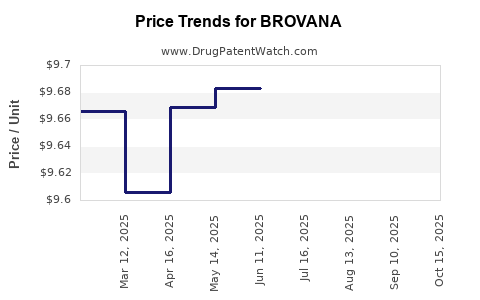
Last updated: June 23, 2026
BROVANA (arformoterol) is an inhaled long-acting beta2-agonist (LABA) delivered as a nebulized solution for maintenance treatment of bronchospasm associated with COPD. The commercial trajectory is shaped by (1) post-LOE pricing pressure across respiratory inhalation generics, (2) the limited scope of high-value COPD biologics in this segment, (3) formulary migration tied to reimbursement, and (4) the presence or absence of competitive “AB-rated” nebulized arformoterol offerings in the U.S. market.
Bottom line: BROVANA’s long-run revenue outlook is dominated by the pace of generic and authorized-competitive entry for nebulized arformoterol, the sustainability of payer coverage for COPD maintenance nebulized LABAs, and the ability of the incumbent to defend pricing and channel share after exclusivity milestones.
What drives BROVANA (arformoterol) market dynamics in US COPD treatment?
Key demand drivers
- COPD prevalence and treatment algorithm: LABA-containing maintenance regimens remain core for symptom reduction and exacerbation reduction in COPD. Nebulized LABAs capture patients who cannot use hand-held inhalers or who are managed in settings favoring nebulization.
- Patient-device fit: BROVANA’s nebulized format supports continuity for patients switching between inhaler and nebulizer regimens due to technique barriers, coordination limitations, or clinician preference.
- Payer adjudication: COPD maintenance products are judged primarily on formulary positioning, utilization management (prior authorization or step edits), and relative cost per day.
Key supply and channel drivers
- Generic competition in nebulized LABA space: Revenue growth or decline tracks the breadth of generic nebulized arformoterol availability. Even where active ingredient is the same, differences in packaging, concentration, volume fill, and National Drug Code (NDC) coverage can affect substitution speed.
- Wholesaler and institutional contracting: Competitive bids for long-term care facilities and hospital outpatient programs can accelerate unit conversion away from branded-only contracts.
Formulary and reimbursement sensitivity
- COPD maintenance drugs face periodic formulary resets; BROVANA’s performance depends on whether it holds a preferred or non-preferred tier status.
- Net price is the dominant financial KPI, influenced by rebates and chargebacks tied to coverage outcomes.
When does BROVANA lose exclusivity, and what does that mean for pricing?
Exclusivity timing affects two different horizons
- Patent exclusivity/marketing exclusivity drives “branded-only” duration.
- Actual competitive switching depends on generic availability, pricing, and payer substitution rules.
For BROVANA, the practical pricing pressure begins when:
- an approved generic or authorized generic is fully launched and stocked,
- payers implement automatic substitution where allowed or tighten prior authorization,
- contracting shifts to lowest net cost per day.
Featured-snippet answer: Once exclusivity barriers fall and nebulized arformoterol substitutes reach broad plan coverage, BROVANA’s net price tends to compress and volume growth usually cannot fully offset margin loss.
What Orange Book status applies to BROVANA, and how does it shape generic entry risk?
Orange Book listings typically identify:
- Active ingredient(s) and dosage form
- Approved drug product exclusivity
- Patent numbers covering the product, including composition, formulation, or method-of-use
How it shapes risk
- Patents that cover formulation and manufacturing/impurities can delay “same-label” substitutes even after composition-level freedom.
- Patents that cover method-of-use can create barriers if generics pursue different labeling or require carve-outs.
Business read-through: Generic entry risk increases materially when BROVANA Orange Book barriers are limited to narrow claims with predictable design-around paths.
Which companies compete with BROVANA (arformoterol) and how do their offerings compare?
Competitive set (US COPD maintenance, nebulized LABA)
- Direct active-ingredient substitutes: nebulized arformoterol products that are AB-rated equivalents by active ingredient, strength, dosage form, and labeling.
- Therapeutic alternatives (device class competition): inhaled LABAs and LAMA/LABA fixed-dose combinations, even when they are not nebulized, because payers can steer patients into preferred inhaler regimens if technique permits.
- Adjunct COPD therapies: inhaled corticosteroid/LABA products and LAMA combinations compete for maintenance adherence and formulary share, especially when net cost becomes more favorable.
Commercial comparison points that matter
- NDC coverage and plan formularies: the market moves toward whoever has the cleanest payer match.
- Institutional contracts: hospital and long-term care procurement can shift quickly after availability.
- Clinical positioning: nebulized LABA is a niche within COPD maintenance, so competitive outcomes depend on the size of the “nebulizer-appropriate” subgroup.
How many patents protect BROVANA and where are the strongest barriers?
Barrier typology
- Composition-of-matter patents for arformoterol (highest-level protection historically).
- Formulation and delivery patents for nebulized solutions (often include stabilizers, pH, viscosity, or particle/solubility parameters).
- Manufacturing process and impurity profile patents (can be harder to design around).
- Method-of-use patents tied to COPD maintenance dosing regimens.
Business answer: The strongest practical barriers are usually those that control the approved product characteristics most relevant to substitution, labeling, and manufacturing reproducibility for a nebulized solution. If those patents expire later than composition coverage, generic entry can be delayed even when active ingredient freedom is available.
What patent litigation affects BROVANA, including Paragraph IV challenges?
Litigation categories that impact deal timing
- Hatch-Waxman Paragraph IV ANDA litigation: can trigger stay periods, settlement agreements, and entry timing changes.
- Infringement suits covering nebulized formulation and method-of-use claims: can limit launch designs to “non-infringing” labels or dosing schedules.
Financial transmission mechanism
- Litigation can delay generic launch and preserve price and market share.
- Settlements can set a defined “first generic” date that overrides patent clock uncertainty.
What settlement agreements and launch dates matter most for BROVANA’s financial forecast?
When there is litigation under Hatch-Waxman, the key elements for financial planning are:
- Effective settlement date
- Agreed entry date for generic nebulized arformoterol
- Scope of launch (label, strength, packaging, distribution channel)
- Any non-explicit covenants that limit “carve-out” claims and delay broader commercialization
Business model impact
- A settlement-based entry date compresses the incumbent’s remaining revenue runway into a predictable decline curve.
- It also sets underwriting parameters for expected unit conversion after launch.
How does BROVANA compare with other COPD maintenance drugs on revenue exposure?
Relative revenue exposure drivers
- Nebulized niche concentration: BROVANA’s revenue is concentrated in a specific delivery channel. That can reduce competitive spread from inhaler-only generics but increases susceptibility to direct nebulized substitutes.
- Substitution flexibility: COPD therapy is highly interchangeable across LABA/LAMA/LABA regimens. If payers prefer inhalers, BROVANA can face substitution even if direct arformoterol nebulized competition is limited.
- Net price vulnerability: respiratory generics and authorized multisource products typically pressure net pricing through rebates and contracting.
Practical comparison
- BROVANA’s financial exposure is higher when:
- payers move toward lowest net cost COPD maintenance,
- nebulized arformoterol generics are launched with broad coverage,
- institutional substitution policies favor generics quickly.
- Exposure lowers when:
- nebulizer-appropriate patient share is protected in formularies,
- branded rebates keep BROVANA on preferred tiers,
- competing inhaler options have higher prior authorization friction.
What formulation and device constraints limit generic entry for BROVANA?
Nebulized solutions face technical constraints that often translate into legal and regulatory hurdles:
- Solution stability and viscosity: ensures consistent nebulization performance and reproducible dose delivery.
- pH and excipient system: affects tolerability and shelf stability.
- Nebulizer compatibility: product performance can vary by nebulizer system; label requirements can indirectly constrain substitutions.
- Manufacturing controls: impurity profile and sterility assurance for solution products can complicate generic development timelines.
Business read-through: For nebulized solutions, “easy substitution” depends on whether a generic can meet both the regulatory requirements and the real-world dose delivery expectations that maintain labeling parity.
What is the likely trajectory of BROVANA revenue post-LOE?
Typical post-LOE pattern for a branded niche respiratory maintenance drug
- Phase 1: pre-entry
- Stabilization with some volume erosion from switching and stocking shifts.
- Phase 2: entry and payer adoption
- Rapid net price compression from formulary repositioning and generic rebate dynamics.
- Phase 3: consolidation
- Market settles with a dominant generic or small group of multisource products.
- Branded revenue typically declines with residual share tied to patient-specific factors and institutional contracts.
Key financial metrics to track
- Net sales by quarter and trend in utilization units (vials, treatments)
- Average selling price and net price per day of therapy
- Share changes in COPD maintenance nebulized category
- Contract losses in institutional settings
What FDA regulatory pathway outcomes influence BROVANA competition?
Regulatory outcomes that affect market entry
- ANDA approvals for generic arformoterol nebulized solutions
- Label parity around dosing frequency and COPD indication
- Bioequivalence acceptance for the nebulized solution product
Commercial effect
- FDA approval alone is not sufficient; reimbursement acceptance and distributor stocking determine whether products capture share quickly.
- If multiple ANDAs launch, the pricing floor usually declines with greater competitive intensity.
What generic entry risks exist for BROVANA by geography?
US-centric risk
- BROVANA’s strongest commercial risk is US generic entry because the U.S. sets the largest patent and reimbursement-driven revenue ceiling.
International nuance
- Outside the U.S., the pace of generic entry depends on local regulatory timelines and patent enforcement.
- Many companies execute global launches on staggered schedules, which can create temporary regional outperformance for the branded product.
How strong is the patent estate for BROVANA as a commercial defense?
Patent strength, translated to commercial defense
- Broader, later-expiring claim sets increase time-to-launch and preserve net price.
- Narrow claim scopes increase odds of early design-around or successful invalidity/ non-infringement positions.
- Multiple independent barriers increase the likelihood that at least one patent blocks clean entry.
Financial implication: Stronger estate typically delays the onset of generic-driven net price compression and extends the period where branded rebates can maintain preferred coverage.
Key Takeaways
- BROVANA’s financial trajectory is mainly determined by post-exclusivity generic substitution in nebulized arformoterol and payer/formulary switching in COPD maintenance.
- The market structure is shaped by the nebulized delivery niche, which can slow therapeutic substitution but concentrates risk on direct nebulized arformoterol competitors.
- The revenue runway depends on the Orange Book barrier set (composition vs formulation vs method-of-use) and any Paragraph IV litigation or settlements that set entry dates.
- Post-LOE revenue generally shifts from volume-led growth to a net price compression dynamic until the market settles into a stable multisource environment.
- The forecast should be underwritten on quarterly net sales, net price per treatment, and institutional contract loss rates, not just regulatory milestones.
FAQs
1) What happens to BROVANA net price when generic nebulized arformoterol launches?
Net price typically compresses quickly due to rebate and contracting repricing, with branded residual share largely protected by patient-specific nebulizer suitability and plan-specific formulary exceptions.
2) Are inhaler LABA/LAMA combinations a substitute threat to BROVANA even without direct nebulized arformoterol competition?
Yes. Payers can steer to preferred inhaler-based COPD maintenance regimens, increasing branded loss even when direct generics are delayed.
3) What kinds of patents most often delay nebulized solution generics?
Formulation and manufacturing/purity control patents that affect product characteristics and regulatory acceptance for nebulized delivery.
4) Does FDA approval automatically guarantee market share for generic BROVANA equivalents?
No. Stocking, contracting, and reimbursement coverage determine speed and depth of uptake.
5) How should investors model the revenue decline shape after BROVANA exclusivity ends?
Use a two-step curve: initial volume erosion and rebate pressure before entry, then steeper decline around generic launch and payer adoption, followed by a slower residual-share decline.
References (APA)
- FDA. Orange Book: Approved Drug Products with Therapeutic Equivalence Evaluations. U.S. Food and Drug Administration.
- FDA. Abbreviated New Drug Applications (ANDA). U.S. Food and Drug Administration.
- Hatch-Waxman Act (Drug Price Competition and Patent Term Restoration Act of 1984). Pub. L. No. 98-417.