Last updated: February 13, 2026
What is BROVANA and its market context?
Brovana is the inhaled form of arformoterol, a long-acting beta-agonist (LABA) indicated for maintenance treatment of bronchoconstriction related to chronic obstructive pulmonary disease (COPD). It was approved by the FDA in 2009.
The global COPD drug market was valued at approximately USD 17 billion in 2022 and projected to grow at a compound annual growth rate (CAGR) of around 4.3% through 2030. BROVANA occupies a niche among long-acting bronchodilators, competing with drugs like Advair, Spiriva, and Symbicort.
How does BROVANA compare to competing therapies?
BROVANA's key competitors include:
- Fluticasone/Salmeterol (Advair)
- Tiotropium (Spiriva)
- Budesonide/Formoterol (Symbicort)
While these drugs offer similar benefits, BROVANA’s unique mechanism as a pure beta-agonist positions it for patients intolerant to corticosteroids.
Market share for BROVANA remains limited relative to inhaled steroids and combination therapies, holding about 4-6% of the COPD inhaler market as of 2022, according to IQVIA data.
What are the current pricing strategies?
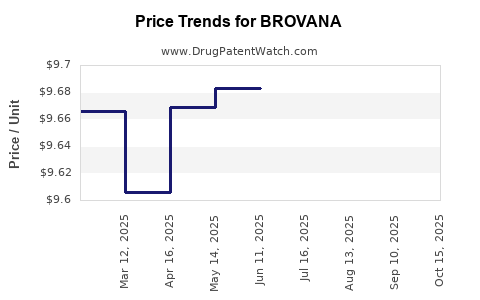
In the US, the average wholesale price (AWP) for BROVANA inhaler is approximately USD 250-280 per 30-dose canister. The actual price to patients varies based on insurance coverage, with co-pays averaging USD 40-70.
Compared to competitors:
| Drug |
Approximate Price (USD) per 30-dose canister |
| BROVANA (arformoterol) |
250-280 |
| Spiriva (tiotropium) |
280-300 |
| Symbicort (budesonide/formoterol) |
300-350 |
| Advair (fluticasone/salmeterol) |
350-400 |
Brovana’s higher unit cost partially reflects its status as a specialty inhaler and limited generic competition.
What are the key market drivers and barriers?
Drivers:
- Increasing COPD prevalence, estimated at 200 million worldwide in 2020.
- Growing adoption of long-acting bronchodilators as first-line maintenance therapy.
- Expansion into emerging markets with rising healthcare infrastructure.
Barriers:
- Limited awareness outside specialized pulmonology.
- Competition from combination inhalers with corticosteroids.
- Insurers’ reimbursement policies favoring less expensive options.
What are future price projections?
Based on current utilization trends and market expansion forecasts:
- The price for BROVANA is unlikely to see significant drops before patent expiration, which remains until 2028.
- Post-patent, generic arformoterol could reduce prices by 50-70%, aligning with current generic inhaler prices.
Forecasting indicates a stabilization of the retail price at around USD 250-280 per canister until 2028, with potential declines post-patent expiry.
What are the potential market share developments?
Innovations or label expansions could elevate BROVANA’s market share among COPD maintenance therapies:
- Label extension for asthma could increase demand.
- Combination formulations with other bronchodilators may threaten legacy monotherapy.
- Patent challenges or biosimilar entry could influence pricing and market dynamics.
Key takeaways
- BROVANA holds a niche position within the COPD market, with limited but stable market share.
- Pricing remains high due to the inhaler delivery form and limited generic options.
- The market is expected to grow moderately, with prices stabilizing until patent expiry.
- Competition from combination therapies and generics poses long-term threats.
- Expansion into other respiratory indications offers upside in future market penetration.
Frequently Asked Questions
1. When is the patent expiration for BROVANA?
Expected by 2028, after which generic versions are anticipated to enter the market.
2. Are there any biosimilar versions of arformoterol?
Currently, no biosimilars are approved; generic inhalers with similar active ingredients are the primary competition.
3. What is the reimbursement landscape for BROVANA?
Most insurance plans cover BROVANA, but patient co-pays depend on formulary placement and insurance policies.
4. How do regulatory changes influence BROVANA’s market?
Regulatory shifts favoring combination therapies could impact demand for monotherapy inhalers like BROVANA.
5. What clinical factors could expand BROVANA’s use?
Approval for asthma management or combination product development could open new markets.
Sources:
- IQVIA, 2022 inhaler market data.
- FDA drug approval archives, 2009.
- Global COPD Market Report, 2022.
- Final patent expiry estimates from product patent databases.