Last updated: September 27, 2026
Bonsity is a teriparatide injection approved by the U.S. Food and Drug Administration under the 505(b)(2) pathway. Its commercial opportunity comes from competing with Eli Lilly’s Forteo and generic teriparatide products in the osteoporosis market. Bonsity is not a biosimilar and does not have publicly reported standalone revenue. Its financial trajectory depends on payer formulary access, distributor contracting, price discounts, and the speed of generic substitution.
What is Bonsity and who markets it?
Bonsity is a prescription injection containing teriparatide, a recombinant form of human parathyroid hormone fragment 1-34. It is indicated for patients with osteoporosis at high risk for fracture, including postmenopausal women and men with primary or hypogonadal osteoporosis. It is also used for glucocorticoid-induced osteoporosis in specified patients.
| Attribute |
Bonsity |
| Active ingredient |
Teriparatide |
| Dosage form |
Subcutaneous injection |
| Strength |
250 mcg/mL |
| FDA pathway |
505(b)(2) new drug application |
| U.S. application |
NDA 211939 |
| Reference product |
Forteo |
| Original innovator |
Eli Lilly |
| Primary commercial sponsor |
Alvogen-related commercial operations |
| Therapeutic category |
Anabolic osteoporosis treatment |
| Product type |
Follow-on teriparatide, not a biosimilar |
| Administration |
Daily subcutaneous injection |
| Commercial constraint |
Historically limited duration of teriparatide therapy |
FDA approved Bonsity in 2019 based on a 505(b)(2) application that relied in part on information associated with Forteo. The pathway allowed the sponsor to reference established safety and efficacy information while supporting product-specific differences through additional data.[1]
When did Bonsity lose exclusivity, and what is its patent position?
Bonsity does not have a publicly established product-level exclusivity period comparable to a new chemical entity. Its commercial protection is primarily tied to regulatory approval, product differentiation, manufacturing capabilities, and distribution contracts.
The key patent event was the loss of meaningful U.S. exclusivity around the Forteo franchise. Eli Lilly’s core teriparatide product protection expired before or around the period when follow-on and generic teriparatide entrants began reaching the U.S. market. The precise commercial barrier varied by patent, pediatric exclusivity, settlement arrangements, and product-specific litigation.
What patents protect Bonsity?
Publicly available FDA materials do not indicate that Bonsity has a major Orange Book patent estate that independently supports long-term market exclusivity. Bonsity was developed as a follow-on teriparatide product rather than as a novel molecular entity.
Potentially relevant intellectual-property categories include:
- Teriparatide composition and peptide-sequence patents
- Recombinant production and purification methods
- Formulation and stability patents
- Injection-device and cartridge technology
- Manufacturing controls and analytical methods
- Labeling-related method-of-use rights
These categories do not have equal commercial value. Composition patents covering teriparatide have limited remaining relevance because the active ingredient has been marketed for many years. Manufacturing and formulation rights may create operational barriers, but they generally do not prevent all competing teriparatide products from entering the market.
What is the Orange Book status of Bonsity?
Bonsity is listed in FDA drug-product materials as a teriparatide product approved under an NDA rather than as an ANDA generic. Its Orange Book position is weaker than the patent position historically associated with Forteo. No publicly prominent Bonsity patent listing is broadly recognized as supporting a late-decade exclusivity cliff.
The commercial implication is direct: competitors can challenge Bonsity primarily through price, payer access, supply reliability, and interchangeable or therapeutically substitutable products rather than by waiting for a large Bonsity-specific patent expiration.
How does Bonsity compare with Forteo and generic teriparatide?
Bonsity competes against the reference product Forteo and lower-cost teriparatide products. Its clinical differentiation is limited because all products provide teriparatide as the active anabolic agent.
| Product |
Sponsor or manufacturer |
Regulatory route |
Competitive position |
| Forteo |
Eli Lilly |
Original NDA |
Brand recognition, physician familiarity, established reimbursement |
| Bonsity |
Alvogen-related sponsor |
505(b)(2) NDA |
Follow-on product with potential price advantage |
| Generic teriparatide |
Multiple generic manufacturers |
ANDA |
Lowest-cost competition where covered |
| Tymlos |
Radius Health |
Original NDA |
Competing anabolic osteoporosis therapy |
| Evenity |
Amgen/UCB |
Original biologic therapy |
Monthly injectable alternative with different mechanism and safety profile |
Forteo retains advantages in brand familiarity, historical clinical use, and payer recognition. Bonsity can compete when it offers lower net cost or better supply terms. Generic teriparatide products place greater pressure on Bonsity because they can be substituted within pharmacy and payer channels at lower prices.
Tymlos, which contains abaloparatide, competes on anabolic therapy rather than on molecular identity. Evenity competes in the same high-risk osteoporosis segment but uses a different biological mechanism and monthly administration schedule.
What is the market size and commercial opportunity for Bonsity?
The U.S. osteoporosis market includes oral bisphosphonates, injectable antiresorptive medicines, anabolic therapies, and newer specialty products. Teriparatide occupies a narrower segment focused on patients at high fracture risk or those who have failed or cannot tolerate other therapies.
Bonsity’s addressable market is constrained by four factors:
- Teriparatide is generally used for patients with substantial fracture risk.
- Daily injection reduces convenience relative to monthly or twice-yearly alternatives.
- Treatment duration has historically been limited by labeling and clinical practice considerations.
- Generic and follow-on competition compresses net pricing.
The market remains commercially relevant because fracture prevention can reduce hospitalization, surgery, long-term disability, and institutional care. Payers, however, often manage anabolic therapies through prior authorization and step-therapy requirements. Patients may be required to try an oral bisphosphonate or another antiresorptive agent before receiving teriparatide.
What drives Bonsity pricing?
Bonsity pricing is influenced by:
- Wholesale acquisition cost
- Medicaid and commercial rebates
- Medicare Part D plan design
- Specialty-pharmacy dispensing
- Formulary placement
- Manufacturer assistance programs
- Competition from generic teriparatide
- Pen-device and cartridge supply costs
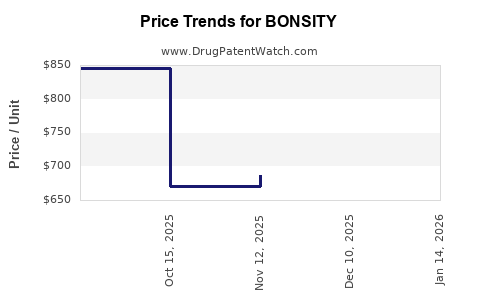
Published list price is less relevant than net price after rebates and discounts. A follow-on product can gain prescriptions while producing limited revenue if it must provide steep rebates to secure preferred formulary treatment.
What is the financial trajectory for Bonsity?
No public company filing provides a separately reported Bonsity revenue line. Alvogen is privately held, and its public disclosures do not provide a reliable product-level sales history for Bonsity. Therefore, Bonsity revenue, gross margin, market share, and annual growth cannot be stated as verified financial figures.
The likely financial trajectory has four phases:
| Period |
Commercial condition |
Financial effect |
| 2019 approval and launch preparation |
Entry into an established teriparatide market |
High launch and market-access costs |
| Early commercialization |
Limited differentiation from Forteo |
Moderate prescription adoption, heavy contracting pressure |
| Generic teriparatide expansion |
More price competition |
Lower net price and margin compression |
| Mature market |
Stable demand from high-risk osteoporosis patients |
Revenue depends on formulary retention and supply execution |
Bonsity’s financial profile is therefore more likely to resemble a niche specialty product than a large-growth pharmaceutical asset. The product can generate recurring revenue if it retains payer access and maintains reliable cartridge and device supply. It is unlikely to command premium pricing without a clear delivery, adherence, safety, or access advantage.
What FDA regulatory issues affect Bonsity?
Bonsity’s regulatory status is established through an FDA-approved NDA. The principal regulatory issues are product quality, device performance, labeling compliance, pharmacovigilance, and manufacturing consistency.
Is Bonsity a biosimilar?
No. Bonsity is not a biosimilar under the Public Health Service Act. Teriparatide is a peptide drug, and Bonsity was approved through the 505(b)(2) pathway. Generic teriparatide products are generally approved under the ANDA pathway when they satisfy applicable sameness and bioequivalence requirements.
This distinction affects substitution. A 505(b)(2) product does not automatically receive the same pharmacy-substitution treatment as an interchangeable biosimilar.
What formulation patents protect Bonsity?
Bonsity uses a liquid injectable formulation containing teriparatide and excipients needed for stability and delivery. Formulation-related intellectual property may cover:
- Peptide stability in solution
- Preservative systems
- Cartridge compatibility
- Device performance
- Storage conditions
- Manufacturing and fill-finish processes
These rights may protect specific implementations but do not necessarily block alternative teriparatide formulations or delivery systems. The strongest practical barrier is often validated manufacturing capacity rather than a single formulation patent.
Which companies are challenging Bonsity?
Bonsity faces competition from both branded osteoporosis manufacturers and generic drugmakers. The most relevant competitors are:
- Eli Lilly, through Forteo
- Generic teriparatide manufacturers
- Radius Health, through Tymlos
- Amgen and UCB, through Evenity
- Merck and other antiresorptive manufacturers
- Providers of denosumab, bisphosphonates, and other fracture-prevention therapies
Publicly reported information does not establish a major patent-litigation campaign directed specifically at Bonsity. The greater commercial threat is market substitution by lower-priced teriparatide products and payer preference for alternative osteoporosis therapies.
What Paragraph IV challenges and patent litigation affect Bonsity?
A Paragraph IV certification is primarily relevant to ANDA applicants challenging patents listed for a reference drug. Bonsity itself is an NDA product approved through the 505(b)(2) route, so its market position is not defined by a conventional generic-drug patent challenge to Bonsity.
The principal litigation risk historically surrounded Forteo-related patents and generic teriparatide entrants. These disputes could affect the timing of generic entry, but they do not create a durable Bonsity-specific moat. No broadly material settlement agreement involving Bonsity has been publicly identified as controlling the U.S. teriparatide market.
What generic launch scenarios exist for Bonsity?
Scenario 1: Continued price erosion
Generic teriparatide products gain preferred formulary status. Bonsity remains available but must discount heavily. Prescription volume may remain stable while revenue and gross margin decline.
Scenario 2: Stable niche positioning
Bonsity maintains contracts with specialty pharmacies and selected insurers. Its revenue remains modest but predictable, supported by prescriber familiarity and supply reliability.
Scenario 3: Device or access differentiation
Bonsity gains share through better injection-device performance, patient-support services, distribution coverage, or lower patient out-of-pocket costs. This scenario requires measurable commercial differentiation because the active ingredient is the same as competing teriparatide products.
Scenario 4: Supply disruption
Manufacturing or cartridge shortages shift demand to competitors. In a concentrated injectable market, supply reliability can produce short-term share gains, but those gains may reverse when competitors restore availability.
How strong is the Bonsity patent estate?
The Bonsity patent estate appears commercially limited compared with the historic Forteo estate. Its strength is better characterized as moderate-to-low for blocking competition and moderate for protecting specific manufacturing or formulation implementations.
| Patent-estate factor |
Assessment |
| Molecular exclusivity |
Weak; teriparatide is long established |
| Orange Book leverage |
Limited public evidence of a major Bonsity-specific barrier |
| Formulation protection |
Potentially relevant but product-specific |
| Manufacturing complexity |
Meaningful barrier for sterile peptide injection |
| Device protection |
Possible, depending on cartridge and pen configuration |
| Regulatory advantage |
Established 505(b)(2) approval |
| Generic vulnerability |
High |
| Biosimilar vulnerability |
Not applicable |
What licensing deals affect Bonsity?
Bonsity’s commercial model depends on sponsor, manufacturing, distribution, and specialty-pharmacy relationships. Public disclosures do not provide a detailed, product-specific licensing economics profile, including royalty rates, minimum purchase commitments, or milestone payments.
The absence of disclosed product-level licensing terms limits external assessment of Bonsity’s contribution margin. Any revenue estimate that assumes a specific royalty burden or transfer price would be speculative.
What is the geographic coverage of Bonsity?
Bonsity’s most visible regulatory and commercial position is in the United States. The product’s value outside the U.S. depends on country-specific approvals, reimbursement, patent status, local distribution, and competing teriparatide products.
The United States remains the principal market for assessing Bonsity because:
- FDA approval established the regulatory pathway.
- Forteo and generic teriparatide competition is mature.
- Specialty-pharmacy and payer contracting are central to access.
- U.S. patent and exclusivity events shaped entry timing.
Key Takeaways
- Bonsity is an FDA-approved teriparatide injection developed through the 505(b)(2) pathway.
- It is a follow-on product to Forteo, not a biosimilar.
- No reliable public source reports standalone Bonsity revenue or market share.
- Its financial trajectory is constrained by generic teriparatide competition and payer discounting.
- Manufacturing reliability, specialty-pharmacy access, and formulary placement matter more than molecular differentiation.
- The product appears to have limited blocking patent strength compared with the historical Forteo estate.
- The main commercial risk is price and substitution pressure, not a known Bonsity-specific patent cliff.
- Bonsity is best viewed as a niche specialty pharmaceutical with recurring but margin-sensitive revenue potential.
FAQs
Is Bonsity interchangeable with Forteo?
Bonsity contains the same active ingredient, teriparatide, but it is not automatically interchangeable with Forteo solely because of its 505(b)(2) approval. Substitution depends on state law, payer policy, prescription requirements, and the product’s regulatory designation.
Is Bonsity cheaper than Forteo?
Bonsity may have a lower net cost than Forteo, but actual patient and payer pricing depends on insurance coverage, rebates, specialty-pharmacy contracts, and assistance programs. List price alone does not establish the commercial price advantage.
Can patients switch from Forteo to Bonsity?
A switch may be clinically appropriate, but it must be managed by the prescribing clinician. The decision can depend on treatment history, device use, insurance coverage, adherence, and the patient’s remaining allowable treatment duration.
Does Bonsity have a 2030 patent expiration date?
A publicly established Bonsity-specific patent expiration date that controls broad market exclusivity is not evident in the principal FDA product materials. Any patent covering a particular formulation, device, or manufacturing process would have a narrower scope than a composition patent.
Will generic teriparatide eliminate Bonsity revenue?
Generic teriparatide is likely to reduce Bonsity’s price and market share, but it does not necessarily eliminate revenue. Bonsity can retain business through payer contracts, supply reliability, patient support, or channel relationships.
References
- U.S. Food and Drug Administration. (2019). Bonsity (teriparatide injection) prescribing information. FDA.
- U.S. Food and Drug Administration. (2024). Orange Book: Approved drug products with therapeutic equivalence evaluations. FDA.
- U.S. Food and Drug Administration. (2024). Drugs@FDA: Bonsity, NDA 211939. FDA.
- U.S. Food and Drug Administration. (2024). Guidance for industry: Applications covered by section 505(b)(2). FDA.
- Eli Lilly and Company. (2024). Annual report. Lilly.