Last Updated: September 24, 2026

BONJESTA Drug Patent Profile


✉ Email this page to a colleague

« Back to Dashboard


When do Bonjesta patents expire, and what generic alternatives are available?

Bonjesta is a drug marketed by Duchesnay and is included in one NDA. There are four patents protecting this drug and one Paragraph IV challenge.

The generic ingredient in BONJESTA is doxylamine succinate; pyridoxine hydrochloride. There is one drug master file entry for this compound. Six suppliers are listed for this compound. Additional details are available on the doxylamine succinate; pyridoxine hydrochloride profile page.

AI Deep Research
Questions you can ask:
  • What is the 5 year forecast for BONJESTA?
  • What are the global sales for BONJESTA?
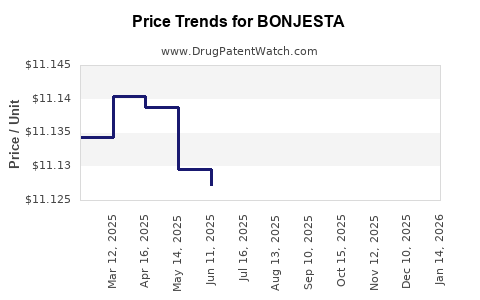
  • What is Average Wholesale Price for BONJESTA?
Recent Clinical Trials for BONJESTA

Identify potential brand extensions & 505(b)(2) entrants

SponsorPhase
Duchesnay Inc.Phase 3
Health DecisionsPhase 3

See all BONJESTA clinical trials

Pharmacology for BONJESTA
Paragraph IV (Patent) Challenges for BONJESTA
Tradename Dosage Ingredient Strength NDA ANDAs Submitted Submissiondate
BONJESTA Extended-release Tablets doxylamine succinate; pyridoxine hydrochloride 20 mg/20 mg 209661 1 2018-08-28

US Patents and Regulatory Information for BONJESTA

BONJESTA is protected by four US patents.

Applicant Tradename Generic Name Dosage NDA Approval Date TE Type RLD RS Patent No. Patent Expiration Product Substance Delist Req. Exclusivity Expiration
Duchesnay BONJESTA doxylamine succinate; pyridoxine hydrochloride TABLET, EXTENDED RELEASE;ORAL 209661-001 Nov 7, 2016 RX Yes Yes 9,937,132 ⤷  Start Trial Y ⤷  Start Trial
Duchesnay BONJESTA doxylamine succinate; pyridoxine hydrochloride TABLET, EXTENDED RELEASE;ORAL 209661-001 Nov 7, 2016 RX Yes Yes 9,089,489 ⤷  Start Trial Y ⤷  Start Trial
Duchesnay BONJESTA doxylamine succinate; pyridoxine hydrochloride TABLET, EXTENDED RELEASE;ORAL 209661-001 Nov 7, 2016 RX Yes Yes 9,375,404 ⤷  Start Trial Y ⤷  Start Trial
>Applicant >Tradename >Generic Name >Dosage >NDA >Approval Date >TE >Type >RLD >RS >Patent No. >Patent Expiration >Product >Substance >Delist Req. >Exclusivity Expiration

International Patents for BONJESTA

When does loss-of-exclusivity occur for BONJESTA?

Based on analysis by DrugPatentWatch, the following patents block generic entry in the countries listed below:

Argentina

Patent: 0126
Patent: COMPOSICION DE DOXILAMINA Y PIRIDOXINA Y/O SUS METABOLITOS O SALES
Estimated Expiration: ⤷  Start Trial

Patent: 2580
Patent: FORMA DE DOSIFICACIÓN DE DOXILAMINA Y PIRIDOXINA Y/O SUS METABOLITOS O SALES
Estimated Expiration: ⤷  Start Trial

Australia

Patent: 13224598
Patent: Formulation of doxylamine and pyridoxine and/or metabolites or salts thereof
Estimated Expiration: ⤷  Start Trial

Brazil

Patent: 2014020186
Patent: FORMULAÇÃO DE DOXILAMINA E PIRIDOXINA E/OU SEUS METABÓLITOS OU SAIS
Estimated Expiration: ⤷  Start Trial

Canada

Patent: 48798
Patent: FORMULATION DE DOXYLAMINE ET DE PYRIDOXINE ET/OU DE LEURS METABOLITES OU SELS (FORMULATION OF DOXYLAMINE AND PYRIDOXINE AND/OR METABOLITES OR SALTS THEREOF)
Estimated Expiration: ⤷  Start Trial

Chile

Patent: 14001828
Patent: Sistema de dosificacion oral de liberacion dual que comprende doxilamina y piridoxina y/o sus analogos, metabolitos y sales de los mismos; forma de dosificacion oral de liberacion dual; kit farmaceutico; uso para aliviar los sintomas de nauseas y vomitos, incluidos los del embarazo.
Estimated Expiration: ⤷  Start Trial

China

Patent: 4136004
Patent: 多西拉敏和吡哆醇和/或其代谢物或盐的制剂 (Formulation of doxylamine and pyridoxine and/or metabolites or salts thereof)
Estimated Expiration: ⤷  Start Trial

Cyprus

Patent: 23122
Estimated Expiration: ⤷  Start Trial

Denmark

Patent: 26611
Estimated Expiration: ⤷  Start Trial

European Patent Office

Patent: 87971
Patent: FORMULATION DE DOXYLAMINE ET DE PYRIDOXINE ET/OU DE LEURS MÉTABOLITES OU SELS (FORMULATION OF DOXYLAMINE AND PYRIDOXINE AND/OR METABOLITES OR SALTS THEREOF)
Estimated Expiration: ⤷  Start Trial

Patent: 26611
Patent: FORMULATION DE DOXYLAMINE ET DE PYRIDOXINE ET/OU DE LEURS MÉTABOLITES OU SELS (FORMULATION OF DOXYLAMINE AND PYRIDOXINE AND/OR METABOLITES OR SALTS THEREOF)
Estimated Expiration: ⤷  Start Trial

Hong Kong

Patent: 97035
Patent: 多西拉敏和吡哆醇和/或其代謝物或鹽的製劑 (FORMULATION OF DOXYLAMINE AND PYRIDOXINE AND OR METABOLITES OR SALTS THEREOF)
Estimated Expiration: ⤷  Start Trial

Hungary

Patent: 52301
Estimated Expiration: ⤷  Start Trial

Israel

Patent: 3644
Patent: צורות מינון בעלות שחרור דואלי הניתנות דרך הפה אשר מכילות דוקסילאמין ופירידוקסין, ערכות המכילות אותן ושימושן להקלת סימפטומים של בחילה והקאה (Dual release oral dosage forms comprising doxylamine and pyridoxine, kits comprising them and their use in alleviating the symptoms of nausea and vomiting)
Estimated Expiration: ⤷  Start Trial

Japan

Patent: 14701
Estimated Expiration: ⤷  Start Trial

Patent: 15508082
Patent: ドキシラミンおよびピリドキシン、ならびに/またはその代謝物もしくは塩の製剤
Estimated Expiration: ⤷  Start Trial

Patent: 16053092
Patent: ドキシラミンおよびピリドキシン、ならびに/またはその代謝物もしくは塩の製剤 (FORMULATION OF DOXYLAMINE AND PYRIDOXINE AND/OR METABOLITES OR SALTS THEREOF)
Estimated Expiration: ⤷  Start Trial

Lithuania

Patent: 26611
Estimated Expiration: ⤷  Start Trial

Mexico

Patent: 5912
Patent: FORMULACIÓN DE DOXILAMINA Y PIRIDOXINA Y/O SUS METABOLITOS O SALES. (FORMULATION OF DOXYLAMINE AND PYRIDOXINE AND/OR METABOLITES OR SALTS THEREOF.)
Estimated Expiration: ⤷  Start Trial

Patent: 14008594
Patent: FORMULACION DE DOXILAMINA Y PIRIDOXINA Y/O SUS METABOLITOS O SALES. (FORMULATION OF DOXYLAMINE AND PYRIDOXINE AND/OR METABOLITES OR SALTS THEREOF.)
Estimated Expiration: ⤷  Start Trial

New Zealand

Patent: 7593
Patent: Formulation of doxylamine and pyridoxine and/or metabolites or salts thereof
Estimated Expiration: ⤷  Start Trial

Poland

Patent: 26611
Estimated Expiration: ⤷  Start Trial

Portugal

Patent: 26611
Estimated Expiration: ⤷  Start Trial

Singapore

Patent: 201403931Y
Patent: FORMULATION OF DOXYLAMINE AND PYRIDOXINE AND/OR METABOLITES OR SALTS THEREOF
Estimated Expiration: ⤷  Start Trial

South Korea

Patent: 1588259
Estimated Expiration: ⤷  Start Trial

Patent: 140139496
Patent: 독실아민 및 피리독신 및/또는 이들의 대사물질들 또는 염들의 제형물 (/ FORMULATION OF DOXYLAMINE AND PYRIDOXINE AND/OR METABOLITES OR SALTS THEREOF)
Estimated Expiration: ⤷  Start Trial

Spain

Patent: 09713
Estimated Expiration: ⤷  Start Trial

Taiwan

Patent: 1334780
Patent: Formulation of doxylamine and pyridoxine and/or metabolites or salts thereof
Estimated Expiration: ⤷  Start Trial

Patent: 38657
Estimated Expiration: ⤷  Start Trial

Uruguay

Patent: 631
Patent: FORMULACIÓN DE DOXILAMINA Y PIRIDOXINA Y/O SUS METABOLITOS O SALES
Estimated Expiration: ⤷  Start Trial

Patent: 283
Patent: FORMULACIÓN DE LIBERACIÓN PLURIMODAL DE DOXILAMINA Y PIRIDOXINA Y/O METABOLITOS O SALES DE LAS MISMAS
Estimated Expiration: ⤷  Start Trial

Generics may enter earlier, or later, based on new patent filings, patent extensions, patent invalidation, early generic licensing, generic entry preferences, and other factors.

See the table below for additional patents covering BONJESTA around the world.

Country Patent Number Title Estimated Expiration
Australia 2003245774 PHARMACEUTICAL DOSAGE FORM BEARING PREGNANCY-FRIENDLY INDICIA ⤷  Start Trial
Belgium 1016043 FORME POSOLOGIQUE PHARMACEUTIQUE PORTANT UNE SIGNALETIQUE INDIQUANT UNE PARFAITE INNOCUITE EN CAS DE GROSSESSE. ⤷  Start Trial
Canada 2392486 FORME POSOLOGIQUE PHARMACEUTIQUE PORTANT UNE INSCRIPTION POUR LES FEMMES ENCEINTES (PHARMACEUTICAL DOSAGE FORM BEARING PREGNANCY-FRIENDLY INDICIA) ⤷  Start Trial
>Country >Patent Number >Title >Estimated Expiration

Supplementary Protection Certificates for BONJESTA

Patent Number Supplementary Protection Certificate SPC Country SPC Expiration SPC Description
3185856 CA 2024 00001 Denmark ⤷  Start Trial PRODUCT NAME: COMBINATION OF DOXYLAMINE, OR A PHARMACEUTICALLY ACCEPTABLE SALT THEREOF, AND PYRIDOXINE, OR A PHARMACEUTICALLY ACCEPTABLE SALT THEREOF; NAT. REG. NO/DATE: 66650 20230704; FIRST REG. NO/DATE: NL RVG 128835 20230216
3185856 CR 2024 00001 Denmark ⤷  Start Trial PRODUCT NAME: COMBINATION OF DOXYLAMINE, OR A PHARMACEUTICALLY ACCEPTABLE SALT THEREOF, AND PYRIDOXINE, OR A PHARMACEUTICALLY ACCEPTABLE SALT THEREOF; NAT. REG. NO/DATE: 66650 20230704; FIRST REG. NO/DATE: NL RVG 128835 20230216
3185856 122024000003 Germany ⤷  Start Trial PRODUCT NAME: KOMBINATION AUS DOXYLAMIN, ODER EINES PHARMAZEUTISCH AKZEPTABLEN SALZES DAVON, UND PYRIDOXIN, ODER EINES PHARMZEUTISCH AKZEPTABLEN SALZES DAVON; NAT. REGISTRATION NO/DATE: 7006779.00.00 20230717; FIRST REGISTRATION: NIEDERLANDE RVG 128835 20230216
>Patent Number >Supplementary Protection Certificate >SPC Country >SPC Expiration >SPC Description

BONJESTA Market Dynamics and Financial Trajectory

Last updated: August 25, 2026

Bonjesta is a prescription extended-release combination of doxylamine succinate and pyridoxine hydrochloride for nausea and vomiting of pregnancy when conservative measures are inadequate. Its commercial position depends on branded pricing, physician recognition, payer coverage, and protection against generic delayed-release doxylamine-pyridoxine products. The product has a defensible formulation position but limited therapeutic differentiation from Diclegis and lower-cost alternatives.

Public financial disclosure is limited because Bonjesta’s commercial sponsor, Duchesnay USA Inc., is privately held and does not report product-level revenue in SEC filings. A precise historical revenue series, operating margin, or product valuation therefore cannot be established from public filings. The available evidence supports a mature, niche prescription product with recurring demand but material generic and reimbursement pressure.

What is Bonjesta and how does it generate revenue?

Bonjesta contains 20 mg of doxylamine succinate and 20 mg of pyridoxine hydrochloride in an extended-release tablet. The recommended starting dose is one tablet at bedtime, with escalation to two tablets daily when required. It is indicated for nausea and vomiting of pregnancy in patients who do not respond to conservative management.[1]

The commercial revenue model has four components:

Revenue driver Effect on Bonjesta
Prescription volume Supported by the high incidence of nausea and vomiting during pregnancy
Net price Reduced by commercial rebates, Medicaid discounts, and pharmacy benefit management
Payer coverage Determines whether patients fill Bonjesta or use OTC doxylamine plus vitamin B6
Generic competition Creates the largest long-term threat to price and market share

Bonjesta’s target population is large, but the addressable branded market is narrower than the prevalence of pregnancy-related nausea. Many patients are treated with dietary measures, pyridoxine alone, generic antiemetics, or OTC doxylamine and pyridoxine. The product therefore competes in a high-volume clinical category but does not capture the full underlying disease population.

When did Bonjesta receive FDA approval?

Bonjesta was approved by the U.S. Food and Drug Administration in November 2016.[2] It followed Diclegis, an earlier delayed-release doxylamine-pyridoxine product approved in 2013.[3]

FDA regulatory timeline

Event Date Commercial relevance
Diclegis FDA approval April 2013 Re-established a prescription delayed-release doxylamine-pyridoxine product in the U.S.
Bonjesta FDA approval November 2016 Introduced the higher-strength 20 mg/20 mg tablet
Bonjesta marketing period 2016-present Dependent on physician prescribing and payer access
Generic risk period Ongoing Depends on listed patents, certifications, litigation, and FDA approval timing

Bonjesta is a small-molecule drug, not a biologic. Biosimilar competition is therefore irrelevant. The relevant regulatory threat is an abbreviated new drug application, or ANDA, for a therapeutically equivalent delayed-release product.

What patents protect Bonjesta?

Bonjesta’s protection is based primarily on formulation, dosage strength, release characteristics, and use of the doxylamine-pyridoxine combination rather than on new-molecule exclusivity. Doxylamine and pyridoxine are longstanding active ingredients, which limits the value of composition-of-matter protection.

The relevant intellectual-property categories are:

Patent category Strategic value
Extended-release formulation Protects the timed delivery of doxylamine and pyridoxine
Dosage-form claims May distinguish the 20 mg/20 mg Bonjesta tablet from lower-strength products
Combination-product claims Protects the paired active ingredients in a defined formulation
Method-of-use claims Covers treatment of nausea and vomiting of pregnancy
Manufacturing claims May restrict production methods, coating systems, or release profiles

The FDA Orange Book, rather than promotional material or patent databases alone, controls the practical analysis of listed patents and their expiration dates.[4] A complete current patent-expiry conclusion requires reconciliation of the active Orange Book listing, patent-term adjustment, pediatric exclusivity, terminal disclaimers, and any court judgment or settlement.

How strong is the Bonjesta patent estate?

The estate is structurally weaker than a new chemical entity estate because the active ingredients are old and the product’s commercial value rests on formulation and dosing convenience. Formulation patents can still delay generic entry if the claims require a specific release profile or tablet architecture. Their strength depends on claim breadth, prosecution history, prior art, and whether an ANDA applicant can design around the claims.

The estate is stronger against an exact-copy delayed-release product than against:

  • Immediate-release doxylamine-pyridoxine combinations
  • Separate OTC doxylamine and pyridoxine products
  • Alternative prescription antiemetics
  • Formulations using different release coatings
  • Products relying on a different dosage schedule

When does Bonjesta lose exclusivity?

Bonjesta does not have a meaningful new chemical entity exclusivity period because its active ingredients were previously known. The commercial exclusivity analysis depends on FDA regulatory exclusivity, Orange Book patents, pediatric provisions, and litigation outcomes.

The principal risk is not an abrupt loss of all demand. It is a gradual reduction in branded net price and market share after a therapeutically equivalent generic becomes available. Pregnancy-related nausea is recurrent across annual birth cohorts, so the market can remain commercially relevant after patent expiry even when branded economics deteriorate.

Bonjesta exclusivity factors

Factor Likely effect
New chemical entity exclusivity Not a principal protection mechanism
Formulation patents Main potential barrier to exact generic substitution
Method-of-use patents May be vulnerable to section viii carve-outs
Pediatric exclusivity Could add six months if awarded and applicable
ANDA Paragraph IV challenge Can accelerate litigation and first generic entry
Authorized generic Could preserve some manufacturer economics while reducing retail price

A fixed commercial-loss date should not be assigned without the current Orange Book patent table and litigation record. Patent expiration, FDA approval, and actual generic launch are separate events.

Are there Paragraph IV challenges to Bonjesta?

A Paragraph IV certification alleges that an Orange Book-listed patent is invalid, unenforceable, or will not be infringed by the proposed generic. If filed, it can trigger patent litigation under the Hatch-Waxman Act and impose a potential 30-month stay on FDA approval, subject to statutory exceptions.[5]

Publicly available information does not establish a widely reported, market-defining Bonjesta Paragraph IV litigation event comparable to major blockbuster drug challenges. The absence of a prominent public case does not eliminate risk. Smaller products can face ANDA litigation that receives limited financial-market coverage.

The practical monitoring points are:

  1. FDA Orange Book patent listings.
  2. ANDA litigation complaints under 21 U.S.C. § 271(e)(2).
  3. Federal district court docket activity.
  4. FDA approval letters and tentative approvals.
  5. Any settlement providing a licensed generic-entry date.
  6. Pharmacy-level substitution after commercial launch.

What generic entry risks exist for Bonjesta?

Generic risk is high in principle because the product uses old active ingredients and treats a condition with established low-cost alternatives. The timing risk is more difficult to quantify because the relevant product must replicate delayed-release performance and satisfy FDA bioequivalence requirements.

Generic launch scenarios

Scenario Timing Market effect
No approved equivalent Before confirmed approval Bonjesta retains pricing control, subject to payer pressure
Tentative approval only Patent or exclusivity barrier remains Limited immediate commercial effect
First approved generic After regulatory and patent clearance Rapid price erosion likely
Authorized generic Parallel or coordinated launch Lower prices with partial sponsor retention
Multiple generics Follow-on period Greater discounting and reduced branded share

A generic product may not need to reproduce Bonjesta’s commercial messaging. It must meet FDA requirements for the same active ingredients, strength, dosage form, route, and therapeutic equivalence. If the label contains protected methods of use, an ANDA sponsor may use a section viii statement to omit those indications rather than challenge the patent directly.[6]

How does Bonjesta compare with Diclegis?

Bonjesta and Diclegis use the same active ingredients but differ in strength and dosing design.

Product Active ingredients per tablet FDA approval Position
Diclegis 10 mg doxylamine succinate / 10 mg pyridoxine HCl 2013 Lower-strength delayed-release product
Bonjesta 20 mg doxylamine succinate / 20 mg pyridoxine HCl 2016 Higher-strength delayed-release product

Bonjesta can reduce pill burden relative to lower-strength dosing, but the clinical category remains highly substitutable. Prescribers can use Diclegis, generic equivalents where available, or separate OTC ingredients. That limits Bonjesta’s ability to command a premium solely from clinical efficacy.

The strongest commercial argument is convenience and adherence. The weakest point is the availability of inexpensive ingredients with a long history of use.

What is the Orange Book status of Bonjesta?

The Orange Book is the controlling FDA source for therapeutic-equivalence evaluations and listed patents or exclusivity associated with approved products.[4] Bonjesta’s relevant listing should be assessed by product name, active ingredients, dosage form, strength, NDA, and sponsor.

Orange Book analysis should distinguish:

  • Bonjesta from Diclegis
  • Delayed-release tablets from immediate-release products
  • Brand listings from authorized generics
  • Active patents from expired or delisted patents
  • Patent expiry from FDA exclusivity expiry

A formulation patent may remain relevant even when a method-of-use patent is expired. Conversely, a method-of-use listing may have limited practical force if a generic can omit the patented indication through a section viii carve-out.

What is Bonjesta’s financial trajectory?

Bonjesta’s public financial trajectory cannot be measured through audited product-level revenue because Duchesnay is privately held and does not publish a complete Bonjesta income statement. The commercial trajectory is best assessed through market structure rather than reported sales.

Commercial phases

Launch and adoption

The 2016 launch gave Duchesnay a higher-strength formulation positioned around reduced pill burden. Initial growth would have depended on physician education, payer contracting, obstetric prescribing patterns, and brand awareness.

Expansion and normalization

After launch, the product entered a mature specialty-prescription phase. Volume is linked to annual pregnancy incidence rather than chronic treatment duration. Prescription turnover is therefore recurring but short-cycle.

Patent and payer pressure

As patent barriers weaken, payers can move patients toward generic delayed-release products or lower-cost alternatives. Gross sales may remain stable while net revenue declines because of rebates and discounts.

Post-generic economics

After an equivalent generic launch, Bonjesta’s revenue would likely split between residual branded demand, patients with favorable coverage, prescriber preference, and any authorized-generic strategy. The product could remain clinically relevant but would face lower net pricing and reduced negotiating leverage.

What is Bonjesta’s revenue exposure?

Bonjesta is not publicly disclosed as a standalone revenue line by a large publicly traded pharmaceutical company. No reliable public source establishes annual Bonjesta sales, cumulative revenue, EBITDA contribution, or current valuation.

The key financial sensitivities are:

Variable Financial impact
Prescription count Drives gross demand
Average selling price Determines gross revenue
Rebate rate Reduces net sales
Medicaid and government exposure Increases statutory discount obligations
Generic launch date Determines price erosion timing
Sponsor commercialization cost Affects operating margin
Litigation or licensing expense Can reduce near-term profitability

The product’s revenue quality is mixed. Demand is medically recurring, but treatment duration is short and substitution options are extensive. That combination supports a durable niche but limits blockbuster economics.

What licensing deals affect Bonjesta?

No major publicly disclosed third-party licensing transaction has established a clear market valuation or royalty framework for Bonjesta. Duchesnay’s commercial position appears principally tied to its own prescription-product platform and U.S. commercialization activities.

Any private distribution, co-promotion, manufacturing, or supply agreement would require contract-level disclosure to quantify. Public evidence does not support assigning a material licensing contribution to Bonjesta’s financial trajectory.

What manufacturing and IP barriers affect generic entry?

Manufacturing complexity is moderate rather than extreme. The product is an oral tablet, not an injectable, implant, or biologic. The main technical barrier is controlled release, including:

  • Consistent dissolution performance
  • Stability of both active ingredients
  • Tablet coating and release-layer reproducibility
  • Bioequivalence across the dosing interval
  • Scale-up and batch-to-batch control

These barriers can slow development but generally do not create the durable protection associated with complex biologics or device-drug combinations. Once a generic manufacturer solves the formulation and receives approval, manufacturing cost is unlikely to support Bonjesta’s branded price.

Key Takeaways

  • Bonjesta is a 20 mg/20 mg delayed-release doxylamine-pyridoxine tablet approved by the FDA in 2016.
  • Its commercial value rests on formulation, dosing convenience, brand recognition, and payer access.
  • The active ingredients are old, so Bonjesta lacks the protection of a new chemical entity.
  • Formulation patents are more important than composition-of-matter patents.
  • Generic competition is the principal long-term threat.
  • Biosimilar risk does not apply because Bonjesta is a small-molecule oral drug.
  • No reliable public product-level revenue series is available because Duchesnay is privately held.
  • Bonjesta’s likely financial profile is a recurring niche product with meaningful price risk after generic entry.
  • The current Orange Book and federal litigation dockets are required to establish a definitive patent-expiry and Paragraph IV timeline.

FAQs

Is Bonjesta considered a specialty pharmaceutical?

Bonjesta is a prescription product in the obstetric and women’s-health market. It is commercially specialized by indication, but it does not have the manufacturing complexity or biologic profile typically associated with specialty pharmaceuticals.

Can patients buy Bonjesta over the counter?

No. Bonjesta is an FDA-approved prescription product. OTC doxylamine and pyridoxine products are alternatives, but they are not the same branded prescription product or necessarily the same delayed-release formulation.

Does Bonjesta have orphan-drug exclusivity?

No orphan-drug exclusivity is associated with Bonjesta’s indication for nausea and vomiting of pregnancy. The indication affects a broad pregnancy population and does not fit the orphan-drug framework.

What would most increase Bonjesta’s valuation?

A durable delay to generic entry, strong payer coverage, sustained prescription growth, or a licensing transaction with transparent economics would have the greatest potential effect. Public information does not establish that any of these has occurred at a scale sufficient to quantify.

Is Bonjesta clinically differentiated from generic doxylamine-pyridoxine?

The principal differentiation is the branded 20 mg/20 mg delayed-release tablet and its dosing convenience. Clinical differentiation from an FDA-approved therapeutically equivalent generic would generally be limited.

References

  1. U.S. Food and Drug Administration. (2023). Bonjesta prescribing information. FDA.

  2. U.S. Food and Drug Administration. (2016). Bonjesta approval information. Drugs@FDA.

  3. U.S. Food and Drug Administration. (2013). Diclegis approval information. Drugs@FDA.

  4. U.S. Food and Drug Administration. (2024). Approved drug products with therapeutic equivalence evaluations: Orange Book. FDA.

  5. U.S. Congress. (1984). Drug Price Competition and Patent Term Restoration Act, Pub. L. No. 98-417.

  6. U.S. Food and Drug Administration. (2018). Abbreviated new drug application submissions: Refuse-to-receive standards guidance for industry. FDA.

More… ↓

⤷  Start Trial

Make Better Decisions: Try a trial or see plans & pricing

Drugs may be covered by multiple patents or regulatory protections. All trademarks and applicant names are the property of their respective owners or licensors. Although great care is taken in the proper and correct provision of this service, thinkBiotech LLC does not accept any responsibility for possible consequences of errors or omissions in the provided data. The data presented herein is for information purposes only. There is no warranty that the data contained herein is error free. We do not provide individual investment advice. This service is not registered with any financial regulatory agency. The information we publish is educational only and based on our opinions plus our models. By using DrugPatentWatch you acknowledge that we do not provide personalized recommendations or advice. thinkBiotech performs no independent verification of facts as provided by public sources nor are attempts made to provide legal or investing advice. Any reliance on data provided herein is done solely at the discretion of the user. Users of this service are advised to seek professional advice and independent confirmation before considering acting on any of the provided information. thinkBiotech LLC reserves the right to amend, extend or withdraw any part or all of the offered service without notice.