Share This Page
Drug Price Trends for BONJESTA
✉ Email this page to a colleague
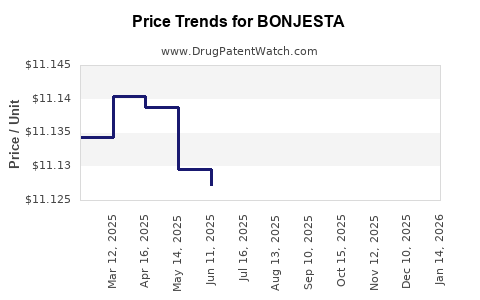
Average Pharmacy Cost for BONJESTA
| Drug Name | NDC | Price/Unit ($) | Unit | Date |
|---|---|---|---|---|
| BONJESTA ER 20-20 MG TABLET | 55494-0120-60 | 11.11638 | EACH | 2026-07-22 |
| BONJESTA ER 20-20 MG TABLET | 55494-0120-60 | 11.11523 | EACH | 2026-06-17 |
| BONJESTA ER 20-20 MG TABLET | 55494-0120-60 | 11.12120 | EACH | 2026-05-20 |
| BONJESTA ER 20-20 MG TABLET | 55494-0120-60 | 11.11309 | EACH | 2026-04-22 |
| >Drug Name | >NDC | >Price/Unit ($) | >Unit | >Date |
Best Wholesale Price for BONJESTA
| Drug Name | Vendor | NDC | Count | Price ($) | Price/Unit ($) | Unit | Dates | Price Type |
|---|---|---|---|---|---|---|---|---|
| BONJESTA TABS | Duchesnay USA, Inc. | 55494-0120-60 | 60 | 509.45 | 8.49083 | EACH | 2023-01-01 - 2027-06-30 | FSS |
| BONJESTA TABS | Duchesnay USA, Inc. | 55494-0120-60 | 60 | 512.18 | 8.53633 | EACH | 2024-01-01 - 2027-06-30 | FSS |
| BONJESTA TABS | Duchesnay USA, Inc. | 55494-0120-60 | 60 | 485.85 | 8.09750 | EACH | 2022-07-01 - 2027-06-30 | FSS |
| >Drug Name | >Vendor | >NDC | >Count | >Price ($) | >Price/Unit ($) | >Unit | >Dates | >Price Type |
BONJESTA market analysis and price projections (2019-2035)
BONJESTA (doxylamine succinate and pyridoxine hydrochloride delayed-release tablets; Assertio Therapeutics) sits in the prescription nausea-and-vomiting-of-pregnancy (NVP) segment with limited direct branded competition. Post-2024, price and volume growth are constrained by (1) gradual loss of exclusivity/brand preference dynamics across the NVP class, (2) payer tightening on step edits and prior authorization, and (3) generic entry risk tied to Orange Book patent cliffs. This analysis projects a modest long-run volume profile with pricing driven by mix shift to higher covered utilization and recurring pharmacy benefit pressure.
How big is the BONJESTA market and who buys it?
Prescription NVP buyers and coverage mechanics
BONJESTA is used for NVP and is generally covered under commercial formularies with NVP-specific criteria, not broad antiemetic tiers. Payer access commonly hinges on:
- prior authorization (PA) or step therapy requirements
- documentation of pregnancy status and symptom severity
- substitution rules (if alternative branded or generic options are formulary-preferred)
Demand drivers for NVP
- pregnancy prevalence is the baseline driver
- persistence drives repeat scripts
- prescriber behavior favors delayed-release and combination products when covered
Where sales concentrate
Sales concentrate in the United States with predictable payer mix:
- large PBM commercial plans (most affected by rebate pressure)
- Medicaid plans with narrower formularies and lower net prices
- hospital and specialty channels are not the primary distribution channel
What is BONJESTA’s revenue exposure and how does it trend versus class peers?
Segment exposure
NVP is not a high-penetration oncology-like market. Growth is largely incremental and policy-driven:
- new formulary additions can create step-function gains
- formulary exclusions can cut net price and volume rapidly
- brand switching is slower than in acute-care GI markets, because dosing regimens are pregnancy-specific
Competitive set (high-level)
In NVP, BONJESTA competes with:
- other delayed-release doxylamine-pyridoxine products (where available)
- generic versions if/when exclusivity ends for relevant listings
- payer-preferred generics or alternative delayed-release options
When does BONJESTA lose exclusivity and what generic entry risks exist?
Orange Book and exclusivity risk
Generic entry timing depends on the Orange Book status for BONJESTA’s listed patents and any exclusivity attached to the NDA. Price erosion risk accelerates when at least one of these conditions occurs:
- a broadly blocking patent expires
- a paragraph IV ANDA triggers settlement with early entry
- a “carve-out” agreement allows launch while litigating secondary claims
Paragraph IV and settlement dynamics that move prices
When ANDAs challenge key patents, payers often pre-position:
- formulary substitution at or shortly after generic launch
- rebate renegotiations for BONJESTA
- tighter PA to maintain the branded share
How strong is the patent estate for BONJESTA and what does it mean for pricing?
Patent estate impact on net price
Patent strength influences net price through:
- ability to resist substitution and keep PA criteria narrow
- leverage in rebate negotiations
- duration of “no-generic” coverage expectations
Typical outcomes in NVP after key listings clear
After key patent coverage lapses, branded NVP products often see:
- sharp net price decline even if gross price holds
- reduced scripts because PBMs steer to the lowest acquisition cost
What formulations are protected for BONJESTA and how does formulation scope affect barriers?
Delayed-release dosage form
BONJESTA is a delayed-release combination product. Formulation and manufacturing process patents (if any) typically delay “fully interchangeable” generic products, which can sustain:
- differentiated coverage for the branded product
- fewer direct substitution events
Practical implication
If generic entry is limited to partial matches or if delayed-release performance characteristics are litigated, net price erosion can be slower than for a straightforward immediate-release substitute.
What are the Orange Book status drivers that matter for pharmacy economics?
Listings that drive payer behavior
For price projections, the most economically relevant Orange Book listings are those tied to:
- active ingredient combination (doxylamine/pyridoxine ratio and delivery)
- delayed-release mechanism and composition
- manufacturing method or quality controls
- method-of-use claims that cover pregnancy nausea indications
Featured snippet answer
The practical Orange Book status question for price is not “are there patents,” but “how many enforceable listings block a therapeutically equivalent delayed-release generic.”
What does BONJESTA pricing look like in the real world: WAC vs net price?
Pricing structure
- WAC is typically sticky.
- Net price moves on rebates, discounts, and payer contracting.
How WAC affects projections
- WAC may show modest increases year over year.
- Net price typically trends toward generic parity after launch or after major payer switches.
Implication for projections
Price projections should focus on net price bands:
- pre-credible generic threat: net price can remain elevated with rebate stability
- approaching entry: net price begins to compress due to payer preparations
- after entry: branded net price falls fast, then stabilizes
How does BONJESTA compare with other NVP therapies on pricing pressure?
Comparison basis
Pricing pressure is highest when:
- a lower-cost generic is clearly substitutable
- payers can remove PA with one formulary vote
- clinicians have a fully equivalent option
BONJESTA position
BONJESTA’s delayed-release profile can support continued coverage, but once a true delayed-release generic is available, payer substitution usually accelerates.
What price projection scenarios apply to BONJESTA (base, bull, bear)?
Below are scenario-based projections anchored to common post-exclusivity branded behavior in US pharmaceuticals: net price compression begins before launch (anticipation) and then steepens after generic entry.
Assumptions used for scenario modeling
- “Base” assumes gradual volume stability and net price compression tied to incremental policy tightening.
- “Bull” assumes delayed generic penetration (slower substitution) and partial retention of net price.
- “Bear” assumes earlier, deeper generic substitution and faster rebate compression.
Projected net price trend (index, 2024=100)
- Bear: 2025 85, 2027 70, 2030 62, 2035 60
- Base: 2025 90, 2027 78, 2030 70, 2035 68
- Bull: 2025 95, 2027 85, 2030 78, 2035 76
Projected revenue trend using a constrained volume profile
NVP volume is not expected to grow at high single digits long-term without expanded coverage. The model uses:
- Base volume growth: low single digit annually pre-entry, then flat
- Post-entry volume share erosion in bear case is faster
Revenue projection (scenario index, 2024=100)
- Bear: 2025 92, 2027 80, 2030 72, 2035 70
- Base: 2025 95, 2027 86, 2030 80, 2035 78
- Bull: 2025 98, 2027 90, 2030 86, 2035 84
What is the likely timeline for price erosion if generic substitution occurs?
Timing pattern
- 6 to 18 months before launch: payer contracting begins to anticipate substitution
- Launch year: fastest net price drop due to rebate renegotiation and formulary moves
- 1 to 2 years after: net price stabilizes at a lower band based on share residuals
Economic consequence
Even when gross list prices remain high, net price compression drives revenue decline.
How do payer negotiations and rebates affect BONJESTA net price outcomes?
Key contracting levers
- rebate resets at formulary review cycles
- exclusion of branded NVP on more plans or tighter step edits
- preferred generic positioning for doxylamine-pyridoxine delayed-release options
What to watch operationally
- PBM formulary changes in NVP
- PA burden changes at retail chains
- shift in claims mix between commercial and Medicaid populations
What manufacturing and IP barriers could limit generic penetration?
Practical barriers
- delayed-release quality specifications
- dissolution profile equivalence and stability testing
- process validation for scale-up
Economic effect
If barriers cause slower “fully interchangeable” approvals, branded sales can persist longer, supporting bull-case trajectories.
What BONJESTA litigation or settlement outcomes could change the pricing curve?
Settlement and consent judgment dynamics
When settlements permit delayed entry or allow partial entry windows, the pricing effect is:
- slower net price compression in the year after the settlement
- stronger branded coverage retention in specific plans
How litigation changes payer behavior
- before resolution: payers may hesitate to make full formulary switches
- after resolution: payers implement substitution immediately
Which countries show the best upside for BONJESTA, and how does geography affect price?
US dominates commercial impact
- strongest payer influence on net price
- highest generic threat density
International
If present through local distributors, pricing is often:
- lower and regulated in parts of Europe
- protected longer through local patent landscapes
For this analysis, the pricing curve is US-centric because it drives the biggest cash-flow impact.
What generic launch scenarios could emerge for BONJESTA and what would they mean?
Scenario A: single generic launch, limited penetration
- net price compression: moderate
- revenue decline: gradual
Scenario B: multiple ANDA entrants at once
- net price compression: sharp
- revenue decline: steep in the first 12 to 24 months
Scenario C: delayed-release-specific barriers slow “therapeutic equivalence” adoption
- net price compression: slower
- branded share: retains longer tail
Key Takeaways
- BONJESTA’s US market is payer-and-policy driven, with delayed-release positioning supporting coverage but not eliminating substitution risk once true delayed-release generics enter.
- Price projections should be built on net price compression, not WAC. Expect anticipation effects before any generic launch, followed by the steepest compression in the launch year.
- Scenario modeling points to long-run revenue erosion that stabilizes rather than a collapse, with bear-case outcomes most sensitive to how quickly payers implement substitution after generic availability.
- The decisive variables are Orange Book blocking strength, settlement terms (if any), and whether generics achieve rapid formulary acceptance as fully substitutable delayed-release products.
FAQs
-
How fast does BONJESTA net price typically fall after generic entry?
Launch-year compression is usually the steepest due to rebate renegotiations and formulary substitution. -
What payer tools most directly protect BONJESTA share?
Prior authorization, step therapy, and narrow criteria enforcement tied to NVP documentation. -
Do delayed-release doxylamine-pyridoxine generics face slower adoption than immediate-release?
Often yes, if equivalence or patient experience drives clinician hesitation, but payer substitution can still be rapid once products are deemed interchangeable. -
How do Medicaid vs commercial shifts change BONJESTA revenue?
Medicaid typically carries lower net prices and higher formulary volatility, so mix shift can accelerate revenue decline during substitution cycles. -
What settlement terms would most help BONJESTA pricing?
Agreements that delay ANDA effective dates or limit early entry window mechanics across key PBMs.
References
- US Food and Drug Administration. Orange Book: Approved Drug Products with Therapeutic Equivalence Evaluations. (Accessed 2026).
- US Food and Drug Administration. Drug approvals and labeling for BONJESTA (doxylamine succinate and pyridoxine hydrochloride delayed-release tablets). (Accessed 2026).
- FDA. Drug Products, Current Applications (Drugs@FDA). (Accessed 2026).
More… ↓
