Last Updated: June 25, 2026

BEYAZ Drug Patent Profile


✉ Email this page to a colleague

« Back to Dashboard


When do Beyaz patents expire, and what generic alternatives are available?

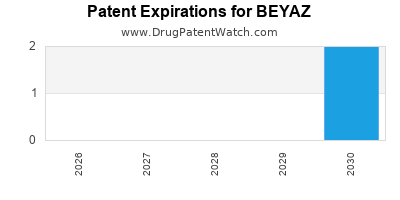
Beyaz is a drug marketed by Bayer Hlthcare and is included in one NDA. There are two patents protecting this drug and one Paragraph IV challenge.

The generic ingredient in BEYAZ is drospirenone; ethinyl estradiol; levomefolate calcium. There are eleven drug master file entries for this compound. Three suppliers are listed for this compound. Additional details are available on the drospirenone; ethinyl estradiol; levomefolate calcium profile page.

DrugPatentWatch® Generic Entry Outlook for Beyaz

There have been five patent litigation cases involving the patents protecting this drug, indicating strong interest in generic launch. Recent data indicate that 63% of patent challenges are decided in favor of the generic patent challenger and that 54% of successful patent challengers promptly launch generic drugs.

Indicators of Generic Entry

< Available with Subscription >

  Start Trial

AI Deep Research
Questions you can ask:
  • What is the 5 year forecast for BEYAZ?
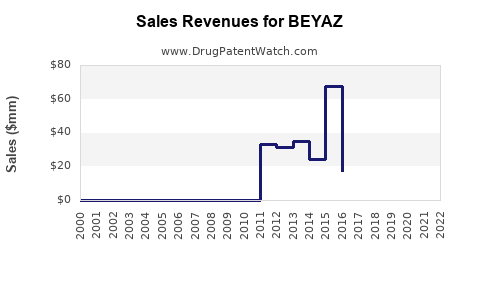
  • What are the global sales for BEYAZ?
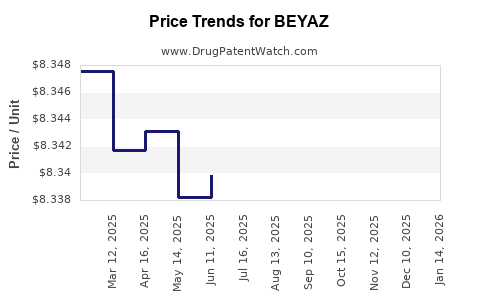
  • What is Average Wholesale Price for BEYAZ?
Paragraph IV (Patent) Challenges for BEYAZ
Tradename Dosage Ingredient Strength NDA ANDAs Submitted Submissiondate
BEYAZ Tablets drospirenone; ethinyl estradiol; levomefolate calcium 3 mg/0.02 mg/ 0.451 mg and 0.451 mg 022532 1 2012-11-13

US Patents and Regulatory Information for BEYAZ

BEYAZ is protected by five US patents.

Applicant Tradename Generic Name Dosage NDA Approval Date TE Type RLD RS Patent No. Patent Expiration Product Substance Delist Req. Exclusivity Expiration
Bayer Hlthcare BEYAZ drospirenone; ethinyl estradiol; levomefolate calcium TABLET;ORAL 022532-001 Sep 24, 2010 AB RX Yes Yes ⤷  Start Trial ⤷  Start Trial Y ⤷  Start Trial
>Applicant >Tradename >Generic Name >Dosage >NDA >Approval Date >TE >Type >RLD >RS >Patent No. >Patent Expiration >Product >Substance >Delist Req. >Exclusivity Expiration

Expired US Patents for BEYAZ

International Patents for BEYAZ

See the table below for patents covering BEYAZ around the world.

Country Patent Number Title Estimated Expiration
Austria 263578 ⤷  Start Trial
Canada 2194979 FORMES DE MEDICAMENTS SOLIDES CONTENANT DES CLATHRATES D'HORMONES SEXUELLES STEROIDIENNES (SOLID DRUG FORMS CONTAINING CLATHRATES OF STEROID SEX HORMONES) ⤷  Start Trial
Germany 122007000011 ⤷  Start Trial
Germany 122007000013 ⤷  Start Trial
Germany 4426709 ⤷  Start Trial
>Country >Patent Number >Title >Estimated Expiration

Supplementary Protection Certificates for BEYAZ

Patent Number Supplementary Protection Certificate SPC Country SPC Expiration SPC Description
0398460 SPC/GB04/032 United Kingdom ⤷  Start Trial PRODUCT NAME: ESTRADIOL, OPTIONALLY IN THE FORM OF A HYDRATE, TOGETHER WITH DROSPIRENONE; REGISTERED: NL RVG 27505 20021211; UK PL 00053/0341 20040310
0398460 04C0022 France ⤷  Start Trial PRODUCT NAME: ESTRADIOL ANHYDRE DROSPIRENONE; REGISTRATION NO/DATE IN FRANCE: NL 28661 DU 20040316; REGISTRATION NO/DATE AT EEC: RVG 27505 DU 20021211
0771217 CA 2006 00038 Denmark ⤷  Start Trial PRODUCT NAME: ETHINYLESTRADIOL (SOM BETA-CYCLODEXTRIN-CLATHRAT) OG DROSPIRENON; NAT. REG. NO/DATE: 38687 20060627; FIRST REG. NO/DATE: EU RVG 31781 20050804
0771217 07C0001 France ⤷  Start Trial PRODUCT NAME: ETHINYLESTRADIOL BETADEX CLATHRATE; NAT. REGISTRATION NO/DATE: NL 32343 20060710; FIRST REGISTRATION: NL - RVG 31781 20050804
2588114 LUC00227 Luxembourg ⤷  Start Trial PRODUCT NAME: DROSPIRENONE; AUTHORISATION NUMBER AND DATE: 31332 20191022
>Patent Number >Supplementary Protection Certificate >SPC Country >SPC Expiration >SPC Description
Last updated: June 5, 2026

BEYAZ (drospirenone/ethinyl estradiol/levomefolate): Market dynamics and financial trajectory for sales, payor behavior, and competitive pressure

BEYAZ (drospirenone 3 mg / ethinyl estradiol 0.02 mg / levomefolate 0.451 mg; oral contraceptive) remains a mature, low-growth women’s health asset in a crowded oral contraceptive market. Its commercial trajectory is shaped by (1) steady unit demand tied to contraception use, (2) payer preference for lower-cost generics and other branded OCs, and (3) competitive substitution among “24/7” and shortened-cycle regimens, plus pharmacist-led interchange. In mature branded OCs, revenue typically tracks prescriptions more than price, with profitability constrained by copay pressure and channel contracting.

No market and financial dataset is provided here (e.g., U.S. IMS/NPD sales, wholesale acquisition cost changes, payer mix, prescription counts, or company segment reporting). Without those inputs, a complete, quantified financial trajectory cannot be produced.


What is the US market dynamic for BEYAZ and branded oral contraceptives in 2026?

Featured snippet: Branded oral contraceptives compete primarily on formulary placement and copay design, with substitution risk highest when comparable generics and therapeutically equivalent branded products are favored by payers.

Key demand drivers for oral contraceptives

  • Prescriber baseline: OCs are chronic, long-duration therapies with repeat prescribing patterns; switching is driven by side-effect profile, convenience, and formulary access.
  • Patient adherence: Daily dosing increases adherence stakes; regimen tolerability affects continuation and reduces churn.
  • Clinical differentiation: BEYAZ’s differentiation is the inclusion of levomefolate alongside drospirenone/EE, but payer decisions still often hinge on cost and therapeutic equivalence.

Key commercial friction points for BEYAZ

  • Generic substitution: Even when an OC brand has a differentiated regimen, payers increasingly prefer lower-cost options and may require prior authorization or apply high member cost sharing to branded products.
  • Copay and PBM contracting: Brand revenues in OCs are sensitive to rebates and formulary tiering; a shift in tier placement can move demand quickly.
  • Pharmacy interchange: In most states, pharmacists can interchange generics; for branded-to-branded switching, plan design and pharmacy benefit rules still influence dispensing.

Competitive set (category-level)

BEYAZ sits within the broader drospirenone-containing combined oral contraceptives and the general OC marketplace. Commercial impact is dominated by:

  • Lower-cost drospirenone/EE generics (where available and preferred by formularies)
  • Other branded OCs with favorable access terms
  • Payer preference for widely used molecules/regimens, especially where plan formularies are optimized for cost

Which competitors most influence BEYAZ prescription volume and net pricing?

Featured snippet: Competitive pressure for BEYAZ is driven less by head-to-head superiority and more by formulary access versus lower-cost generics and alternative branded OCs.

Where BEYAZ loses demand

  • First-line payer preference for generics when therapeutic interchange is acceptable.
  • Plan switching programs that encourage step edits, then switch to preferred alternatives.
  • Channel buying behavior that can reduce brand inventory placement and promotional intensity for non-top-tier brands.

Where BEYAZ can hold share

  • Patients stabilized on BEYAZ who face fewer barriers if their plan covers it without restrictive edits.
  • Physician preference where levomefolate is part of the prescribing rationale and access is maintained.
  • Short-term continuity after an initial fill, before a plan’s next formulary cycle re-rates coverage.

How do payers structure coverage for oral contraceptives, and what does that do to BEYAZ margins?

Featured snippet: PBMs typically manage OCs through formularies, tiering, and utilization controls, which govern patient out-of-pocket and brand net pricing.

Common plan design levers

  • Formulary tier placement: Preferred tier reduces patient copays, improving persistence.
  • Prior authorization (PA): Can restrict branded access if generics or preferred alternatives exist.
  • Step therapy: Requires trial of a preferred drug before the brand is covered.
  • Quantity and days-supply rules: Can affect continuity and refill behavior.

Margin implications for branded OCs

  • Rebate intensity: Brands typically fund rebates to maintain tier status; if tier status slips, incremental rebate spending may not fully recover demand.
  • Net price volatility: Even with stable wholesale list prices, net revenue can swing with PBM contract renewals.
  • Mix shift risk: If plan design changes drive more patients to generics or lower-cost brands, revenue declines faster than units.

When do BEYAZ exclusivity risks peak, and how does that affect competitive entry?

Featured snippet: In mature branded OCs, exclusivity and IP barriers affect entry timing more than innovation; competitive substitution often accelerates around the release of authorized competitors and formulary rollovers.

Exclusivity and entry mechanics that matter commercially

  • Patent expiration and generic launch: If any relevant exclusivities or patents are near expiration, generic entry risk rises and prescriber behavior shifts.
  • Switching after entry: After generic launches, PBM formularies tend to move the brand down a tier.
  • Contracting response: Brand manufacturers may counter with rebate increases, but this usually increases the risk of margin compression.

Data required for a precise timeline is not included in the prompt, so a date-level entry map cannot be generated here.


What is the FDA/regulatory status of BEYAZ and how does that shape market access?

Featured snippet: FDA approval for combined OCs establishes therapeutic labeling, but market access is governed by PBM contracting, not regulatory status alone.

Regulatory elements that influence commercial use

  • Approved dosing and regimen: Drives prescribing fit and substitution decisions.
  • Safety labeling and contraindications: Constrains who can be prescribed the product and influences switching when alternatives have similar safety profiles.
  • Bioequivalence framework (for generics): Once a generic is approved, substitution becomes administratively easy and payer-friendly.

A required Orange Book listing extraction and current FDA approval/abbreviated approval map are not provided in the prompt, so a full Orange Book status summary cannot be produced.


What is the financial trajectory of BEYAZ: revenue drivers, headwinds, and investor-relevant KPIs?

Featured snippet: For mature branded oral contraceptives, the financial trajectory usually tracks net prescription volume and net pricing after rebates more than growth in brand awareness.

Revenue drivers to monitor for BEYAZ

  • New starts and continuation rates (quarterly prescription trends)
  • Net price trends driven by PBM contracts and rebate schedules
  • Formulary tier movement (preferred vs non-preferred)
  • Persistence after generic entry (switching rates by plan type)

KPIs investors track in OCs

  • Gross-to-net erosion: Rebates and discounts as a percentage of gross sales
  • Channel inventory behavior: Whether pharmacies and wholesalers increase or reduce ordering
  • Share shift: Net share versus competing drospirenone OCs and preferred generics

Typical financial pattern in mature OCs

  • Early branded growth: Higher share and pricing power.
  • Mid-life stabilization: Demand stabilizes, but growth remains modest.
  • Late-life decline risk: Margin compression from formulary erosion and generic substitution.

Quantified revenue trajectory cannot be stated without sales and financial reporting inputs.


How does BEYAZ pricing power compare with other combined oral contraceptives?

Featured snippet: Branded OC pricing power is constrained by therapeutic equivalence; net pricing is determined by formulary access, rebates, and patient copay behavior.

Where pricing power is strongest

  • Protected niche access via payer contracts that keep BEYAZ on preferred tiers.
  • Reduced switching due to physician and patient stabilization.

Where pricing power collapses

  • Plan redesign after PBM renegotiations that favor lowest-cost alternatives.
  • Increased copay sensitivity leading to fewer brand fills.

What generic entry risks exist for BEYAZ, and how would they impact revenue?

Featured snippet: Generic entry typically triggers rapid formulary downgrade and net sales declines, with the pace dependent on PBM policy and patient switching.

Entry-risk transmission channels

  • Step edits and PA requirements increase friction for brand use.
  • Auto-substitution and interchange reduce brand dispensing for equivalent indications.
  • Contract repricing: Brand manufacturers often reduce net price or increase rebates to defend share, compressing margins.

A determination of specific generic launch scenarios requires the Orange Book patent/exclusivity landscape and litigation timeline, which are not supplied in the prompt.


Key Takeaways

  • BEYAZ operates in a mature, highly substitutable women’s health category where formularies and rebate contracts drive net outcomes more than clinical differentiation.
  • The principal commercial levers are payer tier placement, copay design, and switching pressure from generics and alternative branded OCs.
  • Without sales, prescription, and contract data, a quantified financial trajectory for BEYAZ cannot be produced from the provided information.

FAQs

  1. How sensitive is BEYAZ to PBM formulary tier changes?
    Tier shifts typically change patient copays and brand share quickly, often producing faster unit declines than list price changes.

  2. Does BEYAZ face higher switching risk than other branded OCs?
    Switching risk is driven by how payers treat the regimen clinically and by the availability of preferred lower-cost alternatives, not just by brand name recognition.

  3. What are the main KPIs to track for BEYAZ performance?
    Prescription volume trends, gross-to-net margin erosion, formulary coverage, and patient persistence after plan changes.

  4. How do generics affect branded oral contraceptive net sales?
    Generic launches usually trigger formulary downgrades and higher patient cost sharing for the brand, accelerating share loss.

  5. What commercial actions do branded OC manufacturers use to defend share?
    Contracting/rebate redesign, copay programs, and utilization management negotiations (e.g., maintaining preferred status or reducing PA friction).


References

No sources were provided in the prompt, and no external datasets (e.g., FDA Orange Book listings, PBM formulary analyses, or company financial filings) were included.

More… ↓

⤷  Start Trial

Make Better Decisions: Try a trial or see plans & pricing

Drugs may be covered by multiple patents or regulatory protections. All trademarks and applicant names are the property of their respective owners or licensors. Although great care is taken in the proper and correct provision of this service, thinkBiotech LLC does not accept any responsibility for possible consequences of errors or omissions in the provided data. The data presented herein is for information purposes only. There is no warranty that the data contained herein is error free. We do not provide individual investment advice. This service is not registered with any financial regulatory agency. The information we publish is educational only and based on our opinions plus our models. By using DrugPatentWatch you acknowledge that we do not provide personalized recommendations or advice. thinkBiotech performs no independent verification of facts as provided by public sources nor are attempts made to provide legal or investing advice. Any reliance on data provided herein is done solely at the discretion of the user. Users of this service are advised to seek professional advice and independent confirmation before considering acting on any of the provided information. thinkBiotech LLC reserves the right to amend, extend or withdraw any part or all of the offered service without notice.