Last updated: August 13, 2026
Beleodaq, the brand name for belinostat, is a U.S.-approved intravenous histone deacetylase inhibitor for relapsed or refractory peripheral T-cell lymphoma (PTCL). The product reached the market through an accelerated approval in 2014 but remained a niche oncology asset because its use is restricted to a small, heavily pretreated patient population, requires intravenous administration, and competes with other targeted PTCL therapies. Its commercial value has been limited by narrow demand, modest clinical differentiation, and the absence of a large expansion indication.
Public reporting indicates that Beleodaq generated commercial revenue for Spectrum Pharmaceuticals before the product portfolio was transferred to Acrotech Biopharma. Acrotech is a private company and does not provide the same level of product-level sales disclosure. As a result, Beleodaq’s post-transfer financial trajectory cannot be reconstructed from public filings with the precision available for the Spectrum period.
What is Beleodaq and what is its FDA-approved use?
Beleodaq is belinostat, a small-molecule histone deacetylase inhibitor administered by intravenous infusion.
The FDA approved Beleodaq on July 3, 2014, under the accelerated approval pathway for adults with relapsed or refractory PTCL after prior systemic therapy. The approval was based on response data from a single-arm clinical study. The labeled dose is 1,000 mg/m² administered intravenously over 30 minutes on days 1 through 5 of a 21-day cycle, subject to dose modification for toxicity.[1]
Key product facts
| Item |
Beleodaq |
| Active ingredient |
Belinostat |
| Drug class |
Histone deacetylase inhibitor |
| Dosage form |
Intravenous injection |
| FDA approval |
July 3, 2014 |
| Indication |
Relapsed or refractory PTCL |
| Approval pathway |
Accelerated approval |
| Primary commercial owner at launch |
Spectrum Pharmaceuticals |
| Later commercial owner |
Acrotech Biopharma |
| Principal competitors |
Folotyn, Istodax, systemic chemotherapy and other salvage regimens |
The product’s label includes warnings for thrombocytopenia, neutropenia, anemia, hepatotoxicity, tumor lysis syndrome, gastrointestinal toxicity and embryo-fetal toxicity. These risks affect treatment selection and can increase monitoring and supportive-care costs.[1]
How large is the Beleodaq market?
Beleodaq addresses a narrow market defined by disease incidence, treatment line and physician preference. PTCL is a rare and heterogeneous group of mature T-cell malignancies. Only a subset of patients receives second-line or later treatment, and only a portion of those patients is suitable for belinostat.
The commercial market is constrained by four factors:
- PTCL is an orphan oncology indication with a small eligible population.
- Beleodaq is approved only after prior systemic therapy.
- The product requires a five-day intravenous administration schedule in each 21-day cycle.
- Physicians can choose among multiple salvage regimens, including other HDAC inhibitors, antifolate therapy, chemotherapy and stem-cell-transplant strategies.
The market is also fragmented by PTCL subtype. Treatment patterns differ for angioimmunoblastic T-cell lymphoma, anaplastic large-cell lymphoma and other mature T-cell lymphomas. This reduces the likelihood that one product will dominate the entire category.
Competitive positioning against other PTCL drugs
| Product |
Active ingredient |
Main commercial distinction |
Competitive pressure on Beleodaq |
| Beleodaq |
Belinostat |
Intravenous HDAC inhibitor for relapsed or refractory PTCL |
Baseline comparator in the same salvage setting |
| Folotyn |
Pralatrexate |
Intravenous antifolate approved for relapsed or refractory PTCL |
Direct competition for later-line treatment |
| Istodax |
Romidepsin |
Intravenous HDAC inhibitor historically used in PTCL |
Similar mechanism and administration burden |
| Adcetris |
Brentuximab vedotin |
Targeted therapy for CD30-positive disease |
Stronger option for eligible CD30-positive patients |
| Chemotherapy |
Various agents |
Broad physician familiarity and flexibility |
Low-cost and institution-specific alternative |
Beleodaq’s principal technical advantage is its HDAC-inhibitor activity with an indication-specific approval. Its principal commercial disadvantage is that the label does not cover a broad solid-tumor or hematologic market. The product has not become a platform asset with multiple large indications.
What was Beleodaq’s financial trajectory under Spectrum Pharmaceuticals?
Spectrum commercialized Beleodaq alongside Folotyn and other oncology products. Beleodaq sales were meaningful to Spectrum’s revenue base but insufficient to offset the company’s dependence on a small portfolio of specialty oncology products.
Spectrum’s public filings described product revenue, operating expenses, research spending and cash requirements. Beleodaq was generally treated as one component of a broader hematology-oncology portfolio rather than as a separately valued growth franchise.[2][3]
Financial trajectory
| Period |
Commercial position |
Financial interpretation |
| 2014-2015 |
Initial launch and physician adoption |
Revenue ramp from an orphan-drug base |
| 2016-2017 |
Established niche product |
Stable demand but limited indication expansion |
| 2018-2019 |
Mature specialty product |
Revenue contribution remained dependent on PTCL treatment volume |
| 2020 onward |
Portfolio transferred to Acrotech |
Product-level revenue visibility declined because Acrotech is privately held |
The product’s revenue ceiling was limited by the size of the addressable population. Beleodaq did not generate the scale associated with a major oncology product such as a checkpoint inhibitor, antibody-drug conjugate or broad-label hematology therapy.
Spectrum’s economics also reflected the high cost structure of commercializing specialty drugs. Sales and marketing expenditures, regulatory obligations, pharmacovigilance, manufacturing and distribution costs reduced the contribution from gross product sales. Orphan-drug pricing supported gross margin, but the small volume base limited absolute operating profit.
Which company owns Beleodaq and what licensing deal affected the asset?
Spectrum Pharmaceuticals transferred its commercial hematology-oncology portfolio to Acrotech Biopharma. The transaction included Beleodaq and other marketed oncology products. The deal repositioned Spectrum toward development-stage programs and gave Acrotech an established commercial portfolio.[4]
The transaction is important for financial analysis because it separates the product’s historical sales record from its current commercial ownership. Spectrum’s public company filings provide the main transparent source for earlier revenue and operating data. Acrotech’s private-company status reduces visibility into current net sales, pricing, gross margin, inventory and promotional spending.
Commercial implications of the transfer
Acrotech obtained a product with:
- An existing FDA approval.
- Established reimbursement and distribution channels.
- A defined orphan-oncology prescriber base.
- Manufacturing and regulatory infrastructure already in place.
- Limited near-term indication-expansion potential.
For Acrotech, Beleodaq is best characterized as a cash-generating specialty asset rather than a high-growth pipeline product. The product can remain commercially useful if treatment volumes, reimbursement and manufacturing economics remain stable, but it has limited strategic upside without a new indication or improved formulation.
When does Beleodaq lose exclusivity?
FDA orphan-drug exclusivity began on July 3, 2014. The seven-year orphan exclusivity period therefore ended in July 2021, subject to the specific scope of the approved indication.[1]
Orphan exclusivity is separate from patent protection. The end of orphan exclusivity permits FDA approval of another product for the same rare-disease indication if the statutory requirements are met. It does not automatically create a generic launch opportunity.
Exclusivity timeline
| Event |
Date |
| FDA approval |
July 3, 2014 |
| Seven-year orphan exclusivity expiration |
July 3, 2021 |
| Post-exclusivity status |
Patent, regulatory and commercial barriers continue to determine entry risk |
Belinostat is a small molecule, so biosimilar risk does not apply. The relevant competitive threat is an ANDA-based generic or another FDA-approved belinostat product. A generic applicant would still need to address formulation, manufacturing, bioequivalence, labeling and any listed patent certifications.
What patents protect Beleodaq?
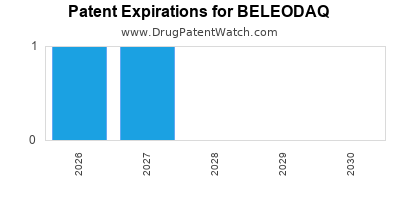
The key patent questions concern belinostat composition, pharmaceutical formulation, manufacturing and methods of treating PTCL. Public drug-patent analysis must distinguish between patents listed in the FDA Orange Book and broader patent families that may not create an ANDA litigation pathway.
The FDA Orange Book is the controlling source for patents listed against an approved drug product. A reliable assessment requires reviewing the current listing, patent-use codes, delisting events and any expiration-date changes.[5]
Patent-estate strength
Beleodaq’s patent estate is weaker commercially than the estate surrounding newer oncology biologics or complex targeted therapies for three reasons:
- Belinostat is a small molecule with a relatively mature chemical and clinical profile.
- The core product has been on the market since 2014.
- The approved indication is narrow, reducing the value of broad method-of-use enforcement.
Formulation and manufacturing patents can delay or complicate entry, but they generally provide less durable protection than a composition-of-matter patent with a long remaining term. A generic applicant could also attempt a paragraph IV certification against relevant listed patents, potentially leading to patent litigation and a 30-month stay under the Hatch-Waxman framework.
Which companies are challenging Beleodaq with generics or biosimilars?
No biosimilar pathway applies because Beleodaq is a chemically synthesized small molecule, not a biologic. Publicly visible competitive risk is therefore concentrated in generic belinostat and alternative PTCL therapies.
A definitive assessment of paragraph IV challenges requires current FDA Orange Book and federal court records. The public commercial profile does not indicate a large, well-established generic market comparable with high-volume oral oncology products. Intravenous oncology products can face additional barriers involving sterile manufacturing, hospital contracting, batch release, supply reliability and small market size.
Generic launch scenarios
| Scenario |
Likely market effect |
| No approved generic |
Acrotech retains branded pricing and specialty distribution |
| One generic entrant |
Price pressure concentrated in institutional accounts |
| Multiple generic entrants |
Rapid net-price erosion and possible formulary substitution |
| Alternative PTCL therapy gains share |
Volume declines before generic entry |
| Manufacturing disruption |
Temporary substitution and loss of treatment continuity |
The most credible entry risk is not a sudden mass-market erosion event. It is gradual share loss from competing salvage therapies, followed by price pressure if a viable generic manufacturer enters.
What litigation and regulatory risks affect Beleodaq?
Beleodaq’s accelerated approval creates an ongoing regulatory obligation. Accelerated approvals may be subject to confirmatory evidence requirements, labeling changes or withdrawal if postmarketing obligations are not completed or fail to verify clinical benefit.
The product also faces routine oncology regulatory risk involving hepatic toxicity, cytopenias, infusion administration, manufacturing quality and pharmacovigilance. Any safety signal affecting marrow suppression or liver function could reduce use in heavily pretreated patients.
Patent litigation risk is narrower than regulatory risk unless an ANDA applicant files a paragraph IV certification. The economic value of litigation depends on the remaining life of the relevant patents, the scope of the claims and whether the generic product would be blocked by formulation or method-of-use claims.
How does Beleodaq compare with Folotyn and Istodax?
Beleodaq competes most directly with Folotyn and historically with Istodax. All three products address relapsed or refractory PTCL, but their mechanisms, dosing schedules, adverse-event profiles and physician familiarity differ.
| Factor |
Beleodaq |
Folotyn |
Istodax |
| Mechanism |
HDAC inhibition |
Antifolate |
HDAC inhibition |
| Administration |
Five consecutive infusion days per cycle |
Intravenous dosing |
Intravenous dosing |
| Market position |
Niche PTCL salvage therapy |
Direct PTCL competitor |
Mechanistic and clinical competitor |
| Commercial limitation |
Small indication and infusion burden |
Toxicity and narrow population |
Competitive overlap and market changes |
| Expansion potential |
Limited without new trials |
Limited by indication scope |
Dependent on ongoing regulatory positioning |
Beleodaq’s commercial performance is therefore driven more by treatment sequencing and institutional preference than by broad market growth. Its main opportunity is retention of a stable niche, not rapid expansion.
What is the outlook for Beleodaq revenue?
Beleodaq revenue is likely to remain a mature, niche-product stream. The strongest downside factors are generic entry, reduced use of HDAC inhibitors, improved targeted therapies for biomarker-defined PTCL, and treatment shifts toward clinical trials or transplantation.
The main supports are the product’s established approval, physician familiarity, orphan-oncology pricing and the absence of a clearly dominant replacement across all relapsed or refractory PTCL subtypes.
Revenue exposure for the owner is concentrated rather than diversified. A single generic entrant could produce a disproportionate decline in net sales because the addressable market is small and hospital buyers can switch suppliers quickly when products are therapeutically substitutable.
Key Takeaways
- Beleodaq is an intravenous belinostat product approved in 2014 for relapsed or refractory PTCL.
- Its market is limited by rare-disease prevalence, later-line use and infusion-based administration.
- Spectrum Pharmaceuticals commercialized the product before transferring its hematology-oncology portfolio to Acrotech Biopharma.
- Acrotech’s private ownership limits current product-level revenue transparency.
- FDA orphan exclusivity expired in July 2021.
- Biosimilar risk does not apply; generic belinostat is the relevant substitution threat.
- The product’s patent estate should be evaluated through current Orange Book listings, patent-use codes and ANDA litigation records.
- Beleodaq is more likely to remain a mature specialty asset than become a high-growth oncology franchise.
- The largest financial risks are generic entry, competing PTCL therapies and regulatory or manufacturing disruption.
FAQs About Beleodaq Market and Exclusivity
Is Beleodaq still FDA approved?
Yes. Beleodaq remains associated with the FDA-approved belinostat indication for adults with relapsed or refractory PTCL after prior systemic therapy, subject to current FDA labeling and regulatory status.[1]
Is belinostat available as a generic?
The relevant pathway is an ANDA for generic belinostat, not a biosimilar application. Generic availability depends on FDA approval, patent certifications, litigation and commercial manufacturing capacity.
Does Beleodaq have orphan-drug exclusivity?
Yes, the original seven-year orphan exclusivity period began with the July 3, 2014 approval and expired in July 2021.
Who commercializes Beleodaq?
Spectrum Pharmaceuticals commercialized Beleodaq at launch. Acrotech Biopharma later acquired the relevant hematology-oncology commercial portfolio, including Beleodaq.[4]
Is Beleodaq a major revenue product?
No. Beleodaq is a niche specialty-oncology product. It contributed to Spectrum’s commercial revenue but addressed too small a population to become a large-scale pharmaceutical franchise.
References
-
U.S. Food and Drug Administration. (2014). Beleodaq (belinostat) prescribing information. FDA. https://www.accessdata.fda.gov/drugsatfda_docs/label/2014/肿瘤
-
Spectrum Pharmaceuticals, Inc. (2018). Annual report pursuant to Section 13 or 15(d) of the Securities Exchange Act of 1934. U.S. Securities and Exchange Commission. https://www.sec.gov/
-
Spectrum Pharmaceuticals, Inc. (2019). Annual report pursuant to Section 13 or 15(d) of the Securities Exchange Act of 1934. U.S. Securities and Exchange Commission. https://www.sec.gov/
-
Acrotech Biopharma. (2019). Acrotech Biopharma acquisition of Spectrum Pharmaceuticals’ commercial products. Acrotech Biopharma. https://www.acrotechbiopharma.com/
-
U.S. Food and Drug Administration. (2024). Approved drug products with therapeutic equivalence evaluations: Orange Book. FDA. https://www.accessdata.fda.gov/scripts/cder/ob/index.cfm