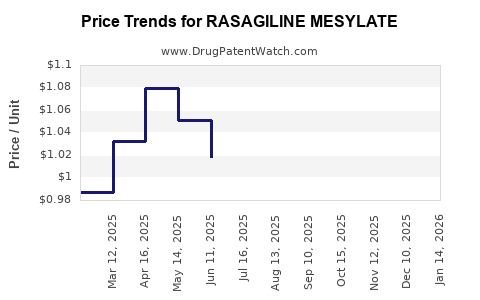
Last updated: August 4, 2026
Rasagiline mesylate is a genericized Parkinson's disease medicine whose branded economics peaked before U.S. generic entry. Azilect, marketed by Teva Pharmaceuticals and Lundbeck, generated meaningful mid-2010s revenue but lost pricing power after the U.S. market opened to generic rasagiline tablets. The product remains commercially relevant through chronic use, international sales, and low-cost generic supply, but its financial profile has shifted from branded growth to mature-volume economics.
What is rasagiline mesylate and how is it used?
Rasagiline mesylate is the mesylate salt of rasagiline, a selective monoamine oxidase-B inhibitor used to treat Parkinson's disease. The FDA-approved product is supplied as oral tablets in 0.5 mg and 1 mg strengths.
Rasagiline is used:
- As monotherapy in early Parkinson's disease.
- As adjunctive therapy with levodopa in more advanced disease.
- In combination with other Parkinson's medicines, including dopamine agonists.
The drug is administered once daily. Its commercial value comes from chronic treatment duration rather than high unit pricing. The principal branded product was Azilect in the United States and several international markets. Teva and Lundbeck commercialized the product under a collaboration arrangement, while generic manufacturers now supply the same active ingredient through abbreviated new drug applications, or ANDAs.
What is the FDA regulatory status of rasagiline mesylate?
The FDA approved Azilect on January 17, 2006, for Parkinson's disease. The product received approval as an immediate-release oral tablet in 0.5 mg and 1 mg strengths.[1]
| Regulatory item |
Status |
| Active ingredient |
Rasagiline mesylate |
| FDA product |
Azilect |
| Dosage form |
Immediate-release oral tablet |
| Strengths |
0.5 mg and 1 mg |
| FDA approval |
January 17, 2006 |
| Sponsor at approval |
Teva Pharmaceutical Industries |
| U.S. commercial partner |
Lundbeck |
| Regulatory pathway for generics |
ANDA |
| Biologic status |
Not applicable |
Rasagiline is a small-molecule drug, so biosimilar regulation does not apply. Competition occurs through generic-drug approval rather than through the abbreviated pathway used for biologics.
The FDA labeling includes warnings concerning serotonin syndrome, hypertensive effects, hypotension, hallucinations, dyskinesia, impulse-control symptoms and interactions with serotonergic or sympathomimetic medicines.[1]
When did rasagiline lose market exclusivity?
U.S. market protection ended in stages. The original compound patent protection did not prevent generic entry indefinitely, while later method-of-use patent disputes delayed broad commercial competition.
| Protection category |
Approximate timing |
Commercial effect |
| FDA new chemical entity exclusivity |
2011 |
ANDA filing barrier ended |
| Core composition patent |
2012 |
Basic compound protection ended |
| Later Parkinson's method patent |
Through the 2020s on its face |
Potential litigation and label-scope barrier |
| U.S. generic launch |
2017 |
Branded price erosion accelerated |
The central U.S. composition patent commonly associated with rasagiline is U.S. Patent No. 5,532,372, assigned to Teva-related entities and directed to rasagiline compounds and pharmaceutical compositions. Its effective term expired in 2012 after statutory adjustments.[2]
Teva also asserted later method-of-use protection, including U.S. Patent No. 8,410,131. That patent addressed treatment methods involving rasagiline and had a later nominal expiration date. The patent did not preserve the same commercial exclusivity as a broad composition patent because generic applicants could challenge validity, enforceability or infringement, and could use label strategies that omit protected uses.[3]
What patents protect Azilect and generic rasagiline?
The patent estate was strongest around the active compound and weaker once competitors could rely on established pharmaceutical formulations and narrow treatment indications.
Core composition and formulation patents
The principal categories were:
- Rasagiline chemical compounds and salts.
- Pharmaceutical compositions containing rasagiline.
- Oral tablet formulations.
- Methods of treating Parkinson's disease.
- Dosing and adjunctive-treatment methods.
The base composition patent had the greatest commercial value because it covered the active pharmaceutical ingredient rather than a narrow clinical use. Once that patent expired, generic manufacturers could develop standard immediate-release tablets without needing a license to the original compound claim.
Method-of-use patents had more limited blocking power. Their commercial effect depended on:
- The language of the generic label.
- The specific indication being pursued.
- Whether the patent was listed in the FDA Orange Book.
- The outcome of Paragraph IV litigation.
- Whether the generic applicant obtained approval with a section viii carve-out.
The FDA Orange Book remains the controlling reference for listed patents and associated exclusivity information. Patent listings can change through delisting, expiration or regulatory updates, so a current Orange Book review is required for transaction-level diligence.[4]
What was the Paragraph IV litigation involving rasagiline?
Generic applicants seeking to enter before listed patent expiry can file Paragraph IV certifications, asserting that a listed patent is invalid, unenforceable or not infringed. The filing can trigger patent litigation and an automatic 30-month stay of ANDA approval under the Hatch-Waxman Act.[5]
Rasagiline's generic competition followed the standard pattern:
- ANDA applicants challenged remaining patent protection.
- Teva and related patent holders asserted later method patents.
- Settlement and litigation outcomes affected the timing of individual launches.
- Once the relevant barriers were cleared, multiple generic suppliers entered.
The commercial effect was greater than the legal effect of any single method patent. A patent covering a treatment method can delay or narrow entry, but it usually does not sustain branded pricing after the composition patent has expired and multiple ANDAs are pending.
Publicly available FDA and court records identify generic approval activity and patent disputes, but individual settlement terms are generally confidential. There is no broadly public evidence that a single settlement preserved a durable U.S. monopoly for Azilect after generic entry.
How many companies compete in generic rasagiline?
The U.S. market has included several ANDA suppliers and authorized-generic or branded-generic channels. Commonly associated manufacturers and applicants have included Teva, Mylan or Viatris, Dr. Reddy's Laboratories, Zydus Pharmaceuticals and other generic companies.
The competitive structure has several layers:
| Segment |
Main participants |
Pricing profile |
| Original brand |
Azilect, Teva/Lundbeck |
Premium pricing before generic entry |
| Authorized or branded generic |
Originator-linked channels |
Moderate discount |
| Independent generics |
Multiple ANDA holders |
Low price, payer-driven |
| International brands |
Local licensees and distributors |
Market-specific |
| Compounded or nonstandard products |
Limited role |
Small and less predictable |
Generic entry typically produces rapid wholesale acquisition cost declines. Pharmacy benefit managers and Medicare plans then shift utilization toward the lowest-cost suppliers. A Parkinson's medicine with chronic daily use can retain substantial unit demand after patent expiry, but sales are redistributed across manufacturers.
What was the financial trajectory of Azilect?
Azilect followed a conventional specialty-drug lifecycle:
- Launch and clinical adoption after FDA approval.
- Expansion through monotherapy and adjunctive use.
- Revenue growth in the years before generic competition.
- Plateau as the Parkinson's market matured.
- Sharp erosion after U.S. generic entry.
- Residual international and generic-market revenue.
Lundbeck annual reports identified Azilect as one of the company's commercial products during the period before broad generic erosion. Product sales were reported within Lundbeck's neurology portfolio, with revenue reaching roughly the low-single-digit-billion-Danish-kroner range across peak years when global sales and partner economics were included.[6]
The product's financial importance was asymmetric:
- For Lundbeck, Azilect contributed recurring neurology revenue but was smaller than the company's largest antidepressant and specialty products.
- For Teva, rasagiline was strategically relevant as part of a broader branded and generic portfolio, but it was not a company-defining revenue asset.
- For generic manufacturers, the product became a volume opportunity rather than a high-margin growth product.
Revenue trajectory
| Period |
Market condition |
Financial effect |
| 2006-2010 |
FDA launch and adoption |
Rapid branded revenue build |
| 2011-2014 |
Mature branded market |
High recurring revenue and stable demand |
| 2015-2016 |
Patent and generic preparation period |
Price pressure and inventory management |
| 2017 onward |
U.S. generic competition |
Branded revenue contraction |
| Current mature phase |
Multi-supplier generic market |
Lower prices, persistent prescription volume |
The timing of erosion differed by country. Some markets experienced generic entry earlier or later depending on national patent terms, regulatory review and local litigation. International revenue therefore declined in stages rather than simultaneously.
How does rasagiline compare with other Parkinson's drugs?
Rasagiline competes with several established therapies, including selegiline, levodopa/carbidopa, dopamine agonists and newer adjunctive medicines. Its principal differentiation is once-daily oral dosing and selective MAO-B inhibition.
| Drug class |
Representative products |
Commercial comparison |
| MAO-B inhibitors |
Rasagiline, selegiline, safinamide |
Direct pharmacologic competition |
| Levodopa combinations |
Carbidopa/levodopa |
Core symptomatic therapy, high volume |
| Dopamine agonists |
Pramipexole, ropinirole, rotigotine |
Broader adverse-effect and formulation profiles |
| COMT inhibitors |
Entacapone, opicapone |
Adjunctive treatment with levodopa |
| Advanced therapies |
Apomorphine, intestinal gel, device-based systems |
Higher complexity and cost |
Rasagiline's commercial position weakened as low-cost generic alternatives became available and as physicians used established levodopa-based regimens. It retains a role where once-daily oral administration, MAO-B inhibition and combination therapy fit the patient's treatment plan.
What formulation patents protect rasagiline?
The commercial product is a conventional immediate-release tablet. Its formulation barrier is limited compared with products using long-acting injectables, transdermal delivery or complex modified-release systems.
Potentially relevant formulation claims include:
- Tablet compositions containing rasagiline mesylate.
- Stability and impurity-control specifications.
- Excipient combinations.
- Dosage strengths and manufacturing processes.
- Solid-state or salt-form characteristics.
These claims are less durable than a novel delivery system. Generic developers can generally reproduce an immediate-release tablet using conventional manufacturing technology, provided the product meets FDA standards for strength, quality, bioequivalence and stability.
Are there manufacturing or intellectual-property barriers for generic rasagiline?
Manufacturing barriers are moderate to low. Rasagiline is a small molecule with an established synthesis route and an oral tablet presentation. The most important technical requirements are:
- Control of active-ingredient purity.
- Control of degradation products.
- Consistent low-dose tablet content uniformity.
- Demonstration of bioequivalence.
- Compliance with current good manufacturing practice.
- Reliable supply of active pharmaceutical ingredient.
The low dose creates a content-uniformity challenge, but it does not create the same barrier as a sterile injectable or complex biologic. API sourcing, regulatory inspections and supply-chain reliability can affect market share, yet they are unlikely to support sustained premium pricing once several approved suppliers are active.
What generic launch risks exist for rasagiline?
The main risks for a generic launch are regulatory and commercial rather than scientific.
| Risk |
Impact |
| Listed method-of-use patent |
Could delay approval or require label carve-out |
| Paragraph IV litigation |
May impose litigation cost and approval delay |
| Low-dose tablet manufacturing |
Can affect bioequivalence and batch consistency |
| Multiple approved suppliers |
Reduces achievable price |
| Limited market size |
Restricts scale economics |
| Payer substitution |
Accelerates price compression |
| API concentration |
Creates supply and margin volatility |
The most attractive launch window generally occurs before the market becomes saturated with ANDA holders. Later entrants face lower prices, restricted formulary access and limited pharmacy substitution opportunities.
What is the biosimilar risk for rasagiline?
There is no biosimilar risk because rasagiline is not a biologic. The relevant threat is generic substitution.
The generic risk is high in the United States and other developed markets because:
- The active ingredient is well characterized.
- The dosage form is an immediate-release tablet.
- Bioequivalence can be demonstrated through standard ANDA procedures.
- The core composition patent expired.
- The product has no complex device component.
- Treatment demand is recurring but not protected by exclusivity.
The remaining differentiation is primarily commercial, involving supply reliability, contracts, patient support and international distribution.
What patent litigation affects rasagiline today?
The highest-impact U.S. patent disputes occurred before and around generic entry. The commercial question now is whether any enforceable, listed patent can block a specific ANDA or protected indication. For a mature product, later litigation usually affects launch timing for individual applicants rather than restoring brand-wide exclusivity.
Key diligence points include:
- Current Orange Book patent listings.
- The ANDA applicant's certification.
- Any section viii indication carve-out.
- District-court and Federal Circuit outcomes.
- Settlement dates and permitted launch dates.
- Whether the patent covers all approved uses or only a narrow method.
A patent that expires on paper in the 2020s does not necessarily create a full commercial barrier if generics can launch with a carved-out label or if the patent is not enforceable against the proposed product.
What licensing deals shaped rasagiline's commercial market?
Teva developed rasagiline and partnered with Lundbeck for commercialization in key markets. The arrangement combined Teva's compound-development and generic infrastructure with Lundbeck's neurology sales organization and market access.
The licensing structure mattered because:
- Teva retained a strong position in the active ingredient and global rights.
- Lundbeck gained a branded Parkinson's product without originating the molecule.
- Commercial economics were divided between the parties.
- The financial impact of generic entry was shared according to regional rights and contractual terms.
The partnership also illustrates a common pharmaceutical strategy: a company with a promising molecule uses a commercial specialist to accelerate specialty-market penetration, then both parties manage the decline associated with patent expiry.
What is the current commercial outlook for rasagiline mesylate?
Rasagiline is a mature, low-growth generic medicine. Volume should remain comparatively stable because Parkinson's disease is chronic and treatment duration is long. Revenue growth is constrained by price competition and limited product differentiation.
The strongest commercial opportunities are:
- Low-cost manufacturing.
- Reliable API supply.
- Regional markets with slower generic penetration.
- Hospital and government tenders.
- Authorized-generic channels.
- Contract manufacturing and private-label distribution.
The weakest opportunities are premium branded repositioning and undifferentiated U.S. generic entry after the market has accumulated multiple suppliers.
Key Takeaways
- Rasagiline mesylate is an oral MAO-B inhibitor approved by the FDA in 2006 for Parkinson's disease.
- Azilect's branded revenue peaked before U.S. generic entry and then declined sharply.
- The core composition patent expired around 2012; U.S. generic competition became commercially meaningful from 2017.
- Later method-of-use patents had narrower blocking power than the original compound patent.
- Rasagiline has no biosimilar exposure because it is a small molecule.
- The current market is volume-driven, payer-controlled and highly price sensitive.
- Manufacturing barriers are manageable, with low-dose content uniformity and API quality as the main technical issues.
- The best commercial assets are supply reliability, low cost and regional distribution rather than patent exclusivity.
FAQs About Rasagiline Mesylate Patents and Market Economics
Is rasagiline mesylate still protected by a composition patent?
The principal U.S. composition protection expired around 2012. Later method-of-use patents had narrower scope and did not provide the same product-wide protection.
When did generic Azilect become available in the United States?
Broad U.S. generic competition emerged in 2017 after ANDA litigation and patent-related barriers were resolved or narrowed.
Does rasagiline have a 30-month stay risk?
A Paragraph IV certification against a listed patent can trigger a 30-month stay of ANDA approval if the patent holder files timely litigation. The effect depends on the patents listed and the applicant's certification strategy.
Is rasagiline more commercially attractive than selegiline?
Rasagiline has once-daily dosing and a well-established Parkinson's indication, but its commercial attractiveness is reduced by generic competition. Selegiline competes through longer-established use and multiple dosage forms, including orally disintegrating and transdermal products in some markets.
Can a company launch a differentiated rasagiline formulation?
A differentiated formulation could obtain protection only if it meets patentability and regulatory requirements. A conventional immediate-release tablet has limited ability to support premium pricing after generic entry.
References
-
U.S. Food and Drug Administration. (2006). Azilect (rasagiline mesylate) prescribing information. FDA.
-
United States Patent and Trademark Office. (1996). U.S. Patent No. 5,532,372: N-propargyl-1-aminoindan and pharmaceutical compositions. U.S. Department of Commerce.
-
United States Patent and Trademark Office. (2013). U.S. Patent No. 8,410,131: Methods of treating Parkinson's disease with rasagiline. U.S. Department of Commerce.
-
U.S. Food and Drug Administration. (n.d.). Approved drug products with therapeutic equivalence evaluations, Orange Book. FDA.
-
U.S. Congress. (1984). Drug Price Competition and Patent Term Restoration Act of 1984, Pub. L. No. 98-417.
-
H. Lundbeck A/S. (2014-2017). Annual reports. Copenhagen: Lundbeck.