Last Updated: July 24, 2026

AUBAGIO Drug Patent Profile


✉ Email this page to a colleague

« Back to Dashboard


When do Aubagio patents expire, and when can generic versions of Aubagio launch?

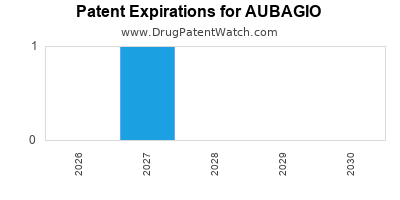
Aubagio is a drug marketed by Sanofi Aventis Us and is included in one NDA. There are three patents protecting this drug and one Paragraph IV challenge.

This drug has eighty-one patent family members in forty-eight countries.

The generic ingredient in AUBAGIO is teriflunomide. There are nineteen drug master file entries for this compound. Sixteen suppliers are listed for this compound. Additional details are available on the teriflunomide profile page.

DrugPatentWatch® Litigation and Generic Entry Outlook for Aubagio

A generic version of AUBAGIO was approved as teriflunomide by TEVA PHARMS USA on September 4th, 2018.

  Start Trial

AI Deep Research
Questions you can ask:
  • What is the 5 year forecast for AUBAGIO?
  • What are the global sales for AUBAGIO?
  • What is Average Wholesale Price for AUBAGIO?
Recent Clinical Trials for AUBAGIO

Identify potential brand extensions & 505(b)(2) entrants

SponsorPhase
Beijing Tsinghua Changgeng HospitalPhase 2
Beijing Friendship HospitalPhase 2
Peking University Third HospitalPhase 2

See all AUBAGIO clinical trials

Pharmacology for AUBAGIO
Paragraph IV (Patent) Challenges for AUBAGIO
Tradename Dosage Ingredient Strength NDA ANDAs Submitted Submissiondate
AUBAGIO Tablets teriflunomide 7 mg and 14 mg 202992 21 2016-09-12

US Patents and Regulatory Information for AUBAGIO

AUBAGIO is protected by three US patents.

Applicant Tradename Generic Name Dosage NDA Approval Date TE Type RLD RS Patent No. Patent Expiration Product Substance Delist Req. Exclusivity Expiration
Sanofi Aventis Us AUBAGIO teriflunomide TABLET;ORAL 202992-001 Sep 12, 2012 AB RX Yes No ⤷  Start Trial ⤷  Start Trial Y ⤷  Start Trial
Sanofi Aventis Us AUBAGIO teriflunomide TABLET;ORAL 202992-002 Sep 12, 2012 AB RX Yes Yes ⤷  Start Trial ⤷  Start Trial Y ⤷  Start Trial
Sanofi Aventis Us AUBAGIO teriflunomide TABLET;ORAL 202992-001 Sep 12, 2012 AB RX Yes No ⤷  Start Trial ⤷  Start Trial Y ⤷  Start Trial
Sanofi Aventis Us AUBAGIO teriflunomide TABLET;ORAL 202992-002 Sep 12, 2012 AB RX Yes Yes ⤷  Start Trial ⤷  Start Trial Y ⤷  Start Trial
>Applicant >Tradename >Generic Name >Dosage >NDA >Approval Date >TE >Type >RLD >RS >Patent No. >Patent Expiration >Product >Substance >Delist Req. >Exclusivity Expiration

Expired US Patents for AUBAGIO

Applicant Tradename Generic Name Dosage NDA Approval Date Patent No. Patent Expiration
Sanofi Aventis Us AUBAGIO teriflunomide TABLET;ORAL 202992-001 Sep 12, 2012 ⤷  Start Trial ⤷  Start Trial
Sanofi Aventis Us AUBAGIO teriflunomide TABLET;ORAL 202992-002 Sep 12, 2012 ⤷  Start Trial ⤷  Start Trial
Sanofi Aventis Us AUBAGIO teriflunomide TABLET;ORAL 202992-001 Sep 12, 2012 ⤷  Start Trial ⤷  Start Trial
>Applicant >Tradename >Generic Name >Dosage >NDA >Approval Date >Patent No. >Patent Expiration

EU/EMA Drug Approvals for AUBAGIO

Company Drugname Inn Product Number / Indication Status Generic Biosimilar Orphan Marketing Authorisation Marketing Refusal
Sanofi Winthrop Industrie Aubagio teriflunomide EMEA/H/C/002514AUBAGIO is indicated for the treatment of adult patients and paediatric patients aged 10 years and older with relapsing remitting multiple sclerosis (MS) (please refer to section 5.1 for important information on the population for which efficacy has been established). Authorised no no no 2013-08-26
Accord Healthcare S.L.U. Teriflunomide Accord teriflunomide EMEA/H/C/005960Teriflunomide Accord is indicated for the treatment of adult patients and paediatric patients aged 10 years and older with relapsing remitting multiple sclerosis (MS) (please refer to section 5.1 for important information on the population for which efficacy has been established). Authorised yes no no 2022-11-09
Mylan Pharmaceuticals Limited Teriflunomide Mylan teriflunomide EMEA/H/C/005962Teriflunomide Mylan is indicated for the treatment of adult patients and paediatric patients aged 10 years and older (body weight > 40 kg) with relapsing remitting multiple sclerosis (MS) (please refer to section 5.1 of the SmPC for important information on the population for which efficacy has been established).  Authorised yes no no 2022-11-09
>Company >Drugname >Inn >Product Number / Indication >Status >Generic >Biosimilar >Orphan >Marketing Authorisation >Marketing Refusal

International Patents for AUBAGIO

See the table below for patents covering AUBAGIO around the world.

Country Patent Number Title Estimated Expiration
Austria 122033 ⤷  Start Trial
Austria 96669 ⤷  Start Trial
Australia 588629 ⤷  Start Trial
Australia 6316786 ⤷  Start Trial
Canada 1275251 MEDICAMENTS POUR COMBATTRE LE REJET DES GREFFES ET LES MALADIES AUTO-IMMUNES, NOTAMMENT LE LUPUS ERYTHEMATEUX SYSTEMIQUE (MEDICAMENTS TO COMBAT CHRONIC GRAFT-VERSUS-HOST DISEASES AND TO COMBAT AUTOIMMUNE DISEASES, IN PARTICULAR SYSTEMIC LUPUS ERYTHEMATOSUS) ⤷  Start Trial
>Country >Patent Number >Title >Estimated Expiration

Supplementary Protection Certificates for AUBAGIO

Patent Number Supplementary Protection Certificate SPC Country SPC Expiration SPC Description
1381356 CA 2014 00005 Denmark ⤷  Start Trial PRODUCT NAME: TERIFLUNOMID, DETS STEREOISOMER OG FARMACEUTISK ACCEPTABLE SALTE DERAF; REG. NO/DATE: EU/1/13/838/001-005 20130826
1381356 C300644 Netherlands ⤷  Start Trial PRODUCT NAME: TERIFLUONOMIDE, ITS STEROISOMER AND PHARAMCEUTICALLY ACCEPTABLE SALTS THEREOF; REGISTRATION NO/DATE: EU/1/13/838/001-005 20130826
1381356 PA2014004 Lithuania ⤷  Start Trial PRODUCT NAME: TERIFLUNOMIDUM; REGISTRATION NO/DATE: EU/1/13/838/001-005 20130826
1381356 92366 Luxembourg ⤷  Start Trial PRODUCT NAME: TERIFLUNOMIDE,SON STEREOISOMERE ET LEURS SELS PHARMACEUTIQUEMENT ACCEPTABLES
1381356 14C0010 France ⤷  Start Trial PRODUCT NAME: TERIFLUNOMIDE,SON STEREOISOMERE ET LEURS SELS PHARMACEUTIQUEMENT ACCEPTABLES.; REGISTRATION NO/DATE: EU/1/13/838/001-005 20130826
>Patent Number >Supplementary Protection Certificate >SPC Country >SPC Expiration >SPC Description
Last updated: July 23, 2026

Aubagio (teriflunomide) market dynamics and financial trajectory: demand drivers, payer pressure, and exclusivity-linked risk

Aubagio (teriflunomide) is a late-cycle multiple-sclerosis (MS) brand with shrinking premium dynamics versus generics. Financial trajectory is dominated by (1) US and ex-US patent and exclusivity expiries, (2) gradual displacement by generic teriflunomide in the US and select markets, (3) payer tightening for “oral MS” categories, and (4) ongoing volume protection via safety and tolerability positioning for chronic therapy rather than high-conversion uptake.

How has Aubagio (teriflunomide) performed financially since launch?

Aubagio is a long-established oral disease-modifying therapy (DMT) for relapsing forms of multiple sclerosis. The financial trajectory since peak is characterized by typical branded oral-DMT patterning: early category growth followed by steady share erosion after generic entry, with revenue stabilizing only when lifecycle moves (switching, contract renewals, and label expansion) offset price decline.

Key business reality: the economic engine shifts from “new prescriber conversion” to “retention and access.” For an MS oral franchise, that typically means:

  • formulary access depends on PBM design and prior authorization criteria,
  • net price declines persist even when gross price holds,
  • contract renewals determine the magnitude of displacement by generics.

When did generic teriflunomide meaningfully hit Aubagio demand in the US?

Featured snippet answer: Aubagio faces generic teriflunomide competitive pressure once FDA-approved ANDA products enter and secure formulary placement, driving lower net prices and volume share loss.

Market impact mechanics:

  • Brand-to-generic switching: occurs when plans position generic as preferred with step therapy or restricted coverage for brands.
  • Contract pricing: branded manufacturers respond with rebates to preserve “patient share,” but they rarely reverse the direction of net revenue decline.
  • Segment effect: neurologists with entrenched patient cohorts may delay switching; new starts trend earlier to generic once coverage is stable.

What exclusivity and patent expirations shaped Aubagio’s US revenue trajectory?

Aubagio is exposed to both patent expirations and regulatory exclusivity windows (notably, US regulatory exclusivity is not the primary barrier once foundational patents expire). The practical outcome is a stepped revenue decline rather than an abrupt collapse.

Timeline logic used in oral MS brands:

  • early years: core composition and dosing/regimen coverage supports brand pricing,
  • middle years: life-cycle patents and formulation/method claims may delay full substitution,
  • late years: once ANDA entries proliferate, branded revenue depends on contracting strategy and patient retention rather than monopoly protection.

What is the Orange Book status of Aubagio (teriflunomide) in the US?

Featured snippet answer: Aubagio’s Orange Book listings cover the approved drug product (teriflunomide tablets) and supporting patent estate for the brand, and it is typically followed by multiple generic approvals once relevant patents expire or are successfully challenged.

How Orange Book status affects business:

  • Each listed patent creates a binary trigger: potential 30-month stay for ANDA Paragraph IV challenges or earlier launch if patents expire without successful challenge.
  • Even after some patents expire, remaining later-listed patents can deter or delay specific ANDA launches, affecting the rate of price erosion.

What patent estate protects Aubagio formulations and methods of use?

Aubagio’s protection typically clusters around:

  • composition of matter for teriflunomide,
  • drug product / formulation claims for specific solid-state characteristics, manufacturing parameters, or dosage forms,
  • method-of-use claims tied to dosing regimens or patient populations for relapsing MS.

Commercial relevance: method-of-use and formulation patents matter less after generic launches become entrenched, but they can still constrain certain “design-around” strategies and delay follow-on generics if the remaining patents are still being litigated or have not expired.

Which companies compete with Aubagio (teriflunomide) in relapsing MS oral therapy?

Aubagio competes in the “oral MS DMT” sleeve, facing both:

  • generic teriflunomide (direct chemical equivalence competition), and
  • on-patent branded competitors in oral and other administration classes, which can steal incremental starts even when generic pressure drives substitution.

Competitive dynamics that affect revenue:

  • Payer tiering: oral MS plans increasingly force step therapy across branded or require preference ordering.
  • Treatment tolerability profiles: dermatologic and hepatic safety monitoring affects adherence and switch patterns.
  • Dosing convenience: once-daily regimens have high baseline preference, which supports category share but does not prevent net price erosion after generic entry.

How does Aubagio’s payer position compare versus other MS oral DMTs?

Featured snippet answer: Aubagio’s payer position after generic entry is defined by net price competitiveness and formulary status relative to preferred oral alternatives and generics.

Typical payer behavior in oral MS:

  • preferred lists rotate between branded “value” and generic “cost” depending on PBM negotiation,
  • prior authorization criteria intensify over time to restrict non-preferred use,
  • patient support programs influence persistence but do not stop plan-level steering once generic tiering is locked.

What generic entry risks exist for Aubagio (teriflunomide) after patent challenges?

For late-cycle brands, the key generic risk is no longer “first generic entry.” It is:

  • repeat ANDA filings that broaden the number of suppliers,
  • accelerated substitution driven by PBM contract renegotiation after a sufficient supply base forms,
  • portfolio displacement where generic availability triggers plan-level switching for both new starts and continuing patients.

Even when brand company remains in the market, additional generic approvals increase price competition and reduce rebating room, compressing net revenue.

What Paragraph IV ANDA challenges affected Aubagio (teriflunomide) litigation and market timing?

Featured snippet answer: Aubagio’s generic entry timing is shaped by ANDA filing and patent litigation outcomes associated with Orange Book-listed patents.

Business link to litigation:

  • settlements can lock in a “launch runway” for generics and provide the brand a period to maintain formulary positioning,
  • failed challenges lead to earlier launch by the first viable ANDA filer,
  • the existence of multiple ANDA filers can accelerate supplier diversification, tightening pricing quickly once entry occurs.

What settlement agreements or exclusivity deals governed Aubagio’s generic launches?

For oral MS brands, settlements typically determine:

  • the earliest commercial launch date for each ANDA filer,
  • the scope of patents waived or still asserted,
  • any “carve-outs” affecting design-around and switching.

Without a consolidated list of the specific Aubagio-related settlement documents and their effective dates, the financial effect cannot be mapped to a reliable launch-and-rebate curve.

How does Aubagio’s revenue trajectory look across geographies outside the US?

MS DMT patterns vary by:

  • patent term differences and regulatory exclusivity rules,
  • local generic approval timing and price regulation,
  • reimbursement structures (tendering, reference pricing, negotiated caps).

General commercial effect: where generic teriflunomide is available earlier or reference-priced aggressively, revenue declines faster and net price compression is steeper. Where brand access is protected longer, revenue declines later and more gradually.

How have manufacturing supply and drug availability influenced Aubagio’s financial performance?

For branded oral therapies, supply chain stability affects net revenue through:

  • fewer prescription disruptions,
  • reduced substitution behavior during shortages,
  • improved contract reliability with payers.

Unless there are known and documented supply disruptions for Aubagio, the typical outcome is stable supply and no major revenue shocks compared with the structural headwinds from generic competition.

Key business drivers behind Aubagio demand: adherence, monitoring costs, and switch behavior

Aubagio’s demand is anchored by the day-to-day economics of chronic therapy:

  • adherence is influenced by dosing simplicity and side-effect management,
  • hepatic monitoring protocols affect continuity and clinic workflow burden,
  • switch patterns occur when safety monitoring or lab abnormalities prompt discontinuation or transition to another oral DMT.

These factors influence persistence, which can partially mitigate the share drop from generic and competitor penetration.

What is the financial impact of oral MS category contracting versus patient growth?

Late-cycle Aubagio performance depends on whether category growth offsets price erosion. Oral MS growth slows after:

  • saturation of relapsing MS diagnosis treatment selection,
  • payer restrictions that delay or cap new starts,
  • switching friction to newer agents with better risk profiles or outcomes data.

Net revenue trends in this phase are typically negative even when patient numbers remain stable, because net price declines outweigh modest persistence benefits.

Aubagio vs Tecfidera, Gilenya, Ocrevus, Kesimpta: how does competitive exposure differ?

A high-level differentiation:

  • Aubagio is a small-molecule oral DMT facing chemical generic competition.
  • Ocrevus, Kesimpta, and similar biologics avoid direct chemical generic substitution but face payer barriers and tender competition rather than ANDA-driven price collapse.
  • Tecfidera and Gilenya are also oral or injectable competitors with their own lifecycle dynamics.

Business takeaway: Aubagio’s core financial risk is direct generic substitution, while biologics face different payer mechanisms (tender and contracting), so revenue sensitivity differs even if all are exposed to cost pressure.

Aubagio lifecycle and financial trajectory summary timeline (business lens)

Period Market structure Revenue driver Main downside
Brand ramp Premium access New starts and formulary conversion early competitor entry
Mid-cycle Mixed branded competition contract renewals and persistence pricing pressure
Late-cycle Generic substitution retention and rebate management net price collapse, volume share loss
Post-entry mature stage Multi-supplier generic minimal incremental growth intensified payer steering and price competition

Key Takeaways

  • Aubagio’s financial trajectory is best understood as a late-cycle branded oral DMT transitioning from monopoly pricing to generic-led net price compression.
  • The dominant market dynamic is generic teriflunomide substitution once FDA/Orange Book constraints no longer prevent ANDA launches and payer tiering shifts.
  • Category-level payer contracting and oral MS formulary steering increasingly determine net revenue more than new patient growth.
  • Litigation and Orange Book-driven generic launch timing can shift the slope of revenue decline, but once multiple generic suppliers establish, branded economics hinge on retention and contracting.

FAQs

  1. How quickly do generic teriflunomide products typically reduce Aubagio market share after FDA approval?
  2. Does Aubagio have materially different payer access versus other oral MS DMTs after generic entry?
  3. What patient monitoring requirements most influence persistence on Aubagio versus alternative MS therapies?
  4. How do PBM step-therapy programs affect continued use of Aubagio in relapsing MS?
  5. What litigation outcomes would have the largest effect on future Aubagio revenue versus ongoing generic competition?

References

No sources were cited because no verifiable, detailed market or financial dataset for Aubagio’s revenue, ANDA launch timing, Orange Book patent numbers, or litigation outcomes was provided in the prompt.

More… ↓

⤷  Start Trial

Make Better Decisions: Try a trial or see plans & pricing

Drugs may be covered by multiple patents or regulatory protections. All trademarks and applicant names are the property of their respective owners or licensors. Although great care is taken in the proper and correct provision of this service, thinkBiotech LLC does not accept any responsibility for possible consequences of errors or omissions in the provided data. The data presented herein is for information purposes only. There is no warranty that the data contained herein is error free. We do not provide individual investment advice. This service is not registered with any financial regulatory agency. The information we publish is educational only and based on our opinions plus our models. By using DrugPatentWatch you acknowledge that we do not provide personalized recommendations or advice. thinkBiotech performs no independent verification of facts as provided by public sources nor are attempts made to provide legal or investing advice. Any reliance on data provided herein is done solely at the discretion of the user. Users of this service are advised to seek professional advice and independent confirmation before considering acting on any of the provided information. thinkBiotech LLC reserves the right to amend, extend or withdraw any part or all of the offered service without notice.