ARISTADA Drug Patent Profile
✉ Email this page to a colleague
When do Aristada patents expire, and what generic alternatives are available?
Aristada is a drug marketed by Alkermes Inc and is included in two NDAs. There are twenty-two patents protecting this drug.
The generic ingredient in ARISTADA is aripiprazole lauroxil. There is one drug master file entry for this compound. One supplier is listed for this compound. Additional details are available on the aripiprazole lauroxil profile page.
DrugPatentWatch® Generic Entry Outlook for Aristada
Aristada was eligible for patent challenges on October 5, 2019.
By analyzing the patents and regulatory protections it appears that the earliest date
for generic entry will be October 26, 2030. This may change due to patent challenges or generic licensing.
There have been six patent litigation cases involving the patents protecting this drug, indicating strong interest in generic launch. Recent data indicate that 63% of patent challenges are decided in favor of the generic patent challenger and that 54% of successful patent challengers promptly launch generic drugs.
Indicators of Generic Entry
AI Deep Research
Questions you can ask:
- What is the 5 year forecast for ARISTADA?
- What are the global sales for ARISTADA?
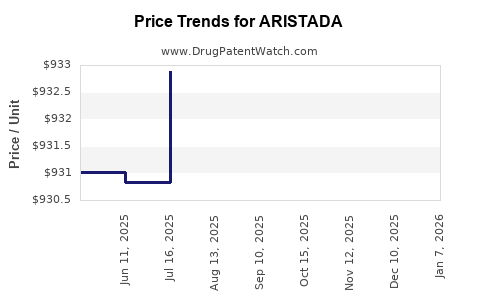
- What is Average Wholesale Price for ARISTADA?
Summary for ARISTADA
| US Patents: | 18 |
| Applicants: | 1 |
| NDAs: | 2 |
| Finished Product Suppliers / Packagers: | 1 |
| Raw Ingredient (Bulk) Api Vendors: | 58 |
| Clinical Trials: | 4 |
| Patent Applications: | 285 |
| Drug Prices: | Drug price information for ARISTADA |
| Patent Litigation and PTAB cases: | See patent lawsuits and PTAB cases for ARISTADA |
| What excipients (inactive ingredients) are in ARISTADA? | ARISTADA excipients list |
| DailyMed Link: | ARISTADA at DailyMed |
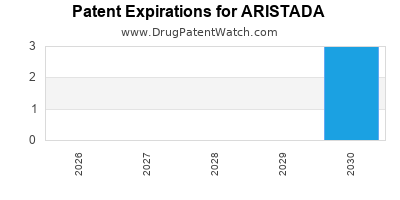
DrugPatentWatch® Estimated Loss of Exclusivity (LOE) Date for ARISTADA
Generic Entry Date for ARISTADA*:
Constraining patent/regulatory exclusivity:
NDA:
Dosage:
SUSPENSION, EXTENDED RELEASE;INTRAMUSCULAR |
*The generic entry opportunity date is the latter of the last compound-claiming patent and the last regulatory exclusivity protection. Many factors can influence early or later generic entry. This date is provided as a rough estimate of generic entry potential and should not be used as an independent source.
Recent Clinical Trials for ARISTADA
Identify potential brand extensions & 505(b)(2) entrants
| Sponsor | Phase |
|---|---|
| University of California, Los Angeles | Phase 4 |
| Alkermes, Inc. | Phase 4 |
| Alkermes, Inc. | Phase 3 |
Pharmacology for ARISTADA
| Drug Class | Atypical Antipsychotic |
US Patents and Regulatory Information for ARISTADA
ARISTADA is protected by nineteen US patents.
Based on analysis by DrugPatentWatch, the earliest date for a generic version of ARISTADA is ⤷ Start Trial.
This potential generic entry date is based on patent ⤷ Start Trial.
Generics may enter earlier, or later, based on new patent filings, patent extensions, patent invalidation, early generic licensing, generic entry preferences, and other factors.
| Applicant | Tradename | Generic Name | Dosage | NDA | Approval Date | TE | Type | RLD | RS | Patent No. | Patent Expiration | Product | Substance | Delist Req. | Exclusivity Expiration |
|---|---|---|---|---|---|---|---|---|---|---|---|---|---|---|---|
| Alkermes Inc | ARISTADA INITIO KIT | aripiprazole lauroxil | SUSPENSION, EXTENDED RELEASE;INTRAMUSCULAR | 209830-001 | Jun 29, 2018 | RX | Yes | Yes | ⤷ Start Trial | ⤷ Start Trial | Y | ⤷ Start Trial | |||
| Alkermes Inc | ARISTADA | aripiprazole lauroxil | SUSPENSION, EXTENDED RELEASE;INTRAMUSCULAR | 207533-003 | Oct 5, 2015 | RX | Yes | Yes | ⤷ Start Trial | ⤷ Start Trial | Y | ⤷ Start Trial | |||
| Alkermes Inc | ARISTADA | aripiprazole lauroxil | SUSPENSION, EXTENDED RELEASE;INTRAMUSCULAR | 207533-002 | Oct 5, 2015 | RX | Yes | No | ⤷ Start Trial | ⤷ Start Trial | Y | ⤷ Start Trial | |||
| Alkermes Inc | ARISTADA | aripiprazole lauroxil | SUSPENSION, EXTENDED RELEASE;INTRAMUSCULAR | 207533-003 | Oct 5, 2015 | RX | Yes | Yes | ⤷ Start Trial | ⤷ Start Trial | ⤷ Start Trial | ||||
| Alkermes Inc | ARISTADA | aripiprazole lauroxil | SUSPENSION, EXTENDED RELEASE;INTRAMUSCULAR | 207533-004 | Jun 5, 2017 | RX | Yes | No | ⤷ Start Trial | ⤷ Start Trial | Y | ⤷ Start Trial | |||
| Alkermes Inc | ARISTADA | aripiprazole lauroxil | SUSPENSION, EXTENDED RELEASE;INTRAMUSCULAR | 207533-003 | Oct 5, 2015 | RX | Yes | Yes | ⤷ Start Trial | ⤷ Start Trial | ⤷ Start Trial | ||||
| Alkermes Inc | ARISTADA | aripiprazole lauroxil | SUSPENSION, EXTENDED RELEASE;INTRAMUSCULAR | 207533-003 | Oct 5, 2015 | RX | Yes | Yes | ⤷ Start Trial | ⤷ Start Trial | Y | ⤷ Start Trial | |||
| >Applicant | >Tradename | >Generic Name | >Dosage | >NDA | >Approval Date | >TE | >Type | >RLD | >RS | >Patent No. | >Patent Expiration | >Product | >Substance | >Delist Req. | >Exclusivity Expiration |
International Patents for ARISTADA
When does loss-of-exclusivity occur for ARISTADA?
Based on analysis by DrugPatentWatch, the following patents block generic entry in the countries listed below:
Argentina
Patent: 7239
Estimated Expiration: ⤷ Start Trial
Patent: 9699
Estimated Expiration: ⤷ Start Trial
Australia
Patent: 10266018
Estimated Expiration: ⤷ Start Trial
Patent: 10266040
Estimated Expiration: ⤷ Start Trial
Canada
Patent: 66033
Estimated Expiration: ⤷ Start Trial
Patent: 66088
Estimated Expiration: ⤷ Start Trial
Patent: 37222
Estimated Expiration: ⤷ Start Trial
Patent: 35442
Estimated Expiration: ⤷ Start Trial
Croatia
Patent: 0171415
Estimated Expiration: ⤷ Start Trial
Cyprus
Patent: 20054
Estimated Expiration: ⤷ Start Trial
Denmark
Patent: 45502
Estimated Expiration: ⤷ Start Trial
European Patent Office
Patent: 45343
Estimated Expiration: ⤷ Start Trial
Patent: 45502
Estimated Expiration: ⤷ Start Trial
Patent: 09151
Estimated Expiration: ⤷ Start Trial
Patent: 24616
Estimated Expiration: ⤷ Start Trial
Finland
Patent: 45502
Estimated Expiration: ⤷ Start Trial
Hong Kong
Patent: 53046
Estimated Expiration: ⤷ Start Trial
Hungary
Patent: 33442
Estimated Expiration: ⤷ Start Trial
Japan
Patent: 32453
Estimated Expiration: ⤷ Start Trial
Patent: 33841
Estimated Expiration: ⤷ Start Trial
Patent: 93341
Estimated Expiration: ⤷ Start Trial
Patent: 61643
Estimated Expiration: ⤷ Start Trial
Patent: 46896
Estimated Expiration: ⤷ Start Trial
Patent: 42239
Estimated Expiration: ⤷ Start Trial
Patent: 12531429
Estimated Expiration: ⤷ Start Trial
Patent: 12531434
Estimated Expiration: ⤷ Start Trial
Patent: 15063562
Estimated Expiration: ⤷ Start Trial
Patent: 15071641
Estimated Expiration: ⤷ Start Trial
Patent: 16172742
Estimated Expiration: ⤷ Start Trial
Patent: 17048247
Estimated Expiration: ⤷ Start Trial
Patent: 19172699
Patent: 神経学的および精神的障害の治療のための複素環式化合物 (HETEROCYCLIC COMPOUNDS FOR TREATMENT OF NEUROLOGICAL AND PSYCHOLOGICAL DISORDERS)
Estimated Expiration: ⤷ Start Trial
Lithuania
Patent: 45502
Estimated Expiration: ⤷ Start Trial
New Zealand
Patent: 7107
Patent: Heterocyclic compounds for the treatment of neurological and psychological disorders
Estimated Expiration: ⤷ Start Trial
Patent: 7108
Patent: Prodrugs of nh-acidic compounds
Estimated Expiration: ⤷ Start Trial
Poland
Patent: 45502
Estimated Expiration: ⤷ Start Trial
Portugal
Patent: 45502
Estimated Expiration: ⤷ Start Trial
San Marino
Patent: 01700430
Estimated Expiration: ⤷ Start Trial
Saudi Arabia
Patent: 0310539
Patent: مركبات NH-الحمضية (NH-ACIDIC COMPOUNDS)
Estimated Expiration: ⤷ Start Trial
Serbia
Patent: 352
Patent: HETEROCIKLIČNA JEDINJENJA ZA LEČENJE NEUROLOŠKIH I PSIHOLOŠKIH POREMEĆAJA (HETEROCYCLIC COMPOUNDS FOR THE TREATMENT OF NEUROLOGICAL AND PSYCHOLOGICAL DISORDERS)
Estimated Expiration: ⤷ Start Trial
Slovenia
Patent: 45502
Estimated Expiration: ⤷ Start Trial
Spain
Patent: 39065
Estimated Expiration: ⤷ Start Trial
Patent: 85698
Estimated Expiration: ⤷ Start Trial
Patent: 31438
Estimated Expiration: ⤷ Start Trial
Taiwan
Patent: 1103912
Patent: Prodrugs of NH-acidic compounds
Estimated Expiration: ⤷ Start Trial
Patent: 83935
Estimated Expiration: ⤷ Start Trial
Generics may enter earlier, or later, based on new patent filings, patent extensions, patent invalidation, early generic licensing, generic entry preferences, and other factors.
See the table below for additional patents covering ARISTADA around the world.
| Country | Patent Number | Title | Estimated Expiration |
|---|---|---|---|
| Argentina | 077239 | ⤷ Start Trial | |
| Argentina | 109699 | ⤷ Start Trial | |
| Australia | 2010266018 | ⤷ Start Trial | |
| Australia | 2010266040 | ⤷ Start Trial | |
| Canada | 2766033 | ⤷ Start Trial | |
| Canada | 2766088 | ⤷ Start Trial | |
| Canada | 2937222 | ⤷ Start Trial | |
| >Country | >Patent Number | >Title | >Estimated Expiration |
Supplementary Protection Certificates for ARISTADA
| Patent Number | Supplementary Protection Certificate | SPC Country | SPC Expiration | SPC Description |
|---|---|---|---|---|
| 1675573 | C300669 | Netherlands | ⤷ Start Trial | PRODUCT NAME: ARIPIPRAZOLE; REGISTRATION NO/DATE: EU/1/13/882 20131115 |
| 1675573 | 92427 | Luxembourg | ⤷ Start Trial | PRODUCT NAME: ARIPIPRAZOLE |
| 0367141 | SPC/GB04/039 | United Kingdom | ⤷ Start Trial | PRODUCT NAME: ARIPIPRAZOLE OR A SALT THEREOF; REGISTERED: UK EU/1/04/276/001 20040604; UK EU/1/04/276/002 20040604; UK EU/1/04/276/003 20040604; UK EU/1/04/276/004 20040604; UK EU/1/04/276/005 20040604; UK EU/1/04/276/006 20040604; UK EU/1/04/276/007 20040604; UK EU/1/04/276/008 20040604; UK EU/1/04/276/009 20040604; UK EU/1/04/276/010 20040604; UK EU/1/04/276/011 20040604; UK EU/1/04/276/012 20040604; UK EU/1/04/276/013 20040604; UK EU/1/04/276/014 20040604; UK EU/1/04/276/015 20040604; UK EU/1/04/276/016 20040604; UK EU/1/04/276/017 20040604; UK EU/1/04/276/018 20040604; UK EU/1/04/276/019 20040604; UK EU/1/04/276/020 20040604 |
| 1675573 | 300669 | Netherlands | ⤷ Start Trial | PRODUCT NAME: ARIPIPRAZOLE; REGISTRATION NO/DATE: EU/1/13/882 20131115 |
| 1675573 | 2014C/029 | Belgium | ⤷ Start Trial | PRODUCT NAME: ARIPIPRAZOLE; AUTHORISATION NUMBER AND DATE: EU/1/13/882 20131119 |
| >Patent Number | >Supplementary Protection Certificate | >SPC Country | >SPC Expiration | >SPC Description |
ARISTADA (aripiprazole lauroxil) Market Dynamics and Financial Trajectory (Sales, Pricing, Loss of Exclusivity, and Competitive Pressures)
More… ↓
DrugChatter Q&A for ARISTADA
Make Better Decisions: Try a trial or see plans & pricing
Drugs may be covered by multiple patents or regulatory protections. All trademarks and applicant names are the property of their respective owners or licensors. Although great care is taken in the proper and correct provision of this service, thinkBiotech LLC does not accept any responsibility for possible consequences of errors or omissions in the provided data. The data presented herein is for information purposes only. There is no warranty that the data contained herein is error free. We do not provide individual investment advice. This service is not registered with any financial regulatory agency. The information we publish is educational only and based on our opinions plus our models. By using DrugPatentWatch you acknowledge that we do not provide personalized recommendations or advice. thinkBiotech performs no independent verification of facts as provided by public sources nor are attempts made to provide legal or investing advice. Any reliance on data provided herein is done solely at the discretion of the user. Users of this service are advised to seek professional advice and independent confirmation before considering acting on any of the provided information. thinkBiotech LLC reserves the right to amend, extend or withdraw any part or all of the offered service without notice.
ISSN: 2162-2639

Privacy and Cookies
Terms & Conditions
Site Map
DrugPatentWatch Alternatives
LOE / Major Patent Expirations 2026 - 2027
NCE-1 Patent Challenge Dates 2026 - 2027
Friedman, Yali. "DrugPatentWatch" DrugPatentWatch, thinkBiotech, 2026, www.DrugPatentWatch.com.
See Primary Research Papers Citing DrugPatentWatch