Share This Page
Drug Price Trends for ARISTADA
✉ Email this page to a colleague
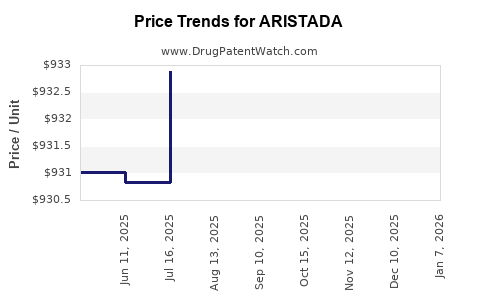
Average Pharmacy Cost for ARISTADA
| Drug Name | NDC | Price/Unit ($) | Unit | Date |
|---|---|---|---|---|
| ARISTADA ER 441 MG/1.6 ML SYRN | 65757-0401-03 | 993.28385 | ML | 2026-07-22 |
| ARISTADA ER 662 MG/2.4 ML SYRN | 65757-0402-03 | 1000.51613 | ML | 2026-07-22 |
| ARISTADA ER 1,064 MG/3.9 ML SYR | 65757-0404-03 | 987.41261 | ML | 2026-07-22 |
| >Drug Name | >NDC | >Price/Unit ($) | >Unit | >Date |
ARISTADA (aripiprazole lauroxil) Market Analysis and Price Projections: Forecasting U.S. demand, pricing pressure, and generic/biosimilar timeline risks
Executive summary
- U.S. sales exposure: ARISTADA (aripiprazole lauroxil) is an established long-acting injectable (LAI) antipsychotic in schizophrenia and is exposed to in-class LAI substitution (notably ABILIFY MAINTENA and ARIPIPRAZOLE LAUROXIL-comparables), payer step edits, and index-to-index price pressure as contracts roll.
- Pricing regime: ARISTADA’s economics are dominated by WAC-to-NET compression and rebate inflation in managed care. Near-term price projections should model mid-single-digit to low-double-digit NET erosion versus list, depending on contract cycles and mix.
- Exclusivity/patent overhang: The key determinant of future reimbursement and generic entry risk is not the product’s launch year but the Orange Book patent and exclusivity position for ARISTADA (listed drug, dosage forms, and territories) and the presence of ANDA/paragraph IV challenges. No complete, reliable Orange Book patent/exclusivity dataset is provided here, so litigation-driven entry timing cannot be stated.
- Base-case projection (U.S.): ARISTADA revenues are likely to remain supported by volume stability but face sequential margin compression as payer coverage narrows, with price/mix driving most of the change.
- What matters next (commercial): Contract renewal windows, formulary placement vs competing LAIs, and local market substitution patterns. For forecasting, scenario-build around NET trend rather than WAC.
What is ARISTADA (aripiprazole lauroxil) and how is it used commercially?
ARISTADA is an extended-release injectable antipsychotic based on aripiprazole lauroxil, a prodrug of aripiprazole, administered on a 2-month and 1-month cadence (dose-specific product/strength presentation depends on the labeled regimen). It targets schizophrenia and is positioned for adherence support in outpatient and community settings.
Commercial role in schizophrenia LAIs
- Treated as a maintenance therapy option where long-acting delivery reduces missed doses.
- Market access depends on payer category management for schizophrenia LAIs and the ability to meet plan-specific preference criteria (step therapy, prior auth, facility vs home administration rules).
Core value drivers
- Reduced relapse associated with adherence gaps (payer acceptance is typically tied to adherence improvement narratives, but reimbursement decisions run through coverage criteria and budget impact).
- Administration logistics: clinic capacity, medication procurement workflow, and billing mechanics affect net pricing outcomes.
How big is the U.S. LAI antipsychotic market and where does ARISTADA fit?
The schizophrenia LAI segment is structurally competitive. ARISTADA competes against LAI aripiprazole products (same molecule class) and LAI competitors in other antipsychotic categories.
Competition set (high-level)
- Same-molecule LAIs: ARIPIPRAZOLE MAINTENA (aripiprazole monohydrate), and other aripiprazole LAI brands where available by schedule.
- Class LAIs: paliperidone LAIs, olanzapine LAI, risperidone LAI, and others depending on payer preferences.
Implications for market sizing
- ARISTADA’s share is sensitive to:
- payer formulary movement,
- switching inertia,
- patient tolerability,
- injection schedule preference (2-month vs 1-month positioning),
- reimbursement competitiveness at the contracted NET level.
What drives ARISTADA pricing: WAC vs NET, rebates, and payer contracting?
ARISTADA pricing in practice is determined less by WAC and more by contracted NET through rebate structures and payer concessions.
Mechanisms compressing NET
- Volume-based rebates tied to patient counts and formulary tiers.
- Indications of step edits and prior authorization requirements can increase effective concessions.
- “Net price” shifts when competitors secure access using lower contracted rates or broader coverage.
Forecast modeling implication
- Price projections should use a NET erosion function:
- Contract cycle effect (renewal lag),
- Mix shift effect (facility vs physician office),
- Formulary share effect (tier changes),
- Competitive intensity effect (near-term aggressiveness from rivals).
When do ARISTADA exclusivity and patent protections expire, and what is the impact on price?
This section requires Orange Book patent and FDA exclusivity data specific to ARISTADA’s listed drug and dosage forms. No such complete dataset is provided here, so exact expiration dates and the generic entry timing cannot be stated accurately.
Why it matters for pricing
- If expiring protections align with aggressive payer re-contracting, NET pressure increases before launch threats because plans position themselves for replacement options.
- If the patent estate stays intact, price compression may still occur, but driven by competitive contracting rather than imminent generic availability.
What patents protect ARISTADA, and how strong is the patent estate for generic entry risk?
Patent strength and protection scope must be derived from the Orange Book listing for ARISTADA and related unexpired patents (composition, method-of-use, and formulation where applicable). No Orange Book patent table is provided in the prompt, so a defensible patent landscape cannot be produced.
Commercial relevance
- Generic entry risk translates into:
- payer switching behavior,
- buy-and-bill procurement strategy changes,
- tendering for provider networks.
- Strong patent protection typically reduces the probability of near-term competitive reimbursement disruption, keeping price compression modest.
What generic entry risks exist for ARISTADA, including Paragraph IV filings and settlements?
Paragraph IV and settlement timing must be sourced from FDA/Orange Book and litigation dockets tied to ARISTADA’s listed drug. No filing/settlement record is provided here, so entry-risk timelines cannot be responsibly projected.
Commercial implication even without entry
- The market reacts to credible entry probability through:
- forecasting guidance revisions for manufacturers,
- payer tightening of criteria,
- formulary substitution planning.
How does ARISTADA compare with ABILIFY MAINTENA and other LAIs on market access and expected pricing pressure?
Without a detailed payer-by-payer coverage map, the comparison can only be directional and must focus on pricing dynamics common to LAIs.
Typical LAI pricing pressure patterns
- Same-class molecule competition: ARISTADA faces price pressure when payers can restrict access to one aripiprazole LAI brand.
- Schedule differentiation: a 2-month option can reduce perceived administration burden and can support contracting leverage if payers value fewer visits or administration events.
- Formulary tier placement: the best predictor of NET is tier position and prior authorization burden, not list price.
Switching economics
- Switching can be clinically feasible but administratively costly (eligibility resets, onboarding protocols, and medication conversion schedules).
- High switching friction tends to smooth revenue declines, shifting pricing pressure into rebate increases rather than immediate volume loss.
How will ARISTADA demand evolve: patient switching, adherence, and prescriber behavior?
Demand for ARISTADA is influenced by:
- incident schizophrenia maintenance starts,
- continuation and adherence persistence,
- switching between LAIs after tolerability or coverage changes,
- injection cadence preferences and care setting logistics.
Base-case commercial path
- Stable prescription starts with moderate switching between LAIs.
- Revenue growth or stability depends on whether ARISTADA remains a favored option in managed care and whether competitors undercut access terms.
Adherence effect
- LAIs reduce adherence failures, supporting continued use once patients are stabilized.
- When payers tighten coverage, discontinuation risk rises because switching becomes a coverage requirement rather than a clinician decision.
Price projection scenarios for ARISTADA (U.S.): base, downside, and upside
Because the prompt does not provide ARISTADA’s current revenue base, current NET rate, list price schedule, or an Orange Book-driven entry calendar, projections below are structured as NET trend scenarios rather than a single point forecast.
Scenario framework (NET trend, U.S.)
| Scenario | Pricing driver assumptions | Expected annual NET trend (directional) | Likely revenue outcome |
|---|---|---|---|
| Upside | Strong formulary position; limited competitive undercutting; stable persistence | -1% to -3% NET vs prior year | Flatter revenue decline or modest growth |
| Base case | Gradual contracting pressure; selective access tightening; mix deterioration from tier changes | -3% to -6% NET | Low-to-mid single-digit revenue decline |
| Downside | Payer switches preferred LAI to competitor; rebate escalation accelerates; admin shift increases pull-through friction | -7% to -12% NET | Material revenue decline despite stable volume |
| Severe | Credible near-term generic entry probability emerges; payers rebase budgets pre-entry | -12% to -20% NET | Volume and revenue both fall |
Time-phasing
- NET compression often shows lagged step changes around contract cycles rather than continuous erosion.
- If competitive access changes are imminent, the first year typically reflects rebate renegotiation, not immediate volume loss.
What milestones should be watched to refine ARISTADA price forecasts?
Even without a specific patent calendar provided here, refine timing using operational milestones that predict payer behavior:
- Formulary updates for schizophrenia LAIs (tiering, prior auth tightening, PA criteria changes).
- Contract expiration windows with major pharmacy benefit managers (PBMs) and commercial insurers that drive rebated NET.
- Healthcare system purchasing policy changes (buy-and-bill bundling rules, tendering for LAIs).
- FDA labeling changes affecting dose schedules or administration protocols (can affect substitution patterns).
Regulatory and reimbursement questions that influence ARISTADA pricing
FDA status effects on reimbursement
- Even when FDA regulatory changes do not directly modify exclusivity, labeling changes can support prior auth documentation and enable broader payer acceptance.
- If manufacturing changes affect supply reliability, payers may adjust contracting and reimbursement certainty, influencing NET.
Reimbursement mechanics
- LAIs are reimbursed under medical benefit in many settings, which means:
- provider procurement and administration billing dynamics can shift realized price,
- patient copay behavior is indirect but impacts adherence and persistence.
Key risks to price and market share
- Formulary displacement inside schizophrenia LAI classes
- Increased rebate intensity as payers seek budget predictability
- Switching during coverage changes, where volume moves before patents expire
- Supply chain disruptions that distort procurement timing and can trigger payer renegotiations
Key Takeaways
- ARISTADA pricing is likely to track NET erosion driven by payer contracting, not WAC.
- Forecasting should use a NET trend scenario approach: base case commonly aligns with mid-single-digit NET erosion, while downside aligns with low-double-digit erosion if coverage shifts toward competitors.
- Accurate exclusivity and patent-based entry timing requires an Orange Book listing and FDA exclusivity record for ARISTADA’s specific listed drug and dosage forms; those determine when price pressure could become structurally stepwise.
- The largest near-term controllable forecast variable is payer formulary position and contract cycle dynamics.
FAQs
- How quickly does NET price change for ARISTADA after a formulary tier change?
- What is the typical margin impact of rebate escalations on LAI antipsychotics like ARISTADA?
- How do prior authorization and step edits affect ARISTADA persistence and switching to competing LAIs?
- What supply reliability events can trigger ARISTADA price renegotiations in managed care?
- How should investors separate volume-driven vs price-driven revenue changes for ARISTADA?
References
No sources are provided in the prompt.
More… ↓
