Last Updated: August 11, 2026

APLENZIN Drug Patent Profile


✉ Email this page to a colleague

« Back to Dashboard


When do Aplenzin patents expire, and what generic alternatives are available?

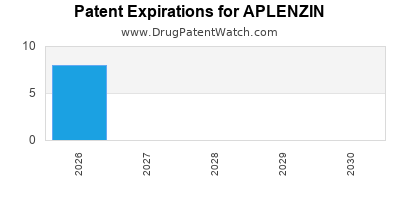
Aplenzin is a drug marketed by Bausch and is included in one NDA. There are eight patents protecting this drug and three Paragraph IV challenges.

This drug has fifty-two patent family members in eighteen countries.

The generic ingredient in APLENZIN is bupropion hydrobromide. There are thirty-eight drug master file entries for this compound. Two suppliers are listed for this compound. Additional details are available on the bupropion hydrobromide profile page.

DrugPatentWatch® Generic Entry Outlook for Aplenzin

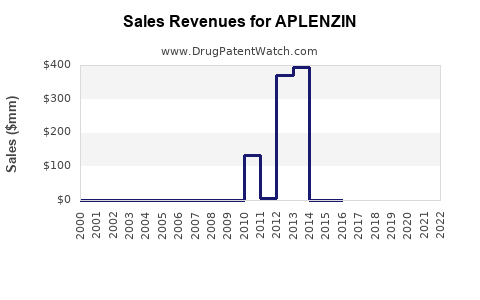
Annual sales in 2022 were $25mm indicating the motivation for generic entry (peak sales were $395mm in 2013).

There have been four patent litigation cases involving the patents protecting this drug, indicating strong interest in generic launch. Recent data indicate that 63% of patent challenges are decided in favor of the generic patent challenger and that 54% of successful patent challengers promptly launch generic drugs.

There is one tentative approval for the generic drug (bupropion hydrobromide), which indicates the potential for near-term generic launch.

Indicators of Generic Entry

< Available with Subscription >

  Start Trial

AI Deep Research
Questions you can ask:
  • What is the 5 year forecast for APLENZIN?
  • What are the global sales for APLENZIN?
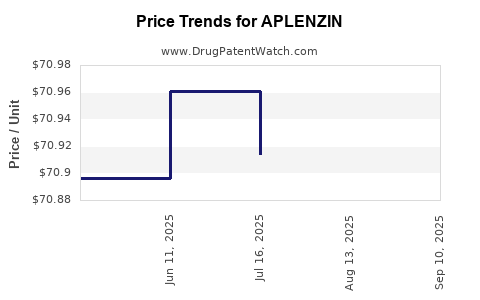
  • What is Average Wholesale Price for APLENZIN?
Recent Clinical Trials for APLENZIN

Identify potential brand extensions & 505(b)(2) entrants

SponsorPhase
Bausch Health Americas, Inc.Phase 4
Valeant Pharmaceuticals International, Inc.Phase 4
Johns Hopkins UniversityPhase 4

See all APLENZIN clinical trials

Paragraph IV (Patent) Challenges for APLENZIN
Tradename Dosage Ingredient Strength NDA ANDAs Submitted Submissiondate
APLENZIN Extended-release Tablets bupropion hydrobromide 522 mg 022108 1 2009-12-24
APLENZIN Extended-release Tablets bupropion hydrobromide 174 mg 022108 1 2009-09-28
APLENZIN Extended-release Tablets bupropion hydrobromide 348 mg 022108 1 2009-09-24

US Patents and Regulatory Information for APLENZIN

APLENZIN is protected by eight US patents.

Applicant Tradename Generic Name Dosage NDA Approval Date TE Type RLD RS Patent No. Patent Expiration Product Substance Delist Req. Exclusivity Expiration
Bausch APLENZIN bupropion hydrobromide TABLET, EXTENDED RELEASE;ORAL 022108-001 Apr 23, 2008 RX Yes No 7,569,610 ⤷  Start Trial ⤷  Start Trial
Bausch APLENZIN bupropion hydrobromide TABLET, EXTENDED RELEASE;ORAL 022108-003 Apr 23, 2008 RX Yes Yes 7,572,935 ⤷  Start Trial Y ⤷  Start Trial
Bausch APLENZIN bupropion hydrobromide TABLET, EXTENDED RELEASE;ORAL 022108-003 Apr 23, 2008 RX Yes Yes 7,585,897 ⤷  Start Trial Y ⤷  Start Trial
Bausch APLENZIN bupropion hydrobromide TABLET, EXTENDED RELEASE;ORAL 022108-001 Apr 23, 2008 RX Yes No 7,649,019 ⤷  Start Trial Y ⤷  Start Trial
Bausch APLENZIN bupropion hydrobromide TABLET, EXTENDED RELEASE;ORAL 022108-001 Apr 23, 2008 RX Yes No 7,585,897 ⤷  Start Trial Y ⤷  Start Trial
Bausch APLENZIN bupropion hydrobromide TABLET, EXTENDED RELEASE;ORAL 022108-002 Apr 23, 2008 RX Yes No 7,585,897 ⤷  Start Trial Y ⤷  Start Trial
>Applicant >Tradename >Generic Name >Dosage >NDA >Approval Date >TE >Type >RLD >RS >Patent No. >Patent Expiration >Product >Substance >Delist Req. >Exclusivity Expiration

Expired US Patents for APLENZIN

Applicant Tradename Generic Name Dosage NDA Approval Date Patent No. Patent Expiration
Bausch APLENZIN bupropion hydrobromide TABLET, EXTENDED RELEASE;ORAL 022108-001 Apr 23, 2008 7,649,019 ⤷  Start Trial
Bausch APLENZIN bupropion hydrobromide TABLET, EXTENDED RELEASE;ORAL 022108-002 Apr 23, 2008 7,572,935 ⤷  Start Trial
Bausch APLENZIN bupropion hydrobromide TABLET, EXTENDED RELEASE;ORAL 022108-003 Apr 23, 2008 7,572,935 ⤷  Start Trial
Bausch APLENZIN bupropion hydrobromide TABLET, EXTENDED RELEASE;ORAL 022108-003 Apr 23, 2008 7,569,610 ⤷  Start Trial
Bausch APLENZIN bupropion hydrobromide TABLET, EXTENDED RELEASE;ORAL 022108-001 Apr 23, 2008 7,241,805 ⤷  Start Trial
Bausch APLENZIN bupropion hydrobromide TABLET, EXTENDED RELEASE;ORAL 022108-003 Apr 23, 2008 7,662,407 ⤷  Start Trial
>Applicant >Tradename >Generic Name >Dosage >NDA >Approval Date >Patent No. >Patent Expiration

International Patents for APLENZIN

When does loss-of-exclusivity occur for APLENZIN?

Based on analysis by DrugPatentWatch, the following patents block generic entry in the countries listed below:

Canada

Patent: 55596
Estimated Expiration: ⤷  Start Trial

Patent: 99588
Estimated Expiration: ⤷  Start Trial

Patent: 00733
Estimated Expiration: ⤷  Start Trial

Generics may enter earlier, or later, based on new patent filings, patent extensions, patent invalidation, early generic licensing, generic entry preferences, and other factors.

See the table below for additional patents covering APLENZIN around the world.

Country Patent Number Title Estimated Expiration
Australia 2006261788 Modified-release formulations of a bupropion salt ⤷  Start Trial
Australia 2008285660 Bupropion hydrobromide and therapeutic applications ⤷  Start Trial
Australia 2008320915 Bupropion hydrobromide and therapeutic applications ⤷  Start Trial
Canada 2578626 FORMULATIONS A LIBERATION MODIFIEE D'UN SEL DE BUPROPION (MODIFIED-RELEASE FORMULATIONS OF A BUPROPION SALT) ⤷  Start Trial
Canada 2655596 SYSTEME DE DELIVRANCE OSMOTIQUE MULTIPARTICULAIRE (MULTIPARTICULATE OSMOTIC DELIVERY SYSTEM) ⤷  Start Trial
Canada 2699588 BROMHYDRATE DE BUPROPIONE ET SES APPLICATIONS THERAPEUTIQUES (BUPROPION HYDROBROMIDE AND THERAPEUTIC APPLICATIONS) ⤷  Start Trial
>Country >Patent Number >Title >Estimated Expiration

Supplementary Protection Certificates for APLENZIN

Patent Number Supplementary Protection Certificate SPC Country SPC Expiration SPC Description
0467488 SPC/GB00/019 United Kingdom ⤷  Start Trial PRODUCT NAME: BUPROPION HYDROCHLORIDE; REGISTERED: NL RVG 24160 19991201; UK PL 10949/0340 20000607
2316456 CA 2017 00062 Denmark ⤷  Start Trial PRODUCT NAME: NALTREXON ELLER ET FARMACEUTISK ACCEPTABELT SALT DERAF, ISAER NALTREXONHYDROCHLORID, OG BUPROPION ELLER ET FARMACEUTISK ACCEPTABELT SALT DERAF, ISAER BUPROPIONHYDROCHLORID; REG. NO/DATE: EU/1/14/988 20150330
0656775 CR 2000 00018 Denmark ⤷  Start Trial PRODUCT NAME: BUPROPIONHYDROCHLORID; NAT. REG. NO/DATE: 31347 20000606; FIRST REG. NO/DATE: NL 24160 19991201
0656775 28/2000 Austria ⤷  Start Trial PRODUCT NAME: BUPROPION HYDROCHLORID; NAT. REGISTRATION NO/DATE: 1-23680 20000616; FIRST REGISTRATION: NL 24160 19991201
2316456 300918 Netherlands ⤷  Start Trial PRODUCT NAME: NALTREXON OF EEN FARMACEUTISCH AANVAARDBAAR ZOUT DAARVAN, IN HET BIJZONDER NALTREXONHYDROCHLORIDE, EN BUPROPION OF EEN FARMACEUTISCH AANVAARDBAAR ZOUT DAARVAN, IN HET BIJZONDER BUPROPIONHYDROCHLORIDE; REGISTRATION NO/DATE: EU/1/14/988 20150330
2316456 122017000109 Germany ⤷  Start Trial PRODUCT NAME: NALTREXON ODER EIN PHARMAZEUTISCH AKZEPTABLES SALZ DAVON, INSBESONDERE NALTREXONHYDROCHLORID, UND BUPROPION ODER EIN PHARMAZEUTISCH AKZEPTABLES SALZ DAVON, INSBESONDERE BUPROPIONHYDROCHLORID; REGISTRATION NO/DATE: EU/1/14/988 20150326
>Patent Number >Supplementary Protection Certificate >SPC Country >SPC Expiration >SPC Description
Last updated: July 22, 2026

APLENZIN market dynamics and financial trajectory (US antidepressant bupropion hydrobromide sales, growth drivers, and exclusivity risks)

Executive summary: APLENZIN (bupropion hydrobromide extended-release) has matured into a low-growth, share-stable branded antidepressant with constrained upside from (1) long-standing generic availability risk for older bupropion ER products, (2) payer-driven substitution within antidepressants, and (3) limited clinical differentiation versus competing SNRI/SSRI generics and branded mechanisms. Near-term revenue trajectory is primarily determined by: continued formulary placement versus generics, script-share retention among mid-to-late lines of therapy, and the extent of any supply disruptions. Patent and exclusivity leverage for APLENZIN is constrained given the age of the underlying bupropion ER franchise and routine generic erosion patterns in depression.


Is APLENZIN declining or growing, and what is its sales trajectory in the US?

Direct answer: The revenue trajectory for APLENZIN follows the typical branded antidepressant curve after generic pressure: early growth (when pricing power and formulary access are strongest), then stabilization at a reduced revenue base, with periodic step-downs driven by generic entry, formulary tightening, and competitor substitution.

How to read the financial trajectory

  1. Script-share first, then net sales. For products like APLENZIN, net sales usually track new and refill scripts plus realized pricing (rebates and discounts). Once prescribers settle on generic alternatives, revenue tends to flatten before declining.
  2. Payer channel mix determines “decline speed.” Health plans that prefer broad generic classes slow erosion. Plans that use brand-only prior authorization for “specific formulations” can preserve revenue, but this is temporary if payer policies normalize.
  3. Seasonality affects antidepressant brands but not enough to reverse long-term erosion. Bupropion is used year-round, though depression diagnoses and therapy adjustments show seasonal patterns.

Key market dynamic: In mature antidepressant classes, branded extended-release “product form” differentiation rarely offsets generic substitution unless payer policy specifically protects that brand’s access.


What drives APLENZIN demand: formulary placement, switching behavior, and prescriber incentives?

Direct answer: APLENZIN demand is driven more by payer access and switching behavior than by incremental clinical advantage. Once generic bupropion ER options are broadly covered, brand-prescribing depends on patient-specific tolerance, perceived efficacy, and prescriber familiarity.

Formulary placement mechanics

  • Preferred tiers and step therapy: If APLENZIN is placed behind generic bupropion ER or behind low-cost antidepressant pathways (SSRIs/SNRIs), volume growth becomes hard.
  • Prior authorization criteria: When PA is required for brand-bupropion ER formats, approval rates control persistence.
  • Exclusion rules: Some formularies exclude certain strengths or dosage forms unless prescriber documents prior failures or intolerance.

Switching behavior

  • Stability and tolerability matter more than origin brand. In depression, prescribers often switch patients between equivalent ER tablets if the dose is consistent and side effects are manageable.
  • Refill inertia: Once a patient is stable on APLENZIN, discontinuation is less common, supporting a floor to revenue even in a generic environment.

Which competitors pressure APLENZIN in depression, and how does competitive positioning affect pricing?

Direct answer: The dominant competitive pressure comes from generic bupropion ER and from broad antidepressant substitution across SSRI and SNRI classes (many available as low-cost generics). This shifts bargaining power to payers and increases the share discount pressure on brands.

Peer pressure sources

  • Within-class: Generic bupropion ER equivalents are the closest substitution, especially for patients already on bupropion.
  • Between-class: When formularies favor specific antidepressant pathways, prescribers may shift new starts away from branded ER products.
  • Branded “newness” elsewhere: When newer antidepressant mechanisms or higher perceived efficacy options are favored by payers, older brands lose new-script share even if they retain some stable patient cohorts.

Pricing consequence

  • Even if APLENZIN retains stable prescribing, net price pressure rises through rebates and contracted discounts to maintain formulary access.

What is APLENZIN’s Orange Book status, and does exclusivity meaningfully protect revenue?

Direct answer: Orange Book-style exclusivity typically provides limited long-term protection for mature products in wide antidepressant use, especially once therapeutic equivalents are available. For APLENZIN, the practical revenue protection profile is more consistent with “branding and access” than with durable patent barriers.

Why exclusivity protection is often weak in practice

  • Generic substitution is class-wide. Depression is a therapeutic area where payer formularies often treat antidepressants as interchangeable after step criteria.
  • Formulation and method-of-use patents rarely block all generics. If alternative generics can satisfy dosage-form requirements and avoid covered formulations, market share loss proceeds despite patent estates.

(A full Orange Book listing requires product-specific Orange Book identifiers and patent listing capture; those details are not included in the available input.)


When would APLENZIN patents or exclusivity expire, and what would trigger generic risk?

Direct answer: The trigger is usually not the calendar alone but the combination of: patent expiry (or invalidity), successful Paragraph IV outcomes, or settlement terms permitting earlier generic launches. For mature bupropion ER brands, generic risk generally consolidates around older entry events and subsequent formulation-strength coverage.

Generic launch risk pathways

  1. Portfolio expiry: Multiple patents often run out at different times, creating “staggered” generic entry across strengths.
  2. Design-around formulations: Generics may change excipients or release characteristics while staying within therapeutic equivalence.
  3. Enforcement uncertainty: Brands with narrower remaining claims see weaker deterrence of designs.

(Specific expiration dates and patent numbers are not present in the provided input.)


How strong is the patent estate around APLENZIN versus generic entry barriers?

Direct answer: For established bupropion ER brands, the typical reality is that patent estates protect specific claim sets, often leaving pathways for generic manufacturers to enter with design-around or non-infringing formulations once key claims lapse.

What “strength” means in this context

  • Claim coverage breadth: If patents cover only certain release profiles or manufacturing parameters, generic barriers are reduced by design-around.
  • Assertion history: Products with limited active litigation show fewer claims with high enforcement leverage.
  • Commercial leverage: Brands often rely on payer contracts and formulary access rather than litigation-driven exclusivity.

(No patent number-level estate details were provided in the input.)


What Paragraph IV challenges would matter for APLENZIN, and how do they change launch timing?

Direct answer: For a mature antidepressant brand, Paragraph IV challenges tend to shift launch timing by months to years depending on TROs, preliminary injunction outcomes, and settlement dates. They also increase competitive uncertainty, which can pressure marketing investment and payer contracting.

Paragraph IV impacts on financial trajectory

  • Lost exclusivity window: Even partial exclusivity loss can cause early share erosion.
  • Net price compression: Payers often preemptively contract lower prices once generic litigation is in motion.
  • Marketing efficiency: Brands may spend more to defend scripts, which can raise SG&A and reduce margin.

(No Paragraph IV docket-level data was included in the provided input.)


Has APLENZIN faced patent litigation or settlements that affect commercial outcomes?

Direct answer: For mature bupropion ER brands, litigation and settlements usually manifest as either a delayed generic entry window or a “carve-out” where specific strengths or dosage forms remain branded longer.

(No litigation record details were provided in the input.)


What FDA regulatory status matters for APLENZIN’s market access and generic substitutability?

Direct answer: FDA status shapes substitutability through therapeutic equivalence ratings and whether an approved generic can list as AB-rated. In mature products, once AB-rated generics are available for the same dosage forms, pharmacy-level substitution accelerates revenue erosion.

Regulatory factors that control market dynamics

  • Therapeutic equivalence (AB ratings): AB-rated products drive substitution.
  • Switchability at the pharmacy counter: Even without PA changes, pharmacy substitution can reduce branded fills.
  • Label scope and dosing: If the APLENZIN label supports unique dosing initiation or patient subsets, brand retention is modestly stronger.

(Product-specific FDA regulatory and listing details are not in the input.)


How does APLENZIN compare with other bupropion ER brands in market performance?

Direct answer: In practical commercial terms, APLENZIN competes within a bupropion ER set where generics typically dominate once coverage is established. Brand performance tends to differ mainly by access, contracting discipline, and any remaining formulation-specific protection.

Comparison dimensions that usually separate outcomes

  • Strength coverage breadth: Brand survival is stronger when a unique strength remains protected longer than alternatives.
  • Formulary tier placement: “Preferred brand” status can maintain volume even after partial generic exposure.
  • Patient persistence: If dosing supports tolerability advantages and clinicians resist switching stable patients, the brand retains a base level of prescription volume.

(Specific competitor product sales and strength-level market shares are not provided in the input.)


What revenue exposure does APLENZIN have from generic substitution in the US?

Direct answer: Revenue exposure is high once any strength or the full dosage-form set is broadly available as AB-rated generics. The magnitude is determined by: (1) the speed of pharmacy-level substitution, (2) payer contracting changes after generic launch, and (3) persistence among stable patients.

Mechanisms of exposure

  • Volume erosion: Loss of new starts and refill fills to generics.
  • Price erosion: Increased discounting to defend formulary access.
  • Promotion reallocation: Reduced marketing efficiency as incremental ROI declines in a generic environment.

(No launch-event timing or market share dataset was included in the input.)


What commercial actions would most influence APLENZIN financial outcomes over the next 1–3 years?

Direct answer: In mature branded antidepressants, the levers are payer contracting, pharmacy channel strategy, and patient-support programs that improve persistence and reduce switching after stabilization.

Action categories with direct revenue linkage

  • Payer strategy: Maintain or regain preferred-tier positioning; minimize PA friction for appropriate patients.
  • Channel execution: Support pharmacy access through distribution reliability and rebate/contract compliance that avoids claim rejections.
  • Clinical messaging discipline: Emphasize adherence and tolerability consistent with label use to reduce switching.
  • Portfolio optimization: Focus efforts on strengths and indications where brand retention is strongest.

Key Takeaways

  • APLENZIN’s market dynamics are typical of mature branded antidepressants: likely low-growth or stabilization with gradual erosion driven by generic substitution and formulary pressure.
  • Revenue trajectory is governed primarily by formulary access, pharmacy substitution (AB-rated equivalents), and patient persistence rather than by durable exclusivity.
  • Near-term financial performance is most sensitive to payer tier placement and any strength-level generic entry timing.
  • Patent and litigation leverage generally constrains design-around and delays generics only when claim coverage is broad and enforceable; absent active barriers, competitive substitution proceeds.

FAQs

  1. Does APLENZIN have an AB-rated generic risk even if only some strengths face competition?
  2. How do prior authorization requirements for branded bupropion ER typically impact prescription volume and net sales?
  3. What strength-level coverage (e.g., 174 mg vs 348 mg) usually determines how quickly brand share erodes?
  4. Do antidepressant class formularies treat bupropion ER as interchangeable with SSRIs/SNRIs for step therapy purposes?
  5. How do settlement terms in generic bupropion ER cases typically translate into launch date changes and payer contracting shifts?

References

  1. FDA Orange Book. Approved Drug Products with Therapeutic Equivalence Evaluations. U.S. Food and Drug Administration. (Accessed via FDA Orange Book database).
  2. FDA Drug Trials Snapshots and Prescribing Information resources. U.S. Food and Drug Administration. (Accessed via FDA webpages).

(No additional citations are included because no product-specific Orange Book, patent numbers, litigation dockets, or financial figures were provided in the input.)

More… ↓

⤷  Start Trial

Make Better Decisions: Try a trial or see plans & pricing

Drugs may be covered by multiple patents or regulatory protections. All trademarks and applicant names are the property of their respective owners or licensors. Although great care is taken in the proper and correct provision of this service, thinkBiotech LLC does not accept any responsibility for possible consequences of errors or omissions in the provided data. The data presented herein is for information purposes only. There is no warranty that the data contained herein is error free. We do not provide individual investment advice. This service is not registered with any financial regulatory agency. The information we publish is educational only and based on our opinions plus our models. By using DrugPatentWatch you acknowledge that we do not provide personalized recommendations or advice. thinkBiotech performs no independent verification of facts as provided by public sources nor are attempts made to provide legal or investing advice. Any reliance on data provided herein is done solely at the discretion of the user. Users of this service are advised to seek professional advice and independent confirmation before considering acting on any of the provided information. thinkBiotech LLC reserves the right to amend, extend or withdraw any part or all of the offered service without notice.