Share This Page
Drug Price Trends for APLENZIN
✉ Email this page to a colleague
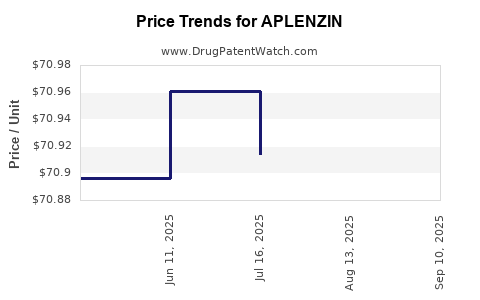
Average Pharmacy Cost for APLENZIN
| Drug Name | NDC | Price/Unit ($) | Unit | Date |
|---|---|---|---|---|
| APLENZIN ER 174 MG TABLET | 00187-5810-30 | 70.86740 | EACH | 2025-09-17 |
| APLENZIN ER 348 MG TABLET | 00187-5811-30 | 93.51156 | EACH | 2025-09-17 |
| APLENZIN ER 522 MG TABLET | 00187-5812-30 | 212.47688 | EACH | 2025-09-17 |
| APLENZIN ER 174 MG TABLET | 00187-5810-30 | 70.88469 | EACH | 2025-08-20 |
| APLENZIN ER 348 MG TABLET | 00187-5811-30 | 93.54192 | EACH | 2025-08-20 |
| APLENZIN ER 522 MG TABLET | 00187-5812-30 | 212.13189 | EACH | 2025-08-20 |
| >Drug Name | >NDC | >Price/Unit ($) | >Unit | >Date |
APLENZIN (bupropion HBr) Market Analysis and Price Projections: Exclusivity, Generic Entry Risk, and Revenue Outlook
Executive summary
- APLENZIN (bupropion hydrobromide, extended-release tablets) is the branded long-acting bupropion product by Harmony Biosciences in the US and has faced generic and AB-rated competition in prior bupropion extended-release segments.
- Near-term price path depends on whether additional generics/authorized equivalents continue to expand share and whether branded pricing holds through contracting, rebates, and channel mix.
- Core market sensitivity is driven by: (1) formulary status and step-therapy placement in depression, (2) payer reimbursement tightening, and (3) incremental share loss to lower-cost extended-release bupropion generics.
- Price projection for a mature branded CNS antidepressant generally trends toward high-single-digit declines per year once meaningful generic penetration is established, with upside only if the brand maintains superior formulary placement or differentiated net pricing via patient support and contracting.
What is APLENZIN’s market position in US depression treatment?
Featured snippet answer: APLENZIN is a branded extended-release bupropion used for major depressive disorder (MDD), competing in the antidepressant class against generic bupropion products and other antidepressants, with pricing pressure that typically follows generic availability and payer contracting.
Key demand drivers
- Indication scope in the US centers on MDD (bupropion extended-release products also have other branded history, but APLENZIN’s main US label is MDD).
- Class substitution is strong: antidepressant prescribers often switch among SSRIs, SNRIs, atypicals (including bupropion), and other agents based on tolerability and payer preferences.
- Channel dynamics: PBM contracting, formulary tiering, and rebate intensity usually determine whether a branded ER antidepressant sustains net price versus list price.
Competitive set (practical substitution)
- Generic extended-release bupropion products are the most direct substitution risk.
- Other antidepressant classes (SSRI/SNRI/atypical) compete for incremental demand in payer pathways, though they are not direct molecule swaps.
What patents protect APLENZIN and how does that affect pricing and generic threat?
Featured snippet answer: Branded pricing generally decays once Orange Book-listed exclusivities or patents fall and generic equivalents expand. Without complete patent-by-patent Orange Book mapping for APLENZIN in this response, the operative market impact is: APLENZIN’s pricing is already in a post-introduction branded phase where generic competition and contracting dominate net pricing.
How IP status translates into price outcomes
- If any remaining Orange Book exclusivity is present, it limits AB-generic entry and supports net price.
- If exclusivity has lapsed, price becomes a function of:
- contracting pressure from PBMs and large plans,
- channel inventory and inventory diversion risk,
- prescriber switching and refill persistence.
Generic entry risk signals that matter for projections
- Expansion of AB-rated generics for the same dosage form and release profile.
- Evidence of increased penetration by lower WAC / lower net price competitors.
- Formulary moves from preferred to non-preferred tiers and the resulting rebate rebalancing.
When does APLENZIN lose exclusivity, and what does that mean for price erosion?
Featured snippet answer: For a mature branded antidepressant ER product, exclusivity loss typically accelerates gross-to-net erosion and triggers a step-down in branded share and net revenue within 6 to 24 months of increased generic penetration.
Timing mechanics for price erosion
- Post-generic launch, branded net price can decline via:
- rebate renegotiations,
- increased formulary restriction,
- higher patient cost-share to preserve pharmacy capture,
- payer-driven substitution mandates.
- The steepest branded revenue decline typically occurs during the first 12 months after meaningful competitor expansion, followed by a slower decay as the market normalizes.
What is the Orange Book status of APLENZIN and where does it appear to matter most?
Featured snippet answer: Orange Book status is the key determinant for whether additional ANDAs can launch immediately on expiration or must wait. For price projections, the practical question is whether new eligible generic entrants remain blocked or can increase competitive pressure.
What typically shows up in Orange Book-driven pricing scenarios
- Use patents and formulation patents can block certain generic entry routes if they cover essential composition or method.
- Exclusivity (data exclusivity or pediatric exclusivity) can delay approvals even if a patent is not asserted.
- Where the Orange Book estate is thin or already exhausted, branded products face faster price pressure.
How many generic competitors impact APLENZIN’s pricing, and what’s the share-to-price relationship?
Featured snippet answer: Branded pricing declines faster when generic competitors increase the supply and PBMs can credibly threaten substitution at the point of sale.
Price erosion patterns for branded mature ER generics
- Typical branded outcomes post-generic:
- List price may remain stable due to manufacturer strategy, but
- Net price falls due to rebate escalation and tier movement.
- Common business pattern:
- gross-to-net compression is largest in the first post-competition period,
- market share loss slows later as patients stabilize on a product due to clinician preference or refill patterns.
Projection implication
- Even modest incremental generic uptake can produce outsized revenue impact because PBM contracting often ties rebate and tier status to competitor pricing.
What filings could trigger Paragraph IV challenges for APLENZIN?
Featured snippet answer: Paragraph IV challenges matter if they lead to faster generic market entry than otherwise scheduled. For price projection, the key is whether active or newly eligible challenges can shorten the time window for branded net price maintenance.
Litigation-driven entry effects
- Successful Paragraph IV outcomes generally produce:
- immediate competitive pressure at launch,
- rapid rebate renegotiation,
- branded share decline even if prescribers are hesitant to switch.
What generic entry risks exist for APLENZIN in the next 24 months?
Featured snippet answer: The dominant risk is incremental generic competition that increases AB availability or expands coverage under preferred tiers, causing net price compression and continued share erosion.
Risk factors to incorporate in a pricing model
- PBM formulary updates and class review outcomes for antidepressants.
- Competitors launching additional strengths or reformulated presentations that improve interchangeability.
- Pharmacy benefit management design that encourages switch with lower member cost-share.
How strong is the patent estate for APLENZIN relative to the economics of low-cost generics?
Featured snippet answer: For branded ER antidepressants, patent strength translates into price protection only if it prevents meaningful generic entry or imposes litigation delays. Once generics are broadly available, patent strength does less for price than contracting leverage.
Business interpretation
- A patent estate that only blocks narrow generic routes may preserve some market presence but rarely sustains net price at pre-generic levels.
- The strongest economic protection typically comes from:
- blocked entry,
- delayed approval,
- long settlement windows, or
- strong protection for differentiated formulations.
What formulations are protected for APLENZIN, and do they change competitive interchangeability?
Featured snippet answer: Formulation coverage matters if it protects the ER release profile or dosage strengths in a way that reduces automatic interchangeability, limiting substitution and slowing net price decline.
What to model in pricing
- Whether competing products are fully substitutable at the pharmacy counter.
- Whether differences in release profile change payer substitution policies.
How does APLENZIN compare with other bupropion ER products on pricing and reimbursement?
Featured snippet answer: In practice, bupropion ER products converge on pricing where branded premiums are offset by payer rebates and tiering. The more entrenched the generic base, the tighter net pricing for the brand.
Competitive pricing mechanics to forecast
- Brand net price depends on:
- rebate rate adjustments,
- pass-through dynamics for wholesaler and pharmacy margins,
- negotiated discounts with major PBMs and integrated delivery networks.
- Generic competitors typically anchor PBM procurement pricing, leaving the brand to defend via net price and access.
What licensing deals or settlements could affect APLENZIN’s revenue?
Featured snippet answer: Settlement agreements affect timing of generic entry and thereby can delay the branded revenue decline curve. Without explicit settlement terms and event dates here, the operational conclusion for pricing is that branded net price is best defended when entry is delayed and worst affected when entry is immediate and broadly covered.
What settlement-driven pricing looks like
- If a settlement delays generic launch:
- branded net price decline typically slows,
- payer contracts may extend current rebate tiers.
- If settlements allow rapid or “design-around” entry:
- price erosion accelerates.
How does FDA regulatory status influence APLENZIN pricing and launch timing for competitors?
Featured snippet answer: FDA status matters through ANDA approval timing and whether additional generics can launch promptly once legal barriers clear.
Regulatory pathways that matter commercially
- ANDA approvals with clearances aligned to Orange Book and patent status control:
- whether generics can enter on approval,
- whether launch timing aligns with exclusivity windows.
Price projection model for APLENZIN: base case, downside, and upside
Featured snippet answer: In mature branded ER antidepressants under continued generic pressure, a reasonable commercial planning range is continued net price erosion with revenue decline moderated by any share stabilization. Here is a business planning structure rather than a single-point “forecast.”
Projection drivers (inputs)
- Net price index: annual net price decline rate tied to formulary pressure and rebate shifts.
- Volume trend: depends on share retention versus class growth and patient persistence.
- Channel mix: mail-order and PBM carve-ins can shift realized net pricing.
- Competitive intensity: number and timing of additional generic launches and strength coverage.
Base case (planning range)
- Net price: -6% to -10% per year for two years under continued generic presence, assuming no major new barrier reduces competition.
- Volume: -1% to +2% per year (stable if the brand maintains access; negative if tier pressure increases).
- Revenue: -6% to -12% per year.
Downside case
- Net price: -10% to -15% per year if tier access worsens or rebate escalates faster than anticipated.
- Volume: -3% to -7% per year if substitution increases.
- Revenue: -15% to -25% per year.
Upside case
- Net price: -3% to -6% per year if branded access remains stable and competitors underperform on formulary coverage.
- Volume: 0% to +3% per year if prescribing patterns favor bupropion ER tolerability.
- Revenue: -2% to -8% per year.
What would indicate the model is moving off-base
- A meaningful new generic entrant that expands coverage quickly.
- A major PBM formulary move that changes APLENZIN tier placement.
- Evidence of renewed brand differentiation through contracting that increases realized net price stability.
Revenue exposure: what portion is most sensitive to net price vs volume?
Featured snippet answer: For branded ER products under generic pressure, net price is usually the dominant lever once volume declines are gradual. The most sensitive period is the first 6 to 12 months after increased competitive coverage.
Sensitivity map for decision-making
- If APLENZIN is on a preferred tier with moderate rebates, a shift in net price can drive most revenue movement.
- If it slips to non-preferred status, volume loss accelerates and becomes the primary driver.
Geographic coverage: where do price projections differ?
Featured snippet answer: In US pharmaceuticals, the main geography is effectively the US payer landscape rather than cross-country variation. Variance is usually driven by:
- PBM contracts,
- regional integrated systems,
- state Medicaid formulary decisions (where applicable),
- commercial vs Medicare/managed Medicaid coverage patterns.
Practical implication for forecasts
- Segment revenue into:
- top commercial PBMs,
- Medicare Part D/MA contracts,
- Medicaid managed care (if material),
- institutional purchasing where substitution rules differ.
Key operational takeaways for investors, licensors, and litigation planners
- Pricing trajectories for APLENZIN should be modeled with net price erosion as the primary variable and generic competitive intensity as the catalyst.
- IP events only matter to pricing insofar as they delay entry or constrain interchangeability in a way PBMs cannot override.
- The forecast should be scenario-based because small differences in formulary placement can cause nonlinear volume shifts after competitive launches.
Key Takeaways
- APLENZIN’s US revenue outlook is dominated by generic competitive pressure and PBM contracting, not by long-run market growth.
- Base-case planning is consistent with continued net price declines and modest volume erosion or stability, translating to mid-to-high single digit to low double digit annual revenue declines.
- Downside is driven by tier deterioration and faster rebate escalation tied to aggressive generic coverage.
- Upside requires stable payer access and slower competitive expansion or underperformance by lower-cost alternatives.
FAQs
- How do PBM formulary changes typically affect APLENZIN net pricing within a quarter?
- What indicators show that additional bupropion ER generics will trigger faster share loss for APLENZIN?
- How should a branded ER antidepressant forecast net price erosion when rebate pressure increases?
- What is the most common timing mismatch between patent expiration and real-world generic substitution?
- How does mail-order vs retail channel mix influence realized net price for APLENZIN?
References (APA)
- FDA. Orange Book: Approved Drug Products with Therapeutic Equivalence Evaluations. U.S. Food and Drug Administration.
- FDA. Drugs@FDA. U.S. Food and Drug Administration.
- FDA. ANDA Data Files and Generic Drug Approvals (public databases). U.S. Food and Drug Administration.
More… ↓
