Last Updated: August 8, 2026

ANJESO Drug Patent Profile


✉ Email this page to a colleague

« Back to Dashboard


Which patents cover Anjeso, and what generic alternatives are available?

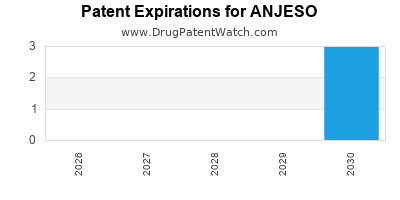
Anjeso is a drug marketed by Baudax and is included in one NDA. There are five patents protecting this drug.

This drug has forty-seven patent family members in thirteen countries.

The generic ingredient in ANJESO is meloxicam. There are twenty-two drug master file entries for this compound. Forty-seven suppliers are listed for this compound. Additional details are available on the meloxicam profile page.

DrugPatentWatch® Litigation and Generic Entry Outlook for Anjeso

A generic version of ANJESO was approved as meloxicam by AVONDALE PHARMS on June 1st, 2004.

  Start Trial

AI Deep Research
Questions you can ask:
  • What is the 5 year forecast for ANJESO?
  • What are the global sales for ANJESO?
  • What is Average Wholesale Price for ANJESO?
Summary for ANJESO
Recent Clinical Trials for ANJESO

Identify potential brand extensions & 505(b)(2) entrants

SponsorPhase
Yangtze River Pharmaceutical Group Co., Ltd.PHASE1

See all ANJESO clinical trials

US Patents and Regulatory Information for ANJESO

ANJESO is protected by five US patents.

Applicant Tradename Generic Name Dosage NDA Approval Date TE Type RLD RS Patent No. Patent Expiration Product Substance Delist Req. Exclusivity Expiration
Baudax ANJESO meloxicam SOLUTION;INTRAVENOUS 210583-001 Feb 20, 2020 DISCN Yes No 10,709,713 ⤷  Start Trial ⤷  Start Trial
Baudax ANJESO meloxicam SOLUTION;INTRAVENOUS 210583-001 Feb 20, 2020 DISCN Yes No 11,253,478 ⤷  Start Trial Y ⤷  Start Trial
Baudax ANJESO meloxicam SOLUTION;INTRAVENOUS 210583-001 Feb 20, 2020 DISCN Yes No 11,458,145 ⤷  Start Trial ⤷  Start Trial
Baudax ANJESO meloxicam SOLUTION;INTRAVENOUS 210583-001 Feb 20, 2020 DISCN Yes No 10,881,663 ⤷  Start Trial ⤷  Start Trial
Baudax ANJESO meloxicam SOLUTION;INTRAVENOUS 210583-001 Feb 20, 2020 DISCN Yes No 9,974,746 ⤷  Start Trial Y ⤷  Start Trial
>Applicant >Tradename >Generic Name >Dosage >NDA >Approval Date >TE >Type >RLD >RS >Patent No. >Patent Expiration >Product >Substance >Delist Req. >Exclusivity Expiration

Expired US Patents for ANJESO

Applicant Tradename Generic Name Dosage NDA Approval Date Patent No. Patent Expiration
Baudax ANJESO meloxicam SOLUTION;INTRAVENOUS 210583-001 Feb 20, 2020 10,463,673 ⤷  Start Trial
Baudax ANJESO meloxicam SOLUTION;INTRAVENOUS 210583-001 Feb 20, 2020 8,512,727 ⤷  Start Trial
Baudax ANJESO meloxicam SOLUTION;INTRAVENOUS 210583-001 Feb 20, 2020 10,471,067 ⤷  Start Trial
>Applicant >Tradename >Generic Name >Dosage >NDA >Approval Date >Patent No. >Patent Expiration

EU/EMA Drug Approvals for ANJESO

Company Drugname Inn Product Number / Indication Status Generic Biosimilar Orphan Marketing Authorisation Marketing Refusal
Norbrook Laboratories (Ireland) Limited Loxicom meloxicam EMEA/V/C/000141DogsAlleviation of inflammation and pain in both acute and chronic musculoskeletal disorders. To reduce postoperative pain and inflammation following orthopaedic and soft-tissue surgery.CatsAlleviation of inflammation and pain in chronic musculoskeletal disorders in cats. To reduce postoperative pain after ovariohysterectomy and minor soft-tissue surgery.CattleFor use in acute respiratory infection with appropriate antibiotic therapy to reduce clinical signs in cattle. For use in diarrhoea in combination with oral rehydration therapy to reduce clinical signs in calves of over one week of age and young, non-lactating cattle. For adjunctive therapy in the treatment of acute mastitis, in combination with antibiotic therapy.PigsFor use in noninfectious locomotor disorders to reduce the symptoms of lameness and inflammation. For adjunctive therapy in the treatment of puerperal septicaemia and toxaemia (mastitis-metritis-agalactia syndrome) with appropriate antibiotic therapy.HorsesFor use in the alleviation of inflammation and relief of pain in both acute and chronic musculoskeletal disorders.For the relief of pain associated with equine colic. Authorised yes no no 2009-02-10
Le Vet Beheer B.V.  Novaquin meloxicam EMEA/V/C/003866Alleviation of inflammation and relief of pain in both acute and chronic musculo-skeletal disorders in horses. Authorised no no no 2015-09-08
Le Vet Beheer B.V Meloxidolor meloxicam EMEA/V/C/002590DogsAlleviation of inflammation and pain in both acute and chronic musculoskeletal disorders.Reduction of postoperative pain and inflammation following orthopaedic and soft-tissue surgery.CatsReduction of postoperative pain after ovariohysterectomy and minor soft-tissue surgery.CattleFor use in acute respiratory infection with appropriate antibiotic therapy to reduce clinical signs.For use in diarrhoea in combination with oral rehydration therapy to reduce clinical signs in calves of over one week of age and young, non-lactating cattle.For adjunctive therapy in the treatment of acute mastitis, in combination with antibiotic therapy.PigsFor use in noninfectious locomotor disorders to reduce the symptoms of lameness and inflammation.For the relief of postoperative pain associated with minor soft-tissue surgery such as castration.For adjunctive therapy in the treatment of puerperal septicaemia and toxaemia (mastitis-metritis-agalactia syndrome) with appropriate antibiotic therapy.HorsesFor use in the alleviation of inflammation and relief of pain in both acute and chronic musculoskeletal disorders.For the relief of pain associated with equine colic. Authorised yes no no 2013-04-22
Boehringer Ingelheim Vetmedica GmbH Novem meloxicam EMEA/V/C/000086Novem 5-mg/ml solution for injection for cattle and pigs:CattleFor use in acute respiratory infection with appropriate antibiotic therapy to reduce clinical signs in cattle.For use in diarrhoea in combination with oral rehydration therapy to reduce clinical signs in calves of over one week of age and young, non-lactating cattle.For the relief of postoperative pain following dehorning in calves.PigsFor use in noninfectious locomotor disorders to reduce the symptoms of lameness and inflammation.For the relief of postoperative pain associated with minor soft-tissue surgery such as castration.Novem 20-mg/ml solution for injection for cattle and pigs:CattleFor use in acute respiratory infection with appropriate antibiotic therapy to reduce clinical signs in cattle.For use in diarrhoea in combination with oral rehydration therapy to reduce clinical signs in calves of over one week of age and young, non-lactating cattle.For adjunctive therapy in the treatment of acute mastitis, in combination with antibiotic therapy.For the relief of postoperative pain following dehorning in calves.PigsFor use in noninfectious locomotor disorders to reduce the symptoms of lameness and inflammation.For adjunctive therapy in the treatment of puerperal septicaemia and toxaemia (mastitis-metritis-agalactia syndrome) with appropriate antibiotic therapy.Novem 40 mg/ml solution for injection for cattle:For use in acute respiratory infection with appropriate antibiotic therapy to reduce clinical signs in cattle.For use in diarrhoea in combination with oral re-hydration therapy to reduce clinical signs in calves of over one week of age and young, non-lactating cattle.For adjunctive therapy in the treatment of acute mastitis, in combination with antibiotic therapy. Authorised no no no 2004-03-02
Boehringer Ingelheim Vetmedica GmbH Metacam meloxicam EMEA/V/C/000033Cats:Alleviation of mild to moderate post-operative pain and inflammation following surgical procedures, e.g. orthopaedic and soft tissue surgery.Alleviation of pain and inflammation in acute and chronic musculo-skeletal disorders.Reduction of post-operative pain after ovariohysterectomy and minor soft tissue surgery.Cattle:For use in acute respiratory infection with appropriate antibiotic therapy to reduce clinical signs.For use in diarrhoea in combination with oral re-hydration therapy to reduce clinical signs in calves of over one week of age and young, non-lactating cattle.For the relief of post-operative pain following dehorning in calves.For adjunctive therapy in the treatment of acute mastitis, in combination with antibiotic therapy.Dogs:Alleviation of inflammation and pain in both acute and chronic musculo-skeletal disorders.Reduction of post-operative pain and inflammation following orthopaedic and soft tissue surgery.Horses:For use in the alleviation of inflammation and relief of pain in both acute and chronic musculo-skeletal disorders.For the relief of pain associated with equine colic.Alleviation of inflammation and relief of pain in both acute and chronic musculo-skeletal disorders.Pigs: For use in non-infectious locomotor disorders to reduce the symptoms of lameness and inflammation.For the relief of post-operative pain associated with minor soft tissue surgery such as castration.For adjunctive therapy in the treatment of puerperal septicaemia and toxaemia (mastitis-metritis-agalactia syndrome) with appropriate antibiotic therapy.Guinea pigs:Alleviation of mild to moderate post-operative pain associated with soft tissues surgery such as male castration. Authorised no no no 1998-01-07
Chanelle Pharmaceuticals Manufacturing Limited Rheumocam meloxicam EMEA/V/C/000121DogsAlleviation of inflammation and pain in both acute and chronic musculo-skeletal disorders in dogs. To reduce post-operative pain and inflammation following orthopaedic and soft tissue surgery.CatsReduction of post-operative pain after ovariohysterectomy and minor soft tissue surgery.Alleviation of mild to moderate post-operative pain and inflammation following surgical procedures in cats, e.g. orthopaedic and soft tissue surgery.Alleviation of pain and inflammation in acute and chronic musculo-skeletal disorders in cats.CattleFor use in acute respiratory infection with appropriate antibiotic therapy to reduce clinical signs. For use in diarrhoea in combination with oral re-hydration therapy to reduce clinical signs in calves of over one week of age and young, non-lactating cattle. For adjunctive therapy in the treatment of acute mastitis, in combination with antibiotic therapy.PigsFor use in non-infectious locomotor disorders to reduce the symptoms of lameness and inflammation. For adjunctive therapy in the treatment of puerperal septicaemia and toxaemia (mastitis-metritis-agalactia syndrome) with appropriate antibiotic therapy. For the relief of post operative pain associated with minor soft tissue such as castration.HorsesAlleviation of inflammation and relief of pain in both acute and chronic musculo-skeletal disorders in horses..For the relief of pain associated with equine colic. Authorised yes no no 2008-01-10
>Company >Drugname >Inn >Product Number / Indication >Status >Generic >Biosimilar >Orphan >Marketing Authorisation >Marketing Refusal

International Patents for ANJESO

See the table below for patents covering ANJESO around the world.

Country Patent Number Title Estimated Expiration
Austria 431131 ⤷  Start Trial
Canada 2517679 FORMULATIONS DE MELOXICANE NANOPARTICULAIRES (NANOPARTICULATE MELOXICAM FORMULATIONS) ⤷  Start Trial
Germany 602004021107 ⤷  Start Trial
Denmark 3090731 ⤷  Start Trial
Denmark 3434261 ⤷  Start Trial
European Patent Office 1617816 FORMULATIONS DE MELOXICANE NANOPARTICULAIRES (NANOPARTICULATE MELOXICAN FORMULATIONS) ⤷  Start Trial
>Country >Patent Number >Title >Estimated Expiration

ANJESO Market Dynamics, Financial Trajectory, Patent Position, and Generic Entry Risk

Last updated: August 5, 2026

ANJESO, the injectable formulation of meloxicam, has generated a small but commercially relevant hospital analgesics business. Its market position depends on hospital adoption, formulary access, stocking economics, and differentiation from intravenous acetaminophen, ketorolac, opioids, and other perioperative analgesics. The product was developed and launched by Baudax Bio and later transferred to Cumberland Pharmaceuticals after Baudax’s financial deterioration.

ANJESO has regulatory approval but limited exclusivity protection compared with a new chemical entity. Its commercial opportunity is concentrated in U.S. hospitals and ambulatory surgical settings. The principal risks are slow formulary conversion, competing low-cost generic analgesics, reimbursement pressure, and the absence of a large protected market.

What is ANJESO and how does it work?

ANJESO is meloxicam injection, a nonsteroidal anti-inflammatory drug administered intravenously. The FDA approved it in February 2020 under New Drug Application 214801 for the management of moderate-to-severe pain, alone or in combination with non-NSAID analgesics, in adults [1].

The product is supplied as a single-dose vial containing 30 mg/mL of meloxicam. The recommended adult regimen is 30 mg administered intravenously once daily, with a maximum treatment duration of seven days in the labeled acute-pain setting [2].

Meloxicam preferentially inhibits cyclooxygenase-2 over cyclooxygenase-1, although the selectivity is dose-dependent and does not eliminate the class risks associated with NSAIDs. The label includes warnings for gastrointestinal bleeding, cardiovascular thrombotic events, renal toxicity, hypertension, and hypersensitivity reactions [2].

How does ANJESO compare with ketorolac and intravenous acetaminophen?

Attribute ANJESO Ketorolac injection Intravenous acetaminophen
Active ingredient Meloxicam Ketorolac Acetaminophen
Drug class NSAID NSAID Non-NSAID analgesic
Route Intravenous Intravenous or intramuscular Intravenous
Typical role Acute moderate-to-severe pain Short-term acute pain Mild-to-moderate pain and opioid-sparing therapy
Main commercial advantage Once-daily dosing and non-opioid analgesia Low acquisition cost and broad generic availability Avoids NSAID-related renal and gastrointestinal risks
Main commercial barrier Premium branded pricing and hospital adoption Established generic competition Dose, liver toxicity, and cost considerations

ANJESO’s clinical positioning is based on opioid-sparing treatment and once-daily dosing rather than a new analgesic mechanism. Its value proposition is strongest where hospitals want an injectable NSAID that can be incorporated into multimodal pain protocols.

When did ANJESO receive FDA approval and lose exclusivity?

ANJESO received FDA approval on February 20, 2020. Because meloxicam was already an established active ingredient, ANJESO did not receive five-year new chemical entity exclusivity.

The product’s regulatory protection was tied primarily to FDA approval of a new dosage form and clinical investigations supporting the injectable product. The applicable three-year exclusivity period generally ran through February 2023, subject to the precise FDA exclusivity record and any qualifying regulatory extensions [1, 3].

Milestone Date
FDA approval of NDA 214801 February 20, 2020
Commercial launch 2020
Expected end of three-year clinical-investigation exclusivity February 2023
Transfer of ANJESO commercial rights to Cumberland Pharmaceuticals 2023
Current market status FDA-approved branded injectable meloxicam

The end of regulatory exclusivity did not automatically create immediate generic competition. A generic applicant would still need to address any applicable Orange Book patents, obtain FDA approval through an ANDA, and establish manufacturing and commercial access.

What patents protect ANJESO?

ANJESO’s protection is narrower than the patent estate typically associated with a novel active pharmaceutical ingredient. The commercial product uses meloxicam, an established NSAID, so the relevant intellectual-property value is concentrated in injectable formulation, dosing, manufacturing, and clinical-use claims.

Publicly available regulatory and company materials identify ANJESO as a proprietary intravenous formulation of meloxicam. The commercial importance of any listed patent depends on whether the claim covers:

  • The injectable composition;
  • Concentration and excipient selection;
  • Stability and storage characteristics;
  • Intravenous administration;
  • A specific dosing regimen;
  • Use in perioperative or acute-pain populations; or
  • Manufacturing processes that are difficult to design around.

What is the Orange Book status of ANJESO?

ANJESO is listed under FDA NDA 214801. The Orange Book is the relevant source for determining whether the NDA holder has listed patents that an ANDA applicant must address through Paragraph IV certification [3].

A patent listing would not necessarily prevent generic entry. It could instead require a Paragraph IV challenge, a section viii statement limiting the generic label, or a non-infringement and invalidity defense. The commercial strength of the estate depends on claim scope, remaining patent term, prosecution history, and whether the claims cover the marketed 30 mg/mL vial.

The available public record does not establish that ANJESO has the long-duration composition-of-matter protection associated with a new molecular entity. Its patent position should therefore be viewed as formulation- and use-dependent rather than molecule-dependent.

Which companies are challenging ANJESO patents?

No major public Paragraph IV litigation against ANJESO is identified in the cited company and FDA materials. Publicly disclosed competitive pressure has centered on established generic analgesics rather than a named generic applicant in active litigation.

Potential ANDA challengers would include generic injectable manufacturers with existing hospital portfolios. Relevant competitive capabilities include:

  • Sterile injectable manufacturing;
  • FDA-approved vial-filling capacity;
  • Hospital contracting infrastructure;
  • Ability to supply group purchasing organizations;
  • Experience with NSAID products; and
  • Willingness to price below a branded hospital product.

A generic meloxicam injection would face a different commercial hurdle from an oral tablet generic. Sterile injectable production requires validated aseptic manufacturing, container-closure controls, stability data, and reliable supply. Those requirements can delay entry even when patent barriers are limited.

What formulations are protected by ANJESO?

The marketed formulation is an intravenous meloxicam solution at 30 mg/mL in a single-dose vial. Formulation-related protection may include concentration, pH, solvents, stabilizers, container materials, and stability characteristics.

The formulation is commercially relevant because injectable meloxicam must meet sterility, particulate, endotoxin, and stability standards. A generic applicant may be able to design around individual formulation claims, but it must still demonstrate pharmaceutical equivalence and bioequivalence or satisfy the FDA’s applicable requirements for injectable products.

Formulation patents are generally less durable than composition-of-matter patents. Their strength depends on whether competitors can use alternative excipients or concentrations without infringing and whether the patent claims survive obviousness challenges.

What method-of-use patents protect ANJESO?

ANJESO is approved for moderate-to-severe acute pain in adults. Potential method-of-use protection may relate to:

  • Once-daily intravenous dosing;
  • Use for up to seven days;
  • Perioperative pain management;
  • Opioid-sparing treatment;
  • Combination therapy with non-NSAID analgesics; or
  • Treatment in defined surgical or acute-care populations.

A generic applicant may attempt to omit patented uses through a section viii statement while retaining non-patented indications. The practical impact depends on how broadly hospitals use the product and whether the protected method is central to prescribing decisions.

Method-of-use patents are usually less effective against off-label use than product patents. Hospitals and physicians can prescribe an approved generic for an unlisted use, creating enforcement and monitoring challenges for the patent holder.

How did ANJESO’s financial trajectory develop?

ANJESO was launched by Baudax Bio in 2020. The product became Baudax’s principal commercial asset, but sales did not produce a sufficient financial base to support the company’s broader operating structure.

Baudax reported product revenue in the low-single-digit millions during the early commercialization period. Revenue growth was constrained by the timing of the launch, the COVID-19 disruption to elective procedures, hospital budget controls, and the time required to secure formulary and purchasing contracts [4, 5].

ANJESO financial trajectory

Period Commercial development Financial implication
2020 Initial FDA launch and hospital introduction Limited first-year sales; elective-procedure disruption
2021 Broader commercial promotion and formulary efforts Revenue increased but remained modest
2022 Product remained Baudax’s principal revenue source Sales were insufficient to offset operating losses and financing needs
2023 Rights transferred to Cumberland Pharmaceuticals Commercial ownership moved to a more diversified specialty-pharmaceutical company
2024 onward Focus on portfolio integration and hospital-channel growth Upside depends on broader institutional adoption and cost discipline

Baudax’s filings showed continuing operating losses, negative cash flow, and dependence on external financing. Those conditions weakened the company’s negotiating position and contributed to the eventual transfer of ANJESO-related assets and rights to Cumberland [4, 5].

The transaction gave Cumberland an established FDA-approved product without requiring it to fund original clinical development. Cumberland’s existing hospital and specialty-pharmaceutical infrastructure provides a more stable platform for ANJESO than Baudax’s single-product commercial model.

What was the licensing or acquisition deal for ANJESO?

Cumberland Pharmaceuticals acquired U.S. and Canadian rights to ANJESO from Baudax Bio in 2023. Public disclosures described upfront consideration and additional economic terms, including potential royalties or contingent payments, subject to the transaction documents and continuing obligations [6].

The transaction had two commercial effects:

  1. It reduced Baudax’s need to fund a standalone hospital-sales organization.
  2. It added ANJESO to Cumberland’s existing acute-care portfolio, which includes products such as Caldolor and other hospital or specialty medicines.

For Cumberland, ANJESO offers portfolio overlap with institutional buyers and analgesic prescribing pathways. The transaction also creates cross-selling potential with other acute-care products. The product remains exposed to the same adoption barriers, but the owner has greater ability to operate it as one component of a broader hospital strategy.

How strong is the ANJESO patent estate?

ANJESO has moderate commercial protection but limited molecule-level exclusivity.

Patent-estate factor Assessment
Active ingredient protection Weak; meloxicam is an established drug
FDA exclusivity Limited relative to an NCE
Formulation protection Potentially meaningful if claims cover the commercial injectable composition
Method-of-use protection Potentially useful but vulnerable to label carve-outs
Manufacturing barriers Meaningful because sterile injectable production is complex
Generic substitution risk Moderate to high if no enforceable blocking patent remains
Litigation history No major publicly identified Paragraph IV dispute in cited materials
Geographic protection Primarily U.S. commercial value; Canadian rights were also transferred

The strongest practical barriers may be manufacturing and hospital contracting rather than patent term. A generic competitor still needs a reliable sterile supply chain and must persuade hospitals to substitute a product used in acute-care protocols.

What generic entry risks exist for ANJESO?

The main generic entry risks are:

  • Expiration or absence of blocking formulation patents;
  • Paragraph IV challenges by injectable-drug manufacturers;
  • Hospital preference for lower-cost ketorolac;
  • Substitution by intravenous acetaminophen;
  • Limited clinical differentiation;
  • Restricted reimbursement for premium branded analgesics;
  • Contracting pressure from group purchasing organizations; and
  • Difficulty sustaining a premium price after a therapeutically equivalent generic launches.

A first generic could take significant share if it offers a meaningful discount and secures hospital contracts. The initial erosion could be rapid because inpatient buyers are sensitive to acquisition cost and generally have centralized pharmacy and formulary systems.

ANJESO may retain a niche if Cumberland demonstrates operational advantages, including once-daily administration, predictable supply, favorable formulary economics, or a role in opioid-sparing protocols. Those advantages would support brand retention but would not eliminate generic substitution risk.

What is ANJESO’s competitive landscape?

ANJESO competes in multimodal acute-pain management rather than in a standalone branded category. Its competitors include:

  • Generic ketorolac injection;
  • Intravenous acetaminophen;
  • Oral and injectable ibuprofen;
  • Opioid analgesics;
  • Regional anesthesia and nerve-block procedures;
  • Local anesthetics;
  • Non-pharmacologic perioperative pain protocols; and
  • Combination opioid and non-opioid regimens.

Ketorolac is the most direct NSAID comparator. It has extensive hospital familiarity, broad generic availability, and low cost. ANJESO’s differentiation is therefore based on dosing, formulation, tolerability perceptions, and integration into opioid-sparing treatment pathways.

The product also competes against efforts to reduce total hospital medication cost. A branded injectable must demonstrate either clinical utility, workflow savings, or formulary value sufficient to offset its acquisition-price premium.

How much revenue is exposed to ANJESO?

ANJESO was materially important to Baudax because it was the company’s main commercial product. Its low-single-digit-million-dollar annual revenue base was small compared with major hospital analgesics but strategically important relative to Baudax’s overall business.

For Cumberland, ANJESO represents portfolio revenue rather than a company-defining asset. The financial exposure is therefore more manageable. The principal value drivers are:

  • Net sales growth in hospitals and surgery centers;
  • Gross margin after manufacturing and distribution costs;
  • Sales-force and promotional spending;
  • Royalty or contingent-payment obligations;
  • Generic launch timing;
  • Formulary retention; and
  • Repeat ordering by institutional customers.

ANJESO is unlikely to become a large pharmaceutical product without substantial expansion across hospital systems. Its realistic commercial profile is a specialty hospital product with niche revenue potential and moderate downside from generic competition.

What patent litigation and settlement agreements affect ANJESO?

No material publicly disclosed ANJESO patent settlement is identified in the cited sources. No major active Paragraph IV litigation is identified either.

The absence of a public settlement reduces visibility into a negotiated generic-entry date. If an ANDA challenge is filed later, the principal legal issues would likely involve formulation obviousness, claim construction, written description, enablement, and the scope of any method-of-use claims.

What is the FDA regulatory status of ANJESO?

ANJESO remains an FDA-approved prescription drug under NDA 214801 for adult moderate-to-severe pain [1, 2]. It is not a biologic and is not subject to the biosimilar pathway.

The relevant competing approval pathway is an ANDA for a generic injectable meloxicam product. A 505(b)(2) applicant could also seek approval for a related meloxicam injectable product with reliance on existing literature and bridging data, although the commercial and regulatory strategy would depend on formulation differences and the scope of FDA requirements.

Key Takeaways

  • ANJESO is FDA-approved intravenous meloxicam for moderate-to-severe adult pain.
  • FDA approval occurred on February 20, 2020, with limited regulatory exclusivity because meloxicam is an established active ingredient.
  • The product’s commercial protection depends on formulation, method-of-use, manufacturing, and hospital-channel barriers.
  • Baudax Bio’s financial deterioration limited ANJESO’s development as a standalone commercial platform.
  • Cumberland Pharmaceuticals acquired ANJESO rights in 2023 and now has a stronger portfolio platform for hospital commercialization.
  • Generic risk is moderate to high if no enforceable blocking formulation patent remains.
  • Ketorolac injection is the principal low-cost NSAID competitor.
  • ANJESO has niche revenue potential but lacks the market characteristics of a large, molecule-protected pharmaceutical product.
  • No major publicly disclosed Paragraph IV litigation or settlement is identified in the cited materials.
  • Biosimilar risk is not applicable because ANJESO is a small-molecule drug, not a biologic.

FAQs

Can a generic manufacturer launch injectable meloxicam after February 2023?

Yes, subject to FDA approval and any enforceable Orange Book patent claims. The end of clinical-investigation exclusivity does not itself guarantee immediate generic launch.

Is ANJESO protected by a new chemical entity patent?

No. ANJESO contains meloxicam, an established active ingredient. Its protection is based on the injectable product, clinical use, formulation, and related intellectual property.

Does ANJESO compete directly with Caldolor?

Yes. Both products are hospital-oriented non-opioid analgesics, although Caldolor contains intravenous ibuprofen and ANJESO contains intravenous meloxicam. They can compete for similar multimodal pain-management protocols.

Is ANJESO a biologic eligible for biosimilar competition?

No. ANJESO is a small-molecule NSAID. A competitor would generally pursue an ANDA or, depending on the product design, a 505(b)(2) application.

What would most increase ANJESO’s commercial value?

The largest value drivers would be stronger hospital formulary penetration, a differentiated pharmacoeconomic profile, sustained sterile-product supply, and protection against early generic substitution.

References

  1. U.S. Food and Drug Administration. (2020). FDA approves ANJESO (meloxicam) injection for the management of moderate-to-severe pain in adults. FDA.

  2. U.S. Food and Drug Administration. (2023). ANJESO prescribing information. FDA.

  3. U.S. Food and Drug Administration. (2024). Approved drug products with therapeutic equivalence evaluations, Orange Book. FDA.

  4. Baudax Bio, Inc. (2022). Annual report pursuant to Section 13 or 15(d) of the Securities Exchange Act of 1934. U.S. Securities and Exchange Commission.

  5. Baudax Bio, Inc. (2023). Annual report and financial statements. U.S. Securities and Exchange Commission.

  6. Cumberland Pharmaceuticals Inc. (2023). Annual report pursuant to Section 13 or 15(d) of the Securities Exchange Act of 1934. U.S. Securities and Exchange Commission.

More… ↓

⤷  Start Trial

Make Better Decisions: Try a trial or see plans & pricing

Drugs may be covered by multiple patents or regulatory protections. All trademarks and applicant names are the property of their respective owners or licensors. Although great care is taken in the proper and correct provision of this service, thinkBiotech LLC does not accept any responsibility for possible consequences of errors or omissions in the provided data. The data presented herein is for information purposes only. There is no warranty that the data contained herein is error free. We do not provide individual investment advice. This service is not registered with any financial regulatory agency. The information we publish is educational only and based on our opinions plus our models. By using DrugPatentWatch you acknowledge that we do not provide personalized recommendations or advice. thinkBiotech performs no independent verification of facts as provided by public sources nor are attempts made to provide legal or investing advice. Any reliance on data provided herein is done solely at the discretion of the user. Users of this service are advised to seek professional advice and independent confirmation before considering acting on any of the provided information. thinkBiotech LLC reserves the right to amend, extend or withdraw any part or all of the offered service without notice.