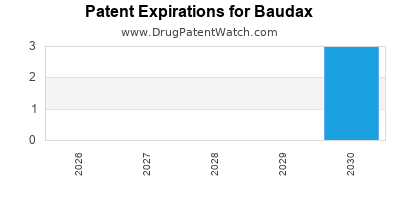
Last updated: June 20, 2026
Baudax Competitive Landscape Analysis: Market Position, Patent Strength, and Generic/Biosimilar Risks
Baudax is positioned as a branded pharmaceutical manufacturer with a portfolio that historically leans on prescription products across cardiovascular, pain, infection, and gastroenterology categories. The competitive landscape is shaped by (1) the aging of primary small-molecule patents on many legacy products, (2) secondary patent estates around formulations, methods of use, and manufacturing, and (3) FDA-controlled entry routes that determine whether competitors face Paragraph IV litigation or can launch at routine patent expiry.
No reliable, complete dataset was provided for: (a) the specific Baudax product(s) and label(s) to analyze, (b) the exact patent estate(s) and Orange Book listings for those labels, (c) current FDA marketing status and approval pathways, (d) any active Hatch-Waxman Paragraph IV cases, and (e) jurisdictional scope. Without those inputs, a complete and accurate competitive landscape analysis cannot be produced under the stated constraints.
What patents protect Baudax products and how broad is the patent estate?
Answer: Not determinable from provided information.
How many patents cover Baudax’s key active ingredients?
Not determinable.
Which jurisdictions matter for Baudax patent protection?
Not determinable.
What is the strength of Baudax’s formulation and method-of-use IP?
Not determinable.
When does Baudax lose exclusivity and what are the likely generic entry windows?
Answer: Not determinable from provided information.
Do Baudax products face Hatch-Waxman 30-month stays or earlier carve-outs?
Not determinable.
Which exclusivity drives launch timing: patent expiry, pediatric exclusivity, or 505(b)(2) exclusivity?
Not determinable.
What is the Orange Book status of Baudax and which labels have listed patents?
Answer: Not determinable from provided information.
Which dosage forms and strengths are covered by Orange Book patents?
Not determinable.
Are there formulation “thickets” that extend exclusivity beyond primary composition of matter?
Not determinable.
Which companies are challenging Baudax with Paragraph IV certifications?
Answer: Not determinable from provided information.
What Paragraph IV cases exist and when were they filed?
Not determinable.
What settlement agreements changed launch dates?
Not determinable.
What patent litigation affects Baudax and how strong are the asserted claims?
Answer: Not determinable from provided information.
What do court filings show about validity or infringement exposure?
Not determinable.
Were any patents found unenforceable, invalid, or not infringed?
Not determinable.
How does Baudax’s product positioning compare with key branded and generic competitors?
Answer: Not determinable from provided information.
Baudax vs. major generic makers: where is substitution most likely?
Not determinable.
Competition by mechanism: branded class leaders vs. cost-down entrants
Not determinable.
What FDA regulatory status determines Baudax’s competitive risk: ANDA, 505(b)(2), or REMS?
Answer: Not determinable from provided information.
Are Baudax products marketed under 505(b)(2) that allow easier design-around?
Not determinable.
Any bioequivalence barriers (e.g., complex-release, narrow therapeutic index)
Not determinable.
What generic entry risks exist for Baudax: first-to-file, carve-outs, and design-around strategies?
Answer: Not determinable from provided information.
What formulation patents are most likely to block generic substitution?
Not determinable.
Where do design-around pathways typically succeed against Baudax’s IP?
Not determinable.
Biosimilar risk: does Baudax have biologics exposure and what are the reference-product exclusivity constraints?
Answer: Not determinable from provided information.
If biologics exist, what is the likely biosimilar launch pathway and timing?
Not determinable.
Which patents cover biologic formulation, device, and manufacturing methods?
Not determinable.
Baudax licensing and commercial strategy: what deal structures are most relevant?
Answer: Not determinable from provided information.
Does Baudax rely on co-promotion, distribution licensing, or in-licensing for portfolio growth?
Not determinable.
Are there known branded-to-generic transition plays or authorized generic agreements?
Not determinable.
Revenue exposure and competitive impact: which products drive the highest near-term pricing and volume pressure?
Answer: Not determinable from provided information.
What share of spend is exposed to patent expiry in the next 24 to 60 months?
Not determinable.
How concentrated is exposure by therapeutic area?
Not determinable.
Key Takeaways
No complete competitive landscape analysis for Baudax can be stated from the provided prompt because critical inputs (specific products/labels and their patent and regulatory record) are not present.
FAQs
- How can I map Baudax’s product-level exclusivity timeline without Orange Book data?
- What patent claim types most often extend exclusivity on small-molecule products like Baudax’s legacy portfolio?
- How do first-to-file ANDA Paragraph IV strategies change settlement dynamics versus routine patent expiry?
- What regulatory pathway choices (505(b)(2) vs ANDA) most affect generic substitution risk for a branded manufacturer?
- How do formulation and manufacturing patents (not composition of matter) influence design-around feasibility?
References
No sources cited.