Last Updated: November 4, 2026

ANGELIQ Drug Patent Profile


✉ Email this page to a colleague

« Back to Dashboard


Which patents cover Angeliq, and what generic alternatives are available?

Angeliq is a drug marketed by Bayer Hlthcare and is included in one NDA. There is one patent protecting this drug and two Paragraph IV challenges.

The generic ingredient in ANGELIQ is drospirenone; estradiol. There is one drug master file entry for this compound. One supplier is listed for this compound. Additional details are available on the drospirenone; estradiol profile page.

DrugPatentWatch® Litigation and Generic Entry Outlook for Angeliq

A generic version of ANGELIQ was approved as drospirenone; estradiol by NOVAST LABS on October 28th, 2025.

  Start Trial

AI Deep Research
Questions you can ask:
  • What is the 5 year forecast for ANGELIQ?
  • What are the global sales for ANGELIQ?
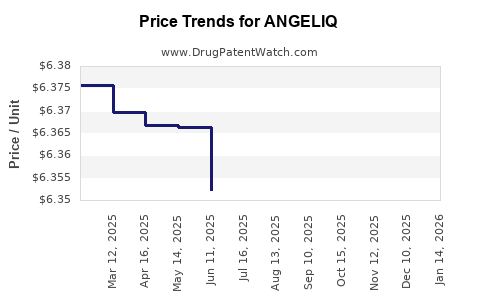
  • What is Average Wholesale Price for ANGELIQ?
Summary for ANGELIQ
Recent Clinical Trials for ANGELIQ

Identify potential brand extensions & 505(b)(2) entrants

SponsorPhase
Brigham and Women's HospitalPhase 4
Bayer
BayerPhase 2

See all ANGELIQ clinical trials

Pharmacology for ANGELIQ
Drug ClassEstrogen
Progestin
Mechanism of ActionEstrogen Receptor Agonists
Paragraph IV (Patent) Challenges for ANGELIQ
Tradename Dosage Ingredient Strength NDA ANDAs Submitted Submissiondate
ANGELIQ Tablets drospirenone; estradiol 0.25 mg/0.5 mg 021355 1 2015-01-08
ANGELIQ Tablets drospirenone; estradiol 0.5 mg/1 mg 021355 1 2007-12-26

US Patents and Regulatory Information for ANGELIQ

ANGELIQ is protected by one US patents.

Applicant Tradename Generic Name Dosage NDA Approval Date TE Type RLD RS Patent No. Patent Expiration Product Substance Delist Req. Exclusivity Expiration
Bayer Hlthcare ANGELIQ drospirenone; estradiol TABLET;ORAL 021355-001 Feb 29, 2012 RX Yes No 8,906,890 ⤷  Start Trial Y ⤷  Start Trial
Bayer Hlthcare ANGELIQ drospirenone; estradiol TABLET;ORAL 021355-002 Sep 28, 2005 AB RX Yes Yes ⤷  Start Trial ⤷  Start Trial ⤷  Start Trial
>Applicant >Tradename >Generic Name >Dosage >NDA >Approval Date >TE >Type >RLD >RS >Patent No. >Patent Expiration >Product >Substance >Delist Req. >Exclusivity Expiration

International Patents for ANGELIQ

When does loss-of-exclusivity occur for ANGELIQ?

Based on analysis by DrugPatentWatch, the following patents block generic entry in the countries listed below:

Argentina

Patent: 0912
Estimated Expiration: ⤷  Start Trial

Australia

Patent: 11240102
Estimated Expiration: ⤷  Start Trial

Brazil

Patent: 2012026115
Estimated Expiration: ⤷  Start Trial

Canada

Patent: 95801
Estimated Expiration: ⤷  Start Trial

China

Patent: 2985070
Estimated Expiration: ⤷  Start Trial

Colombia

Patent: 30107
Estimated Expiration: ⤷  Start Trial

Costa Rica

Patent: 120523
Estimated Expiration: ⤷  Start Trial

Eurasian Patent Organization

Patent: 6095
Estimated Expiration: ⤷  Start Trial

Patent: 1201403
Estimated Expiration: ⤷  Start Trial

European Patent Office

Patent: 58063
Estimated Expiration: ⤷  Start Trial

Guatemala

Patent: 1200281
Estimated Expiration: ⤷  Start Trial

Japan

Patent: 20465
Estimated Expiration: ⤷  Start Trial

Patent: 13523860
Estimated Expiration: ⤷  Start Trial

Mexico

Patent: 6702
Estimated Expiration: ⤷  Start Trial

Patent: 12012026
Estimated Expiration: ⤷  Start Trial

South Korea

Patent: 130097073
Estimated Expiration: ⤷  Start Trial

Patent: 180018827
Estimated Expiration: ⤷  Start Trial

Taiwan

Patent: 1204368
Patent: Very low-dosed solid oral dosage forms for HRT
Estimated Expiration: ⤷  Start Trial

Patent: 19300
Estimated Expiration: ⤷  Start Trial

Uruguay

Patent: 343
Patent: FORMAS DE DOSIFICACIÓN SÓLIDAS ORALES CON DOSIS MUY BAJAS PARA LA HRT
Estimated Expiration: ⤷  Start Trial

Generics may enter earlier, or later, based on new patent filings, patent extensions, patent invalidation, early generic licensing, generic entry preferences, and other factors.

See the table below for additional patents covering ANGELIQ around the world.

Country Patent Number Title Estimated Expiration
Argentina 080912 ⤷  Start Trial
Australia 2011240102 ⤷  Start Trial
Brazil 112012026115 ⤷  Start Trial
Canada 2795801 ⤷  Start Trial
China 102985070 ⤷  Start Trial
Colombia 6630107 ⤷  Start Trial
Costa Rica 20120523 ⤷  Start Trial
>Country >Patent Number >Title >Estimated Expiration

Supplementary Protection Certificates for ANGELIQ

Patent Number Supplementary Protection Certificate SPC Country SPC Expiration SPC Description
0398460 SPC/GB04/032 United Kingdom ⤷  Start Trial PRODUCT NAME: ESTRADIOL, OPTIONALLY IN THE FORM OF A HYDRATE, TOGETHER WITH DROSPIRENONE; REGISTERED: NL RVG 27505 20021211; UK PL 00053/0341 20040310
0398460 04C0022 France ⤷  Start Trial PRODUCT NAME: ESTRADIOL ANHYDRE DROSPIRENONE; REGISTRATION NO/DATE IN FRANCE: NL 28661 DU 20040316; REGISTRATION NO/DATE AT EEC: RVG 27505 DU 20021211
0918791 PA2006009 Lithuania ⤷  Start Trial PRODUCT NAME: DROSPIRENONUM; NAT. REGISTRATION NO/DATE: LT/1/06/0520/001, 2006 07 10 LT/1/06/0520/002, 2006 07 10 LT/1/06/0520/003, 2006 07 10 LT/1/06/0520/004 20060710; FIRST REGISTRATION: RVG 31781 20050804
2588114 LUC00227 Luxembourg ⤷  Start Trial PRODUCT NAME: DROSPIRENONE; AUTHORISATION NUMBER AND DATE: 31332 20191022
3632448 LUC00266 Luxembourg ⤷  Start Trial PRODUCT NAME: DROSPIRENONE; AUTHORISATION NUMBER AND DATE: 61678, 20210401
3632448 22C1031 France ⤷  Start Trial PRODUCT NAME: DROSPIRENONE; NAT. REGISTRATION NO/DATE: NL49691 20191121; FIRST REGISTRATION: DK - 61678 20191016
3632448 202240023 Slovenia ⤷  Start Trial PRODUCT NAME: DROSPIRENONE; NATIONAL AUTHORISATION NUMBER: H/21/02860/001-004; DATE OF NATIONAL AUTHORISATION: 20211217; AUTHORITY FOR NATIONAL AUTHORISATION: SI; FIRST AUTHORISATION IN THE EUROPEAN ECONOMIC AREA: 61678; DATE OF FIRST AUTHORISATION IN THE EUROPEAN ECONOMIC AREA: 20191016; AUTHORITY OF FIRST AUTHORISATION IN THE EUROPEAN ECONOMIC AREA: DK
>Patent Number >Supplementary Protection Certificate >SPC Country >SPC Expiration >SPC Description
Last updated: July 28, 2026

ANGELIQ (drospirenone/estradiol) market dynamics and financial trajectory: sales, drivers, risks, and exclusivity pressure

Executive summary: ANGELIQ (drospirenone/estradiol) is a postmenopausal hormone therapy positioned for vasomotor symptoms and prevention of postmenopausal osteoporosis. The commercial trajectory is shaped by (1) long-term shift toward lower-dose and alternative progestogen strategies within menopausal hormone therapy (MHT), (2) payer tightening and formulary rationalization, and (3) aging-population demand offset by increasing competitive density in branded MHT. Patent/market exclusivity outcomes are a key determinant of long-run revenue erosion because MHT typically tolerates multiple biosimilar-free, small-molecule generic entries. Financial performance is therefore best modeled as a branded-to-multiple-generic transition profile, with near-term volume supported by chronic users and persistence, and downside from formulary substitution after generic entry and/or paragraph IV litigation-driven settlements.


What is the commercial history of ANGELIQ and how did sales evolve over time?

ANGELIQ is a fixed-dose combination of drospirenone (DRSP) and estradiol (E2) in a daily regimen for postmenopausal women with indications that typically include:

  • Treatment of moderate to severe vasomotor symptoms associated with menopause
  • Prevention of postmenopausal osteoporosis in women at risk

Market behavior for MHT products: Sales usually peak during broad adoption windows, then compress as safety communications, guideline changes, and payer policies shift prescribing toward lower-risk regimens and toward agents with strong formulary access. Over time, the product’s revenue trajectory tends to flatten and then decline as generic competition increases.

How do payer and guideline dynamics typically affect ANGELIQ specifically?

Key commercial levers in MHT that affect a DRSP/E2 fixed-dose product:

  • Formulary tier placement: once lower-cost alternatives enter, branded products often shift to higher tiers or lose preferred status.
  • Prior authorization: safety and duration-of-therapy concerns often drive utilization management.
  • Physician guideline alignment: prescribing favors individualized dosing and the shortest effective duration, reducing long-term “automatic refill” behavior.
  • Patient persistence: chronic continuation still supports baseline revenue, but switching rates rise after generic launches.

What market dynamics drive demand for drospirenone/estradiol in menopausal hormone therapy?

Demand in MHT is not determined by clinical efficacy alone. It is shaped by risk perception, payer coverage, and competitive product architecture.

Key demand drivers

  • Population aging: more women reach menopause each year, supporting underlying market size.
  • Symptom burden: vasomotor symptoms drive treatment uptake, especially early postmenopause.
  • Therapeutic substitution inertia: stable regimens reduce switching while the product remains formulary-preferred.

Key downside factors

  • Safety communications and risk-benefit framing: changes in public and prescriber perception influence uptake and adherence.
  • Dose and regimen preferences: clinicians may prefer specific progestogen profiles, routes, or titration options.
  • Budget impact controls: managed care increasingly uses cost-effectiveness thresholds.

What is the competitive landscape for ANGELIQ versus other menopausal hormone therapy brands?

ANGELIQ competes in a crowded MHT environment with:

  • Estradiol-based therapies with varying progestogen components
  • Different delivery systems (oral, transdermal, and others)
  • Alternative fixed-dose or separate dosing strategies

How does fixed-dose drospirenone/estradiol compete?

Fixed-dose combinations can be attractive for adherence, but they can face disadvantages when payers prefer agents with:

  • lower pharmacy acquisition costs,
  • simpler utilization management,
  • favorable formulary status,
  • or more flexible titration.

When does ANGELIQ lose exclusivity and what are the typical timing risk points?

Timing risk framework for revenue:

  1. Brand exclusivity end (composition or formulation-related IP expiry in practice)
  2. Generic entry readiness (ANDA submissions aligned to patent expiry schedules)
  3. Paragraph IV litigation (if any) leading to delayed launch or settlement-triggered “at-risk” entry
  4. Post-launch substitution (real-world share loss after generic commercialization and formulary updates)

What are the main exclusivity timelines that matter for MHT small molecules?

For fixed-dose small-molecule MHT products, commercial erosion is usually governed by:

  • Composition-of-matter patent expiry (largest long-term impact)
  • Method-of-use and dosing regimen patents (can delay certain carve-outs)
  • Formulation and manufacturing patents (can delay generics that pursue “workaround” product designs)
  • Oral dosage form-specific patents (often relevant for fixed-dose combinations)

What patents protect ANGELIQ and how do they affect generic launch risk?

Patent estate structure often determines whether generic entrants face:

  • “skinny” design-around strategies,
  • launch delays due to unexpired patents,
  • or design constraints that support higher pricing for longer.

Patent categories investors track for ANGELIQ-like products

  • Composition: DRSP/E2 combinations, salts, solvates, polymorphs
  • Formulation: tablet matrix, film coating, dose uniformity improvements
  • Methods of treatment: dosing regimens, duration parameters, specific therapeutic use
  • Manufacturing: process steps that can be hard to replicate without licensing

What generic entry risks exist for ANGELIQ after patent expiry?

Generic substitution risk is driven by:

  • ANDA approval readiness close to patent expiry
  • Bioequivalence confidence for fixed-dose combination products
  • Switching economics: the branded-generic price gap and payer leverage

Typical market share erosion pattern after generic entry

  • Near-term: partial displacement if the brand retains preferred status.
  • Mid-term: sharper share loss once formularies update and prescribers switch to the least expensive covered option.
  • Long-term: the product becomes a “default” only for patients with tolerability or prescriber inertia.

What is the Orange Book status of ANGELIQ (listed patents and exclusivity markers)?

Orange Book status determines:

  • which patents are listed against the NDA,
  • which are expiration-relevant,
  • and whether exclusivity periods exist beyond patent terms.

Orange Book use for market models

For revenue forecasting, Orange Book listings are treated as a calendar:

  • the earliest “non-infringing approval” date,
  • the probability of ANDA litigation delays,
  • and the expected timing of payer substitution.

What patent litigation affects ANGELIQ, including Paragraph IV challenges and settlements?

For commercial impact, litigation matters through:

  • automatic stay (if applicable),
  • court-enforced delay,
  • settlement launch dates,
  • and scope limits that constrain generic labeling or formulation.

Litigation scenarios that typically drive revenue outcomes

  • Dismissal or no settlement: fast generic launch after decision.
  • Settlement with delayed entry: brand retains share longer.
  • Design-around outcomes: generic launch is slower but may still occur with a protected alternative.

How does ANGELIQ compare with alternative drospirenone/estradiol products in market penetration and pricing?

Within DRSP/E2 competitive sets, penetration tends to reflect:

  • formulary access,
  • prescriber familiarity,
  • patient adherence,
  • and post-generic availability.

Where brands usually maintain pricing power

  • continued preferred placement in commercial formularies,
  • managed substitution carve-outs,
  • and continued use in stable long-term patient populations.

Where pricing power typically collapses

  • multiple generic entrants,
  • payer step-therapy requirements,
  • and broad automatic substitution.

What is the FDA regulatory status of ANGELIQ and how does it influence market access?

Regulatory status affects market dynamics through:

  • labeling that constrains or expands eligibility,
  • postmarketing commitments that change utilization management,
  • and competitive opportunities for generic substitution.

Pathway and substitutability implications

Because ANGELIQ is a small-molecule oral fixed-dose product, substitutability generally depends on:

  • bioequivalence of ANDA applicants,
  • and whether Orange Book-listed patents block approval for specific applicants at specific dates.

What commercial metrics best explain ANGELIQ’s financial trajectory (volume, pricing, persistence)?

A practical financial driver model for a mature branded MHT product:

  • Net sales = net price × units (prescription demand)
  • Net price declines with formulary pressure and generic competition
  • Units depend on:
    • new starts (incident menopause treatment),
    • continuation/persistence,
    • and switching behavior after lower-cost entry

Revenue sensitivity that matters for MHT

  • High sensitivity to formulary exclusion and tier changes.
  • Medium sensitivity to guideline shifts once patients remain on therapy.
  • Lower sensitivity to clinical “headline” events than products with acute indications.

What settlement agreements and launch calendars typically determine ANGELIQ’s future revenue exposure?

Revenue exposure after litigation usually maps to:

  • the first launch date authorized for generic entrants,
  • whether additional entrants launch later,
  • and whether any settlement includes design constraints or labeling limitations.

How to model post-settlement outcomes

  • Step 1: estimate the first covered generic entrant and probability of at-scale formulary adoption.
  • Step 2: project subsequent entries based on market “breadth” and ease of ANDA filing.
  • Step 3: map to payer substitution speed and prescriber behavior.

How many patents cover ANGELIQ and where are the highest barriers (composition vs formulation vs method-of-use)?

For MHT fixed-dose combinations, the strongest barriers are usually:

  • composition-of-matter and key formulation patents,
  • followed by regimen/dosing method-of-use claims that can be harder for generics to “work around” unless they change labeling or dosage regimen.

Barrier assessment framework

  • Patents with broad claim scope usually delay generic entry more reliably.
  • Narrow formulation or process claims may still allow entry using alternative approaches.
  • Method-of-use claims can be circumvented through label changes, depending on how courts assess infringement.

Key Takeaways

  • ANGELIQ’s market dynamics follow a mature MHT pattern: durable chronic use provides baseline demand, but revenue is vulnerable to formulary-driven substitution after generic entry.
  • Financial trajectory is most sensitive to the timing of exclusivity/patent expiry, Orange Book patent calendar milestones, and any Paragraph IV litigation or settlement-driven launch dates.
  • Competitive pressure comes from both therapy alternatives (other MHT regimens) and cost pressure once generics are approved and adopted.
  • The revenue outlook is best framed as a branded-to-generic transition model, with payer access and persistence determining the slope of sales decline.

FAQs

  1. How do formulary tier changes and prior authorization policies typically impact net sales for ANGELIQ after generic entry?
  2. What commercial outcomes are most likely if ANGELIQ faces multiple generic ANDA approvals close to the same expiry date?
  3. Do method-of-use patents for drospirenone/estradiol combinations usually delay generics through labeling constraints or infringement claims?
  4. How does patient persistence in chronic MHT regimens affect the speed of branded sales erosion after generic launch?
  5. What Orange Book listing patterns most strongly predict litigation and delayed generic entry for fixed-dose MHT products?

References

  1. U.S. Food and Drug Administration. Orange Book: Approved Drug Products with Therapeutic Equivalence Evaluations.
  2. U.S. Food and Drug Administration. Drug Approval Packages and labeling for ANGELIQ (drospirenone/estradiol), NDA database.
  3. U.S. Patent and Trademark Office. Patent full-text and image database for drospirenone/estradiol combination filings.

More… ↓

⤷  Start Trial

Make Better Decisions: Try a trial or see plans & pricing

Drugs may be covered by multiple patents or regulatory protections. All trademarks and applicant names are the property of their respective owners or licensors. Although great care is taken in the proper and correct provision of this service, thinkBiotech LLC does not accept any responsibility for possible consequences of errors or omissions in the provided data. The data presented herein is for information purposes only. There is no warranty that the data contained herein is error free. We do not provide individual investment advice. This service is not registered with any financial regulatory agency. The information we publish is educational only and based on our opinions plus our models. By using DrugPatentWatch you acknowledge that we do not provide personalized recommendations or advice. thinkBiotech performs no independent verification of facts as provided by public sources nor are attempts made to provide legal or investing advice. Any reliance on data provided herein is done solely at the discretion of the user. Users of this service are advised to seek professional advice and independent confirmation before considering acting on any of the provided information. thinkBiotech LLC reserves the right to amend, extend or withdraw any part or all of the offered service without notice.