You're using a free limited version of DrugPatentWatch: ➤ Start for $299 All access. No Commitment.

Last Updated: December 19, 2025

AMYVID Drug Patent Profile


✉ Email this page to a colleague

« Back to Dashboard


When do Amyvid patents expire, and what generic alternatives are available?

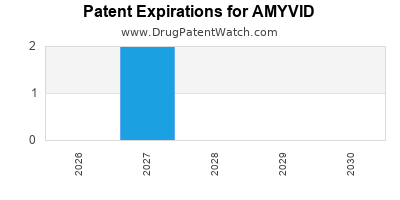
Amyvid is a drug marketed by Avid Radiopharms Inc and is included in one NDA. There are two patents protecting this drug.

This drug has fifty-one patent family members in thirty-three countries.

The generic ingredient in AMYVID is florbetapir f-18. One supplier is listed for this compound. Additional details are available on the florbetapir f-18 profile page.

DrugPatentWatch® Generic Entry Outlook for Amyvid

Amyvid was eligible for patent challenges on April 6, 2016.

By analyzing the patents and regulatory protections it appears that the earliest date for generic entry will be April 30, 2027. This may change due to patent challenges or generic licensing.

There has been one patent litigation case involving the patents protecting this drug, indicating strong interest in generic launch. Recent data indicate that 63% of patent challenges are decided in favor of the generic patent challenger and that 54% of successful patent challengers promptly launch generic drugs.

Indicators of Generic Entry

< Available with Subscription >

  Get Started Free

AI Deep Research
Questions you can ask:
  • What is the 5 year forecast for AMYVID?
  • What are the global sales for AMYVID?
  • What is Average Wholesale Price for AMYVID?
Summary for AMYVID
Drug patent expirations by year for AMYVID
DrugPatentWatch® Estimated Loss of Exclusivity (LOE) Date for AMYVID
Generic Entry Date for AMYVID*:
Constraining patent/regulatory exclusivity:
NDA:
Dosage:
SOLUTION;INTRAVENOUS

*The generic entry opportunity date is the latter of the last compound-claiming patent and the last regulatory exclusivity protection. Many factors can influence early or later generic entry. This date is provided as a rough estimate of generic entry potential and should not be used as an independent source.

Recent Clinical Trials for AMYVID

Identify potential brand extensions & 505(b)(2) entrants

SponsorPhase
Columbia UniversityPHASE1
University of Puerto RicoPhase 2
Universidad Central del CaribePhase 2

See all AMYVID clinical trials

Pharmacology for AMYVID

US Patents and Regulatory Information for AMYVID

AMYVID is protected by two US patents.

Based on analysis by DrugPatentWatch, the earliest date for a generic version of AMYVID is ⤷  Get Started Free.

This potential generic entry date is based on patent ⤷  Get Started Free.

Generics may enter earlier, or later, based on new patent filings, patent extensions, patent invalidation, early generic licensing, generic entry preferences, and other factors.

Applicant Tradename Generic Name Dosage NDA Approval Date TE Type RLD RS Patent No. Patent Expiration Product Substance Delist Req. Exclusivity Expiration
Avid Radiopharms Inc AMYVID florbetapir f-18 SOLUTION;INTRAVENOUS 202008-001 Apr 6, 2012 DISCN Yes No ⤷  Get Started Free ⤷  Get Started Free Y Y ⤷  Get Started Free
Avid Radiopharms Inc AMYVID florbetapir f-18 SOLUTION;INTRAVENOUS 202008-003 Apr 6, 2012 RX Yes Yes ⤷  Get Started Free ⤷  Get Started Free Y Y ⤷  Get Started Free
Avid Radiopharms Inc AMYVID florbetapir f-18 SOLUTION;INTRAVENOUS 202008-004 Oct 13, 2023 RX Yes Yes ⤷  Get Started Free ⤷  Get Started Free Y Y ⤷  Get Started Free
Avid Radiopharms Inc AMYVID florbetapir f-18 SOLUTION;INTRAVENOUS 202008-003 Apr 6, 2012 RX Yes Yes ⤷  Get Started Free ⤷  Get Started Free Y Y ⤷  Get Started Free
>Applicant >Tradename >Generic Name >Dosage >NDA >Approval Date >TE >Type >RLD >RS >Patent No. >Patent Expiration >Product >Substance >Delist Req. >Exclusivity Expiration

International Patents for AMYVID

When does loss-of-exclusivity occur for AMYVID?

Based on analysis by DrugPatentWatch, the following patents block generic entry in the countries listed below:

Australia

Patent: 07243712
Estimated Expiration: ⤷  Get Started Free

Austria

Patent: 39060
Estimated Expiration: ⤷  Get Started Free

Brazil

Patent: 0710225
Estimated Expiration: ⤷  Get Started Free

Canada

Patent: 44530
Estimated Expiration: ⤷  Get Started Free

China

Patent: 1522624
Estimated Expiration: ⤷  Get Started Free

Costa Rica

Patent: 329
Estimated Expiration: ⤷  Get Started Free

Croatia

Patent: 0120135
Estimated Expiration: ⤷  Get Started Free

Patent: 0170857
Estimated Expiration: ⤷  Get Started Free

Cyprus

Patent: 13048
Estimated Expiration: ⤷  Get Started Free

Patent: 19048
Estimated Expiration: ⤷  Get Started Free

Patent: 13024
Estimated Expiration: ⤷  Get Started Free

Denmark

Patent: 99109
Estimated Expiration: ⤷  Get Started Free

Patent: 63392
Estimated Expiration: ⤷  Get Started Free

Ecuador

Patent: 088783
Estimated Expiration: ⤷  Get Started Free

Eurasian Patent Organization

Patent: 7898
Estimated Expiration: ⤷  Get Started Free

Patent: 0870389
Estimated Expiration: ⤷  Get Started Free

European Patent Office

Patent: 99109
Estimated Expiration: ⤷  Get Started Free

Patent: 63391
Estimated Expiration: ⤷  Get Started Free

Patent: 63392
Estimated Expiration: ⤷  Get Started Free

France

Patent: C0034
Estimated Expiration: ⤷  Get Started Free

Guatemala

Patent: 0800201
Estimated Expiration: ⤷  Get Started Free

Hungary

Patent: 32660
Estimated Expiration: ⤷  Get Started Free

Patent: 300028
Estimated Expiration: ⤷  Get Started Free

Israel

Patent: 3567
Estimated Expiration: ⤷  Get Started Free

Japan

Patent: 90954
Estimated Expiration: ⤷  Get Started Free

Patent: 09532349
Estimated Expiration: ⤷  Get Started Free

Lithuania

Patent: 63392
Estimated Expiration: ⤷  Get Started Free

Luxembourg

Patent: 232
Estimated Expiration: ⤷  Get Started Free

Mexico

Patent: 08012527
Patent: DERIVADOS DE ESTIRILPIRIDINA Y SUS USOS PARA UNION A PLACAS AMILOIDES Y OBTENCION DE IMAGENES DE LAS MISMAS. (STYRYLPYRIDINE DERIVATIVES AND THEIR USE FOR BINDING AND IMAGING AMYLOID PLAQUES.)
Estimated Expiration: ⤷  Get Started Free

New Zealand

Patent: 0887
Patent: Styrylpyridine derivatives and their use for binding and imaging amyloid plaques
Estimated Expiration: ⤷  Get Started Free

Norway

Patent: 2090
Estimated Expiration: ⤷  Get Started Free

Patent: 18030
Estimated Expiration: ⤷  Get Started Free

Patent: 084590
Estimated Expiration: ⤷  Get Started Free

Poland

Patent: 99109
Estimated Expiration: ⤷  Get Started Free

Patent: 63392
Estimated Expiration: ⤷  Get Started Free

Portugal

Patent: 99109
Estimated Expiration: ⤷  Get Started Free

Patent: 63392
Estimated Expiration: ⤷  Get Started Free

Serbia

Patent: 222
Patent: DERIVATI STIRILPIRIDINA I NJIHOVA UPOTREBA ZA VEZIVANJE I IMIDŽING AMILOIDNIH PLAKOVA (STYRYLPYRIDINE DERIVATIVES AND THEIR USE FOR BINDING AND IMAGING AMYLOID PLAQUES)
Estimated Expiration: ⤷  Get Started Free

Patent: 171
Patent: DERIVATI STIRILPIRIDINA I NJIHOVA UPOTREBA ZA VEZIVANJE I IMIDŽING AMILOIDNIH PLAKOVA (STYRYLPYRIDINE DERIVATIVES AND THEIR USE FOR BINDING AND IMAGING AMYLOID PLAQUES)
Estimated Expiration: ⤷  Get Started Free

Singapore

Patent: 3338
Patent: STYRYLPYRIDINE DERIVATIVES AND THEIR USE FOR BINDING AND IMAGING AMYLOID PLAQUES
Estimated Expiration: ⤷  Get Started Free

Slovenia

Patent: 99109
Estimated Expiration: ⤷  Get Started Free

Patent: 63392
Estimated Expiration: ⤷  Get Started Free

South Africa

Patent: 0807955
Patent: STRYLPYRIDINE DERIVATIVES AND THEIR USE FOR BINDING AND IMAGING AMYLOID PLAQUES
Estimated Expiration: ⤷  Get Started Free

South Korea

Patent: 1376807
Estimated Expiration: ⤷  Get Started Free

Patent: 080106564
Estimated Expiration: ⤷  Get Started Free

Spain

Patent: 78785
Estimated Expiration: ⤷  Get Started Free

Patent: 28882
Estimated Expiration: ⤷  Get Started Free

Taiwan

Patent: 99366
Estimated Expiration: ⤷  Get Started Free

Patent: 0838852
Patent: Styrylpyridine derivatives and their use for binding and imaging amyloid plaques
Estimated Expiration: ⤷  Get Started Free

Ukraine

Patent: 802
Patent: СТИРИЛПИРИДИНОВЫЕ ПРОИЗВОДНЫЕ И ИХ ПРИМЕНЕНИЕ ДЛЯ СВЯЗЫВАНИЯ И ВИЗУАЛИЗАЦИИ АМИЛОИДНЫХ БЛЯШЕК;СТИРИЛПІРИДИНОВІ ПОХІДНІ І ЇХ ЗАСТОСУВАННЯ ДЛЯ ЗВ'ЯЗУВАННЯ І ВІЗУАЛІЗАЦІЇ АМІЛОЇДНИХ БЛЯШОК (STYRYLPYRIDINE COMPOUNDS USEFUL AND USE THEREOF IN IMAGING AMYLOID DEPOSITS)
Estimated Expiration: ⤷  Get Started Free

Generics may enter earlier, or later, based on new patent filings, patent extensions, patent invalidation, early generic licensing, generic entry preferences, and other factors.

See the table below for additional patents covering AMYVID around the world.

Country Patent Number Title Estimated Expiration
Japan 2009532349 ⤷  Get Started Free
Brazil PI0710225 ⤷  Get Started Free
Croatia P20170857 ⤷  Get Started Free
Taiwan I399366 ⤷  Get Started Free
>Country >Patent Number >Title >Estimated Expiration

Supplementary Protection Certificates for AMYVID

Patent Number Supplementary Protection Certificate SPC Country SPC Expiration SPC Description
1999109 92232 Luxembourg ⤷  Get Started Free PRODUCT NAME: FLORBETAPIR (18 F)
1999109 122013000051 Germany ⤷  Get Started Free PRODUCT NAME: FLORBETAPIR (18F); REGISTRATION NO/DATE: EU/1/12/805 20130114
1999109 C300600 Netherlands ⤷  Get Started Free PRODUCT NAME: FLORBETAPIR ( SUP 18 /SUP F); REGISTRATION NO/DATE: EU/1/12/805 20130114
1999109 SPC/GB13/040 United Kingdom ⤷  Get Started Free PRODUCT NAME: FLORBETAPIR (18F) ((E)-4-(2-(6-(2-(2-(2-((18F)-FLUOROETHOXY)ETHOXY)ETHOXY)PYRIDIN-3-YL(18F); REGISTERED: UK EU/1/12/805 20130117 )VINYL)-N-METHYL BENZENAMINE) OR A PHARMACEUTICALLY ACCEPTABLE SALT THEREOF, ESPECIALLY FLORBETAPIR
>Patent Number >Supplementary Protection Certificate >SPC Country >SPC Expiration >SPC Description

Market Dynamics and Financial Trajectory for AMYVID

Last updated: July 27, 2025

Introduction

AMYVID (aviptadil) represents a novel therapeutic agent developed for respiratory and neuroprotective indications, notably in the context of acute lung injury, COVID-19-related complications, and certain neurodegenerative disorders. As an injectable form of vasoactive intestinal peptide (VIP), AMYVID is positioned within a highly competitive and rapidly evolving pharmaceutical landscape. This article analyzes the current market dynamics and forecasts the financial trajectory of AMYVID, integrating clinical development milestones, regulatory environments, competitive pressures, and commercial strategies.

Market Overview and Therapeutic Landscape

Current Market Size and Segments

The global respiratory disease market alone highlights multimillion-dollar opportunities, driven primarily by COVID-19, chronic obstructive pulmonary disease (COPD), and lung fibrosis. The COVID-19 pandemic propelled demand for innovative therapies, of which AMYVID, with its proposed anti-inflammatory and vasodilatory properties, gained initial attention [1].

Simultaneously, neuroprotective applications targeting neurodegenerative diseases such as amyotrophic lateral sclerosis (ALS) and multiple sclerosis (MS) present opportunities, given VIP's role in neuroregeneration and immune modulation [2].

Emerging Therapeutic Indications

While originally developed for neurodegenerative uses, AMYVID’s emergency indication for severe COVID-19 cases has been a focal point post-pandemic. The drug's mechanism—modulating cytokine responses and reducing pulmonary inflammation—aligns with clinical needs for managing cytokine storms and acute respiratory distress syndrome (ARDS) [3].

Competitive Environment

The competitive landscape features agents such as corticosteroids, monoclonal antibodies like tocilizumab, and antiviral drugs. However, AMYVID's unique peptide-based mechanism offers a different therapeutic angle—targeting inflammatory pathways at the neuroimmunological level. Earlier-stage competitors include other vasoactive peptides and novel biologics in development for COVID-19 and lung injury.

Regulatory and Development Landscape

Regulatory Status

As of 2023, AMYVID has received Emergency Use Authorization (EUA) in select jurisdictions for COVID-19-related indications. Further pivotal trials are underway to secure full regulatory approval across major markets, including the U.S., EU, and China [4].

Clinical Development Milestones

AMYVID has demonstrated promising Phase II results, indicating reductions in pulmonary inflammation and improvements in oxygenation metrics. The ongoing Phase III trials focus on severe COVID-19 subpopulations and neurodegenerative conditions. Positive outcomes are pivotal in bolstering market adoption and pipeline valuation.

Market Drivers and Constraints

Key Drivers

  • Unmet Medical Needs: Limited effective treatments for cytokine storm and ARDS boost demand for innovative agents like AMYVID.
  • Regulatory Fast-Track Approvals: Priority review pathways enhance commercialization prospects upon successful trial outcomes.
  • Strategic Collaborations: Partnerships with government agencies and biotech firms can accelerate market access and scale production.

Constraints

  • Competition from Established Therapies: Corticosteroids and immunomodulators remain standard-of-care, posing barriers for new entrants.
  • Manufacturing and Cost Challenges: Peptide synthesis complexity can inflate production costs and affect pricing strategies.
  • Clinical Efficacy Uncertainty: Pending Phase III results may lead to licensing delays or diminished market confidence.

Forecasting the Financial Trajectory

Revenue Projections

Initial revenue streams are projected from niche markets, primarily severe COVID-19 and neurodegenerative applications. Based on recent clinical outcomes and regulatory progress, a conservative estimate anticipates:

  • Year 1-2: Revenues approximating $50 million, driven by limited EUA sales and ongoing clinical trials.
  • Year 3-4: Post-approval commercialization could see revenues reaching $300–$500 million, contingent on broader indication approvals and expanded geographic penetration.
  • Year 5 and Beyond: With potential indications expansion (e.g., COPD, pulmonary fibrosis), revenues could surpass $1 billion annually, subject to market uptake and reimbursement policies.

Cost Structure and Profitability Outlook

Clinical development costs are substantial, with Phase III trials alone estimated at $150–$200 million globally. Manufacturing scale-up and regulatory compliance further inflate capital expenditure. However, once established, high-margin peptide therapeutics can yield profitability within 3-5 years post-market entry, particularly if reimbursement is secured.

Investment and Funding Outlook

Investors' confidence hinges on trial outcomes, regulatory milestones, and strategic alliances. Recent funding rounds have bolstered R&D pipelines, with valuations potentially rising upon successful trial data release. Venture capital firms and biopharmaceutical giants are keen to participate, anticipating long-term returns.

Market Risks and Mitigation Strategies

  • Clinical Setbacks: Unfavorable trial results could delay market entry; mitigating this requires rigorous trial design and phased approval strategies.
  • Regulatory Delays: Navigating multiple jurisdictions necessitates compliance expertise; early engagement with regulators speeds approval.
  • Competitive Displacement: Developing personalized therapies and combination regimens may mitigate erosion by emerging treatments.

Conclusion and Strategic Outlook

AMYVID's market potential hinges on clinical success, regulatory approval, and strategic commercialization. Given its mechanistic novelty and addressing unmet needs, the drug possesses high growth potential. However, navigating the competitive landscape requires proactive regulatory engagement, strategic partnerships, and robust clinical data generation.

Key Takeaways

  • The COVID-19 pandemic catalyzed interest in AMYVID, positioning it in a niche space for respiratory and neuroprotective indications.
  • Regulatory momentum, including EUA and ongoing Phase III trials, will critically impact near-term revenue outlooks.
  • Market opportunities extend beyond infectious diseases to chronic neurodegenerative disorders, with substantial revenue potential.
  • Cost management, manufacturing scalability, and competitive positioning are essential for achieving profitability.
  • A collaborative approach involving regulators, payers, and healthcare providers is vital to maximize AMYVID’s market potential.

FAQs

1. What distinguishes AMYVID from other COVID-19 treatments?
AMYVID operates via vasoactive intestinal peptide pathways, modulating immune responses and reducing pulmonary inflammation, offering a different mechanism compared to antiviral or corticosteroid therapies, potentially providing benefits in cytokine storm mitigation.

2. What is the current regulatory status of AMYVID?
As of 2023, AMYVID has received emergency use authorization in specific regions for COVID-19-related indications, with ongoing pivotal trials aimed at securing full approval.

3. Which markets hold the highest growth potential for AMYVID?
The United States, European Union, and China present significant markets, driven by high COVID-19 incidence, aging populations, and unmet needs in neurodegenerative disorders.

4. What are the main challenges facing AMYVID’s commercialization?
Key challenges include clinical efficacy validation, manufacturing costs for peptide therapeutics, competitive pressures from existing treatments, and reimbursement hurdles.

5. How might future indications influence AMYVID’s financial trajectory?
Expansion into indications like pulmonary fibrosis and neurodegenerative diseases could diversify revenue streams, boost market penetration, and substantially increase long-term valuation.


References

[1] World Health Organization. (2022). COVID-19 dashboard.
[2] Jurk, D., et al. (2019). “The immune-modulatory role of vasoactive intestinal peptide.” Neuroimmunology Reports.
[3] National Institutes of Health. (2021). Clinical trials on cytokine storm management.
[4] FDA. (2023). Emergency use authorizations and ongoing trial updates.

More… ↓

⤷  Get Started Free

Make Better Decisions: Try a trial or see plans & pricing

Drugs may be covered by multiple patents or regulatory protections. All trademarks and applicant names are the property of their respective owners or licensors. Although great care is taken in the proper and correct provision of this service, thinkBiotech LLC does not accept any responsibility for possible consequences of errors or omissions in the provided data. The data presented herein is for information purposes only. There is no warranty that the data contained herein is error free. We do not provide individual investment advice. This service is not registered with any financial regulatory agency. The information we publish is educational only and based on our opinions plus our models. By using DrugPatentWatch you acknowledge that we do not provide personalized recommendations or advice. thinkBiotech performs no independent verification of facts as provided by public sources nor are attempts made to provide legal or investing advice. Any reliance on data provided herein is done solely at the discretion of the user. Users of this service are advised to seek professional advice and independent confirmation before considering acting on any of the provided information. thinkBiotech LLC reserves the right to amend, extend or withdraw any part or all of the offered service without notice.