You're using a free limited version of DrugPatentWatch: Upgrade for Complete Access

Last Updated: March 26, 2026

AMVUTTRA Drug Patent Profile


✉ Email this page to a colleague

« Back to Dashboard


When do Amvuttra patents expire, and what generic alternatives are available?

Amvuttra is a drug marketed by Alnylam Pharms Inc and is included in one NDA. There are thirteen patents protecting this drug.

This drug has two hundred and fifty-seven patent family members in forty-nine countries.

The generic ingredient in AMVUTTRA is vutrisiran sodium. One supplier is listed for this compound. Additional details are available on the vutrisiran sodium profile page.

DrugPatentWatch® Generic Entry Outlook for Amvuttra

Amvuttra will be eligible for patent challenges on June 13, 2026. This date may extended up to six months if a pediatric exclusivity extension is applied to the drug's patents.

By analyzing the patents and regulatory protections it appears that the earliest date for generic entry will be July 28, 2036. This may change due to patent challenges or generic licensing.

There have been five patent litigation cases involving the patents protecting this drug, indicating strong interest in generic launch. Recent data indicate that 63% of patent challenges are decided in favor of the generic patent challenger and that 54% of successful patent challengers promptly launch generic drugs.

Indicators of Generic Entry

< Available with Subscription >

  Start Trial

AI Deep Research
Questions you can ask:
  • What is the 5 year forecast for AMVUTTRA?
  • What are the global sales for AMVUTTRA?
  • What is Average Wholesale Price for AMVUTTRA?
Summary for AMVUTTRA
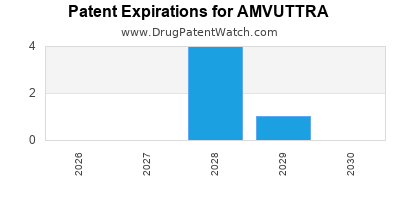
Drug patent expirations by year for AMVUTTRA
Drug Prices for AMVUTTRA

See drug prices for AMVUTTRA

DrugPatentWatch® Estimated Loss of Exclusivity (LOE) Date for AMVUTTRA
Generic Entry Date for AMVUTTRA*:
Constraining patent/regulatory exclusivity:
NDA:
Dosage:
SOLUTION;SUBCUTANEOUS

*The generic entry opportunity date is the latter of the last compound-claiming patent and the last regulatory exclusivity protection. Many factors can influence early or later generic entry. This date is provided as a rough estimate of generic entry potential and should not be used as an independent source.

US Patents and Regulatory Information for AMVUTTRA

AMVUTTRA is protected by thirteen US patents and three FDA Regulatory Exclusivities.

Based on analysis by DrugPatentWatch, the earliest date for a generic version of AMVUTTRA is ⤷  Start Trial.

This potential generic entry date is based on patent ⤷  Start Trial.

Generics may enter earlier, or later, based on new patent filings, patent extensions, patent invalidation, early generic licensing, generic entry preferences, and other factors.

Applicant Tradename Generic Name Dosage NDA Approval Date TE Type RLD RS Patent No. Patent Expiration Product Substance Delist Req. Exclusivity Expiration
Alnylam Pharms Inc AMVUTTRA vutrisiran sodium SOLUTION;SUBCUTANEOUS 215515-001 Jun 13, 2022 RX Yes Yes ⤷  Start Trial ⤷  Start Trial Y Y ⤷  Start Trial
Alnylam Pharms Inc AMVUTTRA vutrisiran sodium SOLUTION;SUBCUTANEOUS 215515-001 Jun 13, 2022 RX Yes Yes ⤷  Start Trial ⤷  Start Trial ⤷  Start Trial
>Applicant >Tradename >Generic Name >Dosage >NDA >Approval Date >TE >Type >RLD >RS >Patent No. >Patent Expiration >Product >Substance >Delist Req. >Exclusivity Expiration

EU/EMA Drug Approvals for AMVUTTRA

Company Drugname Inn Product Number / Indication Status Generic Biosimilar Orphan Marketing Authorisation Marketing Refusal
Alnylam Netherlands B.V. Amvuttra vutrisiran EMEA/H/C/005852Treatment of hereditary transthyretin-mediated amyloidosis (hATTR amyloidosis) in adult patients with stage 1 or stage 2 polyneuropathy. Authorised no no yes 2022-09-15
>Company >Drugname >Inn >Product Number / Indication >Status >Generic >Biosimilar >Orphan >Marketing Authorisation >Marketing Refusal

International Patents for AMVUTTRA

When does loss-of-exclusivity occur for AMVUTTRA?

Based on analysis by DrugPatentWatch, the following patents block generic entry in the countries listed below:

Argentina

Patent: 5543
Estimated Expiration: ⤷  Start Trial

Brazil

Patent: 2018000542
Estimated Expiration: ⤷  Start Trial

Canada

Patent: 94285
Estimated Expiration: ⤷  Start Trial

Chile

Patent: 18000198
Estimated Expiration: ⤷  Start Trial

China

Patent: 8138182
Estimated Expiration: ⤷  Start Trial

Patent: 6064515
Estimated Expiration: ⤷  Start Trial

Croatia

Patent: 0202082
Estimated Expiration: ⤷  Start Trial

Cyprus

Patent: 24545
Estimated Expiration: ⤷  Start Trial

Denmark

Patent: 29002
Estimated Expiration: ⤷  Start Trial

Eurasian Patent Organization

Patent: 1890394
Estimated Expiration: ⤷  Start Trial

European Patent Office

Patent: 29002
Estimated Expiration: ⤷  Start Trial

Finland

Patent: 0230006
Estimated Expiration: ⤷  Start Trial

France

Patent: C1008
Estimated Expiration: ⤷  Start Trial

Hong Kong

Patent: 56494
Estimated Expiration: ⤷  Start Trial

Patent: 56683
Estimated Expiration: ⤷  Start Trial

Hungary

Patent: 51998
Estimated Expiration: ⤷  Start Trial

Patent: 300007
Estimated Expiration: ⤷  Start Trial

Israel

Patent: 6614
Estimated Expiration: ⤷  Start Trial

Patent: 6476
Estimated Expiration: ⤷  Start Trial

Patent: 3082
Estimated Expiration: ⤷  Start Trial

Japan

Patent: 96703
Estimated Expiration: ⤷  Start Trial

Patent: 17559
Estimated Expiration: ⤷  Start Trial

Patent: 11150
Estimated Expiration: ⤷  Start Trial

Patent: 18523655
Estimated Expiration: ⤷  Start Trial

Patent: 21167313
Estimated Expiration: ⤷  Start Trial

Patent: 24028749
Estimated Expiration: ⤷  Start Trial

Patent: 25165939
Estimated Expiration: ⤷  Start Trial

Lithuania

Patent: 329002
Estimated Expiration: ⤷  Start Trial

Patent: 2023505
Estimated Expiration: ⤷  Start Trial

Patent: 29002
Estimated Expiration: ⤷  Start Trial

Luxembourg

Patent: 0297
Estimated Expiration: ⤷  Start Trial

Malaysia

Patent: 5720
Estimated Expiration: ⤷  Start Trial

Mexico

Patent: 18000981
Estimated Expiration: ⤷  Start Trial

Patent: 23012080
Estimated Expiration: ⤷  Start Trial

Morocco

Patent: 335
Estimated Expiration: ⤷  Start Trial

Netherlands

Patent: 1216
Estimated Expiration: ⤷  Start Trial

New Zealand

Patent: 9169
Patent: Transthyretin (ttr) irna compositions and methods of use thereof for treating or preventing ttr-associated diseases
Estimated Expiration: ⤷  Start Trial

Patent: 8442
Patent: Transthyretin (ttr) irna compositions and methods of use thereof for treating or preventing ttr-associated diseases
Estimated Expiration: ⤷  Start Trial

Norway

Patent: 23007
Estimated Expiration: ⤷  Start Trial

Poland

Patent: 29002
Estimated Expiration: ⤷  Start Trial

Portugal

Patent: 29002
Estimated Expiration: ⤷  Start Trial

San Marino

Patent: 02100020
Estimated Expiration: ⤷  Start Trial

Serbia

Patent: 297
Patent: TRANSTIRETINSKE (TTR) KOMPOZICIJE IRNK I POSTUPCI ZA NJIHOVU PRIMENU U LEČENJU ILI PREVENCIJI BOLESTI POVEZANIH SA TTR-OM (TRANSTHYRETIN (TTR) IRNA COMPOSITIONS AND METHODS OF USE THEREOF FOR TREATING OR PREVENTING TTR-ASSOCIATED DISEASES)
Estimated Expiration: ⤷  Start Trial

Singapore

Patent: 201912341S
Patent: TRANSTHYRETIN (TTR) iRNA COMPOSITIONS AND METHODS OF USE THEREOF FOR TREATING OR PREVENTING TTR-ASSOCIATED DISEASES
Estimated Expiration: ⤷  Start Trial

Slovenia

Patent: 29002
Estimated Expiration: ⤷  Start Trial

South Africa

Patent: 1800571
Patent: TRANSTHYRETIN (TTR) IRNA COMPOSITIONS AND METHODS OF USE THEREOF FOR TREATING OR PREVENTING TTR-ASSOCIATED DISEASES
Estimated Expiration: ⤷  Start Trial

Patent: 1902447
Patent: TRANSTHYRETIN (TTR) IRNA COMPOSITIONS AND METHODS OF USE THEREOF FOR TREATING OR PREVENTING TTR-ASSOCIATED DISEASES
Estimated Expiration: ⤷  Start Trial

South Korea

Patent: 2667020
Estimated Expiration: ⤷  Start Trial

Patent: 180028537
Estimated Expiration: ⤷  Start Trial

Patent: 240074895
Estimated Expiration: ⤷  Start Trial

Spain

Patent: 42300
Estimated Expiration: ⤷  Start Trial

Taiwan

Patent: 27963
Estimated Expiration: ⤷  Start Trial

Patent: 07302
Estimated Expiration: ⤷  Start Trial

Patent: 83468
Estimated Expiration: ⤷  Start Trial

Patent: 1718855
Patent: Transthyretin (TTR) iRNA compositions and methods of use thereof for treating or preventing TTR-associated diseases
Estimated Expiration: ⤷  Start Trial

Patent: 2130810
Patent: Transthyretin (TTR) iRNA compositions and methods of use thereof for treating or preventing TTR-associated diseases
Estimated Expiration: ⤷  Start Trial

Patent: 2344688
Patent: Transthyretin (TTR) iRNA compositions and methods of use thereof for treating or preventing TTR-associated diseases
Estimated Expiration: ⤷  Start Trial

Patent: 2532647
Patent: Transthyretin (TTR) iRNA compositions and methods of use thereof for treating or preventing TTR-associated diseases
Estimated Expiration: ⤷  Start Trial

Ukraine

Patent: 6276
Patent: КОМПОЗИЦІЯ НА ОСНОВІ iRNA ДЛЯ ТРАНСТИРЕТИНУ (TTR) І СПОСІБ ЇЇ ЗАСТОСУВАННЯ ДЛЯ ЛІКУВАННЯ АБО ПОПЕРЕДЖЕННЯ TTR-АСОЦІЙОВАНОГО ЗАХВОРЮВАННЯ (TRANSTHYRETIN (TTR) iRNA COMPOSITIONS AND METHODS OF USE THEREOF FOR TREATING OR PREVENTING TTR-ASSOCIATED DISEASES)
Estimated Expiration: ⤷  Start Trial

Uruguay

Patent: 479
Patent: COMPOSICIONES DE ARNi DE TRANSTIRETINA (TTR) Y MÉTODOS PARA SU USO PARA EL TRATAMIENTO O PREVENCION DE ENFERMEDADES ASOCIADAS CON TTR
Estimated Expiration: ⤷  Start Trial

Generics may enter earlier, or later, based on new patent filings, patent extensions, patent invalidation, early generic licensing, generic entry preferences, and other factors.

See the table below for additional patents covering AMVUTTRA around the world.

Country Patent Number Title Estimated Expiration
Japan 2019147846 オリゴヌクレオチドの送達剤としての糖質コンジュゲート (CARBOHYDRATE CONJUGATES AS DELIVERY AGENTS FOR OLIGONUCLEOTIDES) ⤷  Start Trial
New Zealand 797319 Modified rnai agents ⤷  Start Trial
Japan 2016034974 オリゴヌクレオチドの送達剤としての糖質コンジュゲート (CARBOHYDRATE CONJUGATES AS DELIVERY AGENTS FOR OLIGONUCLEOTIDES) ⤷  Start Trial
South Korea 20180028537 ⤷  Start Trial
Israel 313082 ⤷  Start Trial
Israel 303831 ⤷  Start Trial
>Country >Patent Number >Title >Estimated Expiration

Supplementary Protection Certificates for AMVUTTRA

Patent Number Supplementary Protection Certificate SPC Country SPC Expiration SPC Description
3329002 C20230004 00401 Estonia ⤷  Start Trial PRODUCT NAME: VUTRISIRAAN;REG NO/DATE: EU/1/22/1681 16.09.2022
3329002 301216 Netherlands ⤷  Start Trial PRODUCT NAME: VUTRISIRAN; REGISTRATION NO/DATE: EU/1/22/1681 20220916
3329002 CR 2023 00008 Denmark ⤷  Start Trial PRODUCT NAME: VUTRISIRAN; REG. NO/DATE: EU/1/22/1681 20220916
3329002 C03329002/01 Switzerland ⤷  Start Trial PRODUCT NAME: VUTRISIRAN; REGISTRATION NO/DATE: SWISSMEDIC-ZULASSUNG 69074 23.06.2023
3329002 2390008-7 Sweden ⤷  Start Trial PRODUCT NAME: VUTRISIRAN; REG. NO/DATE: EU/1/22/1681 20220916
3329002 2023C/507 Belgium ⤷  Start Trial PRODUCT NAME: VUTRISIRAN; AUTHORISATION NUMBER AND DATE: EU/1/22/1681 20220916
>Patent Number >Supplementary Protection Certificate >SPC Country >SPC Expiration >SPC Description

AMVUTTRA: Market Dynamics and Financial Trajectory

Last updated: February 19, 2026

Executive Summary

AMVUTTRA (tetrabenazine), a vesicular monoamine transporter 2 (VMAT2) inhibitor, is marketed by Takeda Pharmaceutical Company for the treatment of chorea associated with Huntington's disease. Approved by the U.S. Food and Drug Administration (FDA) in August 2022, AMVUTTRA represents a significant therapeutic option in a niche market. The drug's financial trajectory is influenced by its indication's prevalence, competitive landscape, pricing strategy, and patent exclusivity. While specific revenue figures for AMVUTTRA are not yet fully reported due to its recent market entry, analysis of Takeda's orphan drug portfolio and the dynamics of rare disease treatments provides insight into its potential.

What is AMVUTTRA's Mechanism of Action and Approved Indication?

AMVUTTRA is a selective inhibitor of the vesicular monoamine transporter 2 (VMAT2) [1]. VMAT2 is responsible for the transport of monoamines, such as dopamine, serotonin, and norepinephrine, into synaptic vesicles for storage and release. In Huntington's disease, there is an imbalance in these neurotransmitters, leading to hyperkinetic movements like chorea. By inhibiting VMAT2, AMVUTTRA reduces the storage and release of these monoamines, thereby decreasing dopaminergic activity and alleviating chorea [1].

The FDA approved AMVUTTRA on August 19, 2022, for the treatment of chorea associated with Huntington’s disease [1]. Huntington's disease is a progressive neurodegenerative disorder that affects approximately 30,000 people in the United States and an estimated 100,000 people worldwide. Chorea is a prominent symptom in approximately 90% of Huntington’s disease patients [2].

What is the Competitive Landscape for AMVUTTRA?

The market for Huntington's disease chorea treatment has a limited number of approved therapies, creating a concentrated competitive environment.

Existing Treatments

  • Xenazine (tetrabenazine): Also marketed by Takeda, Xenazine is a first-generation VMAT2 inhibitor approved for chorea associated with Huntington's disease. AMVUTTRA is a next-generation formulation of tetrabenazine, offering potential advantages in dosing and tolerability [1, 3].
  • Austedo (deutetrabenazine): Marketed by Teva Pharmaceuticals, Austedo is a deuterated form of tetrabenazine. Deuteration involves replacing certain hydrogen atoms with deuterium, which can alter the drug's metabolism and potentially improve its pharmacokinetic profile and reduce dosing frequency [3, 4]. Austedo is approved for chorea associated with Huntington's disease and tardive dyskinesia.

Differentiation of AMVUTTRA

AMVUTTRA distinguishes itself from Xenazine through its extended-release formulation, which allows for less frequent dosing (once daily) compared to Xenazine's multiple daily administrations. This improved dosing regimen aims to enhance patient compliance and potentially reduce peak-and-trough fluctuations of the drug, which could lead to improved tolerability and efficacy [1, 3].

Compared to Austedo, AMVUTTRA also offers a once-daily dosing option. Clinical trials evaluating AMVUTTRA focused on demonstrating its efficacy and safety in reducing chorea symptoms with this simplified regimen [1]. The market positioning of AMVUTTRA is as a refined therapeutic option building upon the established efficacy of tetrabenazine.

What is AMVUTTRA's Pricing and Reimbursement Strategy?

Pharmaceutical pricing for rare disease treatments, particularly those with limited therapeutic alternatives, is typically high. This strategy is often justified by the significant research and development costs, the small patient population, and the unmet medical need addressed.

  • List Price: While Takeda has not publicly disclosed a specific list price for AMVUTTRA, orphan drugs with similar indications and patient populations often carry significant price tags. For context, Xenazine (tetrabenazine) had an average wholesale price that could range from $7,000 to $15,000 per month for a typical patient, depending on dosage and pharmacy [5]. Austedo (deutetrabenazine) pricing has also been in a similar range, with reported monthly costs exceeding $10,000 [4]. AMVUTTRA's pricing is expected to align with these benchmarks, reflecting its advanced formulation and therapeutic value.
  • Reimbursement Landscape: Reimbursement for AMVUTTRA is primarily driven by private and government payers in the United States and other developed markets. Coverage decisions depend on factors such as clinical necessity, efficacy compared to existing treatments, and cost-effectiveness. Takeda likely engages in direct negotiations with payers and provides patient assistance programs to mitigate out-of-pocket expenses and facilitate access [6].
  • Market Access Challenges: Like many orphan drugs, AMVUTTRA may face scrutiny from payers regarding its cost relative to its demonstrated clinical benefit. demonstrating a clear advantage over Xenazine and Austedo in terms of efficacy, safety, or patient convenience will be crucial for broad market access and favorable formulary placement.

What are AMVUTTRA's Patent Exclusivity and Market Longevity Prospects?

Patent protection is critical for recouping R&D investments and establishing market exclusivity for pharmaceutical products.

Key Patents and Exclusions

  • Core Tetrabenazine Patents: The foundational patents related to tetrabenazine's use in treating hyperkinetic movement disorders have expired or are nearing expiration.
  • AMVUTTRA Formulation Patents: Takeda holds patents related to the specific extended-release formulation of AMVUTTRA, which are crucial for its market exclusivity. These patents typically cover the composition of the extended-release matrix, manufacturing processes, and potentially specific dosing regimens [7].
  • Exclusivity Periods:
    • Orphan Drug Exclusivity (ODE): In the U.S., AMVUTTRA benefits from seven years of Orphan Drug Exclusivity, granted because it treats a rare disease (Huntington's disease). This exclusivity prevents the FDA from approving another drug for the same indication based on a similar clinical investigation during this period [8].
    • New Chemical Entity (NCE) Exclusivity: While AMVUTTRA is a derivative of tetrabenazine, regulatory bodies may grant extended market exclusivity based on its novel formulation or pharmacokinetic profile if deemed to represent a significant advancement. For new formulations of existing drugs, this exclusivity is typically shorter than NCE exclusivity.

Projected Market Longevity

Based on typical patent lifecycles and regulatory exclusivities for orphan drugs, AMVUTTRA is expected to maintain market exclusivity for a significant period. Assuming the key formulation patents are robust and extend for a substantial duration, coupled with ODE, the drug could be protected until the mid-to-late 2030s. Generic competition for tetrabenazine or deutetrabenazine formulations may emerge once patents expire, but AMVUTTRA’s specific extended-release formulation would likely require separate generic development, potentially delaying generic entry.

What is Takeda's Strategic Rationale for AMVUTTRA?

The development and launch of AMVUTTRA align with Takeda's broader strategy in several key areas:

  • Rare Disease Focus: Takeda has a stated commitment to rare diseases, including neurodegenerative disorders. AMVUTTRA strengthens its portfolio in this segment, complementing existing treatments for conditions like Huntington's disease.
  • Portfolio Enhancement: AMVUTTRA is positioned as an improvement over its predecessor, Xenazine. This strategy of evolving existing franchises with next-generation therapies allows Takeda to defend market share, capture new patients, and potentially increase revenue from an established therapeutic area.
  • Orphan Drug Market Dynamics: The orphan drug market is characterized by high unmet needs, limited competition, and premium pricing. Takeda's investment in AMVUTTRA leverages these favorable market dynamics.
  • Pipeline Advancement: The successful development and commercialization of AMVUTTRA demonstrate Takeda's capabilities in drug development for complex neurological conditions, which can support future pipeline initiatives and investor confidence.

What are the Projected Financial Implications and Growth Potential?

Predicting exact financial figures for a newly launched drug is challenging without detailed sales data. However, an analysis of the market size, competitive landscape, and pricing provides a framework for estimating its financial trajectory.

Market Size and Patient Population

  • Huntington's Disease Prevalence: Approximately 30,000 individuals in the U.S. and 100,000 globally have Huntington’s disease [2].
  • Chorea Prevalence: Chorea affects about 90% of Huntington's disease patients [2].
  • Target Patient Segment: A significant portion of these patients may be candidates for pharmacological intervention if their chorea symptoms are debilitating and impact their quality of life.

Revenue Projections

  • Penetration Rate: Assuming a conservative initial market penetration rate of 10-20% of diagnosed patients experiencing significant chorea, this could represent a patient base of 3,000-6,000 in the U.S. alone.
  • Annual Revenue per Patient: With an estimated annual cost of $150,000 to $250,000 per patient (based on extrapolated monthly costs), the U.S. market alone could generate $450 million to $1.5 billion annually if Takeda achieves high penetration and pricing power.
  • Global Potential: International markets, particularly Europe and Japan, could add significant revenue streams, potentially doubling or tripling the global market size.

Growth Factors

  • Improved Patient Compliance: The once-daily dosing regimen is expected to drive adoption among patients seeking a more convenient treatment.
  • Physician Adoption: Clinical trial data demonstrating superior efficacy or tolerability compared to existing options will be key to physician prescribing habits.
  • Label Expansion: While currently focused on Huntington's disease chorea, Takeda may explore potential label expansions for AMVUTTRA in other VMAT2-related disorders if preclinical or clinical data support it.
  • Competitive Dynamics: The effectiveness of Austedo and any new entrants will influence AMVUTTRA's market share.

Risks and Uncertainties

  • Payer Restrictions: Stricter prior authorization requirements or formulary exclusions could limit patient access.
  • Adverse Event Profile: Unexpected long-term safety concerns could impact prescribing.
  • Generic Competition: While AMVUTTRA’s formulation provides a buffer, the eventual emergence of generics for related tetrabenazine molecules could exert pricing pressure.

Given its niche indication and premium pricing, AMVUTTRA is positioned to contribute significantly to Takeda's rare disease and neuroscience franchises. Its financial success hinges on effective market access, physician uptake, and sustained patent protection.

Key Takeaways

  • AMVUTTRA is a novel extended-release formulation of tetrabenazine, approved for chorea associated with Huntington's disease, offering once-daily dosing.
  • The competitive landscape includes Xenazine and Austedo, with AMVUTTRA aiming to differentiate through improved convenience and potential tolerability.
  • Pricing is expected to be premium, aligning with orphan drug benchmarks, with reimbursement heavily influenced by payer negotiations and patient access programs.
  • Patent exclusivity, including Orphan Drug Exclusivity, is projected to provide market protection through the mid-to-late 2030s, followed by potential generic competition.
  • AMVUTTRA supports Takeda's rare disease strategy, enhances its neuroscience portfolio, and leverages the favorable dynamics of the orphan drug market.
  • Financial projections suggest significant revenue potential, contingent on market penetration, physician adoption, and favorable payer outcomes.

Frequently Asked Questions

1. What specific advantages does AMVUTTRA offer over Xenazine?

AMVUTTRA offers a once-daily extended-release formulation, which contrasts with Xenazine's multiple daily dosing requirements. This simplification in the dosing regimen is intended to improve patient compliance and potentially reduce fluctuations in drug concentration, which could enhance tolerability and ease of use.

2. How does AMVUTTRA's clinical profile compare to Austedo (deutetrabenazine)?

Both AMVUTTRA and Austedo are VMAT2 inhibitors used for Huntington's disease chorea and share a once-daily dosing regimen in their respective approved indications. AMVUTTRA is a novel formulation of tetrabenazine, while Austedo is a deuterated version of tetrabenazine. Direct head-to-head clinical comparisons establishing a definitive superiority of one over the other for all patient profiles are not publicly available. Physician and patient preferences may be influenced by individual responses, tolerability profiles, and physician experience.

3. What are the primary side effects associated with AMVUTTRA?

The primary side effects associated with AMVUTTRA are similar to other VMAT2 inhibitors and can include somnolence, fatigue, and insomnia. Other potential side effects observed in clinical trials include depression, anxiety, and irritability. Patients initiating AMVUTTRA require careful monitoring for potential neurological and psychiatric adverse events, including the risk of parkinsonism and suicidal ideation.

4. What is the estimated annual cost of treatment for AMVUTTRA?

While specific pricing details are proprietary, based on the pricing of comparable orphan drugs for Huntington's disease chorea, the annual cost of treatment for AMVUTTRA is anticipated to be in the range of $150,000 to $250,000 per patient. This figure is an estimate and can vary based on dosage, insurance coverage, and patient assistance programs.

5. Is Takeda exploring any other indications for AMVUTTRA beyond Huntington's disease chorea?

As of the latest available information, AMVUTTRA is approved solely for the treatment of chorea associated with Huntington's disease. Pharmaceutical companies continuously evaluate their drug candidates for potential new indications. Any exploration of other uses for AMVUTTRA would require substantial preclinical and clinical research, regulatory submissions, and approvals from health authorities.

Citations

[1] U.S. Food and Drug Administration. (2022, August 19). FDA approves AMVUTTRA™ (valbenazine capsules) for the treatment of chorea associated with Huntington’s disease. FDA News Release. https://www.fda.gov/drugs/new-drugs-existing-drugs/fda-approves-amvuttra-valbenazine-capsules-treatment-chorea-associated-huntingtons-disease

[2] Takeda Pharmaceutical Company Limited. (2022). AMVUTTRA™ (valbenazine capsules) U.S. Prescribing Information. Retrieved from Takeda Medical Information.

[3] National Institute of Neurological Disorders and Stroke. (n.d.). Huntington's Disease Information Page. National Institutes of Health. Retrieved from https://www.ninds.nih.gov/Disorders/All-Disorders/Huntingtons-Disease-Information-Page

[4] Teva Pharmaceuticals USA, Inc. (2017). AUSTEDO® (deutetrabenazine) Prescribing Information. Retrieved from Teva Medical Information.

[5] GoodRx. (n.d.). Tetrabenazine Prices, Coupons & Savings Tips. Retrieved from https://www.goodrx.com/tetrabenazine (Note: Specific pricing fluctuates; this serves as an indicator of historical cost range).

[6] Takeda Pharmaceutical Company Limited. (n.d.). Patient Support Programs. Retrieved from Takeda Corporate Website.

[7] U.S. Patent and Trademark Office. (n.d.). Patent Search Database. Retrieved from USPTO.gov. (Specific patent numbers for AMVUTTRA's formulation would be accessed via this database for detailed analysis).

[8] U.S. Food and Drug Administration. (n.d.). Orphan Drug Designation. FDA Website. Retrieved from https://www.fda.gov/about-fda/center-drug-evaluation-and-research-cder/orphan-drug-designation

More… ↓

⤷  Start Trial

Make Better Decisions: Try a trial or see plans & pricing

Drugs may be covered by multiple patents or regulatory protections. All trademarks and applicant names are the property of their respective owners or licensors. Although great care is taken in the proper and correct provision of this service, thinkBiotech LLC does not accept any responsibility for possible consequences of errors or omissions in the provided data. The data presented herein is for information purposes only. There is no warranty that the data contained herein is error free. We do not provide individual investment advice. This service is not registered with any financial regulatory agency. The information we publish is educational only and based on our opinions plus our models. By using DrugPatentWatch you acknowledge that we do not provide personalized recommendations or advice. thinkBiotech performs no independent verification of facts as provided by public sources nor are attempts made to provide legal or investing advice. Any reliance on data provided herein is done solely at the discretion of the user. Users of this service are advised to seek professional advice and independent confirmation before considering acting on any of the provided information. thinkBiotech LLC reserves the right to amend, extend or withdraw any part or all of the offered service without notice.