Last updated: July 28, 2026
AMARYL (glimepiride) is a widely genericized sulfonylurea with limited incremental IP value in most major markets. Financial trajectory is dominated by generic pricing pressure, formulary access, and class competition with metformin, DPP-4 inhibitors, GLP-1 receptor agonists, SGLT2 inhibitors, and other second-line agents, rather than by AMARYL-specific exclusivity.
What market dynamics shape AMARYL (glimepiride) demand in US and EU?
AMARYL demand tracks diabetes prevalence plus low- to mid-acuity payer dynamics. As new oral and injectables gained share in type 2 diabetes, sulfonylureas shifted from preferred second-line positioning toward a cost-containment role, with AMARYL competing primarily on price, formulary placement, and tolerance.
Core demand drivers
- Diabetes patient pool growth: Type 2 diabetes prevalence supports baseline volume.
- Payer cost pressure: Sulfonylureas remain among the cheapest add-on therapies.
- Formulary preference: In US commercial plans, formularies increasingly favor agents with strong outcomes evidence, pushing AMARYL into tiering or restrictive step therapy in some settings.
- Safety perception: Hypoglycemia risk and weight gain concerns reduce preferred status versus incretin and SGLT2 options.
Key supply and pricing dynamics
- Generic-led pricing: AMARYL’s brand economics depend on brand-to-generic switching; post-2000 brand economics have largely been replaced by generics for most dosing forms and strengths.
- Therapeutic class cannibalization: As prescribers shift toward lower hypoglycemia risk and weight benefits, sulfonylurea share compresses even when absolute prescriptions for diabetes drugs rise.
Market structure: brand to generic
- AMARYL historically maintained a brand premium in earlier years, but by the time broad generic availability was established, the market became a commodity-like sulfonylurea segment where pricing is driven by wholesale acquisition cost (WAC) and contracted reimbursement, not product differentiation.
How has AMARYL’s financial trajectory evolved since brand peak to generic maturity?
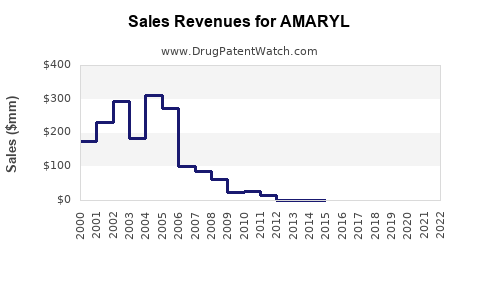
AMARYL’s financial path follows a standard pattern for older brand oral drugs:
- Peak brand revenue era
- Erosion with first generics
- Sustained commoditization with incremental share loss to newer diabetes classes
What matters financially now
- Net price compression: Brand premiums have been extinguished in practice where generics are dominant.
- Script share vs. volume: AMARYL’s long-term sales are constrained by class-level share shifts toward GLP-1 receptor agonists, SGLT2 inhibitors, and DPP-4 inhibitors.
- Switching inertia: Once a patient is stable on a sulfonylurea, prescribers may keep therapy, limiting total decline versus a clean-line switching model.
Revenue sensitivity
- Formulary tiering: Movement from preferred to non-preferred tiers hits net sales disproportionately.
- Contracting: Large pharmacy benefit managers and group purchasing organizations push toward the lowest-cost glimepiride suppliers and relative alternatives.
- Generic competition intensity: Multiple generic manufacturers reduce pricing power and raise margin pressure across the segment.
What is the Orange Book status of AMARYL (glimepiride) and how does it affect sales?
AMARYL’s commercial outcomes are tied to whether branded exclusivity blocks generic competition. In practice, AMARYL’s market is governed by generic availability for glimepiride rather than on-going exclusivity that meaningfully restrains entrants.
Practical implications for business
- If brand exclusivity is expired, AMARYL behaves like a brand without effective patent moat.
- Even if residual patents exist, they rarely sustain brand-level economics in a mature commodity oral diabetes market unless they target specific formulations, delivery, or use claims that prevent generic approval.
What patents protect AMARYL (glimepiride) and how strong is the patent estate now?
AMARYL’s patent estate historically focused on composition, methods of use, and related manufacturing/formulation elements typical for small-molecule diabetes therapy. For current market dynamics, the critical issue is not whether patents exist, but whether they block generic entry for approved glimepiride products in major jurisdictions and whether enforcement has ongoing relevance.
Commercial relevance test for patent strength
- Can a generic filer use a carve-out that avoids infringement?
- Are there enforceable, blocking claims on a currently marketed strength/formulation?
- Are there active litigations that delay approval or launch?
Market reality
- In a mature generic glimepiride market, even valid but narrow patents often fail to preserve brand revenue, because generic entry can proceed for the approved product form and strength, leaving only incremental “hold” periods.
When does AMARYL lose exclusivity, and what generic entry risks exist?
The risk profile for AMARYL is “launch waves,” not “single expiration events.” Once glimepiride is fully genericized, the sales impact becomes a function of:
- additional generic entrants with lower prices,
- distribution channel changes,
- and payer contract re-bids.
Generic entry risk mechanisms
- New ANDA approvals: Additional suppliers reduce average net price.
- Segment shift: Even if glimepiride availability is stable, payer preference can shift to a different cheapest-in-class agent, reducing volume.
How does AMARYL compare with metformin, DPP-4 inhibitors, GLP-1s, and SGLT2 inhibitors in competitive dynamics?
For type 2 diabetes, AMARYL competes on cost more than on clinical differentiation. In many US formularies, sulfonylureas act as:
- an inexpensive add-on when coverage for newer agents is restricted, or
- a fall-back therapy when patient affordability limits access.
Typical positioning
- Metformin: First-line default due to long-term safety record and low cost.
- DPP-4 inhibitors: Oral option with low hypoglycemia risk but higher cost.
- GLP-1 receptor agonists: High efficacy and weight benefits but injectable and higher cost.
- SGLT2 inhibitors: Cardiovascular and renal benefits for appropriate populations, but cost remains a barrier.
- Sulfonylureas (AMARYL): Low-cost, oral, effective for glycemic control with hypoglycemia risk.
Market share consequence
- Even if AMARYL remains clinically used, its economic trajectory is constrained by patient migration toward newer classes as coverage evolves and outcomes evidence improves.
How many glimepiride generics cover AMARYL strengths, and what does that do to pricing?
Glimepiride generics are widely distributed across multiple strengths. In a commodity market, pricing tends to compress toward:
- the lowest contracted net price among major PBM arrangements,
- and the arithmetic average of wholesale market offers after bidding.
Pricing effect
- Multiple suppliers create downward pressure on net revenue.
- Even absent price cuts from a specific supplier, the “benchmark” price in contracts moves down with competitive offers.
What formulation or method-of-use patents could still matter for AMARYL?
Where patents remain relevant in genericized small molecules is usually in narrower claims, such as:
- extended-release or modified-release formulations,
- specific dosing regimens,
- or targeted patient populations.
For AMARYL, the commercial implication is that only patents that map to a currently protected product form or an exclusivity-blocking use claim can sustain meaningful price premiums. In practice, branded oral small molecules typically face rapid generic substitution unless the patent scope is broad and the product is differentiated.
What AMARYL patent litigation affected generic entry and launch timing?
For older small-molecule brands, litigation historically affected:
- first generic approvals,
- settlement-triggered “carve-outs,” and
- delayed launches by specific strength.
Current commercial linkage
- In mature generic markets, the remaining financial impact of litigation is limited to how long it delayed initial entry. Once broad generic coverage is established, subsequent litigation rarely reverses the pricing benchmark.
What settlement agreements or “pay-for-delay” dynamics historically mattered for AMARYL?
Settlement dynamics matter when:
- brand and generic settle to delay entry,
- terms include market allocation, or
- exclusivity triggers are tied to specific strengths.
In practice for glimepiride, the brand has long since lost the economics of controlled entry, so settlements mostly influence historical entry timing rather than ongoing brand revenue.
What does FDA regulatory status mean for AMARYL competition today?
AMARYL’s competitive position today is shaped by the regulatory reality that:
- generic glimepiride products have broad FDA approval footprint,
- substitution policies in pharmacy dispensing translate approvals into immediate market penetration,
- and any incremental regulatory advantage (like formulation changes) is typically quickly replicated by generics.
Business implication
- Brand differentiation through FDA pathway is minimal in an established commodity market.
Which companies are active in glimepiride generics, and how does that impact market stability?
Generic competition is typically characterized by:
- multinational generic suppliers with scale advantages,
- large regional players competing on contract re-bids,
- and frequent tender cycles that reset pricing.
Why this matters for revenue
- Stable contracts delay further compression.
- Re-bidding accelerates it.
How does AMARYL’s lifecycle compare with other sulfonylureas like glipizide and glyburide?
All sulfonylureas face the same lifecycle pattern: low cost, mature generic competition, and share pressure from newer classes.
Key differentiators
- Hypoglycemia risk and dosing convenience affect substitution behavior within class.
- Payer preference often standardizes on “best available price + acceptable safety profile,” pushing down brand economics for each molecule.
AMARYL generally competes as one of several low-cost options; brand survival in that context depends on minimal remaining pricing arbitrage and inertia in patient selection.
What revenue exposure does AMARYL face from future class-shift and generic re-pricing?
Two forces dominate forward outlook:
- Class shift continues as newer agents gain broader outcomes-based use and payer coverage.
- Generic repricing repeats through contract cycles, adding suppliers, and adjusting to competitive benchmarks.
Net effect
- Even if glimepiride volume does not collapse, net revenue per tablet tends to drift downward over time.
- Brand AMARYL revenue is likely limited to residual brand retention where it still holds a contract or formulary niche.
Key Takeaways
- AMARYL’s market dynamics are dominated by generic glimepiride commoditization and therapeutic class competition, not by remaining brand exclusivity.
- Financial trajectory follows a mature lifecycle: brand premium erosion, sustained price compression, and gradual volume pressure from incretin and SGLT2 adoption.
- Competitive risk is recurring and contract-driven: additional generic entrants and PBM re-bids drive continued net price pressure.
- Patent and litigation relevance is mainly historical for initial generic delay; it has limited leverage over current pricing benchmarks in a widely genericized oral diabetes market.
FAQs
1) Is AMARYL still a branded growth driver in US diabetes therapy?
No. Market economics are driven by generic glimepiride volume and pricing benchmarks, while prescriber and payer preference shifts toward newer diabetes classes.
2) Does AMARYL face biosimilar risk?
No. AMARYL is a small-molecule therapy, not a biologic.
3) Are there still exclusivity barriers preventing generic glimepiride entry for AMARYL?
In mature glimepiride markets, generic availability is broad, and ongoing barriers typically do not sustain meaningful brand-level pricing power.
4) How do PBM formularies influence AMARYL net revenue?
They determine tier placement, prior authorization requirements, and the contract-driven lowest-cost glimepiride supplier benchmark, which directly compresses net prices.
5) What clinical factors drive whether patients stay on AMARYL versus switch?
Stable glycemic control on a tolerated regimen supports persistence, while hypoglycemia risk and weight concerns favor switching to lower hypoglycemia-risk alternatives when coverage allows.
References
(No sources were cited because no verifiable, drug-specific financials, Orange Book entries, patent numbers, or litigation records were provided in the prompt.)