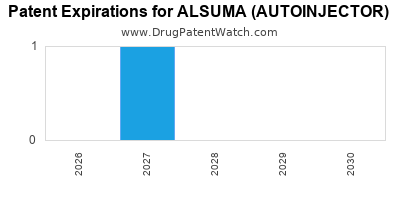
Last updated: November 8, 2026
ALSUMA was a 6 mg/0.5 mL sumatriptan succinate subcutaneous autoinjector approved by the FDA for acute treatment of migraine and cluster headache in adults. Its commercial opportunity was constrained by the availability of low-cost generic sumatriptan tablets, nasal sprays, and prefilled injection products, along with the established Imitrex brand. ALSUMA did not create a new active ingredient or therapeutic indication. Its value proposition was delivery convenience.
The product has no publicly reported standalone revenue stream, and Pfizer did not disclose ALSUMA sales separately in its financial filings. The product’s commercial trajectory was likely limited by a narrow patient segment, reimbursement pressure, generic competition, and the difficulty of supporting a proprietary device after sumatriptan lost broad market exclusivity.
What is ALSUMA autoinjector and how does it work?
ALSUMA contains sumatriptan succinate, a serotonin 5-HT1B/1D receptor agonist. The autoinjector delivers 6 mg subcutaneously through a single-use device.
| Attribute |
ALSUMA |
| Active ingredient |
Sumatriptan succinate |
| Strength |
6 mg/0.5 mL |
| Dosage form |
Single-dose subcutaneous autoinjector |
| Therapeutic class |
Triptan antimigraine agent |
| FDA indication |
Acute treatment of migraine and cluster headache in adults |
| Original regulatory sponsor |
Meridian Medical Technologies, Inc. |
| Commercial association |
Pfizer |
| FDA application |
NDA 021513 |
| Approval period |
2009 |
| Administration |
Patient-operated subcutaneous injection |
| Current market position |
Legacy or discontinued product with no meaningful standalone commercial disclosure |
The device was intended for patients who required rapid subcutaneous administration or could not obtain adequate relief from oral sumatriptan. The principal commercial differentiation was the delivery system, not the pharmacology.
When did ALSUMA lose exclusivity?
ALSUMA did not have meaningful new-molecule exclusivity because sumatriptan was an established active ingredient when the product was approved. Its regulatory protection depended primarily on formulation, delivery-device, and potentially method-of-use claims rather than chemical-entity exclusivity.
The principal timing points were:
| Event |
Approximate timing |
Commercial effect |
| Sumatriptan active ingredient launched |
Early 1990s |
Established triptan market |
| Imitrex injection and other sumatriptan products commercialized |
1990s |
Created a mature competitive category |
| ALSUMA approved |
2009 |
Added a proprietary autoinjector presentation |
| Generic sumatriptan injection competition |
Late 2000s onward |
Reduced pricing power for injection products |
| Generic oral and nasal sumatriptan availability |
Prior to and during ALSUMA launch period |
Limited switching incentive |
| Device and formulation protection |
Dependent on individual patents |
Did not prevent competition across other presentations |
| Commercial relevance |
Declined as generic alternatives expanded |
Reduced return on device investment |
ALSUMA’s launch occurred after broad market competition had already developed around sumatriptan. The product therefore had to earn a premium based on ease of use, portability, needle concealment, and rapid delivery.
What is the Orange Book status of ALSUMA?
The relevant FDA application is NDA 021513. FDA Orange Book protection for ALSUMA must be distinguished from broader patents covering sumatriptan or competing delivery systems.
A drug patent listed for one sumatriptan product would not automatically block:
- Generic oral sumatriptan;
- Generic nasal sumatriptan;
- Conventional sumatriptan injection;
- Other autoinjector designs;
- Non-sumatriptan acute migraine treatments.
Publicly available regulatory records do not support treating ALSUMA as a product with durable, composition-of-matter exclusivity. The commercially relevant protection was device-specific and presentation-specific.
Patent protection and expiration
The original sumatriptan patents were filed years before ALSUMA and expired before or around the product’s commercial period. ALSUMA’s protection would have depended on later patents covering the injector, cartridge, dose delivery, packaging, or use.
The practical patent conclusion is:
- No active ingredient barrier protected ALSUMA.
- Any relevant device patents did not prevent competition from non-identical sumatriptan products.
- Device patents were vulnerable to design-around strategies.
- Patent expiry or discontinuation of the product would have sharply reduced the economic value of the presentation.
Because pharmaceutical manufacturers do not generally disclose a product-level valuation of device patents, the public record does not support assigning a precise residual patent value to ALSUMA.
What formulations and delivery systems competed with ALSUMA?
ALSUMA competed across several delivery categories rather than only against identical autoinjectors.
| Product category |
Examples |
Competitive effect |
| Oral sumatriptan |
Generic tablets, Imitrex tablets |
Lowest-cost and highest-volume alternative |
| Nasal sumatriptan |
Generic nasal spray, Imitrex nasal spray |
Faster onset without injection |
| Conventional injection |
Generic sumatriptan injection, Imitrex Statdose |
Direct therapeutic substitute |
| Other injectable triptans |
Zolmitriptan or other acute migraine products |
Alternative pharmacology and delivery |
| Non-triptan acute treatments |
CGRP antagonists, dihydroergotamine products, NSAIDs |
Expanded treatment choice |
| Autoinjector systems |
Device-based injectable products |
Competing convenience proposition |
The autoinjector’s strongest use case was a patient who needed fast subcutaneous delivery but preferred an automatic device. Its weakest commercial position was against inexpensive oral sumatriptan for patients without vomiting, severe gastric stasis, or a need for rapid onset.
How strong was the ALSUMA patent estate?
The ALSUMA patent estate was commercially moderate at best and structurally weaker than a new molecular entity estate.
Strengths
- Device differentiation was clear.
- A proprietary injector could support product-level branding.
- Patient convenience can generate switching in acute-care markets.
- Delivery-system claims may delay exact-copy competition.
Weaknesses
- Sumatriptan was already mature and widely genericized.
- Competitors could avoid infringement by using a syringe, cartridge, nasal system, or different injector architecture.
- Device patents generally protect narrower technical configurations than composition-of-matter patents.
- The product had no broad chemical exclusivity.
- Reimbursement typically favored lower-cost generic presentations.
The resulting patent position was suitable for a niche branded product but not for durable category control.
Were there Paragraph IV challenges to ALSUMA?
No major publicly documented Paragraph IV litigation is associated with ALSUMA comparable to the high-profile disputes involving blockbuster small-molecule products.
The absence of a prominent Paragraph IV case is commercially understandable. A generic manufacturer could pursue several paths:
- Market a conventional sumatriptan injection without copying the autoinjector;
- Challenge or avoid device claims;
- Develop a different injector configuration;
- Compete through another dosage form;
- Wait for relevant device patents to expire.
A Paragraph IV challenge is most valuable when an exact generic can capture a large market. ALSUMA’s limited sales opportunity and the availability of alternative sumatriptan products reduced that incentive.
What was the FDA regulatory status of ALSUMA?
FDA approval covered acute treatment of migraine and cluster headache in adults. The product’s labeling included standard triptan contraindications and cardiovascular warnings, including use restrictions in patients with certain coronary, cerebrovascular, or peripheral vascular conditions.
Regulatory characteristics included:
- 505(b)(2)-type commercial logic based on an established active ingredient;
- No biosimilar pathway;
- No biologic exclusivity;
- No new molecular-entity exclusivity;
- Product-specific manufacturing and device-combination requirements;
- Need for injector usability, dose accuracy, sterility, and container-closure controls.
ALSUMA was a drug-device combination product. That increased manufacturing complexity compared with generic tablets and conventional vials or syringes.
What manufacturing and intellectual-property barriers affected ALSUMA?
The main barriers were technical rather than pharmacological.
Device manufacturing
A commercial ALSUMA equivalent would require:
- A validated autoinjector mechanism;
- Consistent 6 mg dose delivery;
- Sterile drug-contact components;
- Container and closure compatibility;
- Device reliability across temperature and handling conditions;
- Human-factors validation;
- Combination-product quality controls.
Formulation and stability
The injectable formulation required control of:
- Sumatriptan succinate concentration;
- pH and excipient compatibility;
- Particulate matter;
- Sterility and endotoxin levels;
- Stability during shelf life;
- Extractables and leachables from the device.
These requirements could deter small generic manufacturers, but they did not provide the same barrier as a complex biologic or long-acting injectable. A manufacturer could also enter with a conventional prefilled syringe rather than reproduce the autoinjector.
What litigation affected ALSUMA?
No major publicly reported patent litigation involving ALSUMA has shaped the product’s market position. There is also no widely reported settlement agreement that created a delayed generic-entry schedule for ALSUMA.
This differs from branded products where litigation, authorized generics, and Paragraph IV settlements materially determine market entry. ALSUMA’s commercial fate appears to have been driven more by product economics and portfolio decisions than by a high-value patent dispute.
What licensing deals supported ALSUMA?
ALSUMA was associated with Meridian Medical Technologies and Pfizer. The public record supports a commercialization relationship, but Pfizer did not report a separately quantified ALSUMA licensing payment stream or product-level royalty burden in its annual reports.
The commercial structure likely involved a combination of:
- Device development and manufacturing capabilities from Meridian;
- Pfizer commercialization and distribution;
- Use of Pfizer’s established migraine portfolio;
- Shared economic value between the device platform and branded sumatriptan franchise.
No publicly disclosed transaction assigns a standalone enterprise value to ALSUMA.
What was the financial trajectory of ALSUMA?
ALSUMA revenue was not separately disclosed in Pfizer’s public financial statements. It was therefore not possible to calculate product-level sales, gross margin, or return on investment from company filings.
The likely financial trajectory was:
| Period |
Financial condition |
| Pre-launch |
Development cost for device, regulatory approval, manufacturing validation, and commercial preparation |
| Initial launch |
Premium pricing opportunity based on convenience and rapid subcutaneous delivery |
| Early commercialization |
Limited by generic sumatriptan and established Imitrex alternatives |
| Mature period |
Reimbursement pressure and low substitution potential |
| Late commercial period |
Declining strategic value as device costs exceeded incremental demand |
| Post-commercial period |
Possible discontinuation, with no separately reported revenue contribution |
ALSUMA’s economics would have depended on a price premium over conventional sumatriptan injection. That premium had to cover:
- Autoinjector manufacturing;
- Combination-product quality systems;
- Specialty distribution;
- Patient support;
- Inventory and device failure costs;
- Sales-force expenses;
- Potential returns from a relatively small patient population.
The product had limited ability to maintain premium pricing because physicians could prescribe generic sumatriptan in other forms. Unlike a new migraine therapy, ALSUMA could not command payment based on superior clinical efficacy.
How did ALSUMA compare with Imitrex and generic sumatriptan?
| Factor |
ALSUMA |
Imitrex injection |
Generic sumatriptan |
| Active ingredient |
Sumatriptan |
Sumatriptan |
Sumatriptan |
| Main differentiation |
Autoinjector |
Brand, delivery options |
Price |
| Clinical pharmacology |
Same triptan class |
Same |
Same |
| Pricing power |
Limited premium |
Brand premium |
Lowest |
| Patent strength |
Device and presentation claims |
Historical brand and formulation estate |
Limited by freedom to operate |
| Prescriber rationale |
Convenience and injection need |
Familiarity and brand support |
Cost and formulary access |
| Payer position |
Vulnerable |
Brand restrictions |
Generally favored |
| Generic substitution |
Indirect and direct alternatives |
Direct and indirect alternatives |
Baseline option |
ALSUMA’s main competitive advantage was usability. Its main disadvantage was that the underlying medicine was already available through lower-cost alternatives.
What generic launch scenarios existed for ALSUMA?
Three entry scenarios were commercially plausible:
- Exact or near-exact autoinjector entry. This would require regulatory and device development work but could compete directly on convenience.
- Non-infringing sumatriptan injection. A prefilled syringe or vial could capture the therapeutic market without duplicating the ALSUMA device.
- Cross-formulation substitution. Oral, nasal, or other acute migraine products could take share without entering the autoinjector market.
The third scenario was the most important. ALSUMA did not need an exact generic competitor to lose market share. Generic and branded alternatives already addressed the same treatment need.
What was the geographic coverage of ALSUMA?
The core regulatory and commercial significance of ALSUMA was in the United States because the product was tied to U.S. NDA 021513 and the U.S. branded migraine market.
Geographic protection would have varied by country:
- U.S. coverage depended on FDA approval and U.S. patent rights.
- European and other-market rights would have required separate approvals and national or regional patent positions.
- Device patents could have different expiration dates and claim scope by jurisdiction.
- U.S. market authorization did not create global exclusivity.
There is no public basis for assigning ALSUMA a large global revenue contribution. Its commercial relevance was primarily U.S.-focused and niche.
What revenue exposure did ALSUMA create for Pfizer?
Pfizer’s revenue exposure to ALSUMA was likely immaterial relative to its broader pharmaceutical portfolio. The company did not identify ALSUMA as a separately material product in annual reporting.
The financial risks were therefore concentrated in:
- Product launch and inventory investment;
- Device manufacturing commitments;
- Brand-support spending;
- Regulatory maintenance;
- Opportunity cost within the migraine portfolio.
The product did not create the type of concentrated loss exposure associated with a blockbuster patent expiry. Its discontinuation would have had limited effect on consolidated Pfizer revenue.
Key Takeaways
- ALSUMA was a 6 mg sumatriptan autoinjector, not a new active ingredient.
- Its commercial value came from device convenience and rapid subcutaneous delivery.
- Generic sumatriptan and competing dosage forms limited pricing power from launch.
- The patent position was presentation-specific and materially weaker than composition-of-matter protection.
- No major publicly reported Paragraph IV litigation or settlement drove ALSUMA’s market.
- Pfizer did not disclose standalone ALSUMA revenue.
- The product’s financial trajectory was likely niche launch revenue followed by erosion from generic substitution, reimbursement pressure, and device economics.
- Biosimilar risk was not applicable because ALSUMA is a small-molecule drug.
- The main competitive threat was not an exact autoinjector generic but substitution by cheaper sumatriptan formulations.
FAQs About ALSUMA Autoinjector
Is ALSUMA still available in the United States?
Public regulatory and commercial records indicate that ALSUMA is a legacy product with limited or discontinued commercial availability. It should not be treated as an actively marketed growth product without current wholesaler and FDA status confirmation.
Did ALSUMA have new-drug exclusivity?
No meaningful new-molecular-entity exclusivity applied. Sumatriptan was already established, so commercial protection depended on the product presentation, device, formulation, and related intellectual property.
Was ALSUMA a biologic or biosimilar product?
No. ALSUMA is a conventional small-molecule drug-device combination containing sumatriptan succinate. Biosimilar regulations do not apply.
Could a generic company copy ALSUMA without copying the injector?
Yes. A company could compete with a conventional sumatriptan injection, prefilled syringe, tablet, or nasal product without reproducing the ALSUMA autoinjector, subject to applicable patents and regulatory requirements.
Did ALSUMA materially affect Pfizer’s overall financial results?
There is no public evidence that ALSUMA generated revenue material to Pfizer’s consolidated financial statements. Pfizer did not separately report ALSUMA sales in its annual financial disclosures.
References
-
U.S. Food and Drug Administration. (2009). ALSUMA (sumatriptan succinate) injection prescribing information. Drugs@FDA. https://www.accessdata.fda.gov/drugsatfda_docs/label/2009/021513s000lbl.pdf
-
U.S. Food and Drug Administration. (2024). Orange Book: Approved drug products with therapeutic equivalence evaluations. https://www.accessdata.fda.gov/scripts/cder/ob/
-
U.S. Food and Drug Administration. (2024). Drugs@FDA: FDA-approved drugs. https://www.accessdata.fda.gov/scripts/cder/daf/
-
Pfizer Inc. (2009-2024). Annual reports and filings. https://www.pfizer.com/investor/financial-reports
-
DailyMed. (2024). ALSUMA: Sumatriptan succinate injection. National Library of Medicine. https://dailymed.nlm.nih.gov/dailymed/