Last updated: September 8, 2026
Almotriptan malate is a mature, low-cost prescription triptan with limited branded revenue and a generic-led commercial profile. Its market has shifted from originator-led pricing to price competition among generic manufacturers. Volume remains supported by migraine prevalence and the established role of triptans, while revenue is constrained by generic substitution, inexpensive competing triptans, and newer CGRP therapies.
The commercial opportunity is primarily in efficient generic manufacturing, tender supply, pharmacy distribution, and selected international markets. Almotriptan has limited prospects for major revenue expansion without a new formulation, combination product, over-the-counter switch, or differentiated delivery system.
What is the FDA status of almotriptan malate?
Almotriptan is an FDA-approved oral 5-HT1B/1D receptor agonist for the acute treatment of migraine attacks with or without aura in adults. The original U.S. product was Axert, supplied as 6.25 mg and 12.5 mg tablets. Almotriptan is not indicated for migraine prevention or for the treatment of cluster headache.[1]
| Attribute |
Status |
| Active ingredient |
Almotriptan malate |
| Drug class |
Triptan; selective serotonin 5-HT1B/1D agonist |
| U.S. originator brand |
Axert |
| Dosage form |
Immediate-release oral tablet |
| U.S. strengths |
6.25 mg and 12.5 mg |
| FDA indication |
Acute treatment of migraine in adults |
| Route |
Oral |
| Regulatory pathway for generics |
Abbreviated New Drug Application |
| Biosimilar relevance |
None; this is a small-molecule drug |
Almotriptan’s commercial value is limited by the absence of a protected biologic platform, complex delivery technology, or difficult-to-replicate manufacturing process.
When did almotriptan lose exclusivity?
Almotriptan lost practical market exclusivity after expiration or exhaustion of the principal originator patent and regulatory protections associated with Axert. The product is now treated commercially as a generic triptan in the United States and other major markets.
The exact timing of generic entry depends on jurisdiction, patent certifications, settlements, and local regulatory approvals. The key commercial point is that the product is no longer protected by a durable branded exclusivity position.
Historical exclusivity profile
| Exclusivity category |
Commercial effect |
| New drug approval |
Established the initial Axert market |
| Original compound and use patents |
Delayed generic entry |
| Formulation and dosage patents |
Provided additional but limited protection where enforceable |
| Pediatric exclusivity |
Not a major long-term commercial driver |
| Generic approvals |
Shifted pricing power away from the originator |
| Current position |
Mature generic market |
Unlike newer migraine products, almotriptan does not have an active composition-of-matter exclusivity story supporting premium pricing. Current value depends on manufacturing economics and distribution access rather than patent-backed pricing.
What patents protect almotriptan malate?
The historical patent estate for almotriptan included patents directed to the active compound, related chemical structures, pharmaceutical compositions, and therapeutic use. The principal intellectual-property period has passed in the United States and other major pharmaceutical markets.
A current deal or litigation assessment should distinguish between:
- Compound patents covering almotriptan or related chemical entities.
- Salt and polymorph patents covering almotriptan malate.
- Tablet formulation patents.
- Methods for treating migraine.
- Manufacturing and purification processes.
- Regional patents with different expiration dates.
The existence of a historical patent does not establish current blocking power. A patent can remain listed in a database while being expired, disclaimed, invalidated, or commercially irrelevant.
What is the Orange Book status of almotriptan?
The FDA Orange Book is the controlling source for current U.S. listed patents and reference-listed-drug information. Almotriptan’s current U.S. market position is generic-led, and any historical Axert patent listings should be checked against the current Orange Book record, FDA Drugs@FDA records, and approved ANDA labeling.[2,3]
There is no commercially meaningful biosimilar risk because almotriptan is a chemically synthesized small molecule. The relevant competitive risk is generic entry, additional ANDA approvals, authorized-generic supply, and price compression.
How large is the almotriptan market?
No reliable, current standalone global revenue series for almotriptan malate is publicly disclosed by the originator or major generic manufacturers. Axert revenue was not reported as a separate material segment in the public financial statements of its commercial owners. Generic sales are generally aggregated within broader prescription-drug portfolios.
The market is best understood through demand and pricing drivers rather than an audited product-level revenue figure.
Demand drivers
- High prevalence of migraine.
- Continued use of triptans as established acute therapy.
- Low generic acquisition cost.
- Availability in oral tablet form.
- Familiarity among prescribers and patients.
- Use in patients who do not require newer CGRP therapies.
Revenue constraints
- Multiple generic triptans.
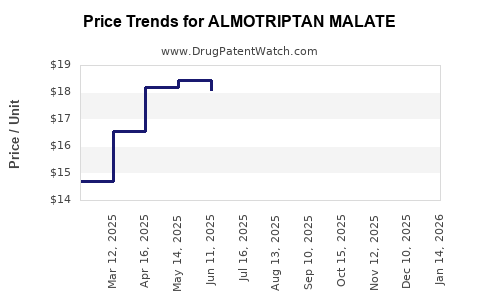
- Low unit prices after loss of exclusivity.
- Pharmacy-benefit-manager pressure.
- Substitution by sumatriptan and rizatriptan.
- Newer oral and injectable CGRP antagonists.
- Limited differentiation among immediate-release tablets.
- No strong pediatric, preventive, or specialty-care franchise.
How does almotriptan compare with competing migraine drugs?
Almotriptan competes in a fragmented acute-migraine market. Sumatriptan has the broadest generic presence and the largest range of dosage forms. Rizatriptan benefits from established brand recognition and orally disintegrating-tablet availability. Eletriptan and zolmitriptan compete on efficacy, tolerability, and delivery options. Ubrogepant, rimegepant, and zavegepant compete as newer CGRP-pathway products, generally at higher prices.
| Product |
Class |
Typical commercial position |
| Almotriptan |
Triptan |
Mature generic oral product |
| Sumatriptan |
Triptan |
Largest and most diversified generic competitor |
| Rizatriptan |
Triptan |
Generic oral and orally disintegrating options |
| Zolmitriptan |
Triptan |
Generic oral and nasal competition |
| Eletriptan |
Triptan |
Generic oral alternative |
| Ubrogepant |
CGRP antagonist |
Branded acute therapy |
| Rimegepant |
CGRP antagonist |
Acute and preventive branded therapy |
| Zavegepant |
CGRP antagonist |
Nasal branded acute therapy |
Almotriptan’s relative advantages are tolerability, established clinical use, and generic affordability. Its disadvantages are limited formulation differentiation and weaker commercial scale than sumatriptan.
What formulations are protected by almotriptan patents?
The principal commercial form is the immediate-release tablet. There is no widely established, high-value extended-release, injectable, transdermal, or nasal almotriptan platform comparable to competing migraine products.
This limits the value of formulation patents. A tablet formulation patent may protect excipient selection, dissolution characteristics, stability, or manufacturing parameters, but such patents have less commercial impact after the originator product loses market exclusivity.
A formulation-based relaunch would face several barriers:
- Limited willingness to pay for a reformulated generic triptan.
- Competition from established orally disintegrating and nasal products.
- Requirement for clinical or bioequivalence support.
- Reimbursement pressure.
- Need for a meaningful patient benefit, such as faster onset or improved use during nausea and vomiting.
Which companies are challenging or competing with almotriptan?
The principal competitive threat comes from manufacturers of generic triptans, not from a single named challenger. U.S. generic supply can change as ANDAs are approved, withdrawn, acquired, or shifted among contract manufacturers.
The relevant competitive groups are:
- Generic pharmaceutical companies supplying almotriptan tablets.
- Manufacturers of sumatriptan, rizatriptan, zolmitriptan, and eletriptan.
- Originators of CGRP antagonists.
- Pharmacy distributors and purchasing organizations.
- Private-label and regional suppliers outside the United States.
Public company filings generally do not identify almotriptan revenue, market share, or gross margin separately. This prevents a reliable ranking of manufacturers by product-level sales without proprietary prescription or procurement data.
What is the financial trajectory of almotriptan?
The financial trajectory follows the standard lifecycle of a mature oral prescription drug.
| Period |
Financial profile |
| Launch period |
Originator-led pricing and physician promotion |
| Patent-protected period |
Higher net price and brand concentration |
| Generic-entry period |
Rapid price reduction and share transfer |
| Mature generic period |
Stable or declining revenue, low unit economics |
| Current opportunity |
Volume-based supply, regional distribution, and manufacturing efficiency |
Revenue likely declined sharply after generic entry, while total patient access remained more stable because lower prices supported continued utilization. For a generic manufacturer, the product can still generate useful portfolio revenue if production costs are low and supply reliability is high. The product is unlikely to support substantial standalone operating profit unless the manufacturer has scale or limited competition in a particular market.
Revenue exposure
Almotriptan is unlikely to represent material revenue exposure for a diversified pharmaceutical company. The product may matter more to:
- Small generic companies with concentrated portfolios.
- Contract manufacturers with migraine-product capacity.
- Regional distributors.
- Firms holding hospital, public-sector, or pharmacy contracts.
- Companies using almotriptan as part of a broader triptan basket.
The main financial risk is price erosion, not sudden clinical obsolescence. The main upside is incremental volume from continued migraine prevalence and substitution away from higher-priced branded therapies.
What generic entry risks exist for almotriptan?
Generic entry risk is already realized in the United States and other mature markets. The remaining commercial risks involve additional competition and substitution.
Generic-market risks
- New ANDA approvals can reduce supply concentration.
- Tender competition can lower net prices.
- A major manufacturer can exit, creating temporary shortages but not necessarily durable pricing power.
- Pharmacy substitution can move patients to lower-cost triptans.
- Payers can prefer sumatriptan or rizatriptan because of broader supplier coverage.
- CGRP products can capture patients with inadequate triptan response or contraindications.
Generic entry does not eliminate demand. It changes who captures the value. Pharmacies, payers, and distributors retain more of the economic benefit, while the originator loses pricing power.
What patent litigation and settlements affect almotriptan?
The commercially important litigation window was the period before and around generic entry, when Paragraph IV certifications could challenge listed Axert patents. A Paragraph IV certification alleges that a listed patent is invalid, unenforceable, or will not be infringed by the proposed generic.
Current investment relevance is limited unless a live patent, settlement restriction, or supply agreement still affects a specific jurisdiction. Historical litigation should not be treated as a current barrier without confirmation from FDA records, federal court dockets, and the applicable patent register.
Settlement agreements, where they existed, could have controlled launch timing, authorized-generic rights, or market-entry conditions. Their economic effect generally diminished after broad generic availability.
How strong is the almotriptan patent estate?
The current patent estate is weak as a source of durable pricing power. The compound is mature, the primary dosage form is conventional, and generic substitution is established.
| Patent-strength factor |
Assessment |
| Active compound protection |
No longer a meaningful broad-market barrier |
| Tablet formulation protection |
Limited commercial relevance |
| Method-of-use protection |
Narrow and difficult to monetize after generic entry |
| Manufacturing patents |
Potentially relevant to cost, but rarely market blocking |
| Biosimilar complexity |
Not applicable |
| Regulatory exclusivity |
Expired for the mature product |
| Overall estate strength |
Low for current commercial defense |
Manufacturing know-how can still matter. Purification, impurity control, crystallization, yield, and process consistency may create cost advantages even when the underlying patent estate is weak. Those advantages are operational rather than exclusionary.
What is the outlook for almotriptan?
The base case is a stable-to-declining mature generic market with continuing demand but limited pricing power. Volume should remain supported by migraine prevalence and the lower cost of triptan therapy. Revenue growth is unlikely without geographic expansion, a supply disruption affecting competitors, or product differentiation.
The most credible commercial opportunities are:
- Low-cost, reliable tablet manufacturing.
- Private-label supply.
- Expansion in markets where generic competition is less developed.
- Portfolio bundling with other migraine medicines.
- Alternative dosage forms with demonstrated patient benefit.
- Strategic supply agreements with distributors or public purchasers.
The primary downside risks are further generic price erosion, payer preference for other triptans, and increased adoption of CGRP therapies.
Key Takeaways
- Almotriptan malate is a mature generic triptan, not a current branded-growth product.
- Axert’s former exclusivity position has lost commercial force.
- The U.S. market is driven by generic supply, pharmacy substitution, and payer economics.
- No material biosimilar risk exists because almotriptan is a small molecule.
- Patent value is primarily historical; manufacturing efficiency is more relevant than blocking IP.
- Product-level revenue is not separately disclosed by major pharmaceutical companies.
- Sumatriptan and rizatriptan are the strongest low-cost triptan competitors.
- CGRP antagonists create premium competitive pressure, particularly in patients with inadequate triptan response.
- The most likely financial trajectory is stable or declining revenue with continued low-cost demand.
- A material commercial upside would require a differentiated formulation, licensing transaction, or favorable regional supply position.
FAQs
Is almotriptan malate still commercially available?
Yes. Almotriptan remains available in certain markets as a prescription oral migraine treatment, although product availability and manufacturer coverage vary by country.
Is almotriptan an interchangeable generic for Axert?
Where an approved generic has the required regulatory designation, it may be substitutable for the reference product under local law. Substitution rules depend on the jurisdiction and the specific product approval.
Does almotriptan have biosimilar competition?
No. Almotriptan is a chemically synthesized small molecule. Its competitive products are generics and alternative migraine medicines, not biosimilars.
Could almotriptan be converted to an over-the-counter product?
An over-the-counter switch would require a regulatory submission demonstrating safe consumer self-selection, appropriate labeling, and safe use without routine physician supervision. No broad U.S. OTC switch has established almotriptan as a major consumer product.
Is almotriptan attractive for pharmaceutical licensing?
Its licensing value is generally limited for a conventional tablet. A transaction could be commercially rational where it includes a differentiated delivery system, regional rights, reliable manufacturing capacity, or a broader migraine portfolio.
References
- U.S. Food and Drug Administration. (2001). Axert (almotriptan malate) tablets: Prescribing information.
- U.S. Food and Drug Administration. (n.d.). Drugs@FDA: FDA-approved drugs.
- U.S. Food and Drug Administration. (n.d.). Approved drug products with therapeutic equivalence evaluations, Orange Book.
- U.S. Food and Drug Administration. (2018). Migraine: Developing drugs for acute treatment.
- U.S. Food and Drug Administration. (2023). Migraine: Developing drugs for preventive treatment.