ALIQOPA Drug Patent Profile
✉ Email this page to a colleague
When do Aliqopa patents expire, and when can generic versions of Aliqopa launch?
Aliqopa is a drug marketed by Bayer Healthcare and is included in one NDA. There are three patents protecting this drug.
The generic ingredient in ALIQOPA is copanlisib dihydrochloride. There is one drug master file entry for this compound. Additional details are available on the copanlisib dihydrochloride profile page.
DrugPatentWatch® Generic Entry Outlook for Aliqopa
Aliqopa was eligible for patent challenges on September 14, 2021.
By analyzing the patents and regulatory protections it appears that the earliest date
for generic entry will be October 22, 2029. This may change due to patent challenges or generic licensing.
Indicators of Generic Entry
AI Deep Research
Questions you can ask:
- What is the 5 year forecast for ALIQOPA?
- What are the global sales for ALIQOPA?
- What is Average Wholesale Price for ALIQOPA?
Summary for ALIQOPA
| US Patents: | 3 |
| Applicants: | 1 |
| NDAs: | 1 |
| Raw Ingredient (Bulk) Api Vendors: | 73 |
| Clinical Trials: | 16 |
| Drug Prices: | Drug price information for ALIQOPA |
| What excipients (inactive ingredients) are in ALIQOPA? | ALIQOPA excipients list |
| DailyMed Link: | ALIQOPA at DailyMed |
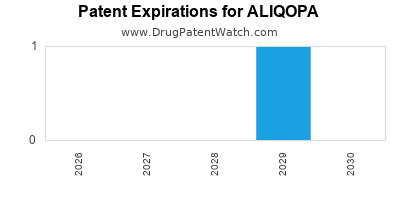

DrugPatentWatch® Estimated Loss of Exclusivity (LOE) Date for ALIQOPA
Generic Entry Date for ALIQOPA*:
Constraining patent/regulatory exclusivity:
NDA:
Dosage:
POWDER;INTRAVENOUS |
*The generic entry opportunity date is the latter of the last compound-claiming patent and the last regulatory exclusivity protection. Many factors can influence early or later generic entry. This date is provided as a rough estimate of generic entry potential and should not be used as an independent source.
Recent Clinical Trials for ALIQOPA
Identify potential brand extensions & 505(b)(2) entrants
| Sponsor | Phase |
|---|---|
| NRG Oncology | Phase 2 |
| City of Hope Medical Center | Phase 1/Phase 2 |
| Dana-Farber Cancer Institute | Phase 1/Phase 2 |
US Patents and Regulatory Information for ALIQOPA
ALIQOPA is protected by three US patents.
Based on analysis by DrugPatentWatch, the earliest date for a generic version of ALIQOPA is ⤷ Start Trial.
This potential generic entry date is based on patent ⤷ Start Trial.
Generics may enter earlier, or later, based on new patent filings, patent extensions, patent invalidation, early generic licensing, generic entry preferences, and other factors.
| Applicant | Tradename | Generic Name | Dosage | NDA | Approval Date | TE | Type | RLD | RS | Patent No. | Patent Expiration | Product | Substance | Delist Req. | Exclusivity Expiration |
|---|---|---|---|---|---|---|---|---|---|---|---|---|---|---|---|
| Bayer Healthcare | ALIQOPA | copanlisib dihydrochloride | POWDER;INTRAVENOUS | 209936-001 | Sep 14, 2017 | DISCN | Yes | No | ⤷ Start Trial | ⤷ Start Trial | ⤷ Start Trial | ||||
| Bayer Healthcare | ALIQOPA | copanlisib dihydrochloride | POWDER;INTRAVENOUS | 209936-001 | Sep 14, 2017 | DISCN | Yes | No | ⤷ Start Trial | ⤷ Start Trial | Y | Y | ⤷ Start Trial | ||
| Bayer Healthcare | ALIQOPA | copanlisib dihydrochloride | POWDER;INTRAVENOUS | 209936-001 | Sep 14, 2017 | DISCN | Yes | No | ⤷ Start Trial | ⤷ Start Trial | Y | Y | ⤷ Start Trial | ||
| >Applicant | >Tradename | >Generic Name | >Dosage | >NDA | >Approval Date | >TE | >Type | >RLD | >RS | >Patent No. | >Patent Expiration | >Product | >Substance | >Delist Req. | >Exclusivity Expiration |
Expired US Patents for ALIQOPA
| Applicant | Tradename | Generic Name | Dosage | NDA | Approval Date | Patent No. | Patent Expiration |
|---|---|---|---|---|---|---|---|
| Bayer Healthcare | ALIQOPA | copanlisib dihydrochloride | POWDER;INTRAVENOUS | 209936-001 | Sep 14, 2017 | ⤷ Start Trial | ⤷ Start Trial |
| >Applicant | >Tradename | >Generic Name | >Dosage | >NDA | >Approval Date | >Patent No. | >Patent Expiration |
International Patents for ALIQOPA
When does loss-of-exclusivity occur for ALIQOPA?
Based on analysis by DrugPatentWatch, the following patents block generic entry in the countries listed below:
Argentina
Patent: 4106
Patent: DERIVADOS DE 2,3-DIHIDROIMIDAZO [1,2-C] QUINAZOLINA SUSTITUIDA UTILES PARA EL TRATAMIENTO DE ENFERMEDADES Y TRASTORNOS HIPER-PROLIFERATIVOS ASOCIADOS CON LA ANGIOGENESIS
Estimated Expiration: ⤷ Start Trial
Australia
Patent: 07328008
Patent: Substituted 2,3-dihydroimidazo[1,2-c]quinazoline derivatives useful for treating hyper-proliferative disorders and diseases associated with angiogenesis
Estimated Expiration: ⤷ Start Trial
Brazil
Patent: 0720178
Patent: DERIVADOS DE 2,3-DI-HIDROIMIDAZO[1,2-C]QUINAZOLINA SUBSTITUÍDA ÚTEIS PARA TRATAR DISTÚRBIOS E DOENÇAS HIPERPROLIFERATIVOS ASSOCIADOS COM ANGIOGÊNESE
Estimated Expiration: ⤷ Start Trial
Canada
Patent: 71614
Patent: PRODUITS DERIVES DE 2,3-DIHYDROIMIDAZO[1,2-C]QUINAZOLINE SUBSTITUES, UTILES POUR LE TRAITEMENT DE TROUBLES HYPERLIFERATIFS ET DE MALADIES ASSOCIEES A UNE ANGIOGENESE (SUBSTITUTED 2,3-DIHYDROIMIDAZO[1,2-C]QUINAZOLINE DERIVATIVESUSEFUL FOR TREATING HYPER-PROLIFERATIVE DISORDERS AND DISEASES ASSOCIATED WITH ANGIOGENESIS)
Estimated Expiration: ⤷ Start Trial
Chile
Patent: 07003508
Patent: COMPUESTOS DERIVADOS DE 2,3-DIHIDROIMIDAZOL[1,2-C]QUINAZOLINA; COMPOSICION FARMACEUTICA QUE COMPRENDE A DICHOS COMPUESTOS; Y SU USO PARA TRATAR ENFERMEDADES Y TRASTORNOS HIPERPROLIFERATIVOS ASOCIADOS A LA ANGIOGENESIS, TALES COMO INFLAMACION, ENFERME
Estimated Expiration: ⤷ Start Trial
China
Patent: 1631464
Patent: Substituted 2,3-dihydroimidazo[1,2-c]quinazoline derivatives useful for treating hyper-proliferative disorders and diseases associated with angiogenesis
Estimated Expiration: ⤷ Start Trial
Patent: 5254634
Patent: SUBSTITUTED 2,3-DIHYDROIMIDAZO[1,2-C]QUINAZOLINE DERIVATIVES USEFUL FOR TREATING HYPER-PROLIFERATIVE DISORDERS AND DISEASES ASSOCIATED WITH ANGIOGENESIS
Estimated Expiration: ⤷ Start Trial
Patent: 8774232
Patent: 2,3-二氢咪唑并[1,2-c]喹唑啉取代衍生物 (2,3-dihydroimidazo[1,2-c]quinazoline Derivatives)
Estimated Expiration: ⤷ Start Trial
Patent: 5724847
Patent: 2,3-二氢咪唑并[1,2-c]喹唑啉取代衍生物 (2, 3-dihydroimidazo [1, 2-c] quinazoline substituted derivatives)
Estimated Expiration: ⤷ Start Trial
Colombia
Patent: 20908
Patent: DERIVADOS DE 2,3 -DIHIDROIMIZAZO[1,2-C]QUINAZOLINA SUSTITUIDOS DE UTILIDAD EN EL TRATAMIENTO DE TRASTORNOS HIPERPROLIFERATIVOS Y ENFERMEDADES ASOCIADAS CON LA ANGIOGENESIS
Estimated Expiration: ⤷ Start Trial
Costa Rica
Patent: 838
Patent: DERIVADOS DE 2,3-DIHIDROIMIDAZOL [1,2-C] QUINAZOLINA SUSTITUIDOS, DE UTILIDAD EN EL TRATAMIENTO DE TRASTORNOS HIPERPROLIFERATIVOS Y ENFERMEDADES ASOCIADAS CON LA ANGIOGENESIS
Estimated Expiration: ⤷ Start Trial
Cuba
Patent: 796
Patent: DERIVADOS DE 2,3-DIHIDROIMIDAZOL[1,2-C]QUINAZOLINA SUSTITUIDOS DE UTILIDAD EN EL TRATAMIENTO DE TRASTORNOS HIPERPROLIFERATIVOS Y ENFERMEDADES ASOCIADAS CON LA ANGIOGÉNESIS
Estimated Expiration: ⤷ Start Trial
Patent: 090103
Patent: DERIVADOS DE 2,3-DIHIDROIMIDAZOL[1,2-C]QUINAZOLINA SUSTITUIDOS DE UTILIDAD EN EL TRATAMIENTO DE TRASTORNOS HIPERPROLIFERATIVOS Y ENFERMEDADES ASOCIADAS CON LA ANGIOGÉNESIS
Estimated Expiration: ⤷ Start Trial
Cyprus
Patent: 17512
Estimated Expiration: ⤷ Start Trial
Denmark
Patent: 96919
Estimated Expiration: ⤷ Start Trial
Dominican Republic
Patent: 009000135
Patent: DERIVADOS DE 2,3-DIHIDROIMIDAZO [1,2-C] QUINAZOLINA SUSTITUÍDOS DE UTILIDAD EN EL TRATAMIENTO DE TRASTORNOS HIPERPROLIFERATIVOS Y ENFERMEDADES ASOCIADAS CON LA ANGIOGÉNESIS
Estimated Expiration: ⤷ Start Trial
Ecuador
Patent: 099387
Patent: DERIVADOS DE 2,3-DIHIDROIMIDAZO[1,2-C]QUINAZOLINA SUSTITUIDOS DE UTILIDAD EN EL TRATAMIENTO DE TRASTORNOS HIPERPROLIFERATIVOS Y ENFERMEDADES ASOCIADAS CON LA ANGIOGÉNESIS
Estimated Expiration: ⤷ Start Trial
El Salvador
Patent: 09003288
Patent: DERIVADOS DE 2, 3-DIHIDROIMIDAZO [1,2-C] QUINAZOLINA SUSTITUIDOS DE UTILIDAD EN EL TRATAMIENTO DE TRASTORNOS HIPERPROLIFERATIVOS Y ENFERMEDADES ASOCIADAS CON LA ANGIOGENESIS
Estimated Expiration: ⤷ Start Trial
Eurasian Patent Organization
Patent: 8839
Patent: ЗАМЕЩЕННЫЕ ПРОИЗВОДНЫЕ 2,3-ДИГИДРОИМИДАЗО[1,2-С]ХИНАЗОЛИНА, ПОЛЕЗНЫЕ ДЛЯ ЛЕЧЕНИЯ ГИПЕРПРОЛИФЕРАТИВНЫХ НАРУШЕНИЙ И БОЛЕЗНЕЙ, СВЯЗАННЫХ С АНГИОГЕНЕЗОМ (SUBSTITUTED 2,3-DIHYDROIMIDAZO[1,2-C]QUINAZOLINE DERIVATIVES USEFUL FOR TREATING HYPER-PROLIFERATIVE DISORDERS AND DISEASES ASSOCIATED WITH ANGIOGENESIS)
Estimated Expiration: ⤷ Start Trial
Patent: 0900733
Patent: ЗАМЕЩЁННЫЕ ПРОИЗВОДНЫЕ 2,3-ДИГИДРОИМИДАЗО[1,2-c]ХИНАЗОЛИНА, ПОЛЕЗНЫЕ ДЛЯ ЛЕЧЕНИЯ ГИПЕРПРОЛИФЕРАТИВНЫХ НАРУШЕНИЙ И БОЛЕЗНЕЙ, СВЯЗАННЫХ С АНГИОГЕНЕЗОМ
Estimated Expiration: ⤷ Start Trial
European Patent Office
Patent: 96919
Patent: PRODUITS DÉRIVÉS DE 2,3-DIHYDROIMIDAZO[1,2-C]QUINAZOLINE SUBSTITUÉS, UTILES POUR LE TRAITEMENT DE TROUBLES HYPERLIFÉRATIFS ET DE MALADIES ASSOCIÉES À UNE ANGIOGÉNÈSE (SUBSTITUTED 2,3-DIHYDROIMIDAZO[1,2-C]QUINAZOLINE DERIVATIVES USEFUL FOR TREATING HYPER-PROLIFERATIVE DISORDERS AND DISEASES ASSOCIATED WITH ANGIOGENESIS)
Estimated Expiration: ⤷ Start Trial
Guatemala
Patent: 0900154
Patent: DERIVADOS DE 2,3-DIHIDROIMIDOZO [1,2-C] QUINIZOLINA SUSTITUIDOS DE UTILIDAD EN EL TRATAMIENTO DE TRASTORNOS HIPERPROLIFERATIVOS Y ENFERMEDADES ASOCIADAS CON LA ANGIOGENESIS
Estimated Expiration: ⤷ Start Trial
Honduras
Patent: 09001131
Patent: DERIVADOS DE 2,3-DIHIDROIMIDAZOL [1,2-C] QUINAZOLINAS SUSTITUIDAS DE UTILIDAD EN EL TRATAMIENTO DE TRASTORNOS HIPERPROLIFERATIVOS Y ENFERMEDADES ASOCIADAS CON LA ANGIOGENESIS
Estimated Expiration: ⤷ Start Trial
Hong Kong
Patent: 17953
Patent: 用於治療過度增殖疾病和血管發生相關性疾病的 -二氫咪唑並 喹唑啉取代衍生物 (SUBSTITUTED 2,3-DIHYDROIMIDAZO[1,2-C]QUINAZOLINE DERIVATIVES USEFUL FOR TREATING HYPER-PROLIFERATIVE DISORDERS AND DISEASES ASSOCIATED WITH ANGIOGENESIS 23-[12-C])
Estimated Expiration: ⤷ Start Trial
Hungary
Patent: 28773
Estimated Expiration: ⤷ Start Trial
Israel
Patent: 8273
Patent: תולדות מותמרות של 3,2-דיהידרואימידאזו [2,1-c] קווינאזולין היעילים לטיפול באי סדרים הנובעים משגשוג-יתר ומחלות הקשורות עם התפתחות כלי דם חדשים (Substituted 2,3-dihydroimidazo[1,2-c] quinazoline derivatives useful for treating hyper-proliferative disorders and diseases associated with angiogenesis)
Estimated Expiration: ⤷ Start Trial
Japan
Patent: 26092
Estimated Expiration: ⤷ Start Trial
Patent: 10511718
Estimated Expiration: ⤷ Start Trial
Jordan
Patent: 47
Patent: مشتقات 2،3 - داي هيدرو إميدازو}1،2-{c كينازولين بها استبدال مفيدة لعلاج اضطرابات فرط التكاثر الخلوي والامراض المتعلق بتولد الاوعية (Substituted 2,3-dihydroimidazo[ 1,2- c] quinazoline Derivatives Useful for Treating Hyper-Proliferative Disorders And Diseases Associated with Angiogenesis)
Estimated Expiration: ⤷ Start Trial
Malaysia
Patent: 7944
Patent: SUBSTITUTED 2,3-DIHYDROIMIDAZO[1,2-C]QUINAZOLINE DERIVATIVES USEFUL FOR TREATING HYPER-PROLIFERATIVE DISORDERS AND DISEASES ASSOCIAT ED WITH ANGIOGENESIS
Estimated Expiration: ⤷ Start Trial
Mexico
Patent: 09006001
Patent: DERIVADOS DE 2,3-DIHIDROIMIDAZO[1,2-C]QUINAZOLINA SUSTITUIDOS DE UTILIDAD EN EL TRATAMIENTO DE TRASTORNOS HIPERPROLIFERATIVOS Y ENFERMEDADES ASOCIADAS CON LA ANGIOGENESIS. (SUBSTITUTED 2,3-DIHYDROIMIDAZO[1,2-C]QUINAZOLINE DERIVATIVES USEFUL FOR TREATING HYPER-PROLIFERATIVE DISORDERS AND DISEASES ASSOCIATED WITH ANGIOGENESIS.)
Estimated Expiration: ⤷ Start Trial
Morocco
Patent: 283
Patent: مشتقات 2،3-ثنائي هيدروميداز [1،2-c] كينازولين تبديل مفيدة لعلاج اضطرابات مفرط الليفيراتيف والأمراض المرتبطة الأوعية الدموية.
Estimated Expiration: ⤷ Start Trial
New Zealand
Patent: 7342
Patent: SUBSTITUTED 2,3-DIHYDROIMIDAZO[1,2-C]QUINAZOLINE DERIVATIVES USEFUL FOR TREATING HYPER-PROLIFERATIVE DISORDERS AND DISEASES ASSOCIATED WITH ANGIOGENESIS
Estimated Expiration: ⤷ Start Trial
Norway
Patent: 2348
Estimated Expiration: ⤷ Start Trial
Patent: 092529
Estimated Expiration: ⤷ Start Trial
Panama
Patent: 59601
Patent: DERIVADOS DE 2,3-DIHIDROIMIDAZO[1,2-C]QUINAZOLINA SUSTITUIDA UTILES PARA EL TRATAMIENTO DE ENFERMEDADES Y TRASTORNOS HIPER-PROLIFERATIVOS ASOCIADOS CON LA ANGIOGENESIS
Estimated Expiration: ⤷ Start Trial
Peru
Patent: 081444
Patent: DERIVADOS DE 2,3-DIHIDROIMIDAZO[1,2-C]QUINAZOLINA SUSTITUIDA UTILES PARA EL TRATAMIENTO DE ENFERMEDADES Y TRASTORNOS HIPER-PROLIFERATIVOS ASOCIADOS CON LA ANGIOGENESIS
Estimated Expiration: ⤷ Start Trial
Poland
Patent: 96919
Estimated Expiration: ⤷ Start Trial
Serbia
Patent: 045
Patent: DERIVATI SUPSTITUISANOG 2,3-DIHIDROIMIDAZO[1,2-C]HINAZOLINA KOJI SU KORISNI ZA TRETMAN HIPER-PROLIFERATIVNIH POREMEĆAJA I BOLESTI POVEZANIH SA ANGIOGENEZOM (SUBSTITUTED 2,3-DIHYDROIMIDAZO[1,2-C]QUINAZOLINE DERIVATIVES USEFUL FOR TREATING HYPER-PROLIFERATIVE DISORDERS AND DISEASES ASSOCIATED WITH ANGIOGENESIS)
Estimated Expiration: ⤷ Start Trial
Singapore
Patent: 7170
Patent: SUBSTITUTED 2,3-DIHYDROIMIDAZO[1,2-C]QUINAZOLINE DERIVATIVES USEFUL FOR TREATING HYPER-PROLIFERATIVE DISORDERS AND DISEASES ASSOCIATED WITH ANGIOGENESIS
Estimated Expiration: ⤷ Start Trial
Slovenia
Patent: 96919
Estimated Expiration: ⤷ Start Trial
South Africa
Patent: 0904691
Patent: Substituted 2,3-dihydroimidazo[1,2-C]Quinazoline derivatives useful for treating hyper-proliferative disorders and diseases associated with angiogenesis
Estimated Expiration: ⤷ Start Trial
South Korea
Patent: 1501785
Estimated Expiration: ⤷ Start Trial
Patent: 090096440
Patent: SUBSTITUTED 2,3-DIHYDROIMIDAZO[1,2-C]QUINAZOLINE DERIVATIVES USEFUL FOR TREATING HYPER-PROLIFERATIVE DISORDERS AND DISEASES ASSOCIATED WITH ANGIOGENESIS
Estimated Expiration: ⤷ Start Trial
Spain
Patent: 72189
Estimated Expiration: ⤷ Start Trial
Taiwan
Patent: 0840582
Patent: Substituted 2,3-dihydroimidazo[1,2-c]quinazoline derivatives useful for treating hyper-proliferative disorders and diseases associated with angiogenesis
Estimated Expiration: ⤷ Start Trial
Patent: 06662
Estimated Expiration: ⤷ Start Trial
Tunisia
Patent: 09000137
Patent: SUBSTITUTED 2,3-DIHYDROIMIDAZO[1,2-C]QUINAZOLINE DERIVATIVES USEFUL FOR TREATING HYPER-PROLIFERATIVE DISORDERS AND DISEASES ASSOCIATED WITH ANGIOGENESIS
Estimated Expiration: ⤷ Start Trial
Ukraine
Patent: 965
Patent: ЗАМЕЩЕННЫЕ ПРОИЗВОДНЫЕ 2,3-ДИГИДРОИМИДАЗО[1,2-с]ХИНАЗОЛИНА, ПОЛЕЗНЫЕ ДЛЯ ЛЕЧЕНИЯ ГИПЕРПРОЛИФЕРАТИВНЫХ НАРУШЕНИЙ И БОЛЕЗНЕЙ, СВЯЗАННЫХ С АНГИОГЕНЕЗОМ (2,3-DIHYDROIMIDAZO[1,2-C]QUINAZOLINE SUBSTITUTED DERIVATIVES USEFUL FOR TREATING HYPER-PROLIFERATIVE AND ANGIOGENESIS DISORDERS)
Estimated Expiration: ⤷ Start Trial
Uruguay
Patent: 761
Patent: DERIVADOS DE 2.3-DIHIDROIMIDAZO(1,2-C) QUINAZOLINA SUSTITUIDA UTILES PARA EL TRATAMIENTO DE ENFERMEDADES Y TRASTORNOS HIPER-PROLIFERATIVOS ASOCIADOS CON LA ANGIOGÉNESIS
Estimated Expiration: ⤷ Start Trial
Generics may enter earlier, or later, based on new patent filings, patent extensions, patent invalidation, early generic licensing, generic entry preferences, and other factors.
See the table below for additional patents covering ALIQOPA around the world.
| Country | Patent Number | Title | Estimated Expiration |
|---|---|---|---|
| African Regional IP Organization (ARIPO) | 3709 | ⤷ Start Trial | |
| Argentina | 085718 | ⤷ Start Trial | |
| Australia | 2012238891 | ⤷ Start Trial | |
| Brazil | 112013025549 | ⤷ Start Trial | |
| Canada | 2832123 | ⤷ Start Trial | |
| Chile | 2013002870 | ⤷ Start Trial | |
| >Country | >Patent Number | >Title | >Estimated Expiration |
More… ↓
Make Better Decisions: Try a trial or see plans & pricing
Drugs may be covered by multiple patents or regulatory protections. All trademarks and applicant names are the property of their respective owners or licensors. Although great care is taken in the proper and correct provision of this service, thinkBiotech LLC does not accept any responsibility for possible consequences of errors or omissions in the provided data. The data presented herein is for information purposes only. There is no warranty that the data contained herein is error free. We do not provide individual investment advice. This service is not registered with any financial regulatory agency. The information we publish is educational only and based on our opinions plus our models. By using DrugPatentWatch you acknowledge that we do not provide personalized recommendations or advice. thinkBiotech performs no independent verification of facts as provided by public sources nor are attempts made to provide legal or investing advice. Any reliance on data provided herein is done solely at the discretion of the user. Users of this service are advised to seek professional advice and independent confirmation before considering acting on any of the provided information. thinkBiotech LLC reserves the right to amend, extend or withdraw any part or all of the offered service without notice.
ISSN: 2162-2639

Privacy and Cookies
Terms & Conditions
Site Map
DrugPatentWatch Alternatives
LOE / Major Patent Expirations 2026 - 2027
NCE-1 Patent Challenge Dates 2026 - 2027
Friedman, Yali. "DrugPatentWatch" DrugPatentWatch, thinkBiotech, 2026, www.DrugPatentWatch.com.
See Primary Research Papers Citing DrugPatentWatch