Bayer Healthcare Company Profile
✉ Email this page to a colleague
What is the competitive landscape for BAYER HEALTHCARE
BAYER HEALTHCARE has thirty-one approved drugs.
There are thirty-nine US patents protecting BAYER HEALTHCARE drugs. There is one tentative approval on BAYER HEALTHCARE drugs.
Summary for Bayer Healthcare
| US Patents: | 39 |
| Tradenames: | 26 |
| Ingredients: | 16 |
| NDAs: | 31 |
| Patent Litigation for Bayer Healthcare: | See patent lawsuits for Bayer Healthcare |
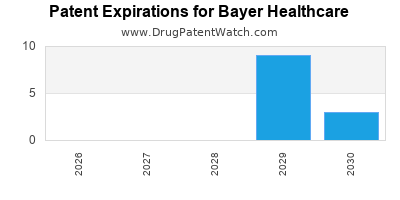
Drugs and US Patents for Bayer Healthcare
| Applicant | Tradename | Generic Name | Dosage | NDA | Approval Date | TE | Type | RLD | RS | Patent No. | Patent Expiration | Product | Substance | Delist Req. | Exclusivity Expiration |
|---|---|---|---|---|---|---|---|---|---|---|---|---|---|---|---|
| Bayer Healthcare | NUBEQA | darolutamide | TABLET;ORAL | 212099-001 | Jul 30, 2019 | RX | Yes | Yes | 8,975,254 | ⤷ Start Trial | Y | Y | ⤷ Start Trial | ||
| Bayer Healthcare | AMBELVIST | gadoquatrane | SOLUTION;INTRAVENOUS | 219627-005 | Jun 12, 2026 | RX | Yes | Yes | 11,944,690 | ⤷ Start Trial | Y | ⤷ Start Trial | |||
| Bayer Healthcare Llc | MYCELEX | clotrimazole | CREAM;TOPICAL | 018183-001 | Approved Prior to Jan 1, 1982 | DISCN | No | No | ⤷ Start Trial | ⤷ Start Trial | |||||
| Bayer Healthcare | AMBELVIST | gadoquatrane | SOLUTION;INTRAVENOUS | 219627-001 | Jun 12, 2026 | RX | Yes | Yes | ⤷ Start Trial | ⤷ Start Trial | |||||
| Bayer Healthcare | VITRAKVI | larotrectinib sulfate | SOLUTION;ORAL | 211710-001 | Nov 26, 2018 | RX | Yes | Yes | 10,668,072 | ⤷ Start Trial | Y | ⤷ Start Trial | |||
| Bayer Healthcare Llc | SHADE UVAGUARD | avobenzone; octinoxate; oxybenzone | LOTION;TOPICAL | 020045-001 | Dec 7, 1992 | DISCN | Yes | No | ⤷ Start Trial | ⤷ Start Trial | |||||
| >Applicant | >Tradename | >Generic Name | >Dosage | >NDA | >Approval Date | >TE | >Type | >RLD | >RS | >Patent No. | >Patent Expiration | >Product | >Substance | >Delist Req. | >Exclusivity Expiration |
Expired US Patents for Bayer Healthcare
| Applicant | Tradename | Generic Name | Dosage | NDA | Approval Date | Patent No. | Patent Expiration |
|---|---|---|---|---|---|---|---|
| Bayer Healthcare | ALIQOPA | copanlisib dihydrochloride | POWDER;INTRAVENOUS | 209936-001 | Sep 14, 2017 | 7,511,041 | ⤷ Start Trial |
| Bayer Healthcare Llc | SHADE UVAGUARD | avobenzone; octinoxate; oxybenzone | LOTION;TOPICAL | 020045-001 | Dec 7, 1992 | 4,522,807 | ⤷ Start Trial |
| Bayer Healthcare Llc | CLARITIN | loratadine | SYRUP;ORAL | 020641-002 | Nov 27, 2002 | 6,132,758 | ⤷ Start Trial |
| Bayer Healthcare Llc | SHADE UVAGUARD | avobenzone; octinoxate; oxybenzone | LOTION;TOPICAL | 020045-001 | Dec 7, 1992 | 4,387,089 | ⤷ Start Trial |
| Bayer Healthcare Llc | MYCELEX | clotrimazole | CREAM;TOPICAL | 018183-001 | Approved Prior to Jan 1, 1982 | 3,660,577 | ⤷ Start Trial |
| Bayer Healthcare Llc | MYCELEX | clotrimazole | CREAM;TOPICAL | 018183-001 | Approved Prior to Jan 1, 1982 | 3,705,172 | ⤷ Start Trial |
| >Applicant | >Tradename | >Generic Name | >Dosage | >NDA | >Approval Date | >Patent No. | >Patent Expiration |
International Patents for Bayer Healthcare Drugs
| Country | Patent Number | Estimated Expiration |
|---|---|---|
| Cyprus | 1124544 | ⤷ Start Trial |
| Serbia | 57592 | ⤷ Start Trial |
| Costa Rica | 20130511 | ⤷ Start Trial |
| South Korea | 20120102057 | ⤷ Start Trial |
| South Korea | 20210045400 | ⤷ Start Trial |
| Singapore | 11202111304U | ⤷ Start Trial |
| >Country | >Patent Number | >Estimated Expiration |
Supplementary Protection Certificates for Bayer Healthcare Drugs
| Patent Number | Supplementary Protection Certificate | SPC Country | SPC Expiration | SPC Description |
|---|---|---|---|---|
| 2493858 | C202030032 | Spain | ⤷ Start Trial | PRODUCT NAME: DAROLUTAMIDA, OPCIONALMENTE EN FORMA DE SAL O ESTER FARMACEUTICAMENTE ACEPTABLE; NATIONAL AUTHORISATION NUMBER: EU/1/20/1432; DATE OF AUTHORISATION: 20200327; NUMBER OF FIRST AUTHORISATION IN EUROPEAN ECONOMIC AREA (EEA): EU/1/20/1432; DATE OF FIRST AUTHORISATION IN EEA: 20200327 |
| 3106463 | 2020C/507 | Belgium | ⤷ Start Trial | PRODUCT NAME: VITRAKVI - LAROTRECTINIB ET/OU SES SELS ACCEPTABLES EN PHARMACIE, EN PARTICULIER L'HYDROGENO SULFATE DE LAROTRECTINIB; AUTHORISATION NUMBER AND DATE: EU/1/19/1385 20190923 |
| 2493858 | 2020/018 | Ireland | ⤷ Start Trial | PRODUCT NAME: DAROLUTAMIDE OPTIONALLY IN THE FORM OF A PHARMACEUTICALLY ACCEPTABLE SALT OR ESTER THEREOF; REGISTRATION NO/DATE: EU/1/20/1432/001 20200330 |
| 2493858 | CR 2020 00020 | Denmark | ⤷ Start Trial | PRODUCT NAME: DAROLUTAMID EVENTUELT I FORM AF ET FARMACEUTISK ACCEPTABELT SALT ELLER EN FARMACEUTISK ACCEPTABELT ESTER DERAF; REG. NO/DATE: EU/1/20/1432/001 20200330 |
| 3106463 | 2020004 | Norway | ⤷ Start Trial | PRODUCT NAME: LAROTREKTINIB OG/ELLER FARMASOEYTISK AKSEPTABLE SALTER DERAV, SAERLIG LAROTREKTINIBSULFAT INKLUDERT LAROTREKTINIBHYDROGENSULFAT; REG. NO/DATE: EU/1/19/1385 20191018 |
| 3106463 | PA2020504,C3106463 | Lithuania | ⤷ Start Trial | PRODUCT NAME: LAROTREKTINIBAS IR (ARBA) FARMACINIU POZIURIU PRIIMTINOS DRUSKOS, YPAC LAROTREKTINIBO SULFATAS, ISKAITANT LAROTREKTINIBO VANDENILIO SULFATA; REGISTRATION NO/DATE: EU/1/19/1385 20190919 |
| >Patent Number | >Supplementary Protection Certificate | >SPC Country | >SPC Expiration | >SPC Description |
Similar Applicant Names
Applicants may be listed under multiple names.
Here is a list of applicants with similar names.
Here is a list of applicants with similar names.
