Share This Page
ADIPEX-P Drug Patent Profile
✉ Email this page to a colleague
Which patents cover Adipex-p, and when can generic versions of Adipex-p launch?
Adipex-p is a drug marketed by Teva and is included in two NDAs.
The generic ingredient in ADIPEX-P is phentermine hydrochloride. There is one drug master file entry for this compound. Twenty-six suppliers are listed for this compound. Additional details are available on the phentermine hydrochloride profile page.
DrugPatentWatch® Litigation and Generic Entry Outlook for Adipex-p
A generic version of ADIPEX-P was approved as phentermine hydrochloride by ELITE LABS INC on May 30th, 1997.
AI Deep Research
Questions you can ask:
- What is the 5 year forecast for ADIPEX-P?
- What are the global sales for ADIPEX-P?
- What is Average Wholesale Price for ADIPEX-P?
Summary for ADIPEX-P
| US Patents: | 0 |
| Applicants: | 1 |
| NDAs: | 2 |
| Raw Ingredient (Bulk) Api Vendors: | 1 |
| Clinical Trials: | 3 |
| Patent Applications: | 6,116 |
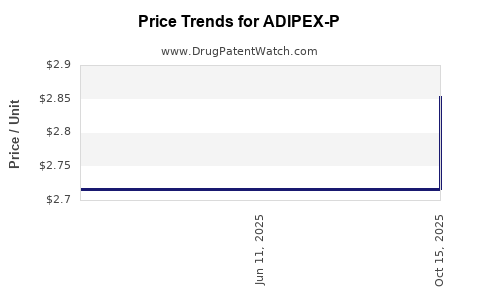
| Drug Prices: | Drug price information for ADIPEX-P |
| DailyMed Link: | ADIPEX-P at DailyMed |
Recent Clinical Trials for ADIPEX-P
Identify potential brand extensions & 505(b)(2) entrants
| Sponsor | Phase |
|---|---|
| University of Kentucky | Phase 1 |
| National Institute on Drug Abuse (NIDA) | Phase 1 |
| New York State Psychiatric Institute | Phase 4 |
US Patents and Regulatory Information for ADIPEX-P
| Applicant | Tradename | Generic Name | Dosage | NDA | Approval Date | TE | Type | RLD | RS | Patent No. | Patent Expiration | Product | Substance | Delist Req. | Exclusivity Expiration |
|---|---|---|---|---|---|---|---|---|---|---|---|---|---|---|---|
| Teva | ADIPEX-P | phentermine hydrochloride | CAPSULE;ORAL | 088023-001 | Aug 2, 1983 | DISCN | Yes | No | ⤷ Start Trial | ⤷ Start Trial | ⤷ Start Trial | ||||
| Teva | ADIPEX-P | phentermine hydrochloride | TABLET;ORAL | 085128-001 | Approved Prior to Jan 1, 1982 | AA | RX | Yes | Yes | ⤷ Start Trial | ⤷ Start Trial | ⤷ Start Trial | |||
| >Applicant | >Tradename | >Generic Name | >Dosage | >NDA | >Approval Date | >TE | >Type | >RLD | >RS | >Patent No. | >Patent Expiration | >Product | >Substance | >Delist Req. | >Exclusivity Expiration |
ADIPEX-P Market Dynamics, Financial Trajectory, Competition, and Patent Position
Adipex-P is a mature, low-cost prescription obesity drug based on phentermine hydrochloride. Its commercial value comes from high prescription volume, brand recognition, and affordability rather than patent protection or premium pricing. Generic phentermine has largely eliminated exclusivity-driven pricing power, while GLP-1 therapies have taken share among patients and prescribers willing to pay for newer chronic-weight-management treatments. KVK-Tech is the current labeled manufacturer of Adipex-P, but it does not publicly report standalone product revenue.
What is Adipex-P and how is it used?
Adipex-P contains phentermine hydrochloride, a sympathomimetic amine indicated as a short-term adjunct to weight reduction in patients with an initial body-mass index of at least 30 kg/m², or at least 27 kg/m² with risk factors such as hypertension, diabetes, or hyperlipidemia. It is used with dietary calorie restriction and increased physical activity.[1]
The product is available in immediate-release tablet and capsule strengths, including 37.5 mg tablets and lower-dose formulations. Phentermine is a Schedule IV controlled substance in the United States because of its stimulant and abuse potential.[2]
The FDA label limits treatment to short-term use, generally interpreted as a few weeks. That labeling distinction separates Adipex-P from chronic-use obesity medicines such as Wegovy, Zepbound, Saxenda, and Qsymia.
How does Adipex-P differ from newer obesity drugs?
| Product | Active ingredient | FDA obesity-use framework | Administration | Relative market position |
|---|---|---|---|---|
| Adipex-P | Phentermine | Short-term use | Oral, once daily or divided dosing depending on formulation | Low-cost, mature |
| Generic phentermine | Phentermine | Short-term use | Oral | Main volume competitor |
| Qsymia | Phentermine/topiramate ER | Chronic weight management | Oral, once daily | Branded combination product |
| Wegovy | Semaglutide | Chronic weight management | Weekly injection | Premium GLP-1 product |
| Zepbound | Tirzepatide | Chronic weight management | Weekly injection | Premium incretin product |
| Contrave | Naltrexone/bupropion | Chronic weight management | Oral | Branded oral alternative |
Adipex-P does not compete directly with GLP-1 medicines on clinical positioning, treatment duration, or price. It competes primarily on cash affordability, oral administration, availability, and familiarity among primary-care and obesity-treatment prescribers.
What is the financial trajectory of Adipex-P?
Adipex-P revenue has the economic profile of a mature branded generic rather than a protected innovative medicine.
The product’s financial trajectory has four defining characteristics:
- Prescription demand remains supported by obesity prevalence and consumer demand for inexpensive pharmacologic weight loss.
- Revenue per prescription is constrained by generic phentermine.
- The brand retains value through recognition, availability, and patient preference.
- Newer GLP-1 therapies create long-term substitution pressure but remain less accessible to many cash-paying patients.
KVK-Tech is privately held and does not disclose Adipex-P revenue, operating margin, prescription volume, or product-level growth. A reliable standalone revenue estimate therefore cannot be derived from public company filings. The relevant financial conclusion is structural: Adipex-P is likely a stable cash-generating legacy product with limited pricing leverage and modest long-term growth potential.
What supports Adipex-P revenue?
Adipex-P benefits from a low-cost treatment model. Patients who cannot obtain insurance coverage for Wegovy or Zepbound, cannot tolerate injections, or face supply and access constraints may seek phentermine. Obesity medicines are frequently subject to benefit exclusions, prior authorization, and high out-of-pocket costs. These factors preserve demand for older oral agents.
The product also benefits from a broad generic supply base. Generic competition reduces branded pricing, but it increases overall market awareness and keeps phentermine accessible through retail pharmacies and cash-pay channels.
What limits Adipex-P revenue?
The principal limitations are generic substitution, short-term labeling, safety restrictions, and the migration of higher-income or better-insured patients toward chronic-use therapies.
Generic phentermine products are therapeutically interchangeable for many patients and are usually priced below Adipex-P. Pharmacies and prescribers therefore have limited economic reasons to maintain a premium branded product unless patients request Adipex-P specifically or the branded product has a supply advantage.
The product also lacks the recurring-revenue profile of chronic GLP-1 therapy. A short-term prescription course produces less annual revenue per patient than long-term weekly injectable treatment, although adherence and discontinuation rates are different across the two categories.
How large is the competitive threat from generic phentermine?
Generic phentermine is the most direct competitive threat to Adipex-P. Unlike a conventional patent cliff, generic entry occurred long ago, so the product has been operating under mature-market conditions for decades.
Generic competition and pricing
The generic market creates three financial effects:
- It caps the price that Adipex-P can command.
- It shifts pharmacy and payer purchasing toward lower-cost alternatives.
- It preserves category demand by keeping phentermine widely available.
Adipex-P can retain a price premium only where brand recognition, patient preference, physician familiarity, or local supply conditions offset generic substitution. That premium is likely narrow relative to the premium available to patent-protected obesity medicines.
Competitive comparison with Qsymia
Qsymia combines phentermine with extended-release topiramate and is approved for chronic weight management. It has a stronger product lifecycle position than Adipex-P because it addresses long-term treatment under a branded combination strategy. Its commercial constraints include higher cost, titration requirements, safety monitoring, reproductive-risk controls, and competition from GLP-1 drugs.
Adipex-P remains simpler and cheaper. Qsymia has greater potential revenue per treated patient, while Adipex-P has greater accessibility and a lower treatment-cost barrier.
Competitive comparison with Wegovy and Zepbound
Wegovy and Zepbound are stronger competitors in patients seeking substantial, sustained weight loss and long-term disease management. Their clinical and commercial advantages include chronic-use labeling, substantial efficacy, and integration into the modern obesity-treatment market.
Their disadvantages are higher prices, injection requirements, insurance restrictions, supply constraints, and tolerability issues. These barriers leave a durable low-cost segment for phentermine products.
The likely market outcome is segmentation rather than complete displacement. GLP-1 therapies should capture premium and insured demand, while Adipex-P and generic phentermine remain concentrated in cash-pay, short-term, and lower-cost treatment channels.
When does Adipex-P lose exclusivity?
Adipex-P has already lost meaningful market exclusivity. Phentermine is an old active ingredient, and generic versions are commercially established. The product does not depend on a current patent expiry date to determine generic entry.
What is the Orange Book status of Adipex-P?
The Orange Book is the FDA’s reference for approved drug products, therapeutic equivalence evaluations, patents, and regulatory exclusivity.[3] Adipex-P’s commercial position is not protected by a current Orange Book patent barrier that prevents generic phentermine competition.
The practical conclusion is that generic entry risk is no longer a future event. It is the existing market condition.
Are there Paragraph IV challenges involving Adipex-P?
Paragraph IV litigation is generally relevant when a listed drug has unexpired patents that block or delay generic approval. Adipex-P’s key commercial exposure does not arise from an impending Paragraph IV event. Generic phentermine has already established market access, and the product’s primary risk is ongoing substitution rather than a single future patent expiry.
No settlement agreement is known to shape the current commercial market for Adipex-P in the way that settlements affect newer patent-protected medicines.
What is the FDA regulatory status of Adipex-P?
Adipex-P is an FDA-approved prescription drug and a Schedule IV controlled substance.[1,2] Its label limits use to short-term treatment as part of a weight-reduction regimen.
Regulatory risks include:
- Controlled-substance prescribing restrictions.
- State-level limits on duration, refills, and telehealth prescribing.
- Contraindications involving cardiovascular disease, hyperthyroidism, glaucoma, agitation, pregnancy, and certain drug interactions.
- Abuse, misuse, and dependence concerns.
- Enforcement attention directed at online weight-loss clinics and inappropriate stimulant prescribing.
The FDA has not treated Adipex-P as a chronic obesity medicine. Any commercial strategy that depends on prolonged use must account for the product label and state prescribing rules.
What patents protect Adipex-P?
No meaningful active patent estate is required to maintain the current Adipex-P business. The active ingredient is old, generic phentermine is available, and the product’s competitive position does not depend on formulation exclusivity.
Are formulation patents important?
Formulation patents are not a major current barrier around standard immediate-release Adipex-P. The product is a conventional oral phentermine formulation rather than a novel delivery system, long-acting injectable, or complex biologic.
Potential technical barriers are limited to manufacturing consistency, controlled-substance compliance, supply reliability, packaging, and regulatory documentation. These are operational barriers, not durable patent barriers.
Are method-of-use patents important?
Adipex-P’s labeled short-term weight-loss use is longstanding. Method-of-use patents do not create a significant commercial moat around the core product. Any off-label or extended-use prescribing would create regulatory and liability exposure rather than a reliable proprietary revenue stream.
What manufacturing and supply factors affect Adipex-P?
Manufacturing economics are relatively favorable because phentermine is a small-molecule oral drug with established production processes. The principal requirements are compliance with controlled-substance rules, quality manufacturing, accurate dosing, and reliable distribution.
Supply interruptions can temporarily improve branded demand if generic competitors experience shortages. That benefit is usually episodic. Once generic supply normalizes, substitution pressure returns.
The product’s low complexity reduces manufacturing barriers but also lowers differentiation. Competitors can manufacture equivalent immediate-release products without investing in novel delivery technology or biologic production capacity.
What patent litigation affects Adipex-P?
Adipex-P is not associated with a current patent dispute that materially determines its market access or revenue outlook. The commercial contest is primarily among KVK-Tech, generic phentermine manufacturers, pharmacy channels, and newer branded obesity-drug companies.
Litigation risk is more likely to arise from controlled-substance distribution, marketing conduct, product liability, or regulatory compliance than from a core composition-of-matter patent dispute.
Which companies are challenging Adipex-P commercially?
The principal challengers are generic manufacturers rather than named patent litigants. Generic phentermine suppliers compete through lower prices, pharmacy access, and payer substitution.
The more important strategic challengers are manufacturers of chronic obesity medicines:
- Novo Nordisk, with Wegovy and Saxenda.
- Eli Lilly, with Zepbound.
- Vivus, now associated with Qsymia’s commercial history.
- Manufacturers developing oral GLP-1 and other next-generation obesity treatments.
Generic phentermine creates immediate price pressure. GLP-1 manufacturers create longer-term therapeutic substitution pressure.
What generic launch risks exist for Adipex-P?
The generic launch phase is historical, not prospective. The current risk is continued erosion of branded share and price.
A generic manufacturer entering or expanding in phentermine can take volume through:
- Pharmacy-level substitution.
- Discounted cash pricing.
- Payer formulary preference.
- Wholesale acquisition discounts.
- Online and telehealth distribution.
Adipex-P’s defenses are brand recognition, patient requests for the branded product, physician familiarity, and availability during generic shortages. These defenses can preserve a niche but are unlikely to restore monopoly economics.
What is the geographic coverage of Adipex-P?
Adipex-P is primarily a United States product. Its commercial opportunity is constrained by country-specific approval, controlled-substance rules, and differing treatment standards for obesity.
The U.S. market is also fragmented by state prescribing requirements. Some states impose stricter rules on stimulant duration, telemedicine, refills, or physician-patient relationships. These differences affect prescription access and can create regional variation in demand.
International expansion would require separate regulatory approvals and would face local restrictions on phentermine availability. International revenue is therefore unlikely to be a major part of the product’s financial profile.
How strong is the Adipex-P commercial position?
| Factor | Assessment | Financial effect |
|---|---|---|
| Patent protection | Weak or absent | No exclusivity premium |
| Generic competition | High | Lower price and branded share |
| Brand recognition | Moderate to strong | Supports retention in selected patients |
| Manufacturing complexity | Low | Easy supply substitution |
| Regulatory burden | Moderate to high | Limits duration and prescribing channels |
| GLP-1 competition | Increasing | Reduces premium and insured demand |
| Cash-pay affordability | Strong | Supports persistent demand |
| Revenue visibility | Limited | KVK-Tech does not report product sales |
Adipex-P has a resilient but low-growth commercial profile. It is more defensible as a low-cost access product than as a branded growth asset.
What is the likely financial trajectory for Adipex-P?
The base-case trajectory is stable-to-declining branded revenue with persistent category demand. Volume may remain durable because obesity prevalence is high and treatment costs for newer products are substantial. Revenue growth is constrained by generic substitution and limited ability to raise prices.
The most likely scenarios are:
| Scenario | Market development | Financial result |
|---|---|---|
| Base case | Generic phentermine remains dominant; GLP-1 use expands | Gradual branded erosion, stable category demand |
| Downside | Insurance coverage for GLP-1s broadens and oral obesity drugs improve | Faster Adipex-P volume and share decline |
| Supportive case | GLP-1 access remains restricted; cash-pay demand persists | Stable prescriptions and modest price support |
| Supply-disruption case | Generic shortages occur | Temporary branded volume increase |
Adipex-P is unlikely to become a high-growth product without a new formulation, a chronic-use regulatory strategy, or a differentiated combination product. Those changes would require new clinical, regulatory, and commercial investment and could alter the product’s risk profile.
Key Takeaways
- Adipex-P is a mature phentermine product with no meaningful current patent moat.
- Generic phentermine is the primary direct competitor and has already eliminated exclusivity-driven pricing power.
- KVK-Tech does not publicly disclose standalone Adipex-P revenue.
- The product’s financial value is tied to affordability, brand recognition, and cash-pay access.
- Wegovy and Zepbound create long-term therapeutic substitution risk, but high cost and access restrictions preserve demand for phentermine.
- Patent litigation and Paragraph IV challenges do not currently define the product’s market outlook.
- The likely trajectory is stable-to-declining branded revenue with persistent low-cost category demand.
- Regulatory exposure centers on controlled-substance prescribing, duration limits, telehealth practices, and misuse risk.
FAQs
Is Adipex-P still profitable after generic phentermine entry?
It can remain profitable as a mature branded product because manufacturing costs are relatively low and demand persists. Profitability depends on brand pricing, prescription volume, distribution terms, and generic substitution.
Can Adipex-P compete with Zepbound on price?
Yes. Adipex-P is generally positioned as a lower-cost oral option. It does not compete with Zepbound on chronic-use labeling or clinical efficacy expectations.
Does Adipex-P have a biosimilar risk?
No. Adipex-P is a small-molecule drug, not a biologic. Its relevant competitive risk is generic substitution, not biosimilar competition.
Could a new Adipex-P formulation create renewed exclusivity?
A genuinely novel formulation could support patent protection if it met patentability requirements and generated supporting clinical and regulatory evidence. Standard immediate-release phentermine would not provide that protection.
Is Adipex-P a significant revenue risk for GLP-1 manufacturers?
It is a limited but durable low-cost competitor. Adipex-P is most relevant among patients who lack coverage for GLP-1 drugs, prefer oral treatment, or seek short-term therapy.
References
-
U.S. Food and Drug Administration. (2012). Adipex-P (phentermine hydrochloride) tablets and capsules prescribing information. KVK-Tech, Inc.
-
U.S. Drug Enforcement Administration. (2024). Controlled substance schedules. https://www.dea.gov/drug-information/drug-scheduling
-
U.S. Food and Drug Administration. (2024). Approved drug products with therapeutic equivalence evaluations: Orange Book. https://www.fda.gov/drugs/drug-approvals-and-databases/approved-drug-products-therapeutic-equivalence-evaluations-orange-book
More… ↓
