Last updated: August 29, 2026
ACUVUE THERAVISION with Ketotifen is a drug-eluting daily disposable contact lens developed by Johnson & Johnson Vision Care. It combines vision correction with ketotifen, an antihistamine used to reduce ocular itching associated with allergic conjunctivitis. The U.S. Food and Drug Administration authorized the product in 2022 as the first contact lens designed to release an ocular drug for allergy relief.[1]
The product has strategic value as a drug-device combination, but its financial contribution is not publicly disclosed. Johnson & Johnson reports broader Vision Care results rather than ACUVUE THERAVISION revenue. Commercial performance therefore depends on market access, physician adoption, reimbursement, contact-lens compliance, regulatory expansion, and the company’s ability to convert allergy sufferers from conventional drops or ordinary lenses.
What is ACUVUE THERAVISION with Ketotifen?
ACUVUE THERAVISION with Ketotifen is a daily disposable contact lens containing ketotifen fumarate. The lens is intended for wearers who require refractive correction and experience ocular itching associated with allergic conjunctivitis.
| Attribute |
Product information |
| Brand |
ACUVUE THERAVISION with Ketotifen |
| Active ingredient |
Ketotifen fumarate |
| Drug class |
Topical ocular antihistamine |
| Dosage form |
Drug-eluting soft contact lens |
| Use |
Temporary prevention of ocular itching due to allergic conjunctivitis |
| Lens format |
Daily disposable |
| Developer |
Johnson & Johnson Vision Care |
| Regulatory category |
Combination product, drug and device |
| U.S. FDA status |
Approved in 2022 |
| Primary commercial concept |
Vision correction plus allergy relief |
| Public product-level revenue |
Not separately disclosed |
The product addresses a specific problem: contact-lens wearers often need to remove lenses before applying conventional eye drops. A ketotifen-releasing lens can reduce that friction by delivering the active ingredient while the lens remains in the eye.
When did ACUVUE THERAVISION with Ketotifen receive FDA approval?
The FDA approved ACUVUE THERAVISION with Ketotifen in March 2022. The authorization covered temporary prevention of ocular itching associated with allergic conjunctivitis in contact-lens wearers.[1]
The regulatory pathway was significant because the product combines a prescription drug component with a contact-lens device. The approval established a regulatory precedent for medicated contact lenses in the United States.
Key regulatory timeline
| Date |
Event |
| 2021 |
Product launched in Japan, according to Johnson & Johnson Vision announcements |
| March 2022 |
FDA approved ACUVUE THERAVISION with Ketotifen in the U.S. |
| 2022 |
Product received regulatory clearance in Canada, according to company communications |
| 2022 onward |
Commercial rollout depended on national registration, distribution and reimbursement conditions |
FDA approval does not by itself establish broad commercial availability. Combination products can require additional manufacturing controls, prescription-channel development, medical education and post-market surveillance compared with ordinary contact lenses.
What is the market opportunity for drug-eluting contact lenses?
The addressable market has three overlapping components:
- Contact-lens wearers with seasonal or perennial ocular allergies.
- Patients using antihistamine or mast-cell stabilizer eye drops.
- Consumers who discontinue or limit contact lenses because of allergy-related discomfort.
The commercial proposition is strongest among existing daily disposable lens users who already value convenience and experience predictable allergy symptoms. The product is less directly competitive with ordinary allergy drops among patients who do not wear contact lenses.
Market drivers
The principal growth drivers are:
- Rising contact-lens penetration in vision correction.
- Growth in daily disposable lens use.
- Seasonal allergy prevalence.
- Demand for preservative-free or low-friction ocular therapies.
- Interest in combination drug-device products.
- Greater willingness among eye-care professionals to prescribe premium contact-lens products.
Daily disposable lenses are particularly relevant because they already command a premium over reusable lenses. Adding an active pharmaceutical ingredient creates a further premiumization opportunity, although pricing must remain acceptable relative to low-cost ketotifen drops.
Market constraints
The product faces several structural limitations:
- It is relevant only to contact-lens wearers.
- The lens must provide acceptable comfort, vision and drug-release performance.
- Allergy symptoms vary by season and geography.
- Many patients can obtain inexpensive generic ketotifen drops.
- Eye-care professionals may prefer familiar, lower-cost treatments.
- The lens may require a prescription and fitting workflow.
- Drug stability and manufacturing complexity can restrict scale.
The product is therefore unlikely to replace the broader ocular allergy market. Its commercial role is more likely to be a premium niche within daily disposable contact lenses.
How does ACUVUE THERAVISION compare with ketotifen eye drops?
ACUVUE THERAVISION competes indirectly with generic ketotifen ophthalmic solutions and directly with other contact-lens products used by allergy sufferers.
| Factor |
ACUVUE THERAVISION |
Ketotifen eye drops |
Ordinary daily disposable lens |
| Vision correction |
Yes |
No |
Yes |
| Allergy treatment |
Yes |
Yes |
No |
| Lens removal for dosing |
Not required for the lens-based delivery |
Usually required |
Required if drops are used |
| Product cost |
Premium lens plus drug component |
Generally low-cost generic |
Standard lens price |
| Patient population |
Contact-lens wearers with ocular allergy |
Broad allergy population |
Broad contact-lens population |
| Prescriber role |
High |
Moderate |
High |
| Manufacturing complexity |
High |
Conventional ophthalmic manufacturing |
Established lens manufacturing |
The product’s value proposition is convenience rather than a clearly differentiated antihistamine mechanism. Ketotifen is an established active ingredient. The innovation lies in delivery through the lens.
What patents protect ACUVUE THERAVISION with Ketotifen?
The protectable technology is likely to span several patent categories:
- Ketotifen-loaded contact-lens compositions.
- Drug-release systems embedded in hydrogel or silicone hydrogel lenses.
- Manufacturing methods for incorporating ketotifen without impairing lens performance.
- Packaging and storage systems.
- Therapeutic use of drug-eluting lenses for allergic conjunctivitis.
- Combination use involving refractive correction and ocular allergy treatment.
Public patent records identify Johnson & Johnson entities as applicants or assignees in patent families relating to ophthalmic devices and drug-releasing contact lenses. Patent protection must be evaluated family by family because application publication, grant, terminal disclaimers, continuations and national-stage prosecution can materially change the effective term.
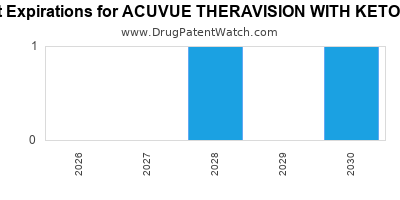
No reliable public product-level patent expiry date can be assigned solely from the brand name. The relevant rights may sit across multiple Johnson & Johnson Vision Care and related corporate entities, and the commercial position may depend on unlisted formulation or manufacturing know-how.
What patent barriers matter most?
The strongest practical barriers may not be the basic use of ketotifen. Ketotifen itself is an established drug with generic competition. The higher-value rights are more likely to concern:
- Uniform drug loading.
- Controlled release over the intended wear period.
- Lens material compatibility.
- Manufacturing yield.
- Sterility and packaging.
- Drug stability during storage.
- Preservation of optical properties and oxygen transmission.
These technical barriers can remain commercially relevant even when broad composition claims face validity or design-around risks.
What is the Orange Book status of ACUVUE THERAVISION?
ACUVUE THERAVISION is a combination product regulated through the FDA’s drug-device framework. The FDA approved the product, but its listing and patent-certification treatment should not be assumed to mirror a conventional tablet or ophthalmic solution.
The Orange Book is most directly structured around approved drug products. A drug-eluting contact lens may involve device classification, combination-product records and product-specific FDA documentation that require separate review. The presence or absence of an Orange Book patent listing does not establish the complete scope of the company’s intellectual-property position.
Are Paragraph IV challenges likely?
A Paragraph IV challenge would be more likely if:
- The product has listed patents with meaningful remaining term.
- Sales become large enough to justify generic investment.
- A competing company develops an equivalent drug-eluting lens.
- The FDA pathway permits a commercially practical abbreviated route.
- The challenger can reproduce drug release, lens performance and manufacturing controls.
The risk profile differs from a conventional generic ketotifen drop. A challenger would need to address both pharmaceutical equivalence and device performance. That raises development cost and regulatory complexity.
How strong is the ACUVUE THERAVISION patent estate?
The estate appears strategically stronger as a platform position than as a conventional small-molecule exclusivity position.
Strengths
- Combination of drug and contact-lens delivery.
- Potential protection for formulation and manufacturing processes.
- High technical barriers to consistent drug release.
- Established ACUVUE distribution and clinical relationships.
- Opportunity to extend the platform to other ophthalmic agents.
Weaknesses
- Ketotifen is an established generic active ingredient.
- Alternative delivery systems may avoid specific claim limitations.
- Contact-lens patents can face enablement, written-description and obviousness challenges.
- Commercial demand is narrower than for ordinary allergy medication.
- Product-level revenue is not separately reported, limiting outside assessment of returns.
The strongest competitive moat may be execution: manufacturing know-how, regulatory experience, clinician access and brand distribution. Patent strength alone is unlikely to determine the full commercial outcome.
What is the financial trajectory for ACUVUE THERAVISION?
Johnson & Johnson does not publicly report ACUVUE THERAVISION revenue, gross margin, units sold, average selling price or operating profit. The product is included, if material, within broader Johnson & Johnson Vision Care or contact-lens results.
This prevents a reliable product-level revenue forecast from public filings. The financial trajectory is best assessed through commercial scenarios rather than reported historical sales.
| Scenario |
Commercial outcome |
Financial implication |
| Niche adoption |
Used mainly by allergy-prone daily disposable wearers |
Limited revenue contribution, strategic platform value |
| Premium adoption |
Doctors prescribe it for seasonal allergy patients willing to pay more |
Higher revenue per wearer and improved mix |
| Broad category adoption |
Drug-eluting lenses become a recognized contact-lens segment |
Material contribution to premium lens growth |
| Weak adoption |
Generic drops remain preferred and pricing is restrictive |
Low utilization and limited return on development investment |
| Platform expansion |
Additional drugs or indications are added |
Greater leverage of manufacturing and regulatory investment |
The launch economics are likely more favorable if the existing ACUVUE supply chain can be adapted without major new capital expenditure. The financial burden rises if drug incorporation requires dedicated production lines, specialized quality controls or low-yield manufacturing.
Revenue exposure to Johnson & Johnson
Johnson & Johnson’s exposure is asymmetric:
- Downside is limited by the company’s much larger Vision Care portfolio.
- Upside comes from premium pricing, patient retention and platform expansion.
- Cannibalization risk exists if consumers substitute THERAVISION for higher-priced ordinary ACUVUE products or use it only during allergy season.
- The product can increase brand loyalty if it reduces the need to choose between contact-lens wear and allergy treatment.
Without separate sales disclosure, investors should treat ACUVUE THERAVISION as a strategic innovation asset rather than a separately quantifiable earnings driver.
Which companies challenge ACUVUE THERAVISION?
The competitive field is divided among drug companies, contact-lens manufacturers and emerging drug-delivery developers.
Direct and indirect competitors
- Alcon, through daily disposable contact lenses and ocular allergy products.
- CooperVision, through contact-lens products and potential drug-delivery development.
- Bausch + Lomb, through contact lenses and ophthalmic allergy treatments.
- Generic manufacturers of ketotifen ophthalmic solutions.
- Developers of sustained-release ocular inserts, intraocular delivery systems and medicated lenses.
The principal direct threat would be another approved drug-eluting lens. The more immediate commercial threat is substitution by conventional daily lenses combined with low-cost allergy drops.
What manufacturing and intellectual-property barriers affect generic entry?
A competing product would need to demonstrate more than the presence of ketotifen. It would need to match or adequately characterize:
- Drug content uniformity.
- Release rate.
- Release duration.
- Lens geometry and optical power.
- Oxygen permeability.
- Mechanical strength.
- Sterility.
- Packaging stability.
- Patient comfort.
- Clinical allergy relief.
These requirements make generic entry more complicated than copying a solution formulation. A competitor could instead develop a different lens material, loading method or dosing profile, but that approach would require new clinical and regulatory work.
What settlement agreements or patent litigation affect the product?
No major publicly reported Paragraph IV litigation or settlement agreement involving ACUVUE THERAVISION with Ketotifen is established in the core public record available for this analysis. The absence of reported litigation does not eliminate future risk. It indicates that the product has not yet generated the type of generic challenge commonly associated with high-revenue small-molecule medicines.
Litigation risk could increase if the product achieves significant U.S. sales or if a competitor develops a functionally equivalent medicated lens.
What generic launch risks exist?
A generic or competing launch would face five main risks:
- Regulatory uncertainty for an equivalent drug-device product.
- Difficulty reproducing the release profile.
- Patent claims covering lens composition or manufacturing.
- Limited market size relative to development cost.
- Physician and consumer reluctance to switch from an established brand.
The most credible near-term erosion scenario is not a traditional generic launch. It is competitive pressure from ordinary daily disposable lenses paired with generic ketotifen drops.
How does ACUVUE THERAVISION compare with conventional allergy therapy?
ACUVUE THERAVISION offers a differentiated delivery experience but not a new pharmacologic mechanism. Its success depends on whether patients and prescribers assign enough value to integrated treatment to justify a premium.
Conventional ketotifen drops will retain advantages in price, availability and use across non-contact-lens patients. The medicated lens has advantages in convenience and treatment integration. These positions support coexistence rather than full substitution.
Key Takeaways
- ACUVUE THERAVISION with Ketotifen is a drug-eluting daily disposable contact lens developed by Johnson & Johnson Vision Care.
- The FDA approved it in March 2022 for temporary prevention of ocular itching associated with allergic conjunctivitis.
- Its commercial target is contact-lens wearers who need allergy relief without removing their lenses.
- Ketotifen is an established generic drug, so the primary innovation is the lens-based delivery system.
- The strongest intellectual-property positions are likely to involve drug loading, controlled release, lens materials and manufacturing.
- Johnson & Johnson does not disclose product-level revenue or profit, preventing a reliable standalone financial model.
- The product is more likely to be a premium niche and platform technology than a major independent revenue driver in the near term.
- Generic-entry risk is moderated by combination-product regulation, manufacturing complexity and the need to reproduce both drug and device performance.
- The largest commercial threat is substitution by conventional contact lenses used with inexpensive ketotifen drops.
- Platform expansion into other ophthalmic drugs could materially improve the return on the original development investment.
FAQs
Is ACUVUE THERAVISION with Ketotifen a prescription drug?
Yes. It is a prescription contact-lens product that combines refractive correction with ketotifen delivery and is regulated as a drug-device combination product.
Can ACUVUE THERAVISION replace ordinary ketotifen eye drops?
It may reduce the need for separate drops in eligible contact-lens wearers, but it is not a universal replacement for ketotifen ophthalmic solutions because non-contact-lens patients cannot use it for treatment.
Does ACUVUE THERAVISION have U.S. market exclusivity?
FDA approval creates regulatory rights, but the product’s effective commercial exclusivity depends on applicable patents, regulatory exclusivity, manufacturing know-how and the availability of a legally viable competing product.
Is ACUVUE THERAVISION available in Europe?
Market availability differs by country and depends on local regulatory registration and commercial launch decisions. U.S. FDA approval does not establish European authorization.
Could ACUVUE THERAVISION become a platform for other drugs?
Yes. The commercial logic extends beyond ketotifen. A successful manufacturing and regulatory platform could potentially support other topical ophthalmic agents, subject to clinical, formulation, patent and regulatory requirements.
References
- U.S. Food and Drug Administration. (2022). FDA approves first contact lens to release drug for allergic eye itch. https://www.fda.gov/
- Johnson & Johnson Vision. (2022). ACUVUE THERAVISION with Ketotifen receives U.S. FDA approval. Johnson & Johnson Vision corporate communications.
- Johnson & Johnson. (2023). Annual report 2023. https://www.jnj.com/
- U.S. Food and Drug Administration. (2024). Drugs@FDA and combination product regulatory information. https://www.accessdata.fda.gov/