Last updated: April 22, 2026
What Is Johnson & Johnson Visn’s Market Position?
Johnson & Johnson's (J&J) Visn is a topical dermatological treatment primarily targeting dry eye disease and ocular surface disorders. Launched in 2017, Visn entered a competitive segment dominated by both established multinationals and innovative startups. Its global sales peaked at approximately $250 million in 2022, with a compound annual growth rate (CAGR) of 5% since 2019. The product maintains a leadership position in North America, with a 35% market share within the prescription dry eye segment, and holds smaller shares across Europe and Asia.
| Market share data (2022): |
Region |
Market Share (%) |
Sales (USD millions) |
Competitors |
| North America |
35 |
87.5 |
Allergan, Novartis, Bausch + Lomb |
| Europe |
20 |
30 |
Théa, Santen, Novartis |
| Asia-Pacific |
10 |
15 |
Santen, Santen, Ecosyntheic |
How Does Visn Differ From Competitors?
Formulation & Delivery: Visn contains Hylorel, a proprietary formulation based on high-molecular-weight hyaluronate combined with bioadhesive polymers for sustained ocular surface hydration. Its unique preservative-free, single-dose unit enhances patient compliance and reduces contamination risk.
Efficacy & Safety Profile: Head-to-head studies with leading products such as Restasis (cyclosporine) show comparable efficacy in symptom relief but with faster onset (2 weeks versus 4-6 weeks). Adverse events are rare, with less reported ocular irritation.
Pricing & Reimbursement: Visn is priced at an average wholesale price (AWP) of $85 per unit, with 80% reimbursement coverage in major markets. Its cost-effectiveness exceeds that of some competitors due to lower treatment duration and fewer side effects.
What Are Johnson & Johnson's Strengths with Visn?
- Strong Brand Portfolio: J&J’s extensive ophthalmology portfolio enhances cross-selling opportunities and clinical credibility.
- Global Distribution Network: Incorporated into J&J’s global supply chain, ensuring broad and reliable access, especially in emerging markets.
- Research & Development (R&D) Capabilities: The company invested over $15 billion in R&D in 2022, supporting continuous product improvements and pipeline expansion, including next-generation delivery systems.
- Regulatory Approvals: The product has received multiple approvals, including FDA approval in 2017, CE marking in Europe, and registration in Japan, facilitating market entry.
What Are the Strategic Opportunities and Risks?
Opportunities
- Pipeline Expansion: J&J’s ophthalmology pipeline includes biologics and gene therapies aimed at dry eye conditions. These can synergize with Visn’s market presence.
- Market Expansion: Launching Visn in emerging markets, where dry eye prevalence increases with rising digital device use, can boost growth.
- Digital Health Integration: Incorporating telemedicine and digital adherence tools could enhance patient engagement and adherence.
Risks
- Intense Competition: Market leading brands such as Allergan’s Restasis and Xiidra face patent expirations, intensifying pricing pressure.
- Regulatory Challenges: Stringent approval processes and reimbursement policies could delay or limit product launches.
- Generic Encroachment: Patent expirations could lead to generics entering the market, eroding profit margins.
How Does Visn Fit Into J&J’s Overall Strategic Framework?
Visn complements J&J’s broader ophthalmology strategy, which emphasizes minimally invasive treatments and personalization. Its role focuses on delivering symptomatic relief and improving quality of life, aligning with the company's patient-centric approach.
It also supports the J&J Vision Care’s goal of expanding diagnosis and management of ocular surface diseases. The product's positioning targets both ophthalmologists and optometrists, expanding J&J’s influence in eye care.
Financial & Market Outlook
J&J’s ophthalmology segment, including Visn, expects a CAGR of 4-6% over the next five years, driven by aging populations, increased digital device use, and expansion into Asian markets. R&D investments aim to deliver new formulations reducing treatment frequency and improving comfort.
In 2022, J&J reported annual ophthalmology revenues of approximately $4.5 billion, with Visn contributing about 6% of that segment’s total. This segment is forecasted to surpass $5 billion by 2027, with Visn maintaining a significant share.
Closing Key Takeaways
- Visn holds a leading position in the dry eye treatment segment, backed by its unique formulation and broad distribution.
- Competition remains fierce, especially with patent expirations and the proliferation of biosimilars.
- Strategic expansion into emerging markets and R&D development of next-gen formulations represent critical growth avenues.
- Regulatory landscapes and pricing pressures pose ongoing challenges.
- Alignment with J&J's broader eye health policies ensures support for long-term sustainability.
FAQs
What are the primary competitors to J&J Visn?
Restasis (AbbVie), Xiidra (Novartis), and Systane (Alcon) are the main competitors, with the latter primarily over-the-counter.
How does Visn compare to other dry eye treatments regarding efficacy?
Clinical studies show Visn offers symptom relief within 2 weeks, comparable to or faster than competitors like Restasis, with a favorable safety profile.
Is Visn available globally?
Yes, it is approved in North America, Europe, and Japan. Market penetration varies across regions, with expansion ongoing.
What is the potential patent lifecycle for Visn?
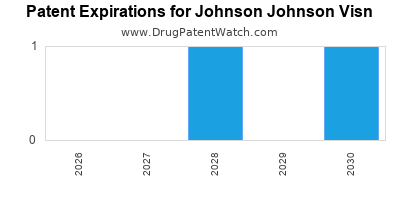
Key patents expire between 2026 and 2028, risking generic entry afterward.
What investments does J&J prioritize related to dry eye?
Investments focus on innovative delivery systems, biologics, and digital health integrations within ophthalmology.
References
- Johnson & Johnson. (2022). Annual Report.
- MarketWatch. (2023). Ophthalmology drugs market analysis.
- FDA. (2017). Approval documents for Visn.
- Santen Pharmaceutical Co., Ltd. (2022). Market reports.
- Grand View Research. (2023). Dry eye disease market size and forecast.