You're using a free limited version of DrugPatentWatch: Upgrade for Complete Access

Last Updated: December 18, 2025

ACTOPLUS MET Drug Patent Profile


✉ Email this page to a colleague

« Back to Dashboard


When do Actoplus Met patents expire, and what generic alternatives are available?

Actoplus Met is a drug marketed by Takeda Pharms Usa and is included in two NDAs. There are four patents protecting this drug.

This drug has forty-one patent family members in twenty-five countries.

The generic ingredient in ACTOPLUS MET is metformin hydrochloride; pioglitazone hydrochloride. There are forty-nine drug master file entries for this compound. Seven suppliers are listed for this compound. Additional details are available on the metformin hydrochloride; pioglitazone hydrochloride profile page.

DrugPatentWatch® Generic Entry Outlook for Actoplus Met

Indicators of Generic Entry

< Available with Subscription >

  Get Started Free

AI Deep Research
Questions you can ask:
  • What is the 5 year forecast for ACTOPLUS MET?
  • What are the global sales for ACTOPLUS MET?
  • What is Average Wholesale Price for ACTOPLUS MET?
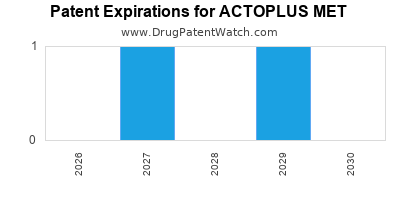
Drug patent expirations by year for ACTOPLUS MET
Drug Prices for ACTOPLUS MET

See drug prices for ACTOPLUS MET

Recent Clinical Trials for ACTOPLUS MET

Identify potential brand extensions & 505(b)(2) entrants

SponsorPhase
National Cancer Institute (NCI)Phase 2
Torrent Pharmaceuticals LimitedPhase 1

See all ACTOPLUS MET clinical trials

US Patents and Regulatory Information for ACTOPLUS MET

ACTOPLUS MET is protected by two US patents.

Applicant Tradename Generic Name Dosage NDA Approval Date TE Type RLD RS Patent No. Patent Expiration Product Substance Delist Req. Exclusivity Expiration
Takeda Pharms Usa ACTOPLUS MET metformin hydrochloride; pioglitazone hydrochloride TABLET;ORAL 021842-001 Aug 29, 2005 DISCN Yes No 9,320,714 ⤷  Get Started Free Y ⤷  Get Started Free
Takeda Pharms Usa ACTOPLUS MET XR metformin hydrochloride; pioglitazone hydrochloride TABLET, EXTENDED RELEASE;ORAL 022024-002 May 12, 2009 DISCN Yes No 7,959,946 ⤷  Get Started Free Y ⤷  Get Started Free
Takeda Pharms Usa ACTOPLUS MET metformin hydrochloride; pioglitazone hydrochloride TABLET;ORAL 021842-002 Aug 29, 2005 AB RX Yes Yes 9,320,714 ⤷  Get Started Free Y ⤷  Get Started Free
>Applicant >Tradename >Generic Name >Dosage >NDA >Approval Date >TE >Type >RLD >RS >Patent No. >Patent Expiration >Product >Substance >Delist Req. >Exclusivity Expiration

Expired US Patents for ACTOPLUS MET

Applicant Tradename Generic Name Dosage NDA Approval Date Patent No. Patent Expiration
Takeda Pharms Usa ACTOPLUS MET metformin hydrochloride; pioglitazone hydrochloride TABLET;ORAL 021842-002 Aug 29, 2005 6,166,043 ⤷  Get Started Free
Takeda Pharms Usa ACTOPLUS MET metformin hydrochloride; pioglitazone hydrochloride TABLET;ORAL 021842-001 Aug 29, 2005 6,172,090 ⤷  Get Started Free
Takeda Pharms Usa ACTOPLUS MET metformin hydrochloride; pioglitazone hydrochloride TABLET;ORAL 021842-001 Aug 29, 2005 4,687,777 ⤷  Get Started Free
>Applicant >Tradename >Generic Name >Dosage >NDA >Approval Date >Patent No. >Patent Expiration

Supplementary Protection Certificates for ACTOPLUS MET

Patent Number Supplementary Protection Certificate SPC Country SPC Expiration SPC Description
1412357 50/2008 Austria ⤷  Get Started Free PRODUCT NAME: SITAGLIPTIN, GEGEBENENFALLS IN DER FORM EINES PHARMAZEUTISCH ANNEHMBAREN SALZES, INSBESONDERE ALS MONOPHOSPHAT, UND METFORMIN, GEGEBENENFALLS IN FORM EINES PHARMAZEUTISCH ANNEHMBAREN SALZES, INSBESONDERE DES HYDROCHLORIDS; NAT. REGISTRATION NO/DATE: EU/1/08/455/001-014, EU/1/08/456/001-014, EU/1/08/457/001-014 20080716; FIRST REGISTRATION: CH 58450 01-03 20080408
1261586 12C0028 France ⤷  Get Started Free PRODUCT NAME: ASSOCIATION COMPRENANT LA SAXAGLIPTINE OU UN DE SES SELS ET LA METFORMINE OU UN DE SES SELS, Y COMPRIS L'ASSOCIATION CHLORHYDRATE DE SAXAGLIPTINE ET CHLORHYDRATE DE METFORMINE; REGISTRATION NO/DATE: EU/1/11/731/001 20111124
1412357 PA2008013 Lithuania ⤷  Get Started Free PRODUCT NAME: SITAGLIPTINUM PHOSPHAS MONOHYDRICUS, METFORMINI HYDROCHLORIDUM; REG. NO/DATE: EU/1/08/455/001-014 20080716
>Patent Number >Supplementary Protection Certificate >SPC Country >SPC Expiration >SPC Description

Market Dynamics and Financial Trajectory for Actoplus Met

Last updated: July 27, 2025

Introduction

Actoplus Met, a combination therapy comprising pioglitazone and metformin, is designed primarily for the management of type 2 diabetes mellitus. Since its approval, it has become an integral option within the therapeutic landscape, particularly for patients requiring combination pharmacotherapy. Understanding its market dynamics and financial trajectory involves analyzing key factors influencing demand, competitive positioning, regulatory environment, and regional adoption patterns.

Product Overview

Actoplus Met integrates two well-established antidiabetic agents. Pioglitazone, a thiazolidinedione, improves insulin sensitivity, while metformin, a biguanide, suppresses hepatic gluconeogenesis. The combination aims to optimize glycemic control with the convenience of a single pill, thereby improving patient adherence. Its patent protections, manufacturing partnerships, and formulary positioning influence overall revenue streams.

Market Demand and Growth Drivers

Global Diabetes Epidemic

The prevalence of type 2 diabetes continues to escalate globally, driven by urbanization, sedentary lifestyles, and rising obesity rates. The International Diabetes Federation estimates approximately 537 million adults were living with diabetes in 2021, projected to reach 643 million by 2030 [1]. This substantial growth underpins a sustained demand for combination therapies like Actoplus Met, which cater to a large, expanding patient base.

Therapeutic Positioning and Clinical Adoption

Actoplus Met appeals to clinicians seeking reliable, efficacious treatment options for patients inadequately controlled on monotherapy. Its favorable pharmacokinetic profile and once-daily dosing contribute to improved patient compliance, boosting demand. Additionally, guidelines from organizations such as the American Diabetes Association (ADA) recommend early combination therapy in specific cases, facilitating its clinical integration.

Market Penetration

In developed markets like the U.S. and Europe, Actoplus Met benefits from established infrastructure, favorable reimbursement policies, and broad physician familiarity. Emerging markets offer significant growth potential, with increasing healthcare spending and rising awareness about diabetes management. However, market penetration varies due to regional regulatory hurdles and local competition.

Competitive Landscape

Key Competitors

Actoplus Met faces competition from other fixed-dose combination (FDC) drugs, including Glucophage XR + Actos, and newer agents such as SGLT2 inhibitors and GLP-1 receptor agonists. Notably, drugs like Janumet (sitagliptin plus metformin) and Invokana (canagliflozin) are noteworthy competitors, offering different mechanisms and regimes.

Patent and Patent Challenges

Patent exclusivity for combination therapeutics often lapses within 10–15 years after market entry, exposing products to generics that intensify price competition. The expiration of patent rights for the individual components, especially metformin and pioglitazone, has historically led to the entry of lower-cost generics, impacting revenues.

Biopharmaceutical Innovation

Emerging formulations or combination therapies, such as dual GIP/GLP-1 receptor agonists, threaten traditional oral combinations like Actoplus Met by offering more potent, convenient, and comprehensive glycemic control, subsequently challenging market share.

Regulatory and Reimbursement Environment

Regulatory Dynamics

Regulatory agencies like FDA and EMA impose rigorous safety and efficacy standards. Notably, controversies surrounding pioglitazone's association with bladder cancer have prompted stricter monitoring and, in some regions, restricted use, influencing prescribing patterns.

Reimbursement Policies

Insurance coverage significantly determines market penetration. In the U.S., coverage for branded drugs is often limited by formulary restrictions favoring generics, which can adversely affect revenue streams for Actoplus Met. Conversely, in countries with government-funded healthcare, reimbursement rates influence accessibility and demand.

Regional Market Opportunities and Challenges

North America

The U.S. dominates the market due to its high diabetes prevalence and advanced healthcare infrastructure. However, competition, patent expiries, and regulatory scrutiny pose risks.

Europe

European markets benefit from high healthcare spending and regulatory stability. Market growth hinges on clinician acceptance and reimbursement policies.

Emerging Markets

Countries such as China, India, and Brazil exhibit rapid diabetes prevalence growth. Challenges include regulatory processes, pricing pressures, and local manufacturing requirements but offer substantial long-term revenue potential.

Financial Trajectory and Revenue Projections

Historical Performance

While specific sales data for Actoplus Met remain confidential, the broader class of oral antidiabetics has historically demonstrated steady growth, driven by global diabetes trends. Sales of legacy products like Actos (pioglitazone) peaked prior to patent expiry, after which revenues declined due to generic competition.

Forecast for Future Revenues

Based on market dynamics, the revenue trajectory for Actoplus Met is expected to reflect:

  • Stabilization in mature markets, where generic competition limits margins.
  • Potential growth in emerging markets due to expanding diabetic populations and increasing healthcare access.
  • Loss of exclusivity in the coming years, likely leading to a shift toward generic formulations or alternative therapies.

Impact of Patent Expiry and Generic Competition

Patent expiration for pioglitazone and metformin combinations typically results in significant revenue erosion, sometimes up to 80%, within 3–5 years post-availability of generics [2]. This underscores the importance of strategic innovation and lifecycle management.

Strategic Approaches

Pharmaceutical companies may pursue:

  • Development of next-generation formulations or fixed-dose combinations with novel agents.
  • Expanding indications or obtaining dual or triple therapy approvals.
  • Market diversification and engagement in emerging markets to offset mature market declines.

Supply Chain and Manufacturing Considerations

Manufacturing efficiency, quality control, and strategic partnerships influence profit margins. The commoditization of metformin and pioglitazone favor cost reductions, but supply chain disruptions (e.g., raw material shortages) can impact commercialization timelines and revenues.

Regulatory and Legal Risks

Negative safety signals or regulatory warnings, such as concerns over pioglitazone-associated bladder cancer risk, have led to usage restrictions in certain jurisdictions, impacting sales and market perception. Continuous post-market surveillance is essential to sustain market access.

Conclusion

The market dynamics for Actoplus Met are characterized by global diabetes prevalence growth, intense competition, patent expiries, and evolving therapeutic standards. While the drug benefits from longstanding clinical use and established reimbursement pathways in major markets, its financial trajectory faces significant headwinds from generics, regulatory challenges, and emerging therapies. Strategic innovation, geographic expansion, and lifecycle management are vital to sustain revenues.


Key Takeaways

  • The rising global diabetes epidemic ensures sustained demand for combination therapies like Actoplus Met, particularly in emerging markets.
  • Patent expirations and generic competition significantly threaten revenue streams, demanding strategic innovation.
  • Regulatory concerns regarding pioglitazone's safety profile influence prescribing habits and market access.
  • Diversification into newer therapies and geographical markets is critical for maintaining financial growth.
  • Effective supply chain management and post-market surveillance are essential in mitigating risks and preserving product viability.

FAQs

Q1: How does the patent expiry of pioglitazone and metformin affect Actoplus Met's market?
Patent expiries allow generic manufacturers to replicate and market lower-cost versions, drastically reducing revenues of branded formulations like Actoplus Met. This typically results in a sharp revenue decline within a few years post-expiry unless mitigated by lifecycle strategies.

Q2: What safety concerns could impact the market for Actoplus Met?
Concerns over pioglitazone's potential link to bladder cancer have led to usage restrictions in certain regions, affecting its prescribing and sales. Continuous monitoring and regulatory updates are crucial to mitigate risks.

Q3: Are there emerging therapies threatening Actoplus Met’s market position?
Yes. Novel agents such as SGLT2 inhibitors and GLP-1 receptor agonists, which offer improved efficacy and additional benefits like weight loss, may replace traditional oral combinations, impacting demand.

Q4: Which regions offer the most growth opportunities for Actoplus Met?
Emerging markets like China, India, and Brazil offer substantial opportunities due to increasing diabetes prevalence, rising healthcare infrastructure, and regulatory reforms favoring access.

Q5: How can companies extend the lifecycle of Actoplus Met?
Strategies include developing next-generation formulations, securing approvals for additional indications, entering new markets, and engaging in clinical research to demonstrate added benefits or safety improvements.


References

[1] International Diabetes Federation (IDF). Diabetes Atlas, 10th Edition, 2021.
[2] U.S. Food and Drug Administration (FDA). Pioglitazone: Drug Safety Communication, 2019.

More… ↓

⤷  Get Started Free

Make Better Decisions: Try a trial or see plans & pricing

Drugs may be covered by multiple patents or regulatory protections. All trademarks and applicant names are the property of their respective owners or licensors. Although great care is taken in the proper and correct provision of this service, thinkBiotech LLC does not accept any responsibility for possible consequences of errors or omissions in the provided data. The data presented herein is for information purposes only. There is no warranty that the data contained herein is error free. We do not provide individual investment advice. This service is not registered with any financial regulatory agency. The information we publish is educational only and based on our opinions plus our models. By using DrugPatentWatch you acknowledge that we do not provide personalized recommendations or advice. thinkBiotech performs no independent verification of facts as provided by public sources nor are attempts made to provide legal or investing advice. Any reliance on data provided herein is done solely at the discretion of the user. Users of this service are advised to seek professional advice and independent confirmation before considering acting on any of the provided information. thinkBiotech LLC reserves the right to amend, extend or withdraw any part or all of the offered service without notice.