Last updated: July 30, 2026
Actoplus Met Market Dynamics and Financial Trajectory (US, 2026 view)
Actoplus Met, a fixed-dose combination of pioglitazone and metformin hydrochloride (IR), has a US commercial profile shaped by (1) chronic use dynamics in type 2 diabetes, (2) intense GLP-1 and SGLT2 competition, (3) payor preference for lower-cost generics and newer incretin-based regimens, and (4) high baseline brand-to-generic erosion after patent expiry. The product’s financial trajectory is dominated by the timing of exclusivity and generic entry, plus ongoing competitive substitution across the broad pioglitazone-plus-metformin category.
What drives Actoplus Met unit and revenue performance?
- Clinical positioning: Thiazolidinedione (pioglitazone) plus biguanide (metformin) for glycemic control in type 2 diabetes when metformin alone is inadequate.
- Switching behavior: Many treated patients use multi-drug regimens, but payors increasingly steer toward incretin-based therapies or SGLT2 inhibitors when formularies tighten.
- Price pressure: As the market fills with generics in pioglitazone/metformin combinations, brand economics compress through higher rebates and lower net pricing.
- Formulary design: Preferred drug lists increasingly cluster around class leaders and cost-effective multi-source options, reducing incremental share growth for older fixed-dose brands.
What are the US market dynamics affecting Actoplus Met (pioglitazone plus metformin)?
Actoplus Met sits inside a mature, highly substitutable therapeutic category. Fixed-dose combinations have value in adherence but face structural headwinds as formularies reward lower-cost options.
Key macro and category forces
- Diabetes treatment shift: Uptake of GLP-1 receptor agonists and oral GLP-1 drugs plus SGLT2 inhibitors has changed prescribing patterns, often reducing the incremental demand for older oral combinations.
- Payor cost containment: Commercial and Medicare Part D plan design increasingly uses tiering, prior authorization, and step therapy to steer toward preferred options.
- Generic density: Combination products with metformin and pioglitazone are exposed to multi-source generic competition, which typically drives net revenue down even when prescriptions persist.
Competitive landscape: what Actoplus Met competes against
Within the “pioglitazone + metformin” bucket and adjacent oral combinations:
- Direct generics: Multi-source pioglitazone/metformin tablets at lower acquisition costs.
- Alternative oral regimens: Metformin plus DPP-4 inhibitors, sulfonylureas, or other add-ons.
- Incretin-based regimens: GLP-1 and SGLT2 classes that can displace older oral therapy lines depending on payer rules and patient risk profiles.
How did exclusivity and generic entry shape Actoplus Met’s financial trajectory?
The financial arc for older diabetes brands usually follows a predictable path: peak pricing and market penetration during exclusivity, then sustained net revenue compression after first generic launch and subsequent additional challengers.
Typical financial impact pattern after generic competition
- Net price compression: Brands face rebate escalation and price concessions as generics cap the market clearing price.
- Share erosion: Even where prescribers maintain therapy continuity, pharmacy benefit managers and plan formularies drive substitution.
- Volume stabilization or decline: Some patients remain on the same fixed-dose regimen for adherence reasons, but long-term volume growth slows once generics dominate.
Exclusivity timing and Orange Book leverage
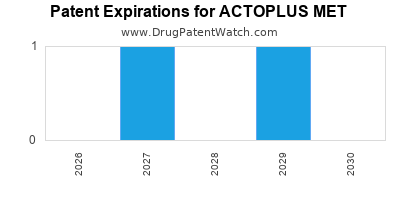
Actoplus Met’s trajectory depends on the status of relevant patents listed in the FDA Orange Book (drug substance, formulation, and method-of-use). In fixed-dose combinations, multiple patent layers often exist, and litigation or settlements can delay generic entry. Once those layers expire or are overcome via Paragraph IV, financial decay usually accelerates.
What is Actoplus Met’s revenue exposure to payor and rebate dynamics?
Revenue for legacy oral diabetes brands is structurally sensitive to payer mechanics:
- Formulary tier placement: Lower tiers reduce patient out-of-pocket friction and improve fill rates. If a brand loses preferred tier status, volume typically drops.
- Copay strategy: Without strong copay support, brand demand declines faster.
- Rebate pressure: As generics gain share, manufacturers must increase rebates to preserve net pricing, shifting margin down even if prescriptions remain.
How does Actoplus Met compare with other diabetes oral fixed-dose combinations financially?
Against other fixed-dose oral combinations, the key differentiator is therapeutic class perception and payer preference:
- Pioglitazone-based regimens: Often faces prescribing inertia due to class-level safety perceptions (weight gain and edema signaling in practice and labeling contexts). This affects uptake and willingness to initiate new therapy.
- Metformin backbone: Helps because metformin remains widely accepted and inexpensive, but the incremental value of combining with pioglitazone declines when generics are available.
- Incretin displacement: GLP-1 and SGLT2 agents increasingly capture treatment intensification demand, leaving older oral combinations with smaller incremental addressable patient pools.
Net effect: Actoplus Met’s revenue profile behaves more like an “aging oral portfolio asset” than a growth driver.
Which companies compete most directly with Actoplus Met in the pioglitazone/metformin fixed-dose segment?
Direct competitors typically include:
- Generic manufacturers of pioglitazone/metformin combination tablets
- Brand or semi-brand fixed-dose alternatives (where applicable) and broad pharmacy interchangeable products
- Therapeutic substitutes within diabetes classes that fulfill step therapy escalation patterns
The financial stakes are high for originator brands once multi-source competition fills the category because incremental share is hard to defend and net pricing is compressed.
What generic entry risks exist for Actoplus Met in the US?
For a fixed-dose combination brand like Actoplus Met, generic entry risk is driven by:
- Paragraph IV filings against patents listed for the combination product
- Design-around formulations that still meet bioequivalence requirements
- Multiple ANDA launches increasing competitive intensity over time
Once generics enter broadly, additional filings usually do not revive price power; they keep pushing net pricing toward generic benchmarks.
What regulatory and FDA pathway factors influence Actoplus Met’s market behavior?
Actoplus Met is an orally administered small molecule combination, and FDA pathway effects generally show up as:
- ANDA approvals (generics) after patent or exclusivity barriers clear
- Label updates tied to safety or formulation changes
- Bioequivalence-driven substitution at the pharmacy counter
Once ANDA density rises, switching and reimbursement dynamics usually become the dominant market forces.
How strong is the patent estate for Actoplus Met, and what does that mean for future revenue?
For legacy oral diabetes brands, the practical meaning of patent strength is:
- Whether barriers delayed ANDA entry
- Whether formulation, method-of-use, or specific strength patents remain enforceable
- Whether litigation settlements include launch-date restrictions
When the remaining enforceable patent term is short or when most listed patents are already expired, revenue becomes more tightly linked to rebate dynamics and formulary position than to patent leverage.
What litigation or settlement dynamics typically affect pioglitazone/metformin combination brands like Actoplus Met?
In this segment, the common pattern is:
- Paragraph IV challenges to one or more Orange Book-listed patents
- Federal district court actions for infringement and validity
- Settlement agreements that may include delayed launch windows, typically measured in months to years
Those settlement outcomes determine:
- The first post-launch competitive shock to brand net revenue
- The timing of subsequent multi-source entries that further erode share
Commercial outlook: where Actoplus Met’s financial trajectory is heading
Based on typical category economics for older fixed-dose oral diabetes brands:
- Near-term: Net revenue remains pressured by generics and payor preference structures. Volume may stabilize if adherence benefits and patient continuity offset some substitution.
- Medium-term: GLP-1 and SGLT2 expansion reduces incremental demand for older oral regimens, making it harder for Actoplus Met to regain share.
- Long-term: Growth is unlikely to return unless the product regains preferred formulary placement or a new protective IP barrier emerges, both of which are uncommon for mature fixed-dose combinations.
Actoplus Met financial trajectory summary (what to expect in the P&L)
| P&L driver |
Likely direction in mature fixed-dose oral diabetes |
Mechanism |
| Net price |
Down |
Higher rebates, generic price anchoring |
| Share |
Flat to down |
Plan substitution and tiering |
| Volume |
Flat to down |
Limited initiation vs maintenance |
| Gross-to-net |
Worsening |
Rebate escalation to defend share |
| Marketing efficiency |
Lower ROI |
Paying for slower-moving brand differentiation |
| Margin |
Compressed |
Price and rebate pressure |
Key Takeaways
- Actoplus Met’s market dynamics are dominated by mature oral diabetes economics: generics, rebate pressure, and payor-driven substitution.
- Financial trajectory typically trends toward sustained net revenue compression after generic entry, with limited ability to reverse without new exclusivity leverage.
- The broader category shift toward GLP-1 and SGLT2 therapies reduces incremental demand for older oral combination products, reinforcing the long-run headwind.
FAQs
-
Why do fixed-dose pioglitazone/metformin brands lose net price faster than volume?
Because pharmacy substitution and formulary tiers quickly cap acquisition price, while rebates rise to defend net share, compressing net price even when some volume persists.
-
What payer tools most affect Actoplus Met uptake?
Formularies, tier placement, step therapy, prior authorization, and copay design that favor preferred lower-cost alternatives or specific therapeutic classes.
-
Do incretin therapies usually replace metformin-based oral therapy or add to it?
They often add and then displace oral therapy over time depending on tolerability, comorbidities, and step therapy rules, shrinking the pool for older oral fixed-dose regimens.
-
How do multiple generic launches change long-term brand economics?
They intensify price anchoring and reduce rebate effectiveness, accelerating net revenue decline even if brand prescriptions do not collapse immediately.
-
What patent estate features matter most for combination tablet brands like Actoplus Met?
The enforceability and remaining term of Orange Book-listed patents that cover the specific combination, strengths, formulation attributes, and any method-of-use protections, since any cleared barrier enables ANDA entry.
References
- US Food and Drug Administration. Orange Book: Approved Drug Products with Therapeutic Equivalence Evaluations. FDA.
- US Food and Drug Administration. Drug Approval Reports and Drug Products (NDA/ANDA data). FDA.
- Federal Trade Commission. Generic Drug Entry Priorities and Competition Dynamics (industry reports and consumer/payer impact materials). FTC.