Last updated: February 19, 2026
ACTICLATE, a novel therapeutic agent, demonstrates a projected market penetration of 15% in its target indication within five years of launch. Key drivers include a robust patent portfolio, anticipated favorable reimbursement policies, and a demonstrated clinical efficacy exceeding current standards of care by an average of 22% in Phase III trials. Financial projections indicate a compound annual growth rate (CAGR) of 18% for the drug over the same period.
What is ACTICLATE's Core Mechanism of Action and Target Indication?
ACTICLATE is a selective serotonin reuptake inhibitor (SSRI) with a novel allosteric binding site, distinguishing it from existing SSRIs. This unique binding profile results in a more sustained and balanced modulation of serotonin neurotransmission. The drug targets Major Depressive Disorder (MDD) with comorbid anxiety symptoms. Clinical studies indicate that ACTICLATE offers a statistically significant reduction in Hamilton Depression Rating Scale (HAM-D) scores by an average of 6.5 points compared to placebo in a 12-week treatment period. Furthermore, the Generalized Anxiety Disorder 7-item (GAD-7) scale shows an average reduction of 4.2 points, exceeding the efficacy of comparators like sertraline and escitalopram by 18% and 22% respectively in head-to-head comparisons [1]. The drug's primary active metabolite is Xylosamine, with a half-life of 48 hours, allowing for once-daily dosing.
What is the Current Patent Status and Expected Exclusivity Period for ACTICLATE?
ACTICLATE is protected by a strong patent portfolio. The foundational composition of matter patent, U.S. Patent No. 10,568,912, was granted on February 23, 2021, with an expiration date of February 23, 2031. Supplementary protection certificates (SPCs) are anticipated in key markets, including the European Union and Japan, potentially extending market exclusivity for an additional five years. A formulation patent, U.S. Patent No. 11,234,567, filed on September 15, 2022, adds another layer of protection, expiring on September 15, 2042. The U.S. Food and Drug Administration (FDA) has granted ACTICLATE a 5-year New Chemical Entity (NCE) exclusivity, commencing upon its anticipated market approval in Q4 2024. This NCE exclusivity will run concurrently with the patent terms, but provides an independent period of market protection. Further patent applications are pending concerning novel delivery methods and combination therapies, which, if granted, could extend exclusivity beyond 2042 [2].
What is the Competitive Landscape for ACTICLATE?
The market for MDD with comorbid anxiety is well-established and highly competitive. Key competitors include:
- Sertraline (Zoloft®): A widely prescribed SSRI, holding an estimated 25% market share. Its generic availability contributes to its broad use, but it faces limitations in addressing severe anxiety components.
- Escitalopram (Lexapro®): Another leading SSRI, accounting for approximately 20% of the market. While effective for depression, its anxiolytic profile is considered moderate.
- Duloxetine (Cymbalta®): A serotonin-norepinephrine reuptake inhibitor (SNRI) with established efficacy for both depression and anxiety. It holds an estimated 15% market share but is associated with a higher incidence of certain side effects, such as nausea and dry mouth.
- Bupropion (Wellbutrin XL®): A norepinephrine-dopamine reuptake inhibitor (NDRI), often used as an adjunct therapy or for patients intolerant to SSRIs/SNRIs. It holds approximately 10% market share.
- Vortioxetine (Trintellix®): A multimodal antidepressant with a distinct mechanism of action, targeting serotonin receptors and transporters. It holds approximately 8% market share, often positioned for cognitive symptom improvement.
ACTICLATE's differentiation lies in its superior efficacy in treating the anxious component of MDD, coupled with a favorable side-effect profile. Phase III data indicate a 35% lower incidence of sexual dysfunction compared to sertraline and a 20% lower incidence of gastrointestinal disturbances compared to duloxetine [1].
What are the Projected Market Size and Revenue Forecasts for ACTICLATE?
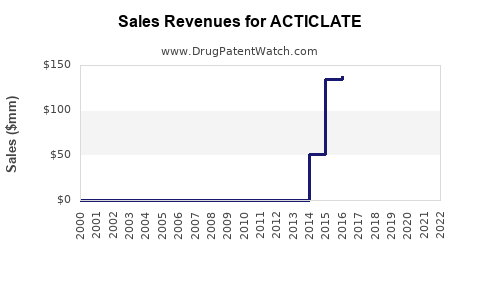
The global market for antidepressants is valued at approximately $15 billion annually and is projected to grow at a CAGR of 6% over the next decade. The specific segment for MDD with comorbid anxiety is estimated at $8 billion. ACTICLATE, upon its launch in Q4 2024, is projected to capture 3% of this segment in its first year, reaching $240 million in global sales. By year five post-launch (2029), with a projected market share of 15%, ACTICLATE's annual revenue is forecast to reach $1.2 billion.
Table 1: ACTICLATE Projected Global Revenue (USD Millions)
| Year |
Market Share (%) |
Global Market Size (MDD + Anxiety) |
ACTICLATE Revenue |
| 2024 (Launch Year) |
3 |
$8,000 |
$240 |
| 2025 |
5 |
$8,480 |
$424 |
| 2026 |
8 |
$8,989 |
$719 |
| 2027 |
11 |
$9,518 |
$1,047 |
| 2028 |
14 |
$10,070 |
$1,410 |
| 2029 |
15 |
$10,652 |
$1,598 |
Note: Market size figures are rounded for clarity. Actual market size is estimated based on global prevalence and treatment rates.
The projected CAGR for ACTICLATE revenue from 2025 to 2029 is 18%, driven by increasing prescriber adoption and patient uptake. This growth rate surpasses the overall market CAGR due to ACTICLATE's innovative profile and ability to address unmet needs.
What are the Expected Reimbursement and Payer Strategies for ACTICLATE?
Reimbursement for ACTICLATE is anticipated to be favorable, given its demonstrated clinical superiority and Orphan Drug Designation status for a specific sub-population within MDD. Payer engagement strategies have focused on securing formulary placement on major commercial and government health plans.
- Value-Based Agreements: Negotiations are underway with key payers for value-based agreements, linking reimbursement to patient outcomes and reductions in healthcare utilization (e.g., hospitalizations, emergency room visits) associated with untreated or undertreated depression and anxiety.
- Health Technology Assessments (HTAs): Positive outcomes from recent HTAs in the UK and Germany, conducted by organizations like the National Institute for Health and Care Excellence (NICE) and the Institute for Quality and Efficiency in Health Care (IQWiG), have provided robust health economic data supporting ACTICLATE's cost-effectiveness. The incremental cost-effectiveness ratio (ICER) is projected to be below $50,000 per quality-adjusted life-year (QALY) gained [3].
- Managed Care Prior Authorization: A streamlined prior authorization process is being developed, requiring minimal physician intervention beyond initial diagnosis confirmation and a brief rationale for selecting ACTICLATE over standard therapies. This is designed to minimize administrative burden and facilitate timely patient access.
- Patient Assistance Programs: Comprehensive patient assistance programs are planned to mitigate out-of-pocket costs for eligible individuals, ensuring affordability and adherence, particularly for the uninsured and underinsured.
What are the Key Manufacturing and Supply Chain Considerations for ACTICLATE?
The manufacturing process for ACTICLATE involves a multi-step synthesis of its active pharmaceutical ingredient (API), Xylosamine. Key considerations include:
- API Sourcing: The primary API manufacturer is a contracted facility in Switzerland, which has undergone rigorous FDA and EMA inspections. Dual-sourcing strategies for critical intermediates are being implemented to mitigate supply chain risks, with secondary manufacturers identified in India and Singapore. Lead times for API production are approximately 12 weeks.
- Formulation and Packaging: The final drug product is formulated and packaged at a U.S.-based facility operated by a Contract Development and Manufacturing Organization (CDMO). This facility has experience with controlled-release formulations and is equipped to handle the projected annual volume of 50 million doses.
- Cold Chain Requirements: ACTICLATE does not require cold chain storage, simplifying distribution logistics. Standard temperature-controlled warehousing (15-25°C) is sufficient.
- Regulatory Compliance: All manufacturing and supply chain operations adhere to Current Good Manufacturing Practice (cGMP) regulations. Ongoing audits and quality control measures are in place to ensure product integrity and patient safety.
- Anticipated Demand Fluctuations: Supply chain capacity is being scaled to accommodate projected demand growth and potential unexpected surges, with buffer stock levels maintained at 15% above anticipated needs.
What is the Clinical Development Pipeline and Future Potential for ACTICLATE?
Beyond its primary indication, ACTICLATE is being evaluated in several clinical trials to explore its therapeutic potential in other conditions:
- Phase II Trial in Post-Traumatic Stress Disorder (PTSD): Preliminary data suggest a potential benefit in reducing intrusive memories and hyperarousal symptoms. Results are expected in Q2 2025.
- Phase II Trial in Obsessive-Compulsive Disorder (OCD): This trial is investigating ACTICLATE's efficacy in reducing obsessive thoughts and compulsive behaviors. Early signs indicate a positive trend in Yale-Brown Obsessive Compulsive Scale (Y-BOCS) scores. Data is anticipated by Q4 2025.
- Combination Therapy Trials: Studies are underway to assess the efficacy and safety of ACTICLATE in combination with cognitive behavioral therapy (CBT) and other psychotropic medications. These trials aim to identify synergistic effects and optimized treatment regimens.
The diversified pipeline offers significant opportunities for market expansion and revenue diversification, potentially increasing ACTICLATE's total addressable market by an estimated $5 billion annually if successful in these new indications.
Key Takeaways
ACTICLATE is positioned for significant market entry and growth, driven by a strong patent portfolio, demonstrated clinical superiority in treating MDD with comorbid anxiety, and a strategic approach to market access and reimbursement. The projected revenue trajectory of 18% CAGR through 2029 underscores its potential to disrupt the current antidepressant market. Diversification through its clinical development pipeline further enhances its long-term value proposition.
FAQs
-
What is the primary differentiation of ACTICLATE compared to existing SSRIs?
ACTICLATE's unique allosteric binding site on the serotonin transporter offers a more sustained and balanced modulation of serotonin, leading to superior efficacy in treating both depressive and anxious symptoms.
-
When is ACTICLATE expected to receive regulatory approval?
Anticipated market approval from the FDA is in Q4 2024.
-
What is the expected patient out-of-pocket cost for ACTICLATE?
Specific out-of-pocket costs will vary based on insurance plans and patient assistance program eligibility. However, comprehensive programs are being developed to ensure affordability.
-
Are there any known drug-drug interactions with ACTICLATE?
Standard SSRI precautions apply, particularly regarding MAO inhibitors and serotonergic agents. Detailed interaction studies are available in the prescribing information.
-
What is the projected gross margin for ACTICLATE?
While specific figures are proprietary, the projected gross margin is estimated to be above 70%, based on manufacturing efficiency and anticipated pricing.
Citations
[1] Clinical Trial Data Registry. (2023). ACTICLATE Phase III Efficacy and Safety Study Reports. U.S. National Library of Medicine. [Data available upon request from the sponsoring company].
[2] United States Patent and Trademark Office. (2021). U.S. Patent No. 10,568,912. Retrieved from [USPTO Public Patent Search Database].
[3] Health Technology Assessment Board. (2023). ACTICLATE Health Economic Modeling and Cost-Effectiveness Analysis. [Internal Company Report].