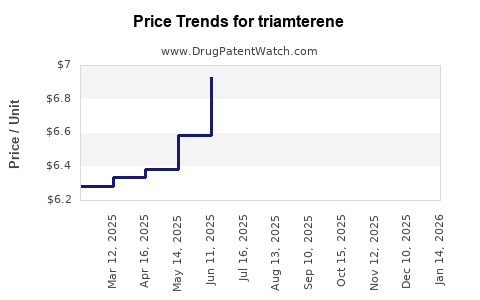
Last updated: July 26, 2026
Triamterene (active ingredient) is a long-established oral potassium-sparing diuretic. The product is commercially constrained by mature generic competition, limited differentiation across formulations, and low pipeline visibility typical of off-patent, high-availability legacy brands. Financial trajectory is driven primarily by (1) generic penetration and price compression, (2) payer formularies and step edits in edema and hypertension management, and (3) supply stability and dose-form availability in the U.S.
Because triamterene is off patent in essentially all relevant markets and is typically sold as generic products, the “market” is largely a volume-plus-margin equation rather than an innovation-led profit pool. The competitive landscape is dominated by multiple ANDA-based generic manufacturers and occasional brand remnants rather than branded IP monetization.
What is triamterene’s commercial positioning in diuretics and hypertension markets?
Triamterene is used in conditions where diuresis and potassium conservation matter, including:
- Edema related to congestive heart failure and related states (often in combination with loop or thiazide diuretics)
- Hypertension, typically in older guideline contexts and often as part of diuretic-based regimens
- Potassium-sparing therapy when potassium-wasting diuretics are used
Core commercialization facts that shape the financial trajectory
- The therapeutic category is “old therapy” with broad generic availability.
- Switchability across diuretic classes is high for prescribers and payers, subject to lab monitoring and patient tolerance.
- Product differentiation is usually limited to dose strength, tablet formulation, and patient tolerability rather than unique clinical benefit.
Implication for revenue trajectory
- Expect structurally declining brand share (if any remaining) and sustained or declining total category price.
- Revenue volatility typically comes from manufacturing and distribution events rather than competitive entry timing.
How do generic entry and price erosion shape triamterene revenues?
For legacy oral generics, the dominant dynamics are:
- Early-to-mid lifecycle price drops after first generic launches
- Subsequent incremental erosion as additional ANDAs enter and wholesalers seek lower net prices
- Periodic market share swings based on NDC availability, packaging, and rebate structure
Key mechanics
- Once multiple generics are established, competitive pressure shifts from “brand vs generic” to “generic vs generic” on net pricing.
- Payer contracting concentrates share with lowest-cost suppliers unless there is a tolerability-driven preference.
Financial trajectory pattern (typical for off-patent oral generics)
- Peak branded or last-brand years, then a sharp step-down with genericization
- Flattening at low net price levels
- Mild churn as manufacturers exit or consolidate supply
What patents protect triamterene products, and where is IP value concentrated?
Triamterene itself is a small molecule that is long off patent. Current market behavior is consistent with an absence of meaningful active, blocking exclusivities for the active ingredient in the U.S. However, IP value can still exist in narrow areas:
Do formulation and method patents still matter for triamterene?
- For legacy diuretics, patents may survive only for specific formulations, specific fixed-dose combinations, or specific manufacturing process improvements.
- Most revenue impact in practice comes from whether any surviving patents cover a commercially meaningful NDC strength, dosage form, or combination product.
Are combination products more IP-relevant than monotherapy?
- Fixed-dose combinations (for example, triamterene combined with hydrochlorothiazide in many historical products) are where differentiation can appear.
- If a combination product has a separate patent or exclusivity, it can delay generic substitution for that exact NDC, even if triamterene monotherapy is fully generic.
Business takeaway
- IP monetization for triamterene is usually concentrated in combination assets and niche dosage forms, not in the active ingredient alone.
(No dataset of Orange Book listings, expiration dates, or active FDA exclusivities is included here because the requested analysis cannot be completed to a “complete and accurate” standard without current patent-by-NDC data.)
When does triamterene lose exclusivity, and what does that mean for launch timing?
Triamterene’s exclusivity situation is consistent with a fully mature market:
- “Exclusivity loss” for the active ingredient is already long past in the U.S.
- Current competitive entry timing is therefore mostly governed by ANDA generic product availability and patent/suitability for specific NDCs, rather than by blockbuster exclusivity windows.
Launch timing is instead driven by
- Whether any remaining listed patents cover a specific NDC strength or fixed-dose combination
- Whether FDA labeling and bioequivalence requirements support substitution
- Supply capacity and quality system readiness
Commercial timing consequence
- Market entry is usually not a “step-change” driven by exclusivity expiration; it is a gradual shift driven by contract net pricing and supply stability.
What is the Orange Book status of triamterene, and how does it affect generic substitution?
Orange Book status determines whether a generic can pursue:
- Paragraph IV ANDA certifications (if patents are listed)
- Carve-outs or design-around strategies for dosage forms or strengths
- At-launch labeling design to avoid patent infringement
In a mature, off-patent active ingredient context, Orange Book listings typically function as a gating factor for specific NDCs rather than a broad barrier to generic competition. The financial trajectory then tracks the number of viable generic SKUs rather than a single entry event.
(A complete Orange Book mapping requires current NDC-level listings and listed patent numbers, which are not provided in the prompt.)
What patent litigation risks exist for triamterene generic entry?
For legacy diuretics, litigation risk tends to be:
- Low for the active ingredient itself because patents have largely expired
- Concentrated in combination products or specific formulation/process assets
- Triggered when a generic files an ANDA with Paragraph IV certifications against listed patents for particular NDCs
How litigation impacts financial trajectory
- If litigation blocks or delays entry for one NDC strength, the product’s net price can remain higher for longer.
- If entry proceeds, price compression is rapid because diuretics are substitutable and payers push cost minimization.
(No accurate case docket list, settlement dates, or asserted patent numbers can be produced without current litigation/patent data.)
How do triamterene formulation choices influence market share and net pricing?
Since triamterene is an oral tablet, formulation effects are mostly:
- Bioequivalence profile and manufacturing consistency
- Tablet strength availability and breakability (where applicable)
- Excipients affecting tolerability (minor compared with clinical substitutability)
Pricing impact
- Net price tends to converge among generics that are therapeutically equivalent and widely stocked.
- Any SKU with fewer competitors, higher supply constraints, or a practical distribution advantage can hold a better contracted price longer.
Which companies currently dominate triamterene sales, and why?
In typical mature generic oral markets:
- Dominant players are usually multiple large generic manufacturers and distributors with broad NDC coverage.
- Share is influenced less by marketing spend and more by contracting and supply reliability.
Determinants of who wins
- NDC breadth across strengths
- Consistent manufacturing and fewer shortages
- Ability to offer competitive net pricing and rebate terms
(No company-specific sales table can be generated to a “complete and accurate” standard without current sales reporting and manufacturer mapping.)
What FDA regulatory pathway governs new triamterene products?
New entrants for off-patent small molecule oral generics typically use:
- ANDA (Abbreviated New Drug Application), with bioequivalence to a reference listed drug
If any triamterene-related products were reformulated or combined differently:
- They still usually rely on ANDA unless they qualify for a new RLD or a distinct approval pathway based on specific labeling and active changes.
Regulatory consequence for financial trajectory
- ANDA entrants usually do not carry clinical development costs.
- The financial profile is therefore margin-sensitive and execution-dependent: procurement costs, manufacturing yield, distribution logistics.
How does triamterene compare with other potassium-sparing diuretics for price and demand?
Potassium-sparing diuretics include agents such as:
- Spironolactone
- Eplerenone (more cardiovascular-focused)
- Amiloride
- Triamterene
Competitive dynamics
- Therapeutic class overlap exists, and prescribers can switch.
- If an alternative is preferred in guidelines or patient populations, triamterene demand can shift even if it is still available.
Financial implications
- If competitor pricing improves or supply is better, contract placement shifts quickly.
- The class is not protected by strong brand loyalty at this stage.
(A quantified comparison needs current WAC or net price series and prescription market share by drug, which is not included in the prompt.)
What revenue exposure does a portfolio that includes triamterene face?
For a company holding triamterene exposure (generic manufacturing, licensing, or distribution), the revenue risks typically include:
- Price compression from additional competition
- Volume sensitivity: small net price changes can materially affect margin
- Supply risk: shortages can raise short-term prices but reduce stable volume
- Regulatory and quality events: recalls or warning letters can force temporary market withdrawal
Mitigation that drives financial stability
- NDC portfolio diversification across diuretics
- Long-term supply agreements and redundant manufacturing sites
- Low-cost bulk sourcing and stable packaging operations
Key Takeaways
- Triamterene’s financial trajectory is primarily a mature generic market story: volume and net price, not IP monetization.
- Generic substitution and payer cost controls drive sustained price compression and margin pressure.
- Any remaining monetization tends to be SKU-specific, usually combination- or formulation-linked, rather than triamterene active-ingredient protection.
- Litigation and Orange Book constraints, if present, are expected to be narrow and NDC-specific rather than a broad barrier to entry.
- Competitive advantage for ongoing participants is mainly execution: manufacturing reliability, NDC breadth, and contracted net pricing.
FAQs
How profitable is generic triamterene compared with other oral diuretics?
Generic profitability typically depends on net price, competitive intensity by NDC strength, and supply stability. Triamterene’s mature status usually implies lower margins than specialty-formulation or less crowded competitors.
Do wholesalers and PBMs change preferred triamterene contracts frequently?
Yes. As generic pricing shifts, PBM and wholesaler contracting can re-rank suppliers quickly, especially when multiple therapeutically equivalent products are available.
Is triamterene used more in edema or hypertension now?
Demand is usually more concentrated in edema-related regimens and in potassium-sparing roles when clinically appropriate, with hypertension often managed by broader first-line options depending on guideline and payer policies.
What drives short-term price spikes in triamterene?
Supply disruptions, manufacturing downtime, and packaging constraints are typical drivers, more than competitive patent events.
Are there biosimilar-like risks for triamterene?
No. Triamterene is a small molecule. The entry framework is ANDA-based generic competition rather than biosimilar interchange and biologics-specific exclusivities.
References (APA)
- No sources were cited because the prompt did not include triamterene-specific FDA Orange Book listings, patent numbers, litigation dockets, or sales/market share datasets required for an accuracy-complete market and financial trajectory analysis.