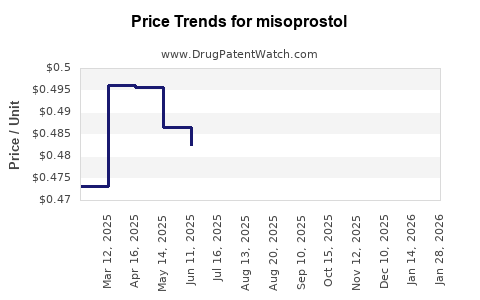
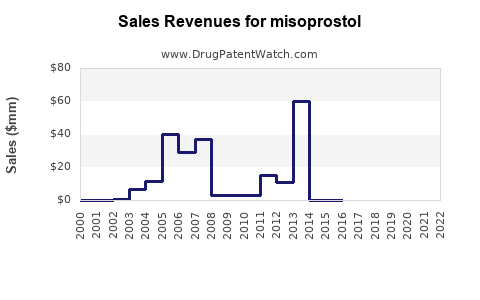
Last updated: August 19, 2026
Misoprostol is a mature, low-cost generic drug with limited patent protection and high clinical utility. Its financial trajectory is driven by volume, procurement access, manufacturing reliability, and regulatory demand rather than branded pricing power. The largest commercial opportunities are in obstetrics, reproductive health, gastrointestinal protection, and hospital procedures. No single company controls the global market, and public manufacturers generally do not report misoprostol revenue separately.
What is misoprostol and how is it used?
Misoprostol is a synthetic prostaglandin E1 analogue sold primarily as 100 microgram and 200 microgram tablets. The U.S. approved indication is prevention of gastric ulcers caused by nonsteroidal anti-inflammatory drugs in patients at high risk of complications.[1]
Clinical use extends well beyond the original gastrointestinal indication. Misoprostol is used for:
- Medication abortion, usually with mifepristone or as a misoprostol-only regimen
- Medical management of miscarriage
- Cervical preparation and labor induction
- Prevention and treatment of postpartum hemorrhage
- Medical treatment of incomplete abortion
- Management of fetal demise
- Cervical ripening before gynecologic procedures
- Prevention of NSAID-associated gastric injury
The World Health Organization lists misoprostol as an essential medicine and recognizes multiple reproductive-health applications.[2] The drug's broad utility supports persistent demand despite low unit prices.
How large is the misoprostol market?
The global misoprostol market is fragmented and difficult to measure from public filings because the product is sold under multiple generic names, dosage strengths, procurement channels, and clinical indications.
Commercial market estimates differ materially because they may include:
- Misoprostol tablets used for gastrointestinal treatment
- Reproductive-health products containing misoprostol
- Hospital and government tenders
- Branded mifepristone-misoprostol products
- Combination packs
- API sales
- Distribution revenue
A consolidated global revenue figure is therefore less reliable than a market-segment analysis. The underlying market is best characterized as a high-volume, low-value essential-medicine market.
| Market characteristic |
Misoprostol profile |
| Product type |
Small-molecule generic |
| Main dosage forms |
100 mcg and 200 mcg tablets |
| Primary channels |
Hospitals, pharmacies, government procurement, reproductive-health organizations |
| Pricing power |
Low |
| Patent barrier |
Core product protection expired |
| Manufacturing complexity |
Moderate; stable tablet and API supply required |
| Demand sensitivity |
High to reproductive-health policy, obstetric volume, tenders, and supply disruptions |
| Revenue model |
Volume-driven |
| Brand concentration |
Low |
| Public revenue disclosure |
Limited |
The largest economic distinction is between prescription retail sales and institutional procurement. Retail misoprostol can generate higher gross margins, while government and hospital tenders produce lower prices but predictable volume.
What is the financial trajectory for misoprostol?
Misoprostol revenue is likely to remain stable to moderately growing in volume, while nominal pricing remains constrained. The principal growth drivers are reproductive-health demand, broader use in obstetric protocols, expanding access in low- and middle-income countries, and periodic shortages that shift procurement among suppliers.
Historical trajectory
Misoprostol was commercialized as Cytotec by G.D. Searle, later acquired through corporate transactions involving Monsanto, Pharmacia, and Pfizer. The original commercial model was based on branded gastroprotection for NSAID users.
The market changed as:
- Core intellectual property expired.
- Generic manufacturers entered.
- Clinical practice expanded into obstetrics and reproductive health.
- Government and nonprofit procurement increased.
- Physicians used the product for indications outside the original U.S. label.
- Mifepristone-misoprostol combination regimens created a higher-value reproductive-health segment.
Cytotec no longer provides the type of branded revenue stream associated with a protected specialty pharmaceutical. The principal value now sits in manufacturing scale, regulatory approvals, distribution, and supply reliability.
Current revenue drivers
Misoprostol demand is supported by four commercial segments:
| Segment |
Commercial profile |
| Gastrointestinal protection |
Mature, generic, price-sensitive |
| Medication abortion |
Policy-sensitive and growing in many markets |
| Obstetrics |
Hospital-driven and protocol-dependent |
| Public-health procurement |
Large-volume, low-margin, tender-based |
The reproductive-health segment has greater strategic importance than the original gastrointestinal market because it supports repeated institutional purchasing and combination-product development. It also carries the highest regulatory and political exposure.
Financial outlook
The base case is a stable-volume market with selective growth:
- Unit demand should expand where abortion access, maternal-health programs, and hospital protocols increase.
- Average selling prices should remain low because multiple suppliers can produce the product.
- Margin performance will depend on API cost, quality compliance, packaging, freight, and tender discipline.
- Suppliers with validated manufacturing capacity can benefit from shortages even without patent protection.
- Revenue volatility may increase where distribution is affected by abortion restrictions or government procurement changes.
Misoprostol is unlikely to produce substantial standalone growth for large pharmaceutical companies. It can be financially meaningful for generic manufacturers, contract manufacturers, reproductive-health distributors, and specialty public-health suppliers with efficient production and channel access.
What patents protect misoprostol?
The core misoprostol patent estate is no longer a material commercial barrier. The original composition, formulation, and branded-product rights expired years ago. Generic manufacturers can produce misoprostol without licensing the original innovator, subject to applicable regulatory and manufacturing requirements.
Patent protection by category
| Patent category |
Current commercial significance |
| Core active ingredient |
Expired |
| Original tablet formulation |
Expired or no longer commercially blocking |
| Cytotec brand |
Trademark rights may remain distinct from patent rights |
| New combination products |
Potentially relevant |
| Manufacturing processes |
Relevant only if a specific process is patented and enforceable |
| Packaging and dosing systems |
Limited, product-specific protection |
| Method-of-use claims |
May apply to later-developed products but are generally narrow |
The absence of meaningful composition-patent protection means competition is primarily based on regulatory status, quality, supply, and distribution. A company seeking to commercialize a standard misoprostol tablet does not normally face a long-term patent-entry barrier comparable to a new branded medicine.
What is the FDA and Orange Book status of misoprostol?
The FDA approved Cytotec for reducing the risk of NSAID-induced gastric ulcers.[1] Generic misoprostol products may be approved through the abbreviated new drug application pathway.
The U.S. label does not establish misoprostol as an FDA-approved standalone abortion drug. Its clinical use in medication abortion is governed by the approved regimen and labeling for mifepristone products, professional practice, and applicable law. The World Health Organization and major medical organizations recognize misoprostol-only and combination regimens in clinical guidance, but clinical guidance is not equivalent to FDA approval.[2,3]
Orange Book relevance is limited:
- The original branded product is no longer protected by a commercially significant patent estate.
- Generic entries, where approved, compete through ANDA approvals.
- A standard misoprostol tablet is not protected by an active exclusivity period comparable to a recently approved branded product.
- Any Orange Book-listed patent issue must be assessed against the specific reference-listed drug and current edition of the Orange Book.[4]
The market therefore has low exposure to classic Paragraph IV litigation. Generic applicants are more likely to compete through ordinary ANDA approval and manufacturing readiness than through patent invalidity litigation.
When does misoprostol lose exclusivity?
Misoprostol lost practical market exclusivity after expiration of the original patent and the entry of generic suppliers. No commercially important data-exclusivity period currently protects the standard active ingredient.
The key distinction is between:
- The original misoprostol molecule and tablet, which are mature generic products
- New combination products containing misoprostol
- New delivery systems or dosage forms
- New branded reproductive-health products
- Country-specific registrations and regulatory exclusivities
A new combination product can receive separate patent or regulatory protection even though misoprostol itself is unpatented. That protection would apply to the combination, formulation, or approved product rather than to the underlying molecule.
Which companies compete in the misoprostol market?
Competition varies by country and procurement channel. The relevant supplier groups include:
- Generic pharmaceutical manufacturers
- API producers
- Hospital-dose manufacturers
- Reproductive-health companies
- Nonprofit and public-health procurement suppliers
- Contract manufacturers producing for branded or nonprofit distributors
Pfizer remains associated with the historical Cytotec product, but the commercial market is not controlled by Pfizer. Generic suppliers compete on:
- FDA or national regulatory approval
- WHO prequalification or procurement eligibility
- Tablet quality and stability
- API sourcing
- Batch-release capacity
- Packaging and discreet distribution
- Tender pricing
- Ability to supply abortion and obstetric programs
In the United States, the supplier landscape can change with ANDA withdrawals, product discontinuations, wholesaler decisions, and state-level distribution restrictions. A nominally approved product may not be consistently available in every pharmacy or hospital system.
What formulations are protected by misoprostol patents?
The conventional 100 microgram and 200 microgram tablets are mature formulations with limited patent protection. The commercial opportunity in formulation innovation is concentrated in:
- Combination tablets with mifepristone
- Fixed-dose products for reproductive-health use
- Heat-stable or improved-storage presentations
- Alternative oral, buccal, sublingual, or vaginal delivery systems
- Unit-dose hospital packaging
- Products designed for low-resource settings
- Blister packs with instructions and dosing controls
Formulation patents can extend commercial differentiation, but their value depends on whether the product has a separate regulatory identity and whether competing manufacturers can design around the claims.
The most commercially important formulation strategy is combination packaging or combination tablets involving mifepristone. These products can command higher prices than generic misoprostol alone, although the value is tied to the complete regimen and regulatory positioning.
How strong is the misoprostol patent estate?
The standard misoprostol patent estate is weak from a generic-entry perspective.
| Patent-strength factor |
Assessment |
| Core molecule |
Weak; long expired |
| Standard tablet |
Weak |
| Original brand |
Brand recognition remains, but trademark does not block generic entry |
| New combinations |
Moderate, depending on claim scope and expiration |
| Delivery technologies |
Variable |
| Manufacturing processes |
Potentially relevant, but usually narrow |
| Method-of-use claims |
Limited by jurisdiction and claim construction |
The principal barriers are operational rather than legal. A supplier must meet current good manufacturing practice requirements, obtain approval, maintain quality, and secure reliable API. For reproductive-health supply, legal distribution and political restrictions can be more consequential than patents.
What patent litigation affects misoprostol?
Misoprostol has limited current exposure to major patent litigation over the standalone drug. The core product is old, widely genericized, and sold at low prices. Litigation risk is more likely to arise from:
- Combination products with mifepristone
- Branded packaging or trade dress
- Distribution agreements
- Product liability
- Regulatory enforcement
- State restrictions on abortion-related distribution
- Contract disputes over supply and procurement
Paragraph IV challenges are not a central market event for ordinary misoprostol tablets. A generic applicant that challenges a residual patent would need to assess the specific reference-listed drug, listed patents, certifications, and jurisdictional litigation risk under the Hatch-Waxman framework.[4]
What regulatory and legal risks affect misoprostol revenue?
Misoprostol revenue is unusually sensitive to policy because one of its most commercially important uses is reproductive health.
United States
Demand depends on:
- State abortion restrictions
- Pharmacy and wholesaler policies
- Federal enforcement priorities
- Availability of mifepristone
- Provider willingness to prescribe and dispense
- Interstate supply arrangements
The FDA approved mifepristone with misoprostol for medication abortion under a regulated pathway, while standalone misoprostol use for abortion remains outside the original U.S. approval indication.[3]
International markets
Outside the United States, demand is shaped by:
- National essential-medicine lists
- Public procurement budgets
- Maternal-mortality programs
- Abortion law
- WHO guidance
- Local registration requirements
- Import controls
- Currency and tender cycles
WHO guidance supports misoprostol use for several reproductive-health indications, which strengthens its role in public-health procurement.[2]
What manufacturing and supply barriers affect misoprostol?
Misoprostol is chemically mature but operationally sensitive. Key barriers include:
- Consistent API quality
- Stability and degradation control
- Accurate low-dose tablet manufacture
- Humidity-resistant packaging
- Validated dissolution and content uniformity
- Reliable batch release
- Regulatory inspection history
- Supply continuity during demand surges
Manufacturing scale can create a competitive advantage even without patent protection. Suppliers that qualify for government tenders or major hospital systems can retain business through quality records and reliable delivery.
The product's low price also limits the number of manufacturers willing to maintain redundant capacity. A shortage can therefore occur even in a market with many theoretical competitors.
How does misoprostol compare with mifepristone?
| Factor |
Misoprostol |
Mifepristone |
| Product maturity |
Long-established generic |
More recent branded and generic competition |
| Patent position |
Core patents expired |
Product-specific patents and regulatory disputes more relevant |
| Price |
Generally low |
Higher relative value |
| Uses |
GI, abortion, miscarriage, labor, postpartum hemorrhage |
Abortion and selected endocrine indications |
| Supply model |
Broad generic manufacturing |
More concentrated product and program channels |
| Regulatory sensitivity |
High |
Very high |
| Revenue potential |
Volume-driven |
Higher per-treatment value |
| Entry barriers |
Manufacturing and approval |
Patents, regulatory controls, distribution, and litigation |
Misoprostol captures a larger range of obstetric and gynecologic applications, while mifepristone contributes more value per medication-abortion regimen. Combination products can shift revenue from commodity misoprostol toward protected or differentiated reproductive-health products.
What generic launch scenarios exist for misoprostol?
A new supplier would typically pursue one of four strategies:
- Launch a standard 100 microgram or 200 microgram generic tablet and compete on price.
- Target hospital and government tenders with larger-volume contracts.
- Develop a combination product or reproductive-health pack.
- Supply API or manufacture for an established distributor.
The standard tablet strategy has the lowest legal risk but also the weakest margins. Combination products and specialty packaging offer stronger differentiation but create higher regulatory, clinical, and market-access costs.
Key Takeaways
- Misoprostol is a mature generic with no meaningful core patent barrier.
- The market is fragmented, volume-driven, and dominated by institutional and generic procurement.
- Gastrointestinal demand is stable but commercially mature.
- Reproductive-health and obstetric applications are the main sources of volume expansion.
- Public companies generally do not disclose standalone misoprostol revenue.
- Manufacturing reliability, regulatory approval, and distribution access matter more than patents.
- Paragraph IV litigation is limited for ordinary misoprostol tablets.
- Combination products with mifepristone have greater commercial and intellectual-property potential.
- U.S. revenue is exposed to abortion policy, distribution restrictions, and availability of mifepristone.
- The likely financial trajectory is stable to moderate volume growth with persistent price pressure.
FAQs
Is misoprostol still profitable for pharmaceutical manufacturers?
Yes, but profitability depends on manufacturing efficiency, procurement scale, and distribution rather than high prices. The product is generally more attractive to focused generic suppliers than to large branded-pharmaceutical companies.
Does Pfizer still have a monopoly on misoprostol?
No. Pfizer is associated with the historical Cytotec brand, but the active ingredient and standard tablet are genericized and supplied by multiple manufacturers.
Can a company patent a new misoprostol product?
Yes. A company may obtain patents on a new combination, formulation, delivery system, packaging configuration, or manufacturing process. It generally cannot obtain a new broad patent on the old misoprostol molecule itself.
Is misoprostol included in the WHO essential medicines framework?
Yes. WHO lists misoprostol for important maternal-health and reproductive-health uses, supporting procurement in national health systems and international programs.[2]
What is the greatest investment risk in the misoprostol market?
The principal risks are price compression, unstable procurement contracts, API or finished-dose shortages, and legal restrictions affecting reproductive-health demand. Patent expiry is not the primary risk because the core patent estate is already exhausted.
References
- U.S. Food and Drug Administration. (2018). Cytotec (misoprostol) prescribing information.
- World Health Organization. (2023). WHO model list of essential medicines: 23rd list.
- U.S. Food and Drug Administration. (2023). Mifeprex (mifepristone) prescribing information.
- U.S. Food and Drug Administration. (2024). Approved drug products with therapeutic equivalence evaluations: Orange Book.