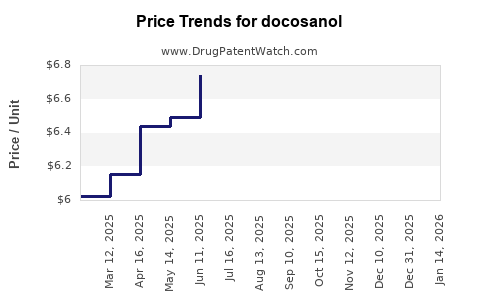
Last updated: September 8, 2026
Docosanol is a mature over-the-counter antiviral ingredient marketed primarily as Abreva 10% cream for recurrent herpes labialis, commonly known as cold sores. The product has no meaningful remaining composition-of-matter exclusivity, faces store-brand and generic competition, and is sold within Haleon's broader consumer-health portfolio. Its commercial value comes from brand recognition, pharmacy distribution, consumer advertising, and repeat purchases rather than patent protection.
What is docosanol and how is it marketed?
Docosanol is a long-chain saturated alcohol used topically for recurrent herpes labialis. Abreva is applied to the affected area five times daily until healing. The FDA authorized nonprescription marketing of docosanol 10% cream in 2000, making it one of the first FDA-approved OTC products for cold sores [1].
| Attribute |
Docosanol |
| Active ingredient |
Docosanol 10% |
| Main branded product |
Abreva |
| Primary indication |
Recurrent herpes labialis |
| Dosage form |
Topical cream |
| Prescription status in the U.S. |
OTC |
| Primary manufacturer and marketer |
Haleon, through the Abreva brand |
| Original U.S. OTC approval |
2000 |
| Main channel |
Pharmacies, mass retailers, grocery, e-commerce |
| Key alternatives |
Generic docosanol, acyclovir, penciclovir, cold-sore patches, symptom-relief products |
| Patent-driven exclusivity |
Expired or commercially immaterial |
| Biosimilar relevance |
None |
Docosanol is believed to interfere with viral-envelope fusion and entry into host cells. It does not eliminate latent herpes simplex virus, and treatment is intended to shorten healing time when started at the first sign of symptoms.
What patents protect docosanol and Abreva?
No active U.S. patent appears to provide a durable monopoly over docosanol 10% cream. The product’s original commercial protection was based on regulatory approval, brand investment, formulation know-how, trademarks, and retail execution rather than a current blocking patent estate.
Early patent activity associated with docosanol and Abreva covered the active ingredient, topical compositions, antiviral use, and manufacturing or formulation concepts. Those rights are now expired or have limited practical value because:
- Docosanol is an established small molecule.
- The principal dosage form is a conventional topical cream.
- The product is available through the OTC regulatory framework.
- Competitors can sell products containing the same active ingredient if they comply with FDA requirements.
- The brand’s strongest barriers are consumer recognition and distribution.
The commercial protection profile differs from that of a prescription product with a long Orange Book patent estate.
| Protection category |
Current commercial position |
| Composition-of-matter patent |
Expired or no longer commercially blocking |
| Basic topical-use patents |
Expired or limited |
| Formulation patents |
Any surviving claims would likely have narrow scope |
| Manufacturing patents |
Potentially relevant to process efficiency, but not a broad market barrier |
| Trademark protection |
Important for Abreva branding |
| Trade dress and packaging |
Important at retail, subject to ordinary brand competition |
| Regulatory exclusivity |
No current exclusivity comparable to a new prescription drug |
| Patent linkage |
Not the primary competitive issue |
What is the Orange Book status of docosanol?
Docosanol is primarily an OTC product rather than a prescription drug protected through the conventional Orange Book patent-linkage system. Abreva’s market position is therefore not dependent on an active Orange Book patent listing that would routinely support Paragraph IV litigation against an ANDA applicant.
The practical competitive question is whether a rival can lawfully market a docosanol product under the applicable FDA OTC pathway. That pathway reduces the importance of patent certification, litigation stays, and first-filer exclusivity that commonly shape generic prescription-drug launches.
Docosanol competitors may include:
- OTC monograph-compliant products containing docosanol.
- Private-label products sold by pharmacies and mass retailers.
- Branded products using different active ingredients.
- Topical prescription antivirals, including acyclovir and penciclovir.
- Non-antiviral products marketed for pain, healing, or symptom relief.
When does docosanol lose exclusivity?
Docosanol has already lost meaningful product exclusivity. The FDA’s 2000 OTC authorization created a commercial opportunity for Abreva, but it did not create a lasting patent barrier comparable to the exclusivity period for a newly approved prescription medicine.
The relevant timeline is:
| Year |
Event |
| Before 2000 |
Docosanol development and patent activity support topical antiviral use |
| 2000 |
FDA permits OTC marketing of docosanol 10% cream |
| 2000s |
Abreva establishes a national U.S. cold-sore brand |
| Later years |
Retail and store-brand docosanol products expand competitive availability |
| 2022 |
Haleon becomes an independent consumer-health company following separation from GSK |
| Current market |
Brand, retail placement, advertising, and consumer trust drive performance more than patent exclusivity |
Because the product is mature, there is no expected “patent cliff” comparable to the loss of exclusivity for a blockbuster prescription drug. Competitive erosion occurs progressively through private-label substitution, retailer bargaining, promotional pricing, and consumer switching.
Which companies are challenging Abreva?
The main competitive threat comes from manufacturers and retailers selling lower-priced alternatives, not from a concentrated group of patent litigants.
Generic and private-label docosanol
Retailers can market store-brand or generic docosanol 10% cream at lower prices than Abreva. These products can gain share when consumers prioritize price or when pharmacists recommend an equivalent active ingredient.
The competitive structure includes:
- National pharmacy chains with private-label cold-sore creams.
- Mass merchants and grocery retailers.
- Online sellers offering generic docosanol.
- Contract manufacturers supplying multiple retail labels.
- Branded products with alternative active ingredients.
The absence of a major patent barrier makes supply, packaging, quality control, and retail access more important than freedom-to-operate around a complex molecule.
Alternative active ingredients
Acyclovir and penciclovir are established antiviral comparators. Their commercial use depends on market, regulatory status, and prescription access. They may be favored by physicians or patients seeking a different treatment regimen.
Non-antiviral products also compete for the same consumer need. Cold-sore patches, hydrocolloid products, anesthetic creams, protective barriers, and lysine-based supplements compete for consumer spending even when they do not have the same mechanism or evidence profile.
What formulations are protected by docosanol patents?
The principal commercial formulation is a 10% topical cream. It is a conventional semisolid dosage form, which limits the ability to sustain market exclusivity through formulation complexity.
Potential formulation differentiation may involve:
- Cream texture and spreadability.
- Absorption and residence time.
- Packaging and applicator design.
- Stability and preservative systems.
- Unit-dose or travel packaging.
- Cosmetic acceptability.
- Combination products with protective or analgesic ingredients.
These characteristics can support consumer preference and brand positioning. They are less likely to create a broad, durable barrier than a controlled-release system, device-linked product, or complex biologic formulation.
What is the FDA regulatory status of docosanol?
Docosanol 10% cream is an FDA-authorized OTC treatment for recurrent herpes labialis in adults and children age 12 and older. The product is intended for use at the first sign of a cold sore.
FDA labeling limits the indication and provides important directions:
- Apply to affected area at the first sign of symptoms.
- Use five times daily until healed.
- Do not use for more than 10 days unless directed by a physician.
- Seek medical advice for severe, frequent, or persistent lesions.
- The product is not intended to treat genital herpes or other viral infections.
The regulatory status supports continued retail distribution but does not provide the growth profile associated with a newly approved indication. Label expansion would be difficult because cold sores are a mature, self-limited condition with many competing treatments.
How strong is the docosanol patent estate?
The docosanol patent estate is weak as a current market-exclusion tool but may still have historical and defensive value.
| Estate factor |
Assessment |
| Active ingredient |
Weak exclusionary position because the molecule is old and widely available |
| Core indication |
Weak because the use is established and broadly understood |
| Dosage form |
Moderate differentiation potential, but limited blocking power |
| Manufacturing |
Possible process advantages without broad market control |
| Trademark |
Stronger than patent protection for Abreva |
| Regulatory moat |
Limited because the product is OTC |
| Retail moat |
Meaningful, particularly in U.S. pharmacies |
| Consumer moat |
Meaningful due to brand recognition and condition-specific awareness |
| Litigation leverage |
Low compared with prescription products |
| Generic-entry resistance |
Low |
Abreva’s principal intangible assets are its name, consumer awareness, shelf placement, digital advertising, and perceived speed of treatment. Haleon can defend those assets through trademark enforcement and marketing, but those measures do not prevent legally compliant competitors from selling docosanol.
What patent litigation and Paragraph IV challenges affect docosanol?
No major current Paragraph IV campaign is central to the U.S. docosanol market. The product’s OTC status and mature active ingredient reduce the incentive for an ANDA-based challenge designed to trigger a 30-month stay or obtain 180-day generic exclusivity.
The more relevant disputes would involve:
- Trademark infringement.
- False or misleading comparative advertising.
- Packaging or trade-dress similarity.
- Product quality and manufacturing compliance.
- Retail distribution and promotional contracts.
- Claims regarding healing time or efficacy.
There is no known litigation event that creates a near-term patent-driven interruption to Abreva sales. Generic entry risk is therefore structural and ongoing rather than concentrated around a particular court decision.
What licensing deals involve docosanol?
Haleon inherited Abreva through the GSK consumer-health business and its subsequent separation into a standalone company. Public company disclosures do not identify a material, separately reported docosanol licensing stream or a major current co-development agreement for the ingredient.
The commercial arrangement is better understood as internal brand ownership and consumer-health commercialization than as a royalty-driven licensing model. Any supplier agreements for active pharmaceutical ingredient, filling, packaging, or distribution are not generally disclosed at the product level.
What is the financial trajectory of docosanol?
Docosanol revenue is not separately reported by Haleon. The product is included within the company’s broader consumer-health portfolio, which also contains major brands such as Sensodyne, Voltaren, Centrum, Theraflu, and Polident. As a result, public filings do not provide standalone Abreva revenue, gross margin, or operating profit.
The financial trajectory is best characterized as mature and cash-generative, with limited volume growth and recurring demand.
Revenue drivers
- Seasonal increases in cold-sore incidence and consumer purchasing.
- High brand awareness in U.S. pharmacies.
- Repeat use by consumers with recurrent outbreaks.
- Retail price increases and premium positioning.
- E-commerce availability.
- Advertising around early treatment.
Revenue pressures
- Lower-priced store-brand docosanol.
- Retailer private-label expansion.
- Consumer trade-down during periods of economic pressure.
- Promotional competition.
- Substitution by patches, prescription antivirals, or symptom-relief products.
- Limited opportunity for new indications.
Haleon reported group revenue of approximately £11 billion in 2023, but it did not disclose Abreva sales separately [2]. This prevents a reliable standalone valuation based on reported company data. Abreva’s value is best assessed as part of Haleon’s U.S. OTC portfolio and as a brand with high gross-margin potential, modest research requirements, and low patent exposure.
How does docosanol compare with prescription cold-sore drugs?
| Factor |
Docosanol |
Acyclovir |
Penciclovir |
| Typical U.S. status |
OTC topical |
Prescription in common formulations |
Prescription topical |
| Main use |
Recurrent herpes labialis |
Herpesvirus infections, including cold sores |
Recurrent herpes labialis |
| Patent position |
Mature, largely expired |
Mature, largely expired |
Mature, largely expired |
| Consumer access |
Direct retail purchase |
Clinician and pharmacy access |
Clinician and pharmacy access |
| Commercial advantage |
Convenience and brand recognition |
Familiar antiviral therapy |
Established topical alternative |
| Main barrier |
Retail competition |
Prescription substitution and generic competition |
Limited use and generic competition |
| Financial profile |
Brand-led OTC revenue |
Generic or low-growth prescription revenue |
Smaller niche revenue |
Docosanol’s advantage is ease of access. Its disadvantage is that the product competes in a low-cost category where consumers can switch readily among brands and treatment formats.
What generic launch risks exist for docosanol?
The risk of additional generic and private-label penetration is high because:
- The active ingredient is established.
- The dosage form is simple.
- The product is sold OTC.
- The condition is common and easy for consumers to self-identify.
- Retailers have incentives to promote higher-margin private-label products.
- Switching costs are low.
A generic launch would not require a dramatic market event. A retailer can expand shelf presence, reduce price, improve search ranking, or offer multi-unit packaging. The likely result is gradual share erosion rather than an immediate collapse in Abreva revenue.
What geographic markets matter for docosanol?
The United States is the central commercial market for Abreva. U.S. consumers recognize the brand, and the product has broad pharmacy and mass-retail distribution.
Outside the United States, market access depends on local regulatory classifications, product registrations, trademark rights, and national treatment habits. The same ingredient may be marketed under different names or may compete with acyclovir, penciclovir, patches, or non-drug products.
The geographic patent position is not likely to create major expansion value. Commercial growth depends more on regulatory registration, retailer access, local pricing, and consumer-health marketing.
Key Takeaways
- Docosanol is a mature OTC antiviral marketed principally as Abreva 10% cream.
- FDA OTC authorization dates to 2000.
- No meaningful current U.S. patent monopoly protects the active ingredient or core product.
- Orange Book patent linkage and Paragraph IV litigation are not the main market drivers.
- Generic and private-label competition presents persistent, low-friction erosion risk.
- Abreva’s strongest assets are trademark, brand recognition, retail access, and consumer trust.
- Haleon does not separately disclose Abreva revenue.
- The product is likely a stable, high-margin consumer-health asset with limited innovation upside.
- Revenue growth depends on pricing, distribution, advertising, and brand retention rather than new indications.
- The principal commercial risk is gradual trade-down to lower-priced docosanol and alternative cold-sore products.
FAQs About Docosanol Market Exclusivity and Commercial Outlook
Is Abreva still patent protected?
No active broad patent protection appears to provide Abreva with a meaningful market monopoly. The product relies primarily on brand and retail advantages.
Can a company sell generic docosanol cream?
Yes. Competitors can market docosanol products if they satisfy applicable FDA requirements, labeling standards, manufacturing controls, and other regulatory obligations.
Does docosanol have biosimilar competition?
No. Docosanol is a small-molecule topical drug, not a biologic. Biosimilar regulation does not apply.
Is Haleon’s Abreva revenue disclosed separately?
No. Haleon reports results by broader consumer-health categories and does not publicly provide standalone Abreva revenue.
What would most likely reduce Abreva sales?
The most likely pressure is gradual substitution by lower-priced store-brand docosanol, followed by competition from cold-sore patches, alternative topical antivirals, and other self-care products.
References
-
U.S. Food and Drug Administration. (2000). FDA approves Abreva for over-the-counter treatment of cold sores. FDA consumer and product information.
-
Haleon plc. (2024). Annual report and financial statements 2023. Haleon.
-
U.S. Food and Drug Administration. (2024). Abreva docosanol 10% cream: Drug facts and labeling information. FDA.
-
U.S. Food and Drug Administration. (2024). Orange Book: Approved drug products with therapeutic equivalence evaluations. FDA.
-
Haleon plc. (2022). Haleon launches as a new world-leading consumer health company. Haleon.