Last updated: July 16, 2026
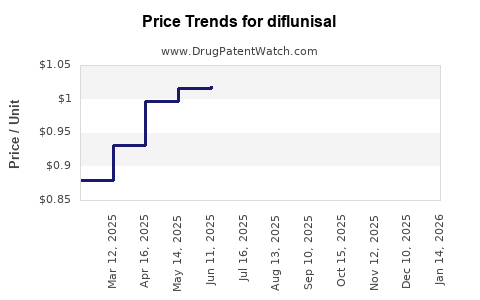
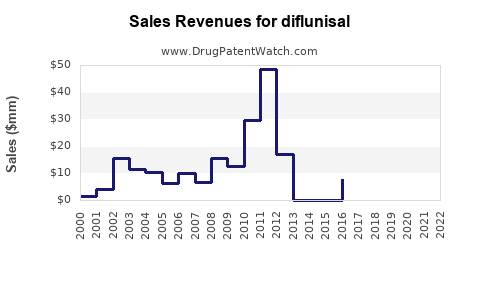
Diflunisal is an older oral NSAID with limited recent innovation-driven growth. The market has shifted toward generics and cross-portfolio substitution within NSAIDs, leaving price erosion as the dominant financial variable. In the U.S., the commercial trajectory is constrained by long-term generic availability, low differentiation versus other NSAIDs, and modest new prescriber adoption. Globally, demand is more sensitive to reimbursement dynamics, OTC/low-cost channel access, and local substitution practices than to product lifecycle events like exclusivity remainders or new clinical entrants.
Core economic read-through
- Market growth is primarily volume-led only in pockets tied to chronic musculoskeletal use patterns and physician familiarity.
- Revenue is structurally capped by generic penetration and price competition.
- Any upside is typically scenario-based: formulary placement, regional pricing stability, and channel mix (hospital vs retail) rather than patent-protected innovation.
- Downside risk is persistent: continued generic undercutting and shifting guideline preferences within NSAIDs.
What drives diflunisal demand in the U.S. and EU?
Answer: Diflunisal demand is driven by chronic musculoskeletal indications where clinicians already know the drug, plus cost-access dynamics in formularies and substitution behavior across NSAIDs. It is not driven by premium pricing or exclusivity.
Key use-and-demand characteristics
- Therapeutic category: oral NSAID used for pain and inflammation, including chronic musculoskeletal presentations.
- Physician adoption profile: older, established NSAID. Uptake depends on familiarity and local practice patterns rather than new mechanism-driven switching.
- Patient adherence: once-daily or scheduled oral dosing convenience can support persistence, but it competes with safer-tolerability choices that have stronger brand or clinical inertia.
Demand sensitivity
- Reimbursement and formulary rules drive market share more than clinical differentiation.
- Substitution across NSAIDs is frequent. Even when diflunisal is covered, payers often steer toward lower-cost alternatives unless it has a clear patient-specific justification.
- Safety/tolerability perceptions shape prescriber behavior; GI and renal risks for NSAIDs are the category-level constraints that limit broad switching into older agents.
Where demand can be most resilient
- Chronic pain continuity among patients stabilized on diflunisal.
- Low-cost procurement environments where generics are treated as interchangeable.
How has diflunisal’s pricing power changed since generic entry?
Answer: Pricing power has largely disappeared; revenue trajectory follows generic price declines, with occasional short-lived stabilization when inventories tighten or distribution is constrained.
Generic price erosion mechanics
- Multiple generic manufacturers typically compress net pricing.
- Tendering and pharmacy benefit management (PBM) contracting frameworks often drive diflunisal toward the lowest net-cost option in its class.
- Any “brand-like” pricing premium is unlikely to persist once multiple ANDA products are broadly available.
Financial impact pattern
- Gross-to-net compression tends to dominate short-term P&L.
- Margins fall as wholesaler/distributor pricing benchmarks adjust downward.
- Share becomes less about switching to diflunisal and more about remaining on contracted formularies.
When does diflunisal face exclusivity or patent expiration risk, and does it matter financially?
Answer: For diflunisal, the dominant financial factor is already the long-standing lack of meaningful exclusivity in practice due to its age. The market risk is not new exclusivity expiration but the continuous churn of generic pricing and competitive entries.
Why exclusivity is not the main driver
- The drug’s age implies any original composition-of-matter protection and early exclusivity windows are effectively out of play.
- Current market dynamics are led by:
- generic competition intensity,
- procurement and formulary positioning,
- safety-driven class substitution.
What that means for forecasting
- Revenue forecasting should be built on:
- contracted share in retail,
- hospital/clinic usage share if relevant,
- unit price trends driven by generic competition,
- substitution away from older NSAIDs.
What is the competitive landscape for diflunisal versus other NSAIDs?
Answer: Diflunisal competes as a low-differentiation NSAID within a wide alternatives set, where prescribers can switch among cheaper generics and, in some segments, toward agents with perceived tolerability advantages.
Direct competitive set
- Generic NSAIDs: ibuprofen, naproxen, diclofenac (oral), indomethacin, meloxicam (where covered), and other class peers.
- Class steering alternatives: payers often prefer the lowest net-cost NSAID after safety labeling review.
- Patient-specific switching drivers: prior intolerance, GI risk management (PPI co-therapy patterns), renal risk, and comorbidity profiles.
Commercial implications
- Diflunisal faces:
- low brand-based differentiation,
- high interchangeability perception,
- competitive pressure from better-placed or more widely stocked NSAIDs.
How do diflunisal’s regulatory and FDA status affect market access and competition?
Answer: FDA-registered generic access determines near-term market supply. For an established NSAID with widespread generic availability, regulatory status mostly affects manufacturing continuity and labeling alignment, not long-term financial upside.
What matters for market access
- ANDA supply continuity: manufacturing approvals and quality consistency drive “real market availability.”
- Labeling and dosing consistency: minor label alignment issues can affect formulary acceptance and substitution behavior.
- Drug interaction cautions: these align with class-wide NSAID risks and affect payer restrictions indirectly.
What patent estate supports diflunisal today, and how strong is it?
Answer: For diflunisal as a mature product, any remaining patent value would typically be tied to narrow formulation, packaging, or method-of-use claims, which have limited ability to materially affect broad generic availability.
Practical estate view
- Broad composition-of-matter protection from early diflunisal development is not expected to constrain current competition.
- Residual patent value, when present, usually does not prevent multiple generic entries for conventional oral tablets/capsules.
How to interpret “strength” commercially
- Even if incremental patents exist, financial impact is determined by:
- whether generics can lawfully sell without design-arounds,
- whether the market cares about the patented improvement type (e.g., specific formulation advantage),
- whether litigations/settlements delay entry.
For diflunisal, the market’s observed behavior is consistent with minimal ongoing IP-driven exclusivity effects.
What generic entry risks exist for diflunisal products and how do Paragraph IV challenges play in?
Answer: Paragraph IV challenges are not the central business variable for diflunisal’s mature stage; the business variable is ongoing generic price competition and supply dynamics rather than episodic litigation-driven entry delays.
Why litigation is less likely to move the needle
- In mature, broadly generic markets, entry dates are not tightly controlled by a single contested patent.
- Multiple ANDAs and established manufacturing capacity reduce the impact of any one Paragraph IV pathway.
Where litigation still matters
- If a specific diflunisal product format or strength is constrained by a narrow patent, litigation could briefly affect supply of that specific presentation.
- These events typically produce localized, short-lived pricing impacts rather than reshaping the total category economics.
How do diflunisal manufacturers and distributors influence the financial trajectory?
Answer: Distribution contracts, tender participation, and wholesaler stocking behavior influence net sales more than marketing spend.
Commercial levers
- PBM and GPO contracts set net price floors and steer volume.
- Wholesale channel stocking influences in-market availability, affecting fill rates and substitution behavior.
- Formulary positioning can stabilize volume but rarely stabilizes price in a multi-generic NSAID class.
What revenue exposure does diflunisal have versus other NSAIDs in a portfolio?
Answer: Diflunisal typically behaves like a low-growth, price-sensitive “maintenance” revenue stream rather than a growth engine.
Portfolio-level implications
- If diflunisal sits within an older-NSAID portfolio:
- its revenue is most exposed to price erosion and contract resets,
- its share stability depends on procurement relationships,
- margin stability is constrained by competition intensity.
What does the financial trajectory look like under three market scenarios?
Answer: The trajectory is largely predetermined by generic competition; scenarios mostly change the speed of decline and the degree of stabilization.
Scenario 1: Continued competitive price erosion (base case)
- Net price declines as additional generics and contract renegotiations push net revenue down.
- Unit volume is relatively stable or slowly declines as prescribers shift to other NSAIDs.
- Overall: modest revenue shrinkage with periodic volatility around supply.
Scenario 2: Contract stability and supply tightening (mild upside)
- Temporary price stabilization if supply is constrained or contracts keep diflunisal as a preferred low-cost option.
- Volume holds due to formulary inertia.
- Overall: flatter top line, better margin yield for a period.
Scenario 3: Stronger class substitution away from older NSAIDs (downside)
- Payer restrictions expand based on safety policies and patient risk stratification.
- Prescribers shift toward alternatives perceived as easier to manage.
- Overall: faster volume declines and accelerated revenue contraction.
Key Takeaways
- Diflunisal’s market is dominated by generic competition and NSAID class substitution, leaving little room for sustained pricing power.
- Demand is familiarity- and contract-driven, not innovation-driven.
- The financial trajectory is expected to track net price erosion more closely than new entrants, exclusivity, or litigation events.
- Any upside is typically tied to formulary placement and channel stability, not patent-protected differentiation.
- Forecasting should prioritize net price trend, contract reset timing, and unit-volume sensitivity to substitutions within the NSAID class.
FAQs
1) Is diflunisal more price-competitive than other oral NSAIDs?
Diflunisal’s commercial role is generally price-competitive as a generic NSAID, but net performance depends on contracted tiers within PBM/GPO frameworks and local substitution patterns.
2) Do diflunisal formulation or packaging differences change payer acceptance?
Only if they improve usability or align with contracted product specifications. In most cases, interchangeability and lowest net cost govern.
3) Can diflunisal benefit from OTC or low-cost channel distribution?
It can see localized volume support if channel access is strong and if payers or pharmacies treat it as interchangeable within the NSAID basket at the same tier.
4) Does FDA regulatory activity materially affect diflunisal sales?
For mature generics, regulatory actions mainly affect supply continuity and label alignment. They rarely drive sustained topline growth.
5) What is the biggest financial risk for diflunisal holders or investors?
Ongoing price compression from entrenched generic competition and potential payer-driven steering to alternative NSAIDs with better net cost or formulary preference.
References (APA)
- FDA. (n.d.). Drugs@FDA: Drug product and approval information. U.S. Food and Drug Administration. https://www.accessdata.fda.gov/scripts/cder/daf/
- FDA. (n.d.). Orange Book: Approved Drug Products with Therapeutic Equivalence Evaluations. U.S. Food and Drug Administration. https://www.fda.gov/drugs/drug-approvals-and-databases/orange-book-data