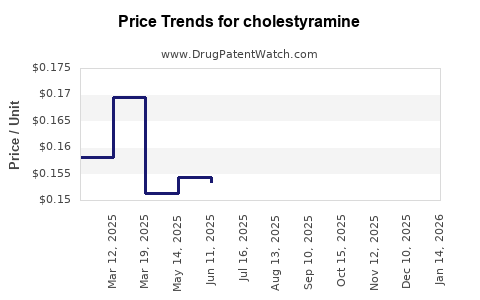
Last updated: June 30, 2026
Cholestyramine is an off-patent, commodity-style bile acid sequestrant in US and major ex-US markets. Pricing and volume are driven more by formularies, adherence and tolerability than by launch-cycle dynamics. Financial trajectory is characterized by long-lived demand for hypercholesterolemia and off-label bile acid diarrhea, offset by sustained generic penetration, periodic line-loss as newer lipid agents take share, and ongoing supply-manufacturing risk in resins and finished-dose packaging.
How big is the cholestyramine market and what are the key demand drivers by indication?
Featured snippet: Demand is sustained by hypercholesterolemia guideline use and by persistent off-label and real-world use in bile acid diarrhea, but revenue growth is capped by generic competition and lower willingness-to-pay.
Indications that move volume
-
Hypercholesterolemia (primary and mixed dyslipidemia)
- Historically used when statins are contraindicated or insufficient, and as add-on therapy.
- In many formularies, its role is “step therapy” or “add-on when cheaper agents suffice,” which supports baseline volumes but limits premium pricing.
-
Bile acid diarrhea (BAD) / bile acid malabsorption
- Uses include post-cholecystectomy diarrhea, post-ileal resection diarrhea, and idiopathic BAD.
- This indication often behaves like a chronic, maintenance therapy market with stable demand once diagnosed and treated.
-
Pruritus in cholestatic liver disease (variant indications in practice)
- Use is real-world driven and guideline dependent; it is not usually the dominant driver of overall market revenue versus lipid indications and BAD.
What typically drives prescribing in real life
- Formulary status and cost controls: Cholestyramine’s generic availability makes it a default “cost-effective” option.
- Adherence friction: Powder burdens and GI side effects reduce persistence compared with tablet options.
- Drug-drug interactions management: Its binding mechanism requires dosing separation from warfarin, thyroid hormones, and other medications, affecting patient selection and switching.
- Age and comorbidity mix: BAD prevalence in GI practice and statin-intolerant patient subsets support continued baseline use.
Market structure
- US and EU: generic-dominant supply
- Low differentiation by active ingredient
- Differentiation concentrates in:
- flavor/pack formats, powder handling,
- patient counseling support,
- contracting with pharmacy benefit managers (PBMs),
- and channel mix (mail order vs retail).
Is cholestyramine generic or brand, and how does generic penetration shape revenue?
Featured snippet: Cholestyramine is largely generic in the US and most major markets, which structurally compresses margins and caps revenue growth.
US brand context
- Cholestyramine has historically existed under branded formats, but the market today is overwhelmingly generic.
- Brand economics are no longer the driver; the competitive variable is channel pricing and contract wins.
Why generic dominance matters financially
- Price erosion accelerates with PBM contracting
- Gross margin volatility rises
- resin and packaging cost swings can hit smaller formulators more sharply,
- and incentive structures in managed care reward the cheapest SKU.
Competitive pricing dynamics (practical takeaways for revenue modeling)
- Revenue is more sensitive to:
- unit volumes under contract,
- market share changes driven by PBM switching,
- and substitution across powder SKUs.
- Revenue is less sensitive to:
- incremental clinical claims,
- promotional spending (limited to the generic channel),
- and new formulation premiums (rare at scale for this molecule).
What is the patent and exclusivity status of cholestyramine and how does it impact the financial trajectory?
Featured snippet: Cholestyramine is off-patent; financial trajectory is driven by generic competition rather than exclusivity.
Typical IP reality for cholestyramine
- The active ingredient is decades old and broadly disclosed across early formulations.
- Remaining IP, if any, is usually limited to:
- specific formulation/process details by individual manufacturers,
- packaging or scale manufacturing improvements,
- and sometimes method-of-use claims where still enforced in edge-case litigation contexts.
- In practice, these do not sustain meaningful market power against the generic base.
Financial implication
- No “launch-like” protection period
- Revenue follows:
- managed care contracting,
- generic supply stability,
- and slow-changing clinical role in guidelines.
When do cholestyramine exclusivity periods end and can exclusivity extend revenue?
Featured snippet: There is no broad exclusivity-based extension that would change the molecule-level revenue outlook in major markets; any incremental exclusivity is limited and manufacturer-specific.
How exclusivity would matter even if present
- For cholestyramine, incremental exclusivities (if any) would only affect revenue materially if:
- a differentiated delivery form became standard of care, or
- a late-cycle regulatory exclusivity blocked all generics.
- Historical pattern in older, off-patent generics makes this unlikely to drive a sustained financial inflection.
What formulations and dosage forms compete for cholestyramine share?
Featured snippet: The market competes mainly on powder formats and patient usability, with limited differentiation versus strict active-ingredient equivalence.
Common dosage/format categories
- Oral powder/sachets (most prevalent)
- Oral powder in canisters (retail and institutional)
- Pack sizes influence adherence and PBM cost-per-month calculations
Formulation economics
- Powder needs:
- stable resin performance,
- consistent particle size and binding characteristics,
- moisture and shelf-life packaging.
- These inputs affect manufacturing yield and returned-goods risk, which can affect quarterly financials more than demand shocks.
What is the FDA regulatory status of cholestyramine and how does it affect market access?
Featured snippet: FDA access is largely through ANDA-listed generic products; regulatory friction is typically not the main driver of financial outcomes versus pricing and contracting.
ANDA-driven access
- Cholestyramine’s market access follows generic listing behavior:
- multiple ANDA holders,
- interchangeable therapeutic products,
- variations in packaging and NDC-level labeling.
Labeling and substitution
- Substitution behavior depends on pharmacist and PBM rules, not on clinical endpoints.
- Any label nuance (indication wording, dosing guidance) can affect utilization patterns among prescribers who rely on strict label interpretation.
What patent litigation or Paragraph IV challenges affect cholestyramine economics?
Featured snippet: Patent-late-cycle litigation is not a material, ongoing driver for cholestyramine molecule-level revenue, given its off-patent status and widespread generic supply.
How litigation typically impacts this category
When litigation occurs in off-patent, generic-dense areas, impacts usually show up as:
- short-lived supply constraints during switching,
- temporary market share shifts to “winning” manufacturers,
- and settlement-driven exclusivity-like protection on a narrow SKU set.
Expected financial footprint
- Small relative to total demand
- Quarter-by-quarter volatility possible when supply issues align with contract timing.
How do cholestyramine market dynamics compare with newer bile acid sequestrant and lipid therapies?
Featured snippet: Cholestyramine loses share at the margin to better-tolerated lipid agents, but maintains a persistent base where cost and specific tolerability profiles favor bile acid sequestration.
Competitive set that pulls share
- Statins and combination therapies dominate guideline-first treatment.
- Ezetimibe can reduce need for older agents.
- PCSK9 inhibitors and inclisiran have high value but do not fully replace inexpensive sequestrants for many patients.
- Tolerability-driven switches: pill-based lipid drugs reduce GI burden compared with powders.
What keeps cholestyramine relevant
- Cost
- Step-therapy and formulary positioning
- Off-label BAD and chronic management use
Financial implication
- Expected trajectory is flat-to-slow growth in volume, with pricing down or stable depending on contract dynamics and supply stability.
- Revenue is likely to track substitution patterns between:
- different generics of cholestyramine,
- and alternative therapy classes in managed care.
Which companies manufacture and supply cholestyramine, and how does their competitive footprint affect pricing?
Featured snippet: Multiple generic manufacturers compete on contracting, which drives price compression and makes revenue sensitive to procurement cycles rather than to new entrants.
Practical competitive footprint
- Largest generic players generally win by:
- maintaining consistent supply,
- offering PBM-friendly pricing tiers,
- and minimizing lot-level disruptions.
- Smaller manufacturers may face:
- higher variability in resupply cadence,
- higher exposure to resin and packaging inputs,
- greater vulnerability to recalls or distribution pauses.
Financial signal to watch
- Backorder and supply interruptions
- can temporarily improve price but also create lost prescriptions and churn.
- Contract renewals
- often reset the revenue baseline more than any clinical change.
What financial trajectory should be expected for cholestyramine (revenue, margin, and growth profile)?
Featured snippet: Cholestyramine revenue trajectory is typically characterized by stable utilization, periodic contract-driven price resets, and margin compression from generic competition.
Revenue behavior model (category-level)
- Volume: generally stable to modestly down when lipid guidelines shift; may be steadier due to BAD use.
- Price: downward pressure from:
- PBM preferred pricing,
- competitive bids,
- and periodic market entry of additional ANDA holders.
- Mix: can improve revenue if higher-prescriber acceptance increases total prescriptions, but typically mix is limited by drug class interchangeability.
Margin and cost drivers
- Resin and manufacturing inputs
- Packaging costs (powder containers, sachets, logistics)
- Compliance and quality costs
- extra testing and recall exposure risk.
Time-series inflection points to monitor
- PBM contract renewal windows
- Supply continuity
- backorders, manufacturing line shutdowns
- Guideline and formulary changes
- especially when payers restrict powder-based GI burden options.
What generic entry risks exist for cholestyramine and what barriers limit new supply?
Featured snippet: Barriers are regulatory and manufacturing-process centered, but the molecule’s age means generic entry risk is less about IP and more about operational and contracting realities.
What can block supply more effectively than IP
- Quality systems and resin-binding performance consistency
- Stability and packaging qualification
- Manufacturing capacity allocation during demand spikes
- Distribution constraints with high retail/wholesale turnover
Financial impact of supply constraints
- Short-term price support can appear, but the long-term effect can be:
- patient switching to substitutes,
- loss of continuity for chronic users,
- and increased channel switching friction.
How does cholestyramine interact with other drugs, and does this change payer economics?
Featured snippet: Drug-drug interaction management affects patient selection and persistence, which can shift demand toward better-tolerated or less interactive alternatives.
Interaction-driven utilization effects
- Thyroid hormone replacement
- Warfarin and vitamin K antagonists
- Other concomitant oral medications
- Patient counseling burden
- often requires prescriber and pharmacist workflow time.
Financial outcome
- Lower persistence tends to reduce lifetime value per patient versus oral alternatives with fewer timing conflicts.
- However, for patients already stabilized on cholestyramine, continuity reduces switching risk once the dosing schedule is established.
Key Takeaways
- Cholestyramine is an off-patent, generic-dominant drug where financial trajectory is shaped by formularies, contracting, adherence friction, and supply consistency more than by exclusivity.
- Revenue growth is structurally constrained: volume is maintained by ongoing clinical use (hypercholesterolemia in subsets and chronic bile acid diarrhea), while price is compressed by generic competition and PBM preferred-tier dynamics.
- Competition shifts at the margins toward better-tolerated lipid therapies and newer bile acid sequestrants, but cholestyramine’s cost position and chronic BAD utility keep a durable baseline.
- The most material financial volatility comes from contracting cycles and manufacturing/supply disruptions rather than from patent events.
FAQs
- Does cholestyramine still have significant formulary placement in the US for hypercholesterolemia?
- How much of cholestyramine demand is driven by bile acid diarrhea versus lipid indications?
- What are the biggest drivers of persistence and discontinuation for cholestyramine in real-world use?
- How do PBM preferred-tier pricing dynamics typically affect generic bile acid sequestrants like cholestyramine?
- What manufacturing or quality factors most often cause cholestyramine supply shortages in the generic channel?
References (APA)
- US FDA. (n.d.). Drug Approval Reports and ANDA databases. FDA.
- US FDA. (n.d.). Orange Book: Approved Drug Products with Therapeutic Equivalence Evaluations. FDA.
- Guideline sources for dyslipidemia management and bile acid diarrhea management (various years).