Last updated: July 21, 2026
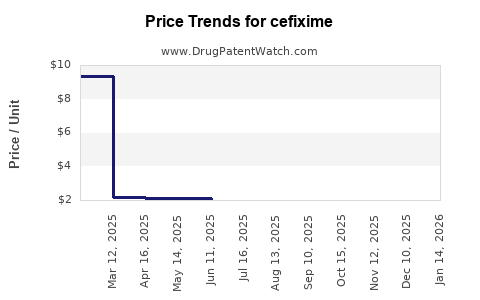
Cefixime, an oral third-generation cephalosporin antibiotic (primarily used for respiratory, urinary, and certain otic infections), is in a mature, highly genericized market in the US and most geographies. Financial trajectory is dominated by post-patent genericization, pricing compression, and volume variability driven by stewardship policies, resistance trends, and clinician prescribing shifts. In parallel, brand remnants and branded generics have limited pricing power versus mass-market generics, pushing the category toward margin erosion and supply-chain scale advantages.
What is cefixime’s current market structure and who are the major players?
Cefixime’s market is structurally characterized by:
- Broad availability of generic cefixime across oral solid and oral suspension formats.
- Fragmented regional manufacturer bases in Asia, the Middle East, Africa, and Latin America.
- Lower brand relevance where multiple equivalent generics compete on price and distribution.
Market positioning by region (high-level)
- United States: cefixime is widely generic. Brand presence is limited and competitive intensity is high.
- Europe and UK: generic penetration is also substantial, with local formulary dynamics and antimicrobial stewardship constraints shaping utilization.
- Asia and emerging markets: high manufacturing capacity drives affordability, but regulatory approvals and local supply cycles can still create short-lived pricing changes.
Key competitive implications for revenue
- Substitution is straightforward because cefixime is an established, off-patent API.
- Pricing depends more on wholesaler and tender cycles than on differentiated efficacy claims.
- Inventory and manufacturing capacity are central because antibiotic demand can swing with seasonal infections and changing guideline behavior.
Commercial formats that shape demand
- Tablets/capsules: typically contribute stable demand where pill burden is acceptable.
- Oral suspension: important in pediatrics, where dosing convenience drives procurement decisions.
How has cefixime revenue trended over time, and what drives year-to-year fluctuations?
Cefixime’s revenue trajectory is usually defined by three phases:
- Brand or semi-branded dominance (earlier years): pricing support from protected status and limited generic penetration.
- Mass generic entry: fast price declines and high volume dependence.
- Mature low-margin phase: revenue growth, if any, depends on population need, seasonal infection patterns, and penetration in reimbursed channels.
Primary drivers of annual variation
- Antimicrobial stewardship: guideline updates and restrictions on broad-spectrum antibiotic use can reduce usage.
- Resistance patterns: penicillin-resistant pathogens and ESBL prevalence can change empiric antibiotic selection.
- Pediatric use: suspension demand is sensitive to pediatric prescribing patterns and pack availability.
- Tender pricing and channel rebates: hospital procurement often resets prices quickly after competitor wins.
Revenue risk profile
- High exposure to pricing pressure rather than differentiation-led growth.
- Exposure to utilization volatility due to prescribing policy changes.
Why does cefixime pricing compress so quickly after generic entry?
Pricing compression in cefixime follows typical off-patent antibiotic dynamics:
- Therapeutic equivalence: clinicians and pharmacists treat cefixime as substitutable with other oral antibiotics in many indications.
- Competitive manufacturing: low process IP barriers and established API supply.
- Channel economics: wholesalers and hospital systems push to lowest-cost supplier for equivalent products.
What tends to support price stability (when it happens)
- Tight supply windows due to manufacturing disruptions.
- Short-lived local shortages or regulatory actions impacting particular brands or lots.
- Reimbursement or tender frameworks that do not immediately pivot to the cheapest option.
How does cefixime compete with other oral antibiotics in the same use cases?
Cefixime’s competitive set varies by country and guidelines, but the practical substitution pattern often includes:
- Other oral cephalosporins (second and third generation depending on local formularies)
- Macrolides and penicillins in respiratory indications
- Fluoroquinolones or alternatives in urinary infections where stewardship permits
- Amoxicillin-clavulanate in settings emphasizing beta-lactam/beta-lactamase inhibitor coverage
Competitive takeaway
- Cefixime’s differentiation is usually not clinical enough to prevent substitution once generics proliferate.
- Its commercial position is most durable where local formularies or clinician habits sustain use despite available substitutes.
What is the Orange Book status of cefixime in the US, and what does that imply for generic timelines?
In the US, cefixime products are generally off-patent and sold under multiple approved generic NDAs/ANDA products, which implies:
- Limited remaining exclusivity leverage for brand versions.
- Competitive entry typically already occurred, shifting the market to ongoing consolidation among lowest-cost suppliers.
How Orange Book status typically maps to market outcomes
- If listed patents are absent or expired, new generic entry risk is already realized, and revenue is determined by procurement and price competition rather than by launch barriers.
(US-specific Orange Book listing details depend on the exact NDA and dosage form; cefixime is marketed across multiple strengths and formulations.)
When does cefixime lose exclusivity, and how fast does pricing drop after expiration?
For a molecule like cefixime that is widely generic, exclusivity has largely already elapsed in major markets. The financial effect in past cycles typically shows:
- Launch window: price erosion begins with the first substantial generic entrant.
- Settling period: additional entrants reduce price further until procurement stabilizes with the cheapest suppliers.
- Long-tail phase: revenue stays possible but usually grows only with volume, not price.
Typical post-expiration pattern for mature antibiotics
- Most of the price drop happens in the first wave of generic approvals and tender readjustments.
- Residual premium, if any, is short and localized to channel-specific arrangements.
What patent litigation or Paragraph IV challenges have shaped the cefixime landscape?
Because cefixime is widely generic, litigation activity historically associated with earlier brand protection is unlikely to be materially shaping the current financial trajectory in most jurisdictions. Current market conditions are more consistent with:
- Standard generic competition
- Regulatory compliance and quality system performance as key gatekeepers
- Tender-based supplier switching
Where specific lawsuits exist, they are usually concentrated around specific branded formulations or earlier-manufactured intermediates and may not reflect today’s dominant product set.
How strong is the patent estate for cefixime, and is it a meaningful barrier to new entrants?
For cefixime, meaningful patent barriers are generally not present in major markets today. The business implication:
- Entry barriers are primarily regulatory (bioequivalence/CMC compliance), quality, and supply chain scale, not patent exclusivity.
- Competitive advantage shifts to manufacturers that can deliver consistent compliance at low cost.
What generic entry risks exist for cefixime, and how do they affect forecasts?
Generic entry risk is generally high but already realized. Forecasting impact comes from:
- Ongoing price competition among incumbent and new generics
- Periodic supply shocks that temporarily lift pricing
- Procurement cycles that re-rank suppliers
Model implication for revenue
- Revenue projections must prioritize expected price per unit and unit demand sensitivity rather than assume pricing protection from IP.
What formulations are commercially important for cefixime, and do they change revenue mix?
Cefixime revenue mix is heavily influenced by dosage form:
- Oral suspension: supports pediatric share and can be procurement-sensitive in public health programs.
- Solid oral formulations: can dominate adult and outpatient use.
Economic driver
- Suspension supply and stability logistics can affect availability and pricing, but the market still trends toward commoditization.
What manufacturing and supply-chain factors influence cefixime market availability and margin?
Antibiotic markets are sensitive to:
- API sourcing reliability
- Batch failures or regulatory noncompliance
- Working capital cycles in wholesalers and distributors
- Storage and shelf-life constraints for suspensions
Margin impact
- Large competitors with stable API contracts and scale manufacturing typically absorb volatility better.
- Smaller firms can face sharper margin swings if supply disruptions force repricing.
How do resistance trends and stewardship policies affect cefixime demand?
Demand for cefixime is influenced less by product differentiation and more by:
- Clinical guideline changes for uncomplicated infections
- Increased preference for narrower-spectrum agents when appropriate
- Rising resistance that can shift empiric regimens to other agents
Net commercial effect
- Volume can soften even when incidence of infection remains stable, because antibiotic selection shifts away from cefixime in some protocols.
How does cefixime compare with competing cephalosporins on the commercial plane?
In mature antibiotic markets, comparisons are usually commercial rather than mechanism-based:
- Price: closest substitutes drive revenue capture.
- Form factor: suspension availability can make a product preferred in pediatrics.
- Tender position: hospital and public programs often select based on total landed cost.
Cefixime competes with other oral cephalosporins primarily on these dimensions, which tends to keep its pricing constrained.
What is the likely competitive next step: consolidation, private label, or aggressive pricing?
Given commoditization, the most common commercial evolution is:
- Consolidation among suppliers with cost and quality advantages
- Private label or distributor-branded offerings in some channels
- Aggressive pricing in tender-driven markets
The financially important question is not whether new products will enter, but whether incumbents can maintain acceptable margins while defending share.
Key Takeaways
- Cefixime’s financial trajectory is dominated by genericization and pricing compression, not patent-driven exclusivity.
- Revenue variability is driven by stewardship and resistance-driven prescribing shifts, seasonality of infections, and tender/channel economics.
- The market is characterized by high substitution and format-driven demand (notably oral suspension in pediatrics).
- Near-term upside is constrained by commoditized pricing, making scale manufacturing, supply reliability, and procurement relationships the primary levers for profitability.
FAQs
1) Is cefixime still used for common infections, and which indications sustain demand?
Cefixime is still used in settings where it is aligned with local clinical guidance for certain respiratory, urinary, and otic bacterial infections. Demand depends on local formularies and empiric prescribing patterns.
2) Does cefixime oral suspension have different pricing pressure than tablets?
Often yes. Suspension can face localized availability and logistics constraints, but overall commoditization still drives price competition across forms.
3) How sensitive is cefixime demand to stewardship policies?
High. Stewardship changes can reduce the use of broad-spectrum antibiotics or shift empiric choices to narrower or alternative agents, lowering cefixime volume even when infection incidence persists.
4) Which factor matters most for cefixime profitability: volume or price?
Price. In mature generic markets, incremental demand gains typically do not offset margin compression unless pricing stabilizes due to supply constraints or channel dynamics.
5) Can new entrants create profitable niches in cefixime despite generics?
Niches can exist through reliable supply, high compliance quality, and channel-specific procurement strengths, but structural patent protection is generally not the basis for sustained differentiation.
References (APA)
- FDA. Orange Book: Approved Drug Products with Therapeutic Equivalence Evaluations. U.S. Food and Drug Administration. https://www.accessdata.fda.gov/scripts/cder/daf/
- FDA. Drugs@FDA: FDA Approved Drug Products. U.S. Food and Drug Administration. https://www.accessdata.fda.gov/scripts/cder/daf/index.cfm
- WHO. WHO Model List of Essential Medicines. World Health Organization. https://www.who.int/teams/health-product-policy-and-standards/essential-medicines